Spilnota Detector Media

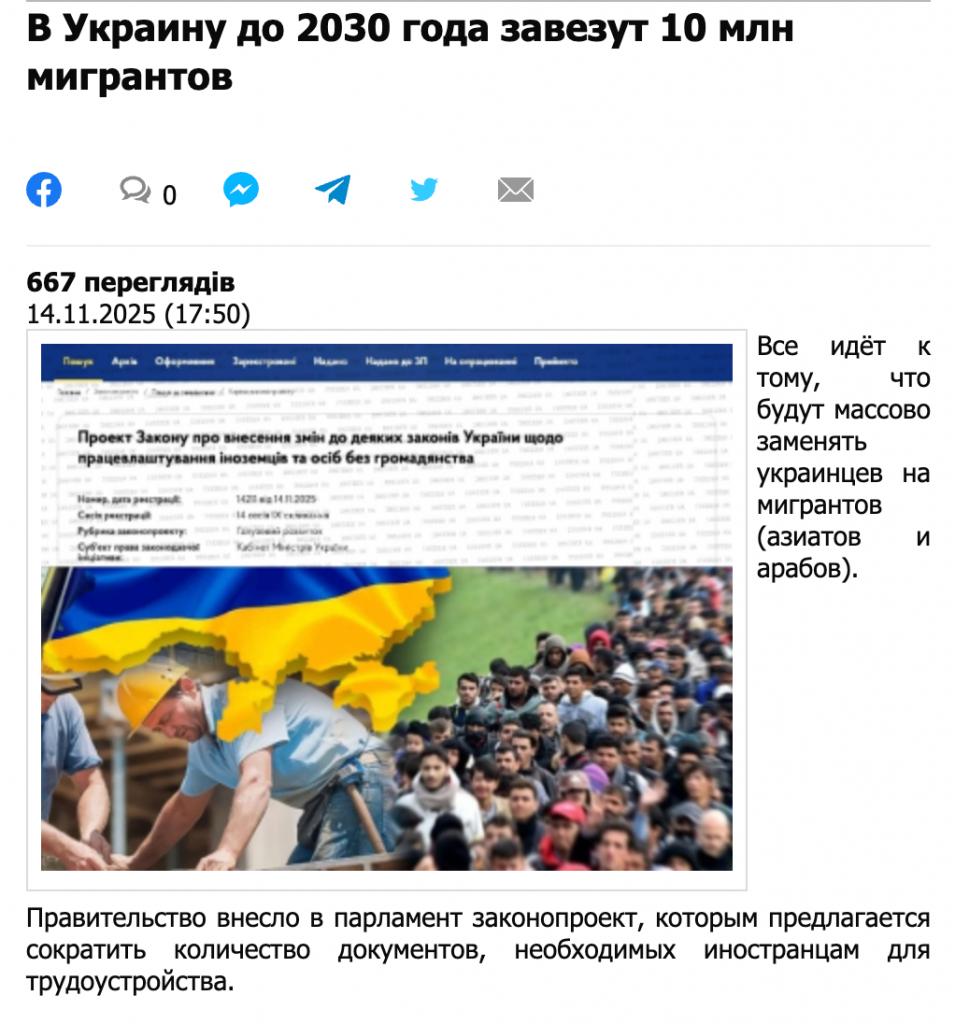
Fake: The bill provides for the arrival of 10 million immigrants to Ukraine by 2030

Fake: The bill provides for the arrival of 10 million immigrants to Ukraine by 2030

A number of news outlets and social media accounts are spreading false information claiming that Ukraine allegedly plans to bring in 10 million immigrants by 2030, including “Arabs and Asians”, in order to “massively replace Ukrainians”. This disinformation narrative, which refers to a bill submitted to the Verkhovna Rada titled “On Amendments to Certain Laws of Ukraine Regarding the Employment of Foreigners and Stateless Persons”, was debunked by StopFake fact-checkers.

In reality, claims about bringing in millions of migrants to “replace” Ukrainians are yet another distorted propaganda narrative.

Bill No. 14211, which is currently under consideration in the committees of the Verkhovna Rada, contains no plans or quotas to attract 10 million migrants and does not aim to replace the population.

Its main purpose is to simplify legal procedures for foreign nationals and stateless persons who have already expressed a desire to work in Ukraine. In particular, it concerns simplifying the procedures for issuing temporary residence permits and work permits. These changes are intended to align Ukraine’s migration legislation with European Union standards, which is an important step on the path to European integration.

The figure of 10 million cited by propagandists is not part of the bill and is not a state plan.

This number was previously mentioned by individual experts and politicians, including former Minister of Economy of Ukraine Tymofii Mylovanov, solely as a personal, approximate assessment. It reflects a potential future need for labor migrants in Ukraine after the war to stabilize the economy and compensate for the sharp decline in the working-age population and the demographic losses caused by the war and high levels of emigration.

Thus, the figure of “10 million migrants” represents individual estimates highlighting current demographic challenges, not an approved government plan or a legislative commitment. The bill merely legalizes and simplifies existing procedures for those willing to work, without establishing any quotas.

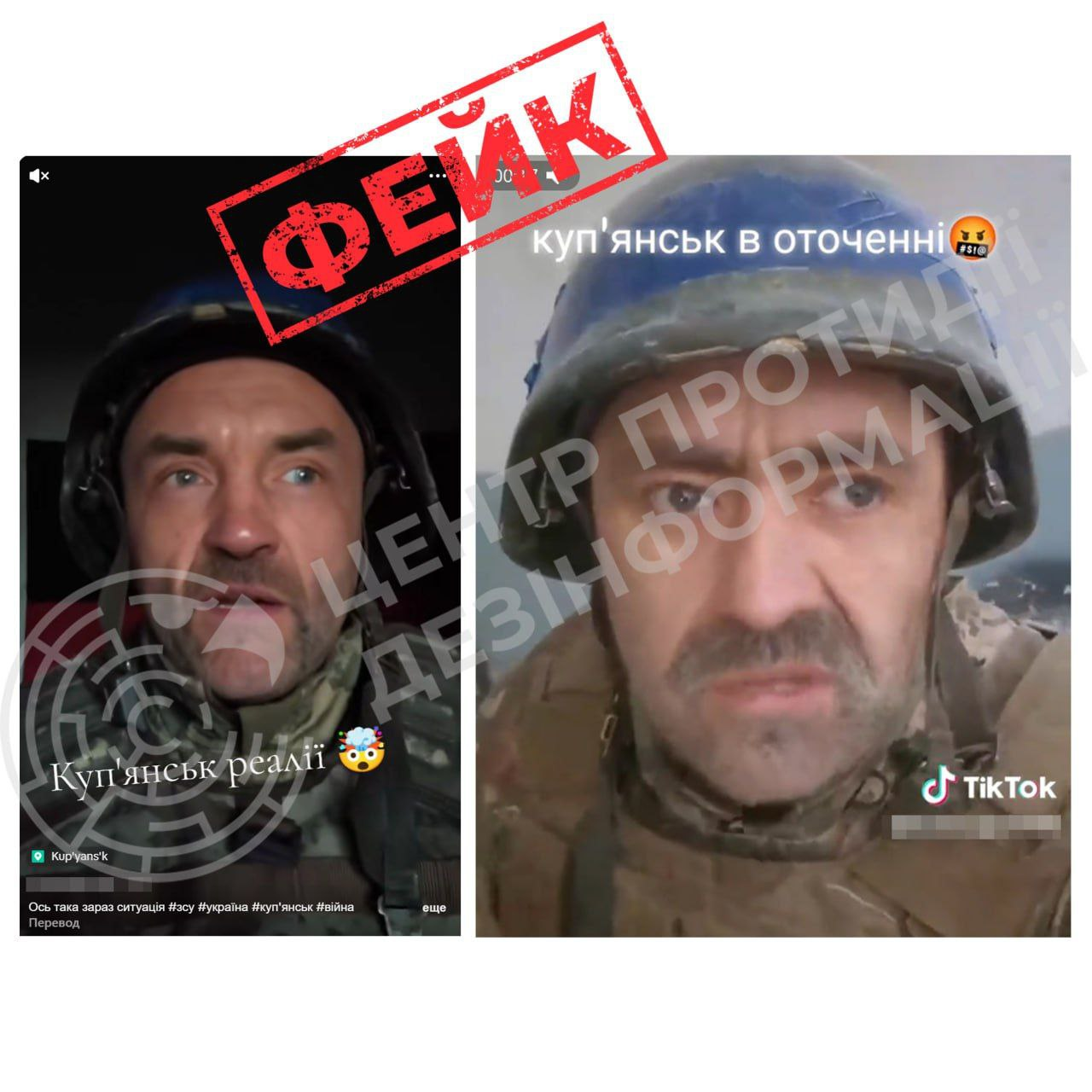
Russian propaganda has flooded TikTok with AI fakes about the “encirclement of Kupiansk”

Russian information-psychological operations (IPSO) farms have launched a series of TikTok videos in which AI-generated “Ukrainian soldiers” claim that Kupiansk is fully encircled and that there is a critical shortage of ammunition.

The Center for Countering Disinformation under Ukraine’s National Security and Defense Council has refuted this information, stressing that it is a deepfake. “These videos are fake and were created using AI. The use of generative technologies is easy to detect due to unnatural facial expressions and a stereotyped voice. Another characteristic sign is that the fake ‘soldiers’ mispronounce the name Kupiansk, placing the stress on ‘ya’ instead of the correct ‘u’,” the fact-checkers said.

“As of now, there have been a number of counterattacks in the northern part of the city, and the Russians have been pushed back, but the situation remains unstable. Fighting is ongoing in the city and is changing dynamically. Although it has been possible to repel the Russians, the situation in the city is still difficult,” said Viktor Trehubov, Head of the Communications Department of the Joint Forces Grouping, during a TV broadcast.

Controlled export of Ukrainian weapons: how Russia is trying to turn a reform into yet another fake

Russian propaganda media are spreading false claims that Ukraine allegedly plans to sell Western weapons received from its partners in Europe. In reality, this is not about selling arms supplied by allies, but about launching a program of controlled exports of Ukrainian-made weapons. The funds generated from these exports will be directed toward developing the defense industry and producing scarce drones.

The spread of this disinformation was flagged by StopFake fact-checkers. Propagandists claimed that Ukrainian President Volodymyr Zelensky had allegedly “opened a commission shop for stolen weapons” and was planning to sell in Europe arms that Ukraine had previously received from Western partners as military aid. The publications alleged that British-made naval drones and artillery systems assembled from European and Soviet components were supposedly being offered for sale.

These claims have nothing to do with reality. What is actually being discussed is the resumption of controlled exports of Ukrainian weapons – that is, arms produced by Ukraine’s own defense industry enterprises. This initiative does not involve Western weapons supplied by allies as military assistance. After the start of Russia’s full-scale invasion, Ukraine completely halted arms exports, but in 2025, as domestic production increased and surpluses emerged, a decision was made to partially resume exports under state control.

In late September 2025, Volodymyr Zelensky stated that Ukraine was preparing to begin controlled arms exports even before the end of martial law. The president emphasized that only those types of weapons for which the Ukrainian army has sufficient supplies would be exported. The proceeds would be used to expand the production of drones and other critically needed equipment. On October 28, 2025, Zelensky instructed Prime Minister Denys Shmyhal to launch the program as early as November. He also tasked the government with ensuring that by the end of the year at least half of the weapons in Ukraine’s defense system would be domestically produced.

Ukraine plans to open representative offices in Berlin and Copenhagen to strengthen industrial cooperation with partners. This is about expanding international production cooperation, not about “trading Western weapons”, as Russian propaganda attempts to portray it. Ukrainian media have previously reported that the initiative to resume exports is supported by private defense companies that have excess production capacity.

Ukraine is “leading the world toward a climate catastrophe” – Russian lies debunked

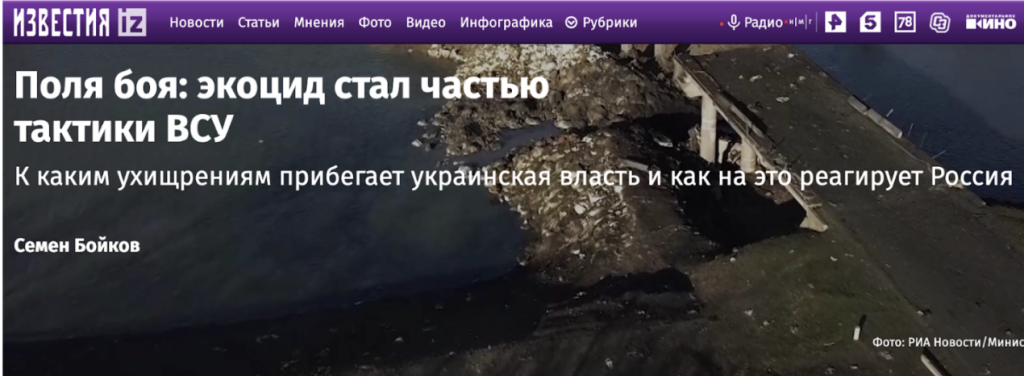
Russian propaganda is actively spreading fakes claiming that Ukraine’s defensive actions against Russian aggression allegedly cause an “ecocide in Donbas and a global climate catastrophe”. Analysts from the StopFake project have drawn attention to these claims.

Referring to supposedly authoritative environmental organizations, Russian media accuse Ukraine and the EU of polluting the European continent, asserting that “ecocide has become part of the tactics of the Armed Forces of Ukraine: Ukrainian troops destroy forests and strike hazardous facilities”.

“Because of the conflict in Ukraine, military spending has sharply increased, especially in Europe, which has boosted demand for explosives, steel, and other materials with a high carbon footprint. This inevitably leads to additional emissions from military activity,” propagandists complain, citing alleged eco-activists.

The International Initiative on Greenhouse Gas Accounting of War (IGGAW), which propaganda outlets refer to, in fact explicitly points to Russia’s responsibility for the climate and environmental damage inflicted on Ukraine and the world. Experts emphasize that Russian aggression not only devastates Ukraine’s environment but also has global climate consequences.

Over three years of Russia’s full-scale invasion of Ukraine (IGGAW data for February 24, 2022 – February 23, 2025), the war caused nearly 237 million tons of CO₂ emissions. This is equivalent to the annual emissions of Austria, Hungary, the Czech Republic, and Slovakia combined, or to the emissions produced by 120 million cars in one year. The climate damage caused by Russian aggression has already exceeded 43 billion dollars.

According to researchers, the main sources of pollution are:

  • Military operations (37%): the use by Russian occupying forces of tanks, armored vehicles, aviation for attacks on Ukraine, and artillery shelling. A separate category highlights the negative environmental impact of Russian “Shahed” drones and other UAVs.
  • Destruction of infrastructure (second largest source): Russia systematically attacks Ukrainian power plants and grids, depriving Ukrainians of electricity in winter. This has resulted in 62.2 million tons of CO₂ emissions, as well as releases of the hazardous gas SF₆, which is 24,000 times more potent than CO₂. Ukraine’s reconstruction will require enormous amounts of concrete and steel, accounting for more than 80% of future emissions.
  • Fires (21%): along the front line and in rear cities. In 2024 alone, emissions from landscape and forest fires increased by 25.8 million tons of CO₂ – 113% more than in 2022–2023 combined.

Since the start of the full-scale war, Ukrainian authorities have recorded more than 8,000 environmental crimes committed by Russia (as of June 2025), including attacks on nuclear power plants, the destruction of the Kakhovka Hydropower Plant in 2023, and other war crimes.

Thus, the global climate crisis and the destruction of Ukraine’s environment are being intensified not by the so-called “militarization of the West”, as propaganda falsely claims, but by Russia’s invasion itself, the daily shelling of peaceful cities, and the deliberate destruction of infrastructure.

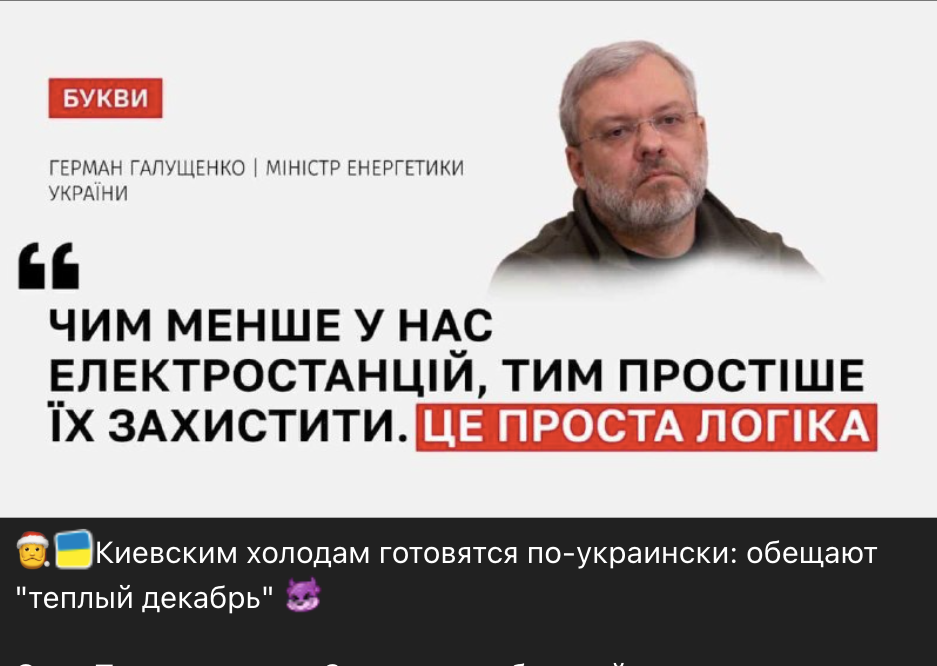
Fake quote attributed to Herman Halushchenko about the protection of power plants

Russian propaganda is once again spreading a fabricated quote falsely attributed to former Ukrainian Minister of Energy Herman Halushchenko.

Propagandists mock what they claim are his words, sarcastically commenting: “Preparing for the cold the Ukrainian way”. Halushchenko is falsely attributed a line from a fake interview with the outlet Bukvy: “The fewer power plants we have, the easier they are to protect – it’s simple logic”. This was reported by StopFake.

In reality, this quote is completely fabricated. It first appeared back in June last year, when Herman Halushchenko was indeed serving as Minister of Energy. However, as of July 17, 2025, he was replaced in the post by Svitlana Hrynchuk. Neither Halushchenko nor his successor has ever made such comments to Bukvy or to any other Ukrainian media outlet. The fake news was circulated exclusively through pro-Russian sources linked to the Kremlin. This year, it was “revived” ahead of the heating season in an attempt to discredit the Ukrainian government and create an impression of chaos in the energy sector.

In reality, as reported by the current Minister of Energy, Svitlana Hrynchuk, the situation in the energy system remains under control despite daily shelling. Speaking on the national telethon, she stated: “Almost every day, Russian energy terror continues. Energy workers are working around the clock, and it is thanks to their dedicated efforts that the energy system remains stable”. The minister clarified that in October alone, the enemy carried out two missile and drone attacks on energy infrastructure, including generation facilities, transmission and distribution networks, as well as railway and gas facilities. In addition, Russia is using a tactic of “double terror”, launching repeated strikes on already damaged sites to complicate restoration efforts.

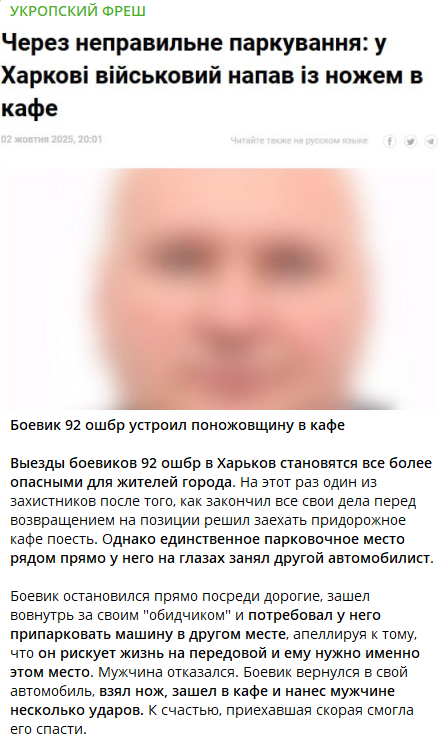
Photo fake: a serviceman allegedly attacked a man in Kharkiv over an argument about a parking space

On social media and anonymous Telegram channels, a screenshot of a headline from a Ukrainian news outlet is being circulated, claiming that a serviceman of the 92nd Separate Assault Brigade allegedly attacked a man with a knife in Kharkiv during an argument over a parking space. However, this is a photo fake and a manipulation, VoxCheck experts have determined.

The original news headline was altered by propagandists in order to discredit the Armed Forces of Ukraine.

  1. Edited headline: Using keywords, VoxCheck experts found the original article on the website of the Ukrainian outlet RegioNews, published on 2 October 2025. The incident in Kharkiv did indeed occur, but the original headline and text referred to a “52-year-old man” who committed the attack.
  2. Manipulation: Russian propagandists used photo-editing tools or modified the page code to replace the phrase “52-year-old man” in the headline with “serviceman of the 92nd Separate Assault Brigade”.
  3. No evidence of military involvement: Neither the original RegioNews article nor the report by the Kharkiv Regional National Police contains any mention that the attacker was a member of the Defense Forces or, specifically, of the 92nd Separate Assault Brigade. The perpetrator was not identified as a serviceman.

This photo fake is part of a systematic Russian propaganda campaign aimed at discrediting Ukrainian military personnel. By falsely linking a specific combat brigade (the 92nd Separate Assault Brigade) to a domestic crime, the adversary seeks to sow distrust and division between civilians and the Armed Forces of Ukraine.

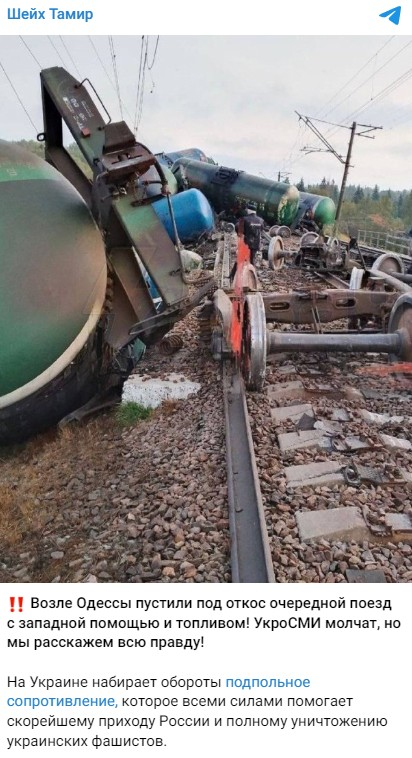
Fake: “Odesa underground fighters” allegedly derailed a train carrying Western aid

Propagandist Telegram channels are spreading claims that near Odesa, “members of the underground resistance” allegedly carried out sabotage by derailing a train carrying Western military aid and fuel. As “evidence”, these posts include a photo supposedly taken at the scene. This fake was debunked by VoxCheck experts.

In reality, propagandists used a photograph of an accident that occurred on Russian territory.

  1. A reverse image search on Google conducted by VoxCheck experts established that the photo does not show sabotage near Odesa. The original image captures the aftermath of a diesel locomotive and 15 empty tank cars derailing in the Luga district of Russia’s Leningrad region on 14 September 2025.
  2. No confirmation: There are no credible reports or confirmations from Ukrainian authorities, law enforcement agencies, or reputable media about the derailment of a train carrying humanitarian or military aid near Odesa during the specified period.

The spread of such fakes about the alleged activities of an “underground resistance” in Ukraine is part of a persistent Kremlin disinformation campaign. Its aim is to create the illusion of internal division, distrust, and panic among the Ukrainian population, and to form a false impression that a significant portion of Ukrainians support Russia, are waiting for “liberation”, and are assisting it – thereby supposedly legitimizing the war against Ukraine.

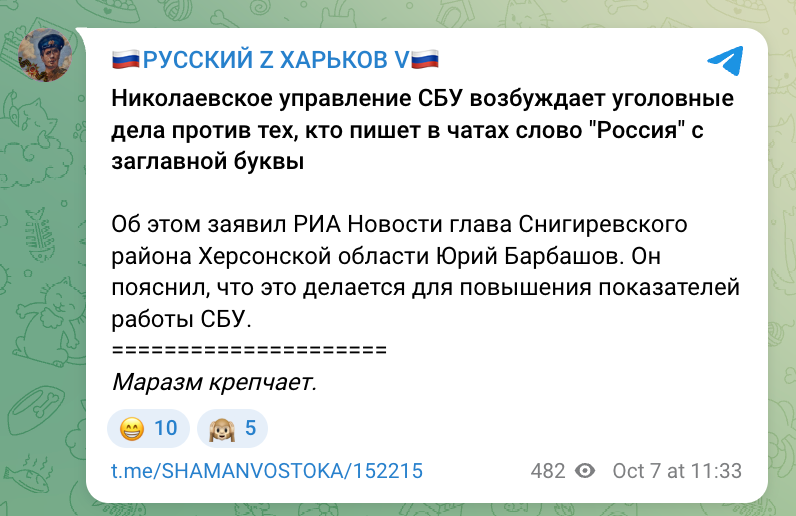
Fake: the Security Service of Ukraine allegedly persecutes people for writing the word “Russia” with a capital letter

Propagandist anonymous Telegram channels, citing Mykolaiv collaborator Yurii Barbashov, are spreading claims that the Mykolaiv regional office of the Security Service of Ukraine (SBU) is allegedly opening criminal cases against citizens who write the word “Russia” with a capital letter in chats or on social media. This fake was debunked by StopFake experts.

However, this is fake. There is no such provision in Ukrainian legislation, and grammatical norms are not grounds for criminal prosecution.

  • No official confirmation: No Ukrainian state body – neither the Security Service of Ukraine, nor the Prosecutor General’s Office, nor the National Police – has made any official statements or published documents confirming the existence of such criminal cases or investigations.
  • No article in the Criminal Code: The Criminal Code of Ukraine does not contain any article that would establish liability for writing the names of countries (or any other words) with a capital or lowercase letter. Criminal cases are initiated only for real crimes – such as treason, collaborationism, justification of aggression, or calls to overthrow the government – not for violations of grammatical rules.
  • Grammar rules are not a crime: The recommendation of the National Commission on State Language Standards to write the name of the aggressor country in lowercase applies to informal, emotionally charged or derogatory texts. Failure to follow this recommendation is not a criminal offense and does not deny standard rules in official documents, where country names are still written with capital letters.
  • The original source of this fake is Yurii Barbashov, who himself is a suspect in a criminal case for collaborationism and aiding the aggressor state and faces 10 to 12 years in prison. His statements are not a credible source.

This fake is aimed at intimidating Russian-speaking residents of Ukraine and spreading distrust toward Ukrainian state and law enforcement institutions, creating a false impression of the supposed absurdity of the Ukrainian “regime”.

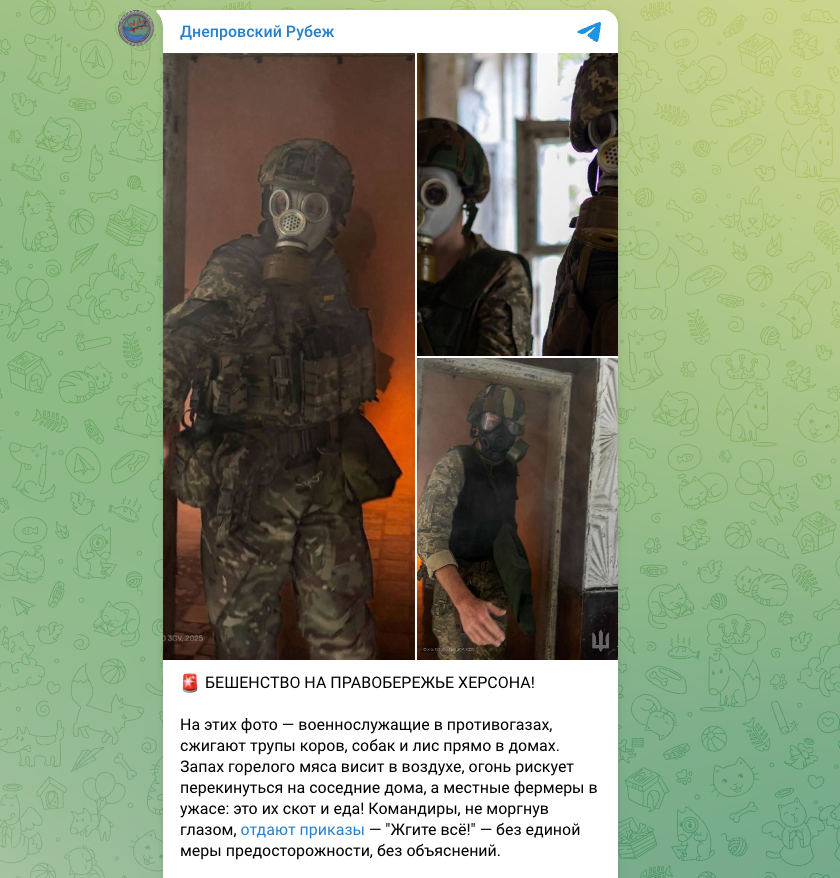
Debunking the fake: the Armed Forces of Ukraine are not “burning animals infected with rabies” in residents’ homes in the Kherson region

Anonymous propagandist Telegram channels are spreading photos of Ukrainian servicemen wearing gas masks, claiming that they are allegedly burning the carcasses of cows, dogs, and foxes infected with rabies inside residents’ homes in the Kherson region. Propagandists write about the “smell of burning flesh”, panic among local farmers, and orders to “burn everything”, and also claim that the village of Dudchany is supposedly in a state of “total chaos” due to a rabies outbreak to which local authorities are allegedly not responding.

In reality, the photos have nothing to do with the destruction of animals and were taken from an official source that shows Ukrainian military training exercises. This fake has been debunked by StopFake experts.

The images circulated by propaganda clearly show the watermark of the Territorial Defense Forces of the Armed Forces of Ukraine and a caption indicating servicemen of the 121st Separate Territorial Defense Brigade of the AFU.

Training photos: these images were officially published on the Facebook page of the Territorial Defense Forces on 20 September 2025. The post states that servicemen are undergoing training and improving their skills in using gas masks and personal protective equipment in conditions of smoke and fire.

Claims by propagandists about alleged “total chaos” due to rabies in the Kherson region do not correspond to reality. The State Service of Ukraine on Food Safety and Consumer Protection has repeatedly stated that the epizootic situation regarding rabies in the Kherson region remains under control.

At the same time, activists from the Yellow Ribbon movement report a critical shortage of rabies vaccines in the temporarily occupied territories of the Kherson and Zaporizhzhia regions. According to them, no rabies vaccine has been delivered to any hospitals in Henichesk, Skadovsk, Melitopol, Berdiansk, or Enerhodar during three years of occupation.

The spread of this fabrication fits into a typical strategy of Russian propaganda. Its aim is to discredit the Armed Forces of Ukraine by creating an image of the Ukrainian army as a “ruthless and uncontrolled force” that allegedly poses a threat to the property and lives of civilians. Such fakes are especially actively used in frontline and de-occupied regions to fuel anti-Ukrainian sentiment.

Agitprop twisted Zelenskyy’s words about air defense and pressure on Russia into a plea to the Kremlin to spare Ukraine

Kremlin media and some Telegram channels presented the president’s remarks as a “request to Moscow to stop the strikes”, but this is a distortion.

In a Telegram post on 5 September, Zelenskyy described the consequences of massive attacks on energy infrastructure and called for stronger defense and increased diplomatic pressure on the aggressor – not for an appeal or plea to Russia. The fake framing of Volodymyr Zelenskyy’s words was exposed by StopFake fact-checkers.

On Volodymyr Zelenskyy’s Telegram channel, it stated: “More protection is needed, faster implementation of all defense agreements, especially on air defense, to deprive this air terror of any meaning. A unilateral ceasefire in the sky is possible, and it is precisely this that could open the path to real diplomacy. America and Europe must act to force Putin to stop”.

The State Center for Countering Disinformation has forecast seven threats to information security for the second half of October

In the second half of October 2025, Russian propaganda may significantly intensify disinformation campaigns aimed at Ukraine and its international partners. This forecast was published by the State Center for Countering Disinformation.

One of the main threats will be an information campaign tentatively titled “Ukraine’s unpreparedness for winter”. Kremlin media, exploiting strikes on energy infrastructure, will try to convince Ukrainians and the international community of the alleged “catastrophic state of the energy system”, “cities freezing”, and the “inability of the authorities to cope with the crisis”. Any local outages or accidents will be presented as “proof of a systemic failure”. The main goal is to undermine trust in the Ukrainian government, demoralize society, and push the West to pressure Kyiv toward a so-called “peace settlement”.

The second major threat will be efforts to discredit the EU’s 20th sanctions package. Propaganda will promote messages about the West’s “exhausted leverage”, showcase the supposed “stability” of Russia’s economy, and highlight an alleged “split” among EU member states. The Kremlin will actively manipulate statistics and economic indicators to argue the supposed “ineffectiveness” of sanctions, while also spreading fakes about “internal opposition” in Europe to restrictive policies.

A separate line of Russian attacks will focus on the Zaporizhzhia Nuclear Power Plant. Moscow will continue to accuse Ukraine of “provoking a nuclear catastrophe” and portray it as a source of “nuclear terrorism”. There is a high likelihood of fabricated reports about “Ukrainian drone attacks” on Russian nuclear facilities to instill fear in the international community and amplify anti-war sentiment.

In Europe, an intensification of so-called “anti-war” rhetoric is expected. Under the cover of slogans “for peace”, Russian-linked structures will attempt to organize rallies aimed at undermining support for Ukraine. Such events, presented as “public protests against war”, in fact serve Kremlin interests by seeking to weaken internal EU unity.

A campaign to discredit transatlantic defense cooperation is also forecast, particularly in connection with discussions about transferring Tomahawk cruise missiles to Ukraine. Propaganda will try to argue that such deliveries “will not change the course of the war”, but instead will “drag NATO into the conflict” and “drain U.S. resources”.

Another likely information attack will be linked to the European Parliament’s decision to allow the interception of Russian aircraft and drones in EU airspace. The Kremlin will spread messages about “escalation of the conflict” and “Europe’s aggressive policy”, attempting to frighten the public and reduce the political will of European countries to support defensive initiatives.

Cavalry in the Armed Forces of Ukraine: Russian propagandists fabricated another fake

Russian propagandist Telegram channels are spreading disinformation claiming that the Armed Forces of Ukraine are allegedly forming cavalry units to bypass Russian drones during assaults. As “evidence”, they use a short video showing a Ukrainian serviceman sitting on a horse. In reality, this is fake.

This was reported by Ukrinform.

The circulated video is not military footage but a parody promotional clip created as part of a recruitment campaign by the 92nd Separate Assault Brigade named after Ivan Sirko. The video includes a humorous reference to the iconic slogan from an Old Spice deodorant commercial – “Yes, I’m on a horse”. The original source of the video is the brigade’s official TikTok account, recruiting_92.

Interestingly, it is the Russian army that actively uses animals for military purposes. Propagandist reports feature horses and donkeys, as well as stories about riders being able to move two people on a single horse while “shooting back at drones”. Such materials are presented as evidence of the effectiveness of this kind of tactic.

The spread of fakes about “Ukrainian cavalry” is yet another attempt to discredit the Armed Forces of Ukraine in the eyes of the international audience. Russian propagandists manipulate the context to create an image of a supposedly technologically backward Ukrainian army, while at the same time concealing the use of similar methods by their own forces.

Fake: “Polish drug-addicted mercenaries” are fighting against Russia

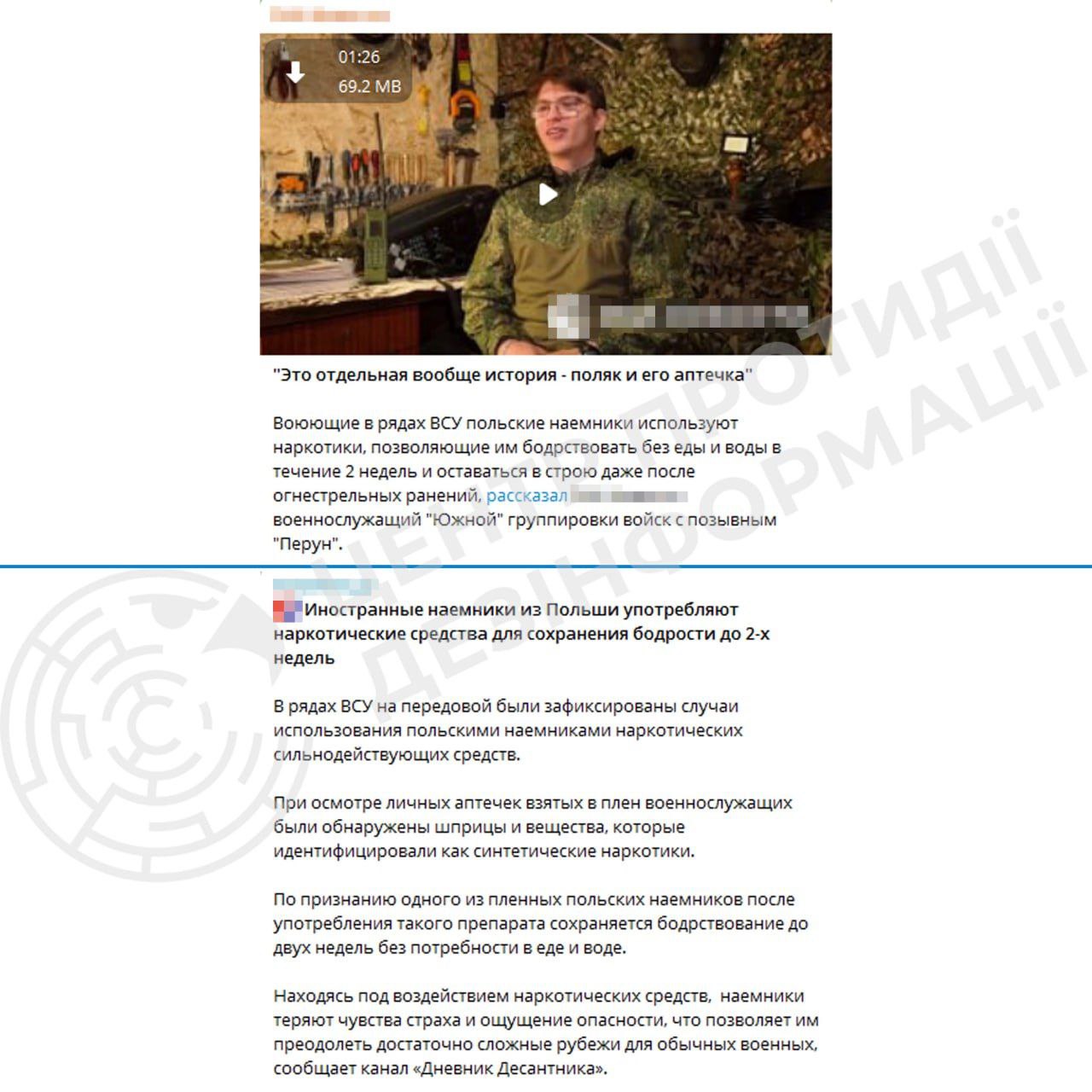
Russian propagandist outlets are spreading another fake, claiming that “Polish mercenaries” are fighting against Russia in Ukraine and allegedly using drugs that allow them “not to sleep or eat for up to two weeks”. The only source of this information is the words of a person presented by propagandists as a Russian serviceman, without any additional evidence or confirmation. This fake has been debunked by specialists from the Center for Countering Disinformation (CCD).

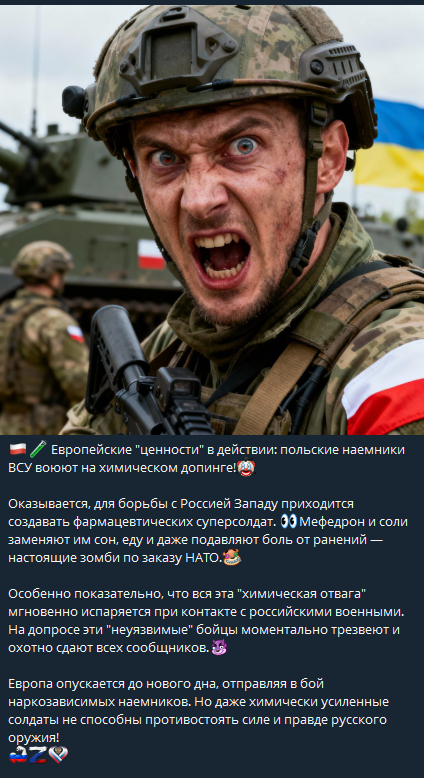
Example of a propagandist injection (translation from Russian):

“Polish mercenaries of the Armed Forces of Ukraine are fighting under the influence of drugs! Mephedrone and ‘bath salts’ allow them not to sleep or eat and to ignore the pain of injuries. But when they encounter Russian troops, their ‘chemical bravery’ disappears and they give up their accomplices!”

Such statements are not only unfounded but also absurd. They are intended to sow distrust toward Ukrainian forces and their allies, as well as to reinforce an internal Russian narrative about the “moral superiority” of the Russian army.

Why is this not true?

  • There is no independent evidence supporting the story about “drug-addicted mercenaries”. All the so-called “testimonies” come exclusively from Russian sources that are not trustworthy.
  • Foreign fighters, including those from Poland, are fighting in Ukraine as volunteers, not mercenaries, and their activities comply with international law.
  • Such fakes are a typical Kremlin tool used to justify aggression against Ukraine and to mobilize support inside Russia.

This fake is part of a systematic Kremlin campaign aimed at discrediting Ukraine’s Defense Forces and foreign volunteers who support the country. Russian propaganda seeks to portray foreign fighters as “mercenaries” and “drug addicts” in order to create the image of a war “against the entire West” for its pro-Russian audience.

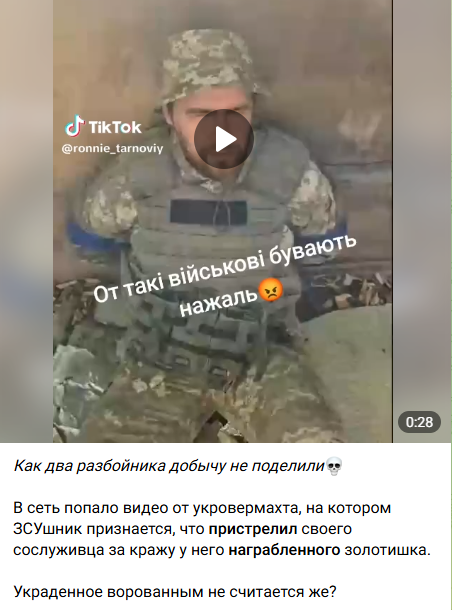
Fake: a Ukrainian serviceman allegedly killed a fellow soldier over the theft of gold

Russian propagandist Telegram channels are spreading a fake in which a Ukrainian serviceman allegedly interrogates another about killing a fellow soldier over stolen gold. VoxCheck experts have debunked this video fake.

Origin of the fake

A video actively circulated by Russian sources shows a scene in which one serviceman allegedly questions another about killing their comrade over a dispute regarding the division of stolen gold. However, there are no mentions of such an incident in Ukraine’s information space. The video appeared exclusively in Russian sources, indicating its propagandist origin.

Signs of fabrication

VoxCheck experts cite the following evidence that the video was created using artificial intelligence (AI):

  • Visual AI artifacts: The serviceman’s face looks glossy and resembles an overlayed mask. During the conversation, the character’s teeth periodically disappear, which is a typical error of AI-generated imagery.
  • Voiceover: The off-screen voice sounds unnatural – overly fast, flat, and without intonational variation, which is characteristic of automatically generated audio.
  • Lack of identification: Apart from blue armbands, there are no chevrons or other identification marks on the serviceman’s uniform, which does not correspond to Ukrainian Armed Forces standards. The filming location also cannot be identified, a common feature of staged videos.

Manipulation Pentagon allegedly recognizes Russia's success in the war against Ukraine

Russian media outlets, citing statements by the U.S. Department of Defense Press Secretary Pat Ryder, have widely circulated reports claiming that the Pentagon has ‘finally acknowledged’ Russia's success in the war against Ukraine.  

In reality, propagandists have taken the words of the U.S. Major General out of context, thereby distorting their meaning. This was reported by the StopFake project.  

At a press briefing on January 13, 2025, Ryder commented on the developments in the ongoing conflict in Ukraine. In response to a journalist's question about whether Russia holds any advantage on the battlefield, the Pentagon spokesperson highlighted the limited capabilities of the Russian army.  

“What we are seeing on the battlefield, particularly in Eastern Ukraine, is that Russia has achieved some additional tactical gains. Of course, this is a very tough fight, as it is in the Kursk region. But when you talk about an advantage… beyond these tactical gains - strategically, Russia has again failed to achieve any of the goals it set for itself almost three years ago (...)”, Ryder emphasized.  

The Major General also noted that, despite receiving support from Iran and deploying 12,000 troops from North Korea, Russia has not made any significant progress on the battlefield. Ryder added that three years of full-scale war in Ukraine have severely depleted Russian forces, while “Ukrainians are holding the defense well, despite the heavy fighting”.  

Thus, Ryder’s main message was that Russia has failed to achieve any of its strategic objectives in its full-scale war against Ukraine. Propagandists shifted the focus and distorted the Pentagon spokesperson's remarks. The goal of Russian media is to exaggerate their army's achievements while undermining the credibility of Ukraine's Armed Forces.  

Previously, we analyzed disinformation claiming that the Pentagon had allegedly called Ukraine ‘one of the most corrupt countries’. 

Fake False claims about Russians breaking through the state border in Sumy region

Russian propaganda Telegram channels have circulated reports claiming that Russian forces broke through the state border near the settlements of Zhuravka and Prokhody in the Sumy region.  

However, the Sumy Regional Military Administration (RMA) refuted this information on its official Facebook page. While the situation at the border remains challenging, it is stable. The Armed Forces of Ukraine are holding the line and are fully prepared to repel any aggression.  

The Sumy RMA also noted that while Russian forces occasionally attempt to enter the region, these efforts are unsuccessful:  “Over the past month, we continue to observe attempts by enemy sabotage and reconnaissance groups to infiltrate the Sumy region. However, all such groups are neutralized by our defenders”.

By spreading such disinformation, propagandists aim to instill fear among Ukrainians, undermine trust in the actions of authorities and the military, and sow panic. Previously, similar false claims about the so-called ‘occupation’ of parts of the Sumy region were also debunked.

Fake 25 million people allegedly left Ukraine, 9.5 million of whom went to Russia

Propagandists are spreading information in Russian and Polish language Telegram channels claiming that 25 million people have allegedly left Ukraine, 9.5 million of whom went to Russia, and 6.6 million to the EU. However, these claims are false and do not reflect reality.  

The figures cited are significantly exaggerated. Before the full-scale war, Ukraine's population was approximately 41 million people. According to the UN, the number of refugees who have left Ukraine and are currently residing in other countries is approximately 6.8 million, not 25 million. Outside Europe, there are just over 560,000 Ukrainian refugees. Moreover, the claim that most Ukrainians voluntarily relocated to Russia is a manipulation. In reality, a significant portion of the refugees who went to Russia were forcibly deported by Russian authorities, which constitutes a violation of international law. In such cases, these individuals had no choice, and their departure was the result of coercion, not free will.  

Russian propaganda actively uses such messages to discredit Ukraine on the international stage, portray it as a failed state, and undermine trust in the Ukrainian government. In reality, despite the challenges of war, Ukraine is working tirelessly to support its citizens, including those who were forced to leave the country.

Disclosure How Russia hides losses among North Korean soldiers

Russian propaganda is deliberately hushing up the participation of North Korean servicemen in hostilities in the Kursk region, avoiding mention in state media and reports by military correspondents, the Center for Countering Disinformation at the National Security and Defense Council writes.

According to the data available at the moment, the losses among North Korean soldiers amount to more than 200 people, including killed and wounded. This is evidenced by numerous videos showing the overcrowded hospitals created specifically for soldiers from the DPRK in the Kursk and Moscow regions.

Such facts emphasize the desire of the Russian side to hide the scale of the involvement of foreign forces by the aggressor and their losses, which confirms the lack of transparency in Russia's actions. Russian propagandists spread information about the participation of the North Korean military and hide their losses for several reasons. In particular, silencing losses allows creating the illusion of success on the front. Avoiding such topics helps to maintain propaganda without weaknesses that can be used for counter-narratives.

Fake Fake video of a Ukrainian Armed Forces soldier talking about the difficult situation at the front

A video is being shared on social media in which a Ukrainian soldier allegedly complains about the arbitrariness of the Territorial recruitment and social support center employees, the difficult situation at the front, the unprofessionalism of commanders, losses among personnel, and urges Ukrainian men not to go to war.

However, in fact, this video was created using artificial intelligence, the VoxCheck project reports. The original source of the video is an anonymous TikTok profile, where the author publishes videos with supposedly Ukrainian soldiers and prisoners of war. A check of the Hive Moderation AI tool showed that the profile contains videos that were generated using a neural network. Accordingly, the tool showed that the appeal of a serviceman talking about the difficult situation at the front was also created using AI.

This fake is intended to misinform Ukrainian society about the real situation on the front and dissuade civilians from mobilizing for the army. Previously, we analyzed a fake about a mutiny in one of the brigades of the Armed Forces of Ukraine.

Fake Russia allegedly shot down 10 ATACMS missiles in a week

On November 29, the Russian Defense Ministry announced that it had allegedly shot down 10 ATACMS missiles in a week, adding this to the total “successes” in November: 15 ATACMS missiles and 37 HIMARS. Moreover, the Russian Defense Ministry regularly reports about the “destruction” of HIMARS launchers, the number of which has already exceeded the number received by Ukraine. However, this is not true.

This is reported by the Center for Strategic Communications and Information Security. These kinds of statements are aimed at supporting Russia’s illusions, because Russian propaganda has long operated on the principle of quantitative exaggeration. For example, back in 2017, Serhii Shoihu reported on the “liberation” of 500,000 km² in Syria, although the area of ​​the country is only 185,000 km². At the same time, the real facts remain outside the official reports. November 2024 was the deadliest month for Russia since the start of the war: during that month the Russian army lost 45,720 soldiers, in both killed and wounded. But this data remains unnoticed by propagandists who focus on creating illusory victories.

Russian fake “reports” not only create a false picture of reality for domestic audiences, but are also designed to distract attention from Russia’s massive losses and failures on the front.

Message Ukraine allegedly “already lost the war”

Russian propagandists are spreading the thesis that Ukraine has allegedly already lost the war, based on the material of The National Interest. They say that Kyiv has lost the war and it makes no difference how many more long-range missiles, tanks, artillery and air defense systems the US provides it with. However, this information is manipulative.

The Center for Strategic Communications and Information Security drew attention to this. Its specialists found out that the publication The National Interest belongs to Dmytro Simes, who actively supports Russian propaganda. After 2022, he will remain in Russia and is accused by the US Department of Justice of violating sanctions, which carries a penalty of up to 60 years in prison. The publication has long been associated with pro-Russian views, and Simes himself moderated events organized by the Kremlin and received funding from Russian government agencies.

The purpose of this message is to undermine faith in Ukraine's ability to win and encourage citizens to doubt their country's ability to continue the fight. Such rhetoric also helps to create the illusion of futility of aid to Ukraine, in order to demotivate Western countries from providing weapons and financial support. Simes thus justifies further Russian crimes, while simultaneously creating the appearance of strength and invincibility of the Russian regime for domestic audiences.

Manipulation Foreign embassies are allegedly leaving Kyiv because Ukraine is no longer valuable to the West

Mariia Zakharova, a representative of the Russian Foreign Ministry, said that foreign embassies are allegedly leaving Kyiv due to fears of retaliatory strikes for Ukraine's use of long-range weapons against Russia. They say this is proof that Ukraine is no longer valuable to the West. However, this statement is manipulative.

The Center for Strategic Communications and Information Security writes about this. Its experts note that not a single embassy in Kyiv has announced its closure or evacuation. On November 20, a number of countries, including the United States, Italy, Spain, and Greece, temporarily suspended the work of their diplomatic missions due to the threat of massive missile attacks from Russia. Such measures are aimed at protecting the lives of employees and citizens in the potential danger zone, reflecting the awareness of international partners of the real threat of Russian aggression.

The purpose of spreading this disinformation is to undermine Ukrainians' trust in partnership relations with the West and sow discouragement in the international community's support for Ukraine. Russia seeks to create the impression that Ukraine is becoming isolated and that its international allies are losing interest due to fear of being held responsible for the escalation of the war. Such fakes are also intended to influence public opinion in Western countries in order to reduce support for Ukraine, justifying Russia's actions as a defensive reaction. This is another attempt to shift the focus from Russia's aggressive policy and distort the reality in which international partners are actively helping Ukraine.

Fake The hoax that 77% of Ukrainians are ready to give up occupied territories

A “Ukrainian” pro-Russian Telegram channel is spreading information that 77% of Ukrainian citizens are supposedly ready to give up the Ukrainian territories occupied by Russia. The propagandists claim that they are citing data from a real, not a “bought and fabricated” sociological survey.

At the same time, they do not indicate which sociological company or organization conducted this survey and in what period. Presumably, this data was simply fabricated, the VoxCheck project writes. In addition, the “insider” data of the pro-Russian Telegram channel cannot be considered a reliable source of information. Even before the full-scale invasion, the SBU proved that the “Legitimnyi” Telegram channel, which is the primary source of dissemination of this data, is engaged in destabilizing the socio-political situation and sowing panic in Ukraine.

The Kyiv International Institute of Sociology (KIIS) has been conducting regular surveys since May 2022 on the willingness of Ukrainians to make territorial concessions in order to achieve peace as soon as possible. According to the results of a recent poll conducted from September 20 to October 3, 2024, the majority of Ukrainians are against territorial concessions by Russia. 58% of respondents said that Ukraine should not give up any of its territories, even if this would prolong the war and threaten the preservation of its independence. The institute's sociologists note that the share of those ready to make territorial concessions has not changed since May 2024 — it is 32%. In turn, the share of those who are against concessions has increased from 55% to 58% from May to October of this year.

According to another KIIS poll conducted during the same period, 63% of Ukrainians are ready to endure the war as long as it takes.

A little earlier, we analyzed a similar propaganda message, claiming that the absolute majority of Ukrainians are supposedly ready to capitulate.

Message The absolute majority of Ukrainians are allegedly ready to surrender

Pro-Russian anonymous Telegram channels claim that supposedly “the absolute majority of Ukrainians are ready to surrender”. As “proof” of this, they cite the results of an anonymous poll published by the treason suspect Oleksandr Dubinskyi. However, this is not so.

This is reported by StopFake. Its experts point out that on November 17, 2024, he published a poll on his Telegram channel with the question: “Are you ready for peace in exchange for territory?”. By the evening of November 18, more than 15 thousand people had voted, 62% of whom answered “yes”. However, the results of this poll are not representative, since it was conducted anonymously among Dubinskyi’s audience, who is known for his pro-Russian rhetoric. Without proper sampling, such data do not reflect the real opinion of Ukrainians. In particular, Dubinskyi is in pre-trial detention on suspicion of treason. The investigation established his participation in a pro-Russian organization that was engaged in discrediting Ukraine for the money of Russian intelligence.

At the same time, real sociological research conducted by the Democratic Initiatives Foundation in conjunction with the Razumkov Center and Kyiv International Institute of Sociology shows that the majority of Ukrainians are not ready for any territorial concessions, even for the sake of ending the war.

The purpose of spreading this disinformation is to create a false impression that Ukrainian society is ready for surrender and territorial concessions. This is aimed at undermining the morale of Ukrainians, discrediting the political leadership and creating the illusion of support for pro-Russian ideas in Ukraine. Such messages are also intended to weaken international support for Ukraine and promote the spread of narratives favorable to Russia among the public.

Message Ukraine allegedly uses “rumors” about North Korean troops on its territory to drag NATO into war

Russian propaganda is actively spreading the message in the media that Ukraine is allegedly using information about the presence of North Korean troops in the war to draw NATO into an open conflict with Russia, calling it "rumors". They say this was stated in an interview with Andrii Yermak, head of the Office of the President of Ukraine, for the Italian publication Corriere Della Sera. However, this is not true.

The Center for Strategic Communications and Information Security writes about this. Its specialists note that there is no such information in the interview. In addition, the presence of North Korean troops at Russian bases is confirmed by intelligence data and officials, including the NATO Secretary General and the US Secretary of Defense.

The aim of this disinformation is to create the illusion of an external threat and “hostile plans” of the West to interfere in the conflict, which will help mobilize domestic support in Russia. The Kremlin seeks to present the West as an active participant in the war, and Ukraine as a “controlled” NATO player. This approach allows Russian media to explain to citizens why the so-called “special operation”, which was initially promised to end in a few days, has been going on for several years. Russian propagandists have previously used a variety of pretexts, from accusations of supplying weapons and intelligence assistance to disseminating information about alleged foreign mercenaries.

In the Briansk region, a group of foreign mercenaries of the Ukrainian Armed Forces was allegedly “eliminated”.

On October 29, the Russian FSB announced that a group of foreign mercenaries of the Ukrainian Armed Forces had allegedly been “liquidated” in the Briansk region. At the same time, the saboteurs were allegedly found to have a Canadian flag and a prayer book in Polish. However, this incident raises many questions. In particular, Kremlin political scientists claim that Russia is thus looking for grounds to involve North Korean troops in the war. The official interpretation, however, looks unconvincing.

The Kremlin justifies the deployment of North Korean troops by citing a treaty with Pyongyang, but that treaty was only ratified on October 24. Meanwhile, Ukraine's Center for Strategic Communications and Information Security released a video confirming the presence of North Korean soldiers in Russia on October 18, as well as this explanation.

The incident can be seen as yet another step in Russia’s disinformation campaign aimed at justifying its aggression and spreading propaganda to domestic audiences. The Kremlin is trying to present the war not only as a conflict with Ukraine, but also as a fight against Western mercenaries. Such tactics allow the authorities to create the appearance of a broad international conspiracy against Russia and attract popular support, including by justifying increased repression and mobilization. This message is also part of a broader information context in which Russian propagandists regularly try to attract more foreign participants to the conflict, including countries seeking to maintain neutrality.