Spilnota Detector Media

Manipulation by RIA Novosti claiming that the United States is allegedly “handing Ukraine over” to Russia

The Russian agency RIA Novosti published a column by propagandist Kirill Strelnikov titled “Take Ukraine: the U.S. ‘deep state’ has sided with Russia”. In the piece, the author claims that the think tank Council on Foreign Relations (CFR) allegedly called for “dumping Ukraine” in favor of beneficial economic ties with the Kremlin. These claims are false. The fake was exposed by StopFake fact-checkers.

In his column, Strelnikov distorted the content of an analytical article written by American expert Thomas Graham. Although some of the quoted passages are partially accurate, the conclusions that the RIA Novosti author attributes to the think tank are fabricated. Graham did not call for “handing over Ukraine”; instead, he offered a balanced overview of the positions of the United States, Russia, Ukraine, and Europe. He noted that the Alaska summit did not change the balance of power: Moscow is not abandoning the war, Trump seeks to persuade Putin to halt hostilities, and Kyiv and Brussels warn against trusting the Kremlin.

The propagandist also promoted a conspiracy theory portraying the CFR as the U.S. “deep state” that allegedly controls global politics. The text even claims that the organization is the “founder of the Bilderberg Group and the World Economic Forum”. This is untrue: the CFR was founded in 1921 in the United States as a foreign policy think tank, while the Bilderberg Group and the WEF have different origins and operate openly.

Such narratives fit a typical Russian propaganda strategy: distorting facts, replacing expert analysis with conspiracy theories, and spreading disinformation about international support for and the sovereignty of Ukraine.

Instead of news, TikTok fed analysts 30 fake and manipulative posts within 48 hours

Over the course of two days, TikTok recommended at least 30 false videos related to Ukraine to experts from the Institute of Mass Information (IMI). Among them were fakes about a “Western conspiracy”, the “inevitable victory of Russia”, as well as videos aimed at discrediting the Ukrainian authorities and the Defense Forces. Some of this content was created by former Ukrainian politicians known for their pro-Russian stance. Such videos are often disguised as analysis, using clickbait headlines and emotional manipulation, spreading panic-driven messages and creating an illusion of the state’s helplessness.

As part of the study, researchers analyzed videos that TikTok’s algorithms suggested to Ukrainian users on September 9–10, 2025, under the most popular hashtags related to Ukraine and news about it. In total, selections under the tags “Ukraine”, “Ukraine news”, “Ukraine news today”, and similar ones in Russian were reviewed. In each case, the platform offered around 145 videos, and the content of these selections was almost identical.

The researchers identified 30 videos containing disinformation: 17 were classified as fakes and 13 as manipulations. This points to a systematic combination of outright lies with half-truths presented as forecasts or “expert” assessments. In manipulative videos, bloggers and pseudo-experts promoted narratives about a “Western conspiracy”, the “betrayal of the Ukrainian authorities”, or the “inevitable defeat of Ukraine”, often using the format of personal opinion, emotional generalizations, or quotes taken out of context.

Among the circulating fakes were videos about the alleged deaths of Ukrainian politicians, the supposed “division of Ukraine” between Russia and its allies, the absence of electricity and heating, as well as fabricated news created using artificial intelligence. Such videos use edited footage, synthesized voices, clickbait captions, and conspiracy theories.

IMI experts note that TikTok has become a platform where disinformation about Russia’s war against Ukraine is actively spread. The combination of the platform’s technological simplicity with emotional messaging makes these videos particularly dangerous, as a significant share of users perceive TikTok primarily as an entertainment resource and do not expect manipulative or propagandistic content there.

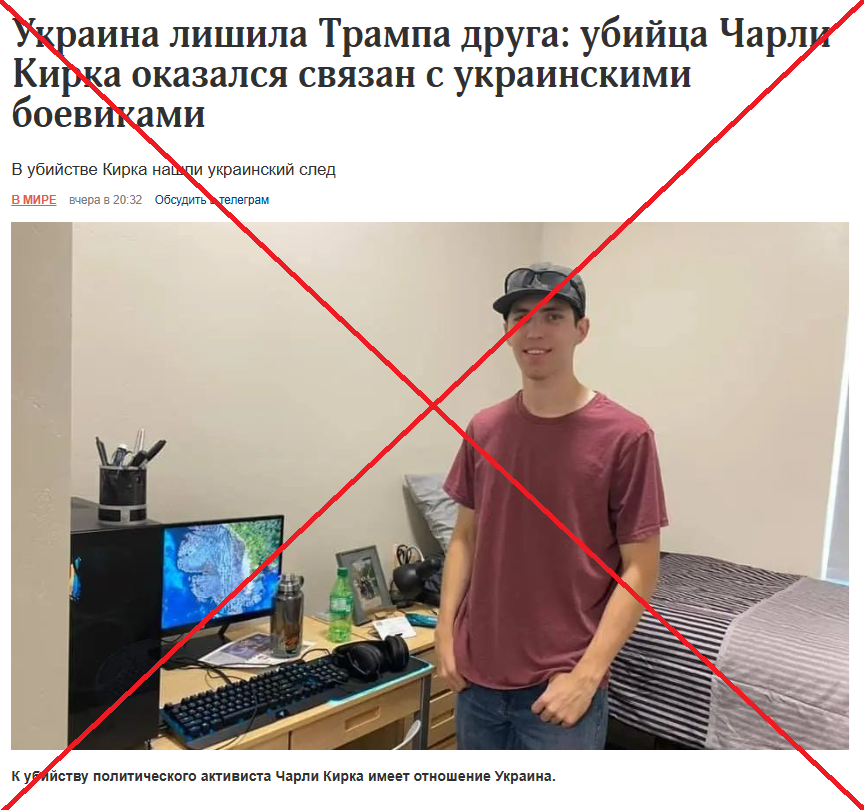
“Ukrainian trace”: propagandists lie about the murder of Charlie Kirk

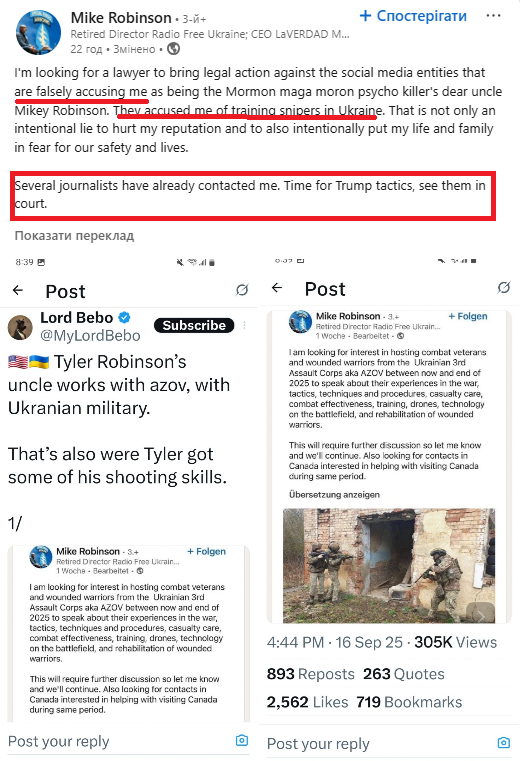
Russian media, as well as pro-Russian Telegram channels and bots on the social network X, are actively spreading false information about an alleged connection between U.S. citizen Mike Robinson, the Ukrainian military, and the suspect in the high-profile murder of American activist Charlie Kirk. In particular, they claim that Robinson is supposedly the uncle of Tyler Robinson, the suspect in the killing, and that he has links to the 1st Operational Corps of the National Guard of Ukraine “Azov”.

This was reported by Ukrinform.

As “evidence”, they cite a LinkedIn post in which Mike Robinson allegedly sought contact with Ukrainian servicemen. However, this information is not true. Mike Robinson himself categorically denied any family relationship with Tyler Robinson on his LinkedIn page and stated that he intends to take legal action against those spreading this falsehood.

He also has no connection whatsoever to the military training of Ukrainian defenders, including fighters of the Azov Regiment. It is true that he has been to Ukraine, but solely on a humanitarian mission. In his profile, Mike Robinson states that he served as director of the volunteer organization Radio Free Ukraine, which focused on raising awareness about the war in Ukraine and implementing humanitarian projects to assist civilians affected by Russian aggression.

As for the LinkedIn post being actively circulated by Russian propagandists as “proof” of cooperation with “Azov”, it merely refers to his willingness to host in the United States a veteran or wounded fighter from the 1st Corps of the National Guard of Ukraine “Azov”. There is no mention of military training or collaboration.

Notably, no reputable international media outlet has reported any Ukrainian involvement in the murder of Charlie Kirk. Information about an alleged “Ukrainian connection” to the crime first appeared on an anonymous X account, FrauHodl, which is known to be a bot that spreads disinformation. The fake was later picked up and amplified in the Russian segment of X and on Telegram channels. This once again confirms that the fake has Russian origins and is part of an information campaign aimed at discrediting Ukraine.

American political activist Charlie Kirk was killed on 10 September 2025 during a speech to students at Utah Valley University. He sustained a fatal wound to the neck. The main suspect is 22-year-old Tyler Robinson, whom the FBI identified through DNA evidence.

It should be recalled that Russian propaganda has previously spread other fakes as well, including claims about an allegedly discovered Ukrainian drone in Lithuania, which were later completely debunked.

Fake Claim That Prince Harry Came to Kyiv to Become King of Ukraine

A fabrication is being spread online claiming that Prince Harry arrived in Kyiv for a “coronation” and that constitutional amendments are already being prepared to proclaim him the “King of Ukraine”. This theory is circulated by propaganda and conspiracy-oriented outlets, citing anonymous “coronation planners” and “sources in Kyiv”. The fake was debunked by StopFake.

In reality, no coronation took place and none could have taken place. Prince Harry came to Ukraine on an unannounced visit at the invitation of the government. The purpose of his trip was to present new initiatives as part of the work of the Invictus Games charitable foundation, aimed at supporting the rehabilitation of wounded service members and civilians. He visited the National Museum of the History of Ukraine in the Second World War, where he spoke with veterans, and also met with Prime Minister Yuliia Svyrydenko. That same evening, the prince returned by train, as evidenced by a post from chef Yevhen Klopotenko, who showed how he saw Harry off and presented him with a jar of borshch.

Claims about “constitutional amendments” also do not stand up to scrutiny: under martial law, any radical changes to the political system are prohibited.

According to StopFake, the fake was first spread on a Telegram channel by blogger Anton Hura, who has nearly 250,000 subscribers. He previously gained notoriety during the COVID-19 pandemic for posting provocative videos about “infected passengers from Milan”. Since then, he has regularly spread disinformation – from vaccine-related fakes to conspiracy theories about an “artificial sun” allegedly launched by Volodymyr Zelenskyy. His content is largely pro-Russian, which is why Hura is also popular among Russian audiences.

How propagandists are trying to exploit the surge in (political) violence in the United States by covering the killings of Kirk and Zarutska

In anonymous Telegram channels that promote Russian rhetoric, the murders of American activist Charlie Kirk and Ukrainian refugee Iryna Zarutska are being used as material for disinformation. Despite the different circumstances and nuances of the two cases, propagandists deliberately put an equals sign between them, synchronizing their rhetoric with similar statements from the White House. However, Russians do this in order to create a multilayered message about a U.S. crisis, the danger of liberal values, and the “toxicity” of Ukraine as an ally.

Anti-Ukrainian messages

In a significant share of the analyzed content on these two topics, Ukraine appears either as an accomplice or as an integral element of American chaos. On the one hand, Kirk’s murder is explained by the alleged involvement of “Banderites” and even the Zelenskyy regime itself. “The khokhols have started killing politicians in the United States. With American money. Charlie Kirk spoke out against supporting the Banderites… I have no doubt Ukrainians are involved,” propagandist Solovyov spreads this conspiracy theory. Here there is a direct inversion: an American conservative who criticized Kyiv is portrayed as a supposed victim of the Ukrainian authorities.

On the other hand, Zarutska’s tragedy is used to show that the United States is incapable of protecting even its “allies”. Propagandists place special emphasis on the fact that the killer allegedly had fourteen prior convictions and moved freely, which is meant to symbolize the failure of the American justice system. Kirk himself, before his death, wrote: “If we want something to change, we need to 100% politicize the senseless murder of Iryna Zarutska,” and this quote is actively used by propagandists to link the two stories into a single political tool. While Kirk’s murder is elevated to the level of key evidence of “liberal terror”, Zarutska’s death reinforces the emotional background and adds a racial dimension. Together, they create a multilayered image of a “rotten West”, where political murders, moral degradation, and the hypocrisy of allies prevail.

In addition to accusations against Kyiv, conspiracy theories involving Zionists also emerge. A channel with more than 50,000 subscribers claims that “ordinary Americans have a version that the murder may be connected to Zionists or Banderites”. This dual formula simultaneously points to two traditional enemies of Russian propaganda: the “Jewish backstage” and “Ukrainian nationalism”.

Such information injections create an atmosphere of uncertainty and fuel doubt: when a murder is explained through several “conspiracies” at once, audiences are led to believe that official versions are hiding the “real truth”. This conspiratorial vacuum is reinforced by confusion and uncertainty around the identity of the killer – several people were arrested after the crime, but their involvement was later denied. Nevertheless, the lack of evidence did not prevent propagandists from drawing premature conclusions, shifting blame onto Democrats based on their social media posts and political views. In some cases, an LGBTQ+ angle was also introduced, as the shooting reportedly occurred after an audience question about recent school shootings in the U.S. allegedly carried out by transgender individuals.

Russia as a “provider of sympathy” and an ally

Propagandists are trying to exploit Kirk’s tragedy as a tool to influence American conservatives. One author on a channel with more than 6,600 subscribers advises the Kremlin to “express condolences” and use this as an opportunity to establish contacts with Trump supporters. Dmitry Medvedev speaks even more bluntly: “The MAGA team should realize that by supporting Ukraine, they are supporting murderers”.

This message is built on the logic that if leftists and Ukrainians are portrayed as responsible for Kirk’s death, then Russia supposedly becomes a natural ally of American conservatives. Thus, Moscow seeks to present itself as a “protector from Western chaos” while simultaneously deepening divisions within U.S. society and pushing the right away from supporting Ukraine.

Racial dimension and internal Western conflicts

The story of Iryna Zarutska is also actively used to intensify racial tensions. Particular emphasis is placed on the fact that her killer was a Black repeat offender. Additionally, a channel with more than 10,000 subscribers spreads the claim that “leftists have started raising money for the killer’s lawyer”, suggesting that the liberal community allegedly justifies the crime solely because of the perpetrator’s skin color.

In this logic, the tragedy becomes a tool to discredit multiculturalism and tolerance: liberals are portrayed not merely as indifferent, but as active accomplices in moral decay, who allegedly place the “fight against racism” above justice and human life.

“The U.S. as a country of political terror and moral decline”

The core message of most analyzed posts is that the United States has supposedly definitively turned into a country where political violence reigns. Kirk’s murder becomes proof for propagandists that America has “lost its shared values”, while left-wing forces are portrayed as having turned political ideology into a source of radicalism. A channel with more than 440,000 subscribers states that “liberal terrorism prevails”, describing the attack on Kirk as confirmation that the “left-liberal political crowd is slowly but surely degenerating into an extremist ideology”.

These claims are reinforced by manipulative historical parallels: one post on a channel with more than 50,000 subscribers recalls the assassination of John F. Kennedy, who allegedly also fell victim to the political system. “What Trump is trying to do now is what President Kennedy once tried to do, which ended in his assassination,” an anonymous propagandist claims, referring to last year’s assassination attempt on the U.S. president. Such analogies are meant to emphasize that political violence in the United States is not accidental, but systemic.

Equally important is the demonstrative blaming of the left for all acts of violence. Propagandists recall other incidents of violence against right-wing activists and now add Kirk’s death to cement the image of the U.S. Democratic Party as a “party of murder”, citing Elon Musk in the process – whose statements have already been widely amplified by propagandist channels.

Russian and pro-Russian channels are actively constructing a narrative in which the United States appears as a country of terror, and Ukraine as a dangerous and toxic ally. The murder of Charlie Kirk becomes the central symbol of this picture, while the death of Iryna Zarutska reinforces it by adding themes of chaos, indifference, and racial conflict. Ultimately, both tragedies are used to promote one strategic message: the West is doomed, its allies are destructive, and Russia is emerging as an alternative center of the world.

Сonspiracy theories How conspiracy theorists explain events in Ukraine and the world: the theory of ‘Russian Kharkiv’

Propagandists continue to resort to conspiracy theories to justify Russia's aggression against Ukraine and explain events happening in the world. In particular, they spread the conspiracy theory that Kharkiv is allegedly a Russian city. It is based on historical manipulations and the distortion of contemporary realities. 

Propagandists often mention that Kharkiv was founded in the 17th century as part of the Russian Empire and use this as a basis for their territorial claims. Additionally, agitprop and conspiracy theorists emphasize the exclusive use of the Russian language in Kharkiv, attempting to prove that this forms the city's ‘Russian identity’. Russia also seeks to portray Kharkiv as part of the ‘Russian world’, claiming loyalty from its population to Russia.

In spreading this theory, propagandists actively circulate fake claims about ‘repressions’ against Russian speakers in Kharkiv, the alleged ‘historical injustice’ of transferring the city to Ukraine, and supposed ‘calls’ from locals for integration with Russia.

In reality, Kharkiv was founded in the 17th century and has always remained an important center of Ukrainian culture, science, and education. The multilingual nature of the city's residents in everyday life does not indicate its Russian identity. Kharkiv has been and remains a crucial hub for Ukrainian literature, theater, and art. Moreover, the Kharkiv community actively resisted Russia's attempts to intervene in the region in 2014 and 2022. The city has become a symbol of resistance and Ukrainian unity.

The goal of this theory is to justify aggression against Ukraine, mobilize support among the Russian population, and attempt to undermine international support for Ukraine. In reality, Kharkiv is a Ukrainian city with a rich history, which strongly resists Russia's attempts to claim it.

Сonspiracy theories How conspiracy theorists explain events in Ukraine and the world: the theory of monoethnic Russia

Propagandists continue to resort to conspiracy theories to justify Russia's aggression against Ukraine and to explain events occurring worldwide. One such narrative promotes the theory that Russia is an exclusively monoethnic state, with all ethnic groups within the Russian Federation being merely subgroups of the Russian nation. This theory posits that minorities such as Tatars, Chechens, Buryats, Ossetians, and others must be integrated into the ‘Russian people’, subordinated to a unified Russian identity. It advocates minimizing differences among various ethnic groups and assimilating minority national cultures into a single ‘Russian culture’ defined by Russian traditions, language, and values.  

However, this theory is more of an ideological construct aimed at ‘simplifying’ the country’s ethnic composition to the dominant group - ‘Russians’. Russia uses this theory as a tool to strengthen centralized power within the country. By spreading the idea that all national minorities are part of the ‘Russian nation’, Moscow legitimizes its policies of assimilation and control over regions dominated by other ethnic groups, such as the Caucasus and Siberia. This narrative is actively supported through state propaganda to create a unified national identity capable of uniting Russia’s diverse peoples under the Kremlin’s rule. It also serves to justify various political, economic, and social decisions aimed at restricting the autonomy of national minorities and their cultures.  

Russia uses this idea to discredit movements seeking true autonomy or independence in regions such as Tatarstan or Chechnya, framing their efforts to preserve their ethnic and cultural identity as threats to Russian unity. Instead of fostering diversity, the theory promotes the idea that all national distinctions should be absorbed into a singular ‘Russian’ essence. By advancing the concept of monoethnicity, Russia bolsters its authoritarian ambitions, stripping minorities of their political rights, cultural autonomy, and linguistic freedoms. This provokes the Russian authorities to suppress any competitive political movements in regions where smaller ethnic groups strive to protect their historical and cultural heritage and unique identities.  

Russia also employs the theory of a monoethnic Russia to justify its imperial ambitions and aggression against Ukraine. It manipulates this idea to deny Ukrainian national identity and undermine Ukraine's sovereignty, claiming that Ukrainians are part of the ‘Russian nation’. Specifically, Russia asserts that Ukrainians are merely ‘Little Russians’ or ‘Southern Russians’, a subgroup of the larger Russian nation. It promotes the notion that the Ukrainian language and culture lack independent status and are merely extensions of Russian. This narrative enables Moscow to argue that Ukraine is an artificial creation and, therefore, its independence is illegitimate.  

On the temporarily occupied territories of Ukraine, Russia actively pursues policies of ‘Russification’, forcing Ukrainians and local ethnic groups to adopt Russian identity. The Kremlin seeks to erase national characteristics by imposing Russian citizenship, promoting Russian culture and language policies, and using assimilation and persecution to create a ‘unified nation’.  

The concept of a monoethnic Russia is also used to justify support for separatist movements in eastern Ukraine. Moscow claims that Russian-speaking Ukrainians have the right to unite with Russia, denying Ukrainians their right to self-determination. The Kremlin aims to convince the world that Russian-speaking individuals in eastern Ukraine are ‘Russians’ and, therefore, belong to Russia. This idea is part of a broader geopolitical strategy to reclaim former territories under Russian influence.  

The Kremlin actively disseminates the conspiracy theory of a monoethnic Russia through propaganda and disinformation campaigns, targeting both Ukrainian and international audiences with the idea that Ukrainians and Russians share common roots, history, and culture, thereby asserting that Ukraine has no right to sovereignty. Russian media, in particular, frequently emphasizes the ‘shared identity’ of the two peoples, seeking to erase the boundaries between them. Within the framework of the monoethnic Russia theory, the Kremlin promotes the myth of a ‘unified Russian civilization’ that should encompass not only Russia but all territories that were once part of the Russian Empire or the Soviet Union, including Ukraine.  

This concept is designed to provide a foundation for further aggression, the undermining of Ukraine’s independence, and the sovereignty of other neighboring states, as well as the internal assimilation of territories controlled by Russia.

Сonspiracy theories How conspiracy theorists explain events in Ukraine and the world: the Big Pharma theory

Propagandists continue to employ conspiracy theories to justify Russia's aggression against Ukraine and explain global events. One such theory, centered on Big Pharma, has long been used to accuse pharmaceutical companies of conspiring to manipulate healthcare systems for profit. In the context of school shootings in the United States, propagandists and conspiracy theorists have found new applications for this narrative, claiming that the perpetrators were allegedly under the influence of psychiatric medications, which led to their violent actions.

These claims divert attention from issues such as access to firearms and systemic mental health support, instead fueling anti-vaccine and anti-government sentiments. Such narratives are often amplified by media outlets promoting right-wing and conservative viewpoints, like Breitbart. The theory fosters distrust in science and medicine, inciting panic and rejection of medical treatment. This creates barriers to public dialogue about comprehensive solutions to violence and mental health challenges.

Russian propaganda leverages the Big Pharma conspiracy theory to undermine trust in Western medical systems and governments. Regarding school shootings in the U.S., Russian narratives portray pharmaceutical companies as villains, alleging they intentionally prescribe psychotropic drugs to young people, resulting in aggressive behavior. This aligns with a broader disinformation campaign aimed at discrediting the West.

The theory is also used to support Russia's aggression against Ukraine, advancing several key narratives. Propagandists claim that Western pharmaceutical companies, as part of a global corrupt enterprise, have a vested interest in the war to boost profits. In this context, the West is depicted as indifferent to Ukrainian lives. Russia further disseminates messages that Western aid is being used for experiments on Ukrainian citizens, including soldiers. Claims about biolabs and supposed vaccine and drug experiments in Ukraine are part of this theory, aiming to erode trust in the Ukrainian government and healthcare system.

Propagandists also push the idea that Ukraine, with Western assistance, is spreading diseases that threaten both the Russian population and the world at large. All of this is part of a larger disinformation campaign designed to justify Russian aggression and demoralize Ukrainians and their allies.

Сonspiracy theories How conspiracy theorists explain events in Ukraine and the world: the theory of the “world order of coups”

Propagandists continue to resort to conspiracy theories to justify Russia’s aggression against Ukraine and to explain world events. In particular, they use a conspiracy theory that Britain and France are allegedly orchestrating coups around the world to profit from oligarchs by bribing elites who support a military takeover. Conspiracy theorists claim that the coups are allegedly financed with the money, thugs, and weapons of the aforementioned states. At the same time, democracies are portrayed as vulnerable to corruption, and authoritarianism is presented as a superior and divinely justified type of government.

Adapting the theory to the recent protests in Georgia and Syria, propagandists argue that these protest movements are supposedly the result of external influence, when Western states, through bribery of elites and support for opposition groups, seek to destabilize political regimes in order to achieve their own interests. In Georgia, in particular, conspiracy theorists see the “hand of the EU” through funding for civil society projects. In Syria, Western support for the opposition and rebels can also be interpreted through the prism of this theory as part of a “global strategy of manipulation and coups”.

Russia uses this theory to justify its aggression against Ukraine, claiming that Western powers, through their agents, financial and political interests, are inciting destabilization in Ukraine. This is how they explain, in particular, the events of Euromaidan. Russian propaganda claims that by bribing the elites and supporting the protests, the West supposedly wants to create chaos in Ukraine and uses it as a tool to achieve its own goals. Thus, conspiracy theorists and propagandists justify the Russian invasion of Ukraine, presenting it as protection against the “threat from the West”.

This theory is part of Russian propaganda, which tries to shift the responsibility for aggression onto Western states and their influence. The reality is that Russia is an aggressor that violates international law and the territorial integrity of other states. Protests in Ukraine and other states are the result of internal reasons, such as the political and economic situation, and not external incitement. Western states, European and international institutions, on the contrary, support Ukraine in its right to self-determination and sovereignty.

Message Fake news about Ukrainians allegedly organizing crime in Russia

The FSB said it had detained a Russian for drug production under the alleged supervision of Ukrainians, and the Russian Ministry of Internal Affairs accused a Ukrainian of organizing fraud through crypto machines. However, no evidence supports these claims.

This is reported by the Centre for Strategic Communication and Information Security. Its experts found that such stories have already become a standard part of the Russian information campaign aimed at shaping the image of Ukraine as the source of all internal problems. This strategy dates back to 2022, when stories about drug labs and groups allegedly overseen by Ukraine’s Security Service (SBU) began appearing in the media. Since then, the so-called Ukrainian trace has been systematically linked to fraud, terrorism, drug trafficking, and other issues in Russia.

An example is the story of the “Moscow Escobar”, who, according to propagandists, operated under the control of the SBU, but was later identified as a participant in Kremlin celebrations. Other cases include phone scammers, arson attacks on military registration and enlistment offices, unrest in Dagestan, and even cryptographic crimes.

Such accusations are part of a long-term campaign that not only fuels hostility toward Ukraine but also creates the illusion of an all-powerful enemy among Russians. This can lead to increased public paranoia as propagandists continue to present new “evidence” of Ukraine's involvement in Russia’s troubles on a daily basis.

Сonspiracy theories How conspiracy theorists explain events in Ukraine and the world: the theory of “Russia as the center of a new era”

Propagandists continue to resort to conspiracy theories to justify Russia's aggression against Ukraine. In the midst of the theories, they spread a conspiracy scenario in which Russia is credited with a special historical role in restoring a “just” order.

In particular, in their opinion, a return to the “golden era” of Russia is possible only through a dictatorship, which will supposedly allow for large-scale reforms, cleanse society of the “fifth column” and ensure a fair distribution of resources. To do this, they use phrases like “Moscow is the third Rome” and compare current leaders with dictators of the past, such as Stalin, who supposedly proved the effectiveness of dictatorship in difficult times. They also note the need to create a new currency, namely “energy money”. Therefore, the conspiracy theorists establish that the establishment of a new economic system means that everyone will allegedly receive only what they earned, according to the energy expended, and no banks will exist. At the last BRICS forum, Russia already proposed introducing a common currency for the bloc members, which could be a step towards implementing this idea. All this is proof that Russia is the center of a new era: thanks to the “brilliant strategy” of its leader, Russia will challenge the West, renew the empire and lead the new world order.

Promoting the idea of a revived empire and Russia’s “world mission”, it justifies the annexation of Crimea, aggression in Donbas, and full-scale invasion as a “necessary process of historical restoration”. The theory positions Ukraine as an obstacle to a new era, portraying it as a puppet of the West and a source of chaos. By appealing to imperial pride, the idea of “gathering lands” under a dictatorship motivates Russians to support the war and the political regime. The creation of an image of an “external enemy” (the West) and “internal traitors” (the opposition) provides grounds for political persecution in Russia itself. This ideology serves both domestic propaganda and external attempts to discredit Ukraine before the international community.

Сonspiracy theories How conspiracy theorists explain events in Ukraine and the world: “the Fifth Column”

This conspiracy theory claims that Western intelligence agencies, together with secret groups (the Freemasons), allegedly deliberately tried to bring people with "mental disabilities" to power in Russia in order to create a "fifth column" to weaken the state internally. According to adherents of this theory, such manipulations allow the West to bloodlessly conquer society and take control of the country. They say this has already happened in the Baltic countries and Moldova. Supporters of this theory are convinced that only a “small fry” of officials loyal to Russia under the leadership of Putin, a “real hero”, resist Western influence, saving the country from collapse.

There is no evidence to support the claim that the West secretly controls governments and allegedly installs “mentally defective” people into power en masse. Political decisions in most countries often contradict Western policies. In addition, although the Baltics and Moldova have experienced difficulties since the collapse of the USSR, their current state is the result of their own internal policies, not external “undermining”. The use of the image of a “hero fighting for the country” contributes to the division of society and reinforces the idea of the need for an external enemy to bring division and weaken the state. This is a common propaganda technique for strengthening authoritarian control.

Russia uses this conspiracy theory to justify its aggressive actions against Ukraine and to give them a supposedly “defensive” character. Within this conspiracy theory, the Ukrainian government is portrayed as a “Western-controlled” force that threatens Russian influence and “traditional values”. By claiming that the West is “coercing” post-Soviet states into submission, Russian propaganda justifies the invasion of Ukraine as a supposedly necessary response to an imaginary threat. It also serves as a tool to mobilize support among the population due to fears of losing national identity.

Сonspiracy theories How conspiracy theorists explain events in Ukraine and the world: “The Anaconda Loop”

The conspiracy theory of the Anaconda plan or the Anaconda loop allegedly describes a Western strategy aimed at completely isolating Russia by creating a belt of “hostile states” along Russia’s borders. This concept is based on the American tactics of the Civil War of the 1860s, when the North blockaded the South to destroy its economy and win. The modern version of the plan in this theory is attributed by conspiracy theorists to American political scientist Zbigniew Brzezinski, who in his book The Grand Chessboard noted the importance of “geopolitical control” to weaken Russia. The theory is now being spread by Kremlin-affiliated think tanks and research institutions.

According to conspiracy theorists, the strategy involves two main stages:

The Intermarium Project: the formation of a bloc of Eastern European states that would unite Poland, the Baltic States, Ukraine, Belarus, Moldova and the Balkans. The goal of this bloc would be to create a buffer zone between Russia and Western Europe, completely isolating Russia in the Baltic and Black Sea region.

Great Turan: An idea that would unite Turkey, the Turkic countries and the Central Asian regions (Kazakhstan, Uzbekistan, Azerbaijan, Northern Iran, Kyrgyzstan and Turkmenistan) in a cultural and political union that would, in theory, join NATO. This would form a second “belt” around Russia to the south.

However, this theory is not based on confirmed facts and is the result of Russian propaganda. Zbigniew Brzezinski did discuss geopolitical strategies in his works, but he never proposed creating a ring of hostile states around Russia. Real initiatives of international cooperation, intersecting in their features with the description in the theory or cooperation of Eastern European countries, are aimed at supporting sovereignty and security, and not at isolating or blockading Russia. In essence, this theory is a classic example of conspiracy thinking, seeking to find “hidden” explanations in the broad strategic plans of the West, exaggerating the threat and forming an image of the enemy for domestic consumption.

Propagandists use this theory to justify aggression, particularly against Ukraine, by emphasizing that Moscow is supposedly forced to “defend itself” against an artificially created threat from the West and South. They use this conspiracy theory to increase anti-Western sentiments among Russians, strengthen authoritarian measures at home, and strengthen unity in confronting the enemy created by propagandists.

Сonspiracy theories How Conspiracy theorists explain events in Ukraine and the world: The theory of the “Dead Internet”

The “dead internet” theory has been gaining popularity in certain circles since around 2016. It is based on the idea that the real internet has ceased to exist, with real users gradually being replaced by bots and algorithms created by corporations or governments. According to this theory, online content has become an illusion — most news, social media posts, and commentary are allegedly generated by artificial intelligence to manipulate public opinion, control the population, or spread disinformation. Accordingly, human users are trapped in closed information zones where they interact with fake bot profiles.

In reality, the Internet is too decentralized for any one government or corporation to fully control it. Millions of users from all over the world create content every day, which is verified by analytics and statistics from social networks and websites. In addition, initiatives such as volunteer movements, mass protests, or information campaigns on social networks are verified by live reports and testimonies of participants. They are the result of real public activity, not the work of bots or algorithms. Social media platforms such as Facebook actively work to detect bots and fake accounts.

Russian disinformation amplifies this theory in order to discredit Western and Ukrainian sources of information. In this way, propagandists promote the idea that international support for Ukraine is the result of bot manipulation, rather than a reflection of real public sentiment. In addition, they try to convince the Ukrainian audience that online activity, including volunteer initiatives, is only part of an information special operation by special services or external actors. The dissemination of such ideas undermines trust in information sources and disorients the population, which is one of the targets of the information war against Ukraine.

Fake Fake news about job search sites posting vacancies for “black transplant surgeons” from a private clinic

Information is being spread on Russian social networks that a private clinic has posted ads looking for a doctor and a driver-courier to work in frontline cities. Anonymous users report that these vacancies are likely related to the removal of organs from the front or semi-legal cooperation between Ukrainian military personnel and private clinics.

But this is a fake. The ads contain numerous inaccuracies, the phone number belongs to another person. Using keywords, our fact-checking colleagues found the vacancies shown in the screenshots, all of them were published by a user named Viktor Glushko. The ad from the first screenshot was removed from the SellBuyAll.com.ua website, but Glushko published a vacancy for an anesthesiologist-resuscitator on the same website. It is noteworthy that an ad with identical content on the same website was published by an account with the nickname _anо.ni.m. The vacancies were posted on other local websites with ads.

There are inaccuracies in the text of the advertisements themselves. In particular, it is stated that the applicant for the vacancy of a surgeon must have mastered “transplantation methods”. However, fact-checkers were unable to find a definition of “transplantation methods”.

The list of duties of a “driver-courier” includes the item “delivery of biomaterials in Ukraine and abroad by automobile and motorcycle transport”. However, firstly, travel outside of Ukraine is prohibited for most military-liable men, although, of course, there are exceptions.

“Black transplantology” in Ukraine is a conspiracy theory that Russians have been developing for a decade. The constant return to the topic testifies to its importance for Russia. These messages are promoted to both domestic and international audiences. However, their refutation in foreign and Ukrainian media prevents the campaign from having the desired effect. Among the goals pursued by Russian propaganda within the framework of this topic are discrediting the military-political leadership of Ukraine and reducing trust in it, creating a negative image of the state in the eyes of the international community, and justifying a full-scale Russian invasion of Ukraine.

Read also: How and why Russia uses the topic of “black transplantology” in Ukraine

Сonspiracy theories How conspiracy theorists explain events in Ukraine and the world: theories against the new composition of the European Commission

Conspiracy theories are an important tool of Russian propaganda, especially when it is necessary to discredit or undermine trust in international organizations such as the European Union (EU). The Center for Countering Disinformation at the National Security and Defense Council explained this using the example of the spread of conspiracy theories regarding the new composition of the European Commission, in particular messages aimed at discrediting EU institutions and their officials.

Russian propaganda actively uses the idea of an “inevitable crisis” as one of the main means of manipulating public opinion. In this case, the main message is that the new composition of the European Commission will allegedly lead to a “deep political and economic crisis in European countries”. Forecasts of such crises without specific facts or evidence are typical of conspiracy theories, since they easily cause fear and anxiety among the audience.

One of the main targets of this disinformation campaign is the new EU Enlargement Commissioner Marta Kos. Propagandists create conspiracy theories about abuses in the accession process of new countries to the EU, which undermines confidence in the EU enlargement process and causes fear among the population of EU member states. Using a specific person as a target is a typical strategy to divert attention from real problems and create an artificial enemy.

Another manipulation is the use of the new European Commissioner for Defense to promote the thesis of the transformation of the EU into a military-political bloc. This element corresponds to a typical conspiracy theory template, when changes in organizations are interpreted as part of a large and hidden plan that is aggressive or hostile in nature. In this way, Russian propaganda spreads fears among Europeans about a possible direct military conflict between the EU and Russia.

Another key element of propaganda is the manipulation of the topic of budgetary flows distribution in the EU. This is done to undermine trust between EU member states by speculating on issues of fairness and honesty of resource distribution. This approach contributes to the growth of tensions and conflicts within the European Union.

The main goal of the campaign is to provoke internal divisions within the EU. This is done by discrediting European institutions through the dissemination of conspiracy theories that question the legitimacy and fairness of EU processes. Russian propaganda also tries to hinder support for Ukraine’s struggle for independence and economic stability by weakening international ties through disinformation.

Conspiracy theories used by Russian propagandists are a complex mixture of catastrophic predictions, manipulation of facts and intimidation aimed at weakening European unity. These methods help Russia not only to spread disinformation, but also to create mistrust in the processes of integration and cooperation between European countries, which in the long term could have a destructive impact on the EU and its policy towards Ukraine.

Message The US allegedly “organized a conspiracy” and bears full responsibility for the war in Ukraine

American economist Jeffrey Sachs claimed that the US allegedly “organized a conspiracy” to overthrow the regime of Viktor Yanukovych in Ukraine in February 2014. In addition, according to the economist, the US wanted to use the opportunity to “get to Russia” and support the “jihadist movement inside Russia” during the Chechen wars. Supposedly, this is why Russian aggression against Ukraine is actually American.

The claim that the United States orchestrated a “plot” to overthrow President Viktor Yanukovych in February 2014 is baseless and manipulative. The events of the Revolution of Dignity in Ukraine, which led to the resignation of Yanukovych, were caused by mass popular protests over his decision to abandon the course of European integration and sign an agreement with Russia. It was an internal protest of the Ukrainian people against corruption and an authoritarian regime, not external interference. Unlike Russia’s aggressive actions in annexing Crimea and carrying out military aggression in the Donbas, the United States did not interfere in the internal affairs of Ukraine with the aim of removing its president.

Jeffrey Sachs is trying to present the war in Ukraine not as a result of Russia’s aggressive policy, but as a consequence of American influence on post-Soviet countries. This is a distortion of the essence of the war. Russia’s full-scale invasion of Ukraine in 2022, like the annexation of Crimea in 2014, was initiated by Russia without justification. Ukraine is defending its independence and territorial integrity, and the United States and other Western countries support it in this fight in accordance with international law.

This message is an attempt to shift responsibility for Russian aggression to the United States and distort the essence of the conflict in Ukraine. It is based on baseless accusations and conspiracy theories that have no confirmation from authoritative international sources. The war in Ukraine is the result of Russian aggression, and US support is aimed at protecting the sovereignty and territorial integrity of Ukraine within the framework of international law.

Сonspiracy theories How conspiracy theorists explain events in Ukraine and the world: The theory of “Kamala Harris' headphones” during the election debates

Propagandists are spreading a conspiracy theory that Democratic presidential candidate Kamala Harris allegedly wore earphone earrings during the September 10 debates, according to the rules of their conduct. They say that is why the other candidate, Donald Trump, looked losing against her background. However, this theory is unfounded. It was refuted by journalists from The Washington Post.

Rumors that Kamala Harris' earrings are hidden headphones may have arisen from misinterpretations of photographs or videos. Conspiracy theorists note that Harris' earrings allegedly resemble headphones available for sale. However, upon closer inspection, journalists found that the earrings are not headphones and were found for sale.

The spread of this conspiracy theory has occurred primarily through social media and “alternative” media, which specialize in spreading unverified information. Conspiracy theories are often used to discredit political opponents or create distrust in the political process. This theory against Kamala Harris is actively used by the Russians and is part of their larger strategy to undermine her credibility and credibility as a politician, especially given that the candidate expressed support for Ukraine during this debate. Such conspiracy theories fuel polarization in American society and distract attention from important issues.

Сonspiracy theories How conspiracy theorists explain events in Ukraine and the world: the theory of “LGBT Chemicals”

The “LGBT chemicals” conspiracy theory claims that certain chemicals added to food, water supplies, or vaccines supposedly have the ability to change a person’s sexual orientation, making them homosexual or bisexual. These chemicals are said to be intentionally distributed by governments or international organizations to reduce birth rates or control populations. Proponents of this conspiracy theory often use terms like “gay bombs” or “fluoridation” to describe these chemicals.

There is no scientifically proven evidence to support the existence of chemicals that can change a person's sexual orientation. Sexual orientation is a complex phenomenon that is influenced by genetic, biological, psychological, and social factors. The scientific community widely accepts that there are no chemicals that can have a significant impact on orientation.

Medical organizations like the American Psychiatric Association (APA) deny the possibility of “chemical influences” on sexual orientation. They emphasize that sexual orientation is not subject to change due to external influences of this type. This conspiracy theory is built on the manipulation of fears and prejudices of people in the LGBT community. Instead of real facts, its proponents use emotional arguments and false data to cause panic and distrust of scientific and medical institutions.

Russian propaganda uses the LGBT chemical conspiracy theory for several purposes. It attempts to portray Western countries as deliberately distributing dangerous substances in order to destroy traditional values and social order. This serves to undermine trust in Western governments and international organizations. Russian propaganda has traditionally been against LGBT rights, using such conspiracy theories to discredit the LGBT community and increase homophobia in society. Propaganda actively uses this theory to support nationalist sentiments, presenting the West as a threat to traditional values and cultural identity.

Сonspiracy theories How conspiracy theorists explain events in Ukraine and the world: the theory of the “Ukrainian deepstate”

Russian propaganda is spreading a new conspiracy theory, which can be called the “Ukrainian deepstate theory”. It is built on the misconception that in Ukraine there is a hidden conflict between the military and political leadership, which allegedly undermines the unity of the state. This theory is based on a distorted and inverted view of the original deep state theory, which describes a secret, invisible force or group of influence that governs a country in defiance of the official government, taking into account not national, but exclusively hidden personal interests.

According to a new theory, there is a hidden power struggle in Ukraine between President Volodymyr Zelenskyi, military leaders such as Valerii Zaluzhnyi, Oleksandr Syrskyi and other influential figures, in particular Kyrylo Budanov. Russian propagandists claim that these figures are allegedly acting against the interests of the state, engaging in intrigue and preparing secret plans that will lead to the political collapse of the country.

In fact, there is no basis for the existence of such a conspiracy. Ukrainian military and political leadership operates in close coordination. Conspiracy theories like the “Ukrainian deepstate” have no basis in reality and are part of a broader Russian disinformation campaign. The theory of the “Ukrainian deepstate” is nothing more than an attempt by Russian propaganda to transfer a Western concept to Ukrainian realities in order to sow distrust among citizens and international partners of Ukraine.

Russian propaganda is trying to create the illusion that Ukraine is supposedly torn by internal conflicts and intrigues, which makes it weak and vulnerable, unlike Russia, where there should supposedly be no contradictions among political figures. Such messages are aimed at undermining faith in the ability of the Ukrainian leadership to effectively combat Russian aggression and ensure security and stability in the country, putting a false sign between dictatorship and stability.

Message Human rights activists are allegedly being harassed in Ukraine

The court's decision to detain the once leading 1+1 TV channel and others, and now Russian propagandist Zhan Novoseltsev in Ukraine, allegedly demonstrates exemplary punishment of citizens who defend their rights. Propagandists claim this.

The Center for Strategic Communications and Information Security explains that Zhan Novoseltsev is not a journalist or human rights activist, but is known as a distributor of fakes and an ally of anti-vaccination activist Ostap Stakhiv. On July 23, the Security Service of Ukraine detained him for calls for armed resistance against the Territorial centers of recruitment and social support workers and attempts to destabilize the situation in the country. Novoseltsev and his accomplices, including pseudo-experts and administrators of online communities, disseminated false information about the Ukrainian military and published personal data of Ukrainian defenders and law enforcement officers. All of them pretended to be journalists, the SBU reports. Novoseltsev also spread conspiracy theories and fake news about the war and energy situation in Ukraine.

Russian propaganda uses this information drive to discredit the Ukrainian authorities and create distrust in state institutions. This is part of an information war aimed at weakening internal unity and damaging its international reputation.

Сonspiracy theories How conspiracy theorists explain events in Ukraine and the world: The theory of “church persecution in Ukraine”

The message that Ukraine and its government are allegedly “curtailing religious freedoms” by banning the activities of the Moscow Patriarchate of the Ukrainian Orthodox Church (UOC-MP) has become increasingly popular in Western conservative circles and has become systemic, as they have long been spread by conspiracy theorists. They claim and convince human rights activists and Western political elites that Ukraine’s actions against the UOC-MP are allegedly aimed at suppressing religious freedom and sabotaging Russian culture.

Supporters of this theory note that such actions by Ukraine are exclusively politically motivated. They believe that measures like the bill to restrict the activities of the UOC-MP are aimed at strengthening “Russophobia” in Ukraine and “artificially strengthening” national identity, separated from Russian cultural and religious ties. They say that such actions by the authorities are not something “natural” from Ukraine.

According to this theory, attempts to limit the activities of the UOC-MP in Ukraine are classified as a “witch hunt”. They say that they are humiliated only because they represent an alternative view of all the events currently taking place in Ukraine, especially after the start of a full-scale Russian invasion. Proponents of this theory believe that this is an attempt to limit the religious rights of Ukrainian Orthodox Christians, which allegedly undermines the image of Ukraine as a legal and free country.

Conspiracy theorists also suggest that Western countries, in particular the United States and European states, are encouraging or supporting Ukraine's actions against the Moscow Patriarchate. They say this is part of a broader strategy to weaken Russia and expand Western influence in Eastern Europe. Therefore, the theory of “church persecution in Ukraine” is closely intertwined with the theory of “cultural attrition of Russia”, since such actions of Ukraine are described as efforts directed against Russian culture and heritage within its borders. The purpose of this, according to conspiracy theorists, is the deliberate destruction of the Moscow Patriarchate, which is “at the heart” of Russian values and culture. They say that the West is leading Ukraine to “immorality and disaster”, while Russia is defending “traditional values” in Ukraine.

This conspiracy theory exaggerates the scale and intentions of the Ukrainian government's actions. Although legal and administrative measures have been taken against individual members of the Moscow Patriarchate, they are often based on specific allegations of wrongdoing rather than on a general policy of religious suppression. Ukraine has repeatedly justified its actions against the Moscow Patriarchate on legal and security grounds. The Moscow Patriarchate has taken an active role in supporting pro-Russian separatism in the country and is seen as an intermediary of Russian political influence. Due to its close connection with the Russian political elite, the UOC-MP is suspected of espionage and undermining Ukrainian sovereignty.

In 2018, the Orthodox Church of Ukraine (OCU) was created, which received autocephaly (independence) from the Ecumenical Patriarchate of Constantinople. This move was seen as a significant step towards Russian religious independence. The creation of the OCU was supported by the Ukrainian government, and Moscow perceived it as a threat to its influence. In particular, Russian propaganda is trying in every possible way to discredit the OCU and its activities, launching a large number of fakes and manipulations in relation to it. They say that the OCU is not a real church, but the UOC-MP is real. Thus, Russia divides people into “right” and “wrong” based on religious preferences.

Сonspiracy theories How conspiracy theorists explain events in Ukraine and the world: conspiracy theories about the assassination attempt on Donald Trump

On July 15, 2024, an assassination attempt was made on Donald Trump. The incident occurred during his speech at one of his election rallies in Butler. The attacker opened fire, but Trump was evacuated in time and was not seriously injured. Propagandists took advantage of this information drive and began to massively disseminate a number of conspiracy theories on this topic.

Joe Biden's Order

Propagandists and members of Trump's team, in particular his vice presidential candidate J.D. Vance, claim that current US President Joe Biden allegedly ordered the assassination attempt on Trump in order to eliminate him as a political rival. They say that after the disastrous debate and a number of ensuing scandals, Biden and his team were left with no other options other than to physically eliminate Trump in the elections.

Supporters of this theory claim that Biden allegedly hinted at the need to eliminate Trump, including in the literal sense. They also accuse journalists of stirring up the atmosphere around the ex-president, which could become a trigger for the attacker. Conspiracy theorists also accuse Biden that the US Secret Service (the security detail assigned to every living US president, sitting or not) did not do enough to protect Trump or even personally have a hand in the incident after Biden directed it.

A number of US Democratic Party figures, including Biden himself and Barack Obama, condemned the attack. The current president said that the fight between him and Trump should take place exclusively within the framework of elections, and the use of violence against one of the candidates is unacceptable. He also promised to tighten security for Trump.

Ukraine is to blame for everything

Conspiracy theorists and Russian propagandists also began to spread the theory that Ukraine was involved in the assassination attempt on Trump. They say that Trump’s anti-Ukrainian rhetoric during the election campaign, and especially the situation around the aid package adopted by Congress, is a motive for this. Conspiracy theorists say: Ukraine has been resorting to such methods for a long time, so this would not be anything strange. As an example, they point to the fact that the Ukrainians allegedly blew up Nord Stream 2.

Deep State

According to this theory, the assassination attempt on Trump was organized by an invisible power structure within the US government (deep state), which wants to destroy Trump because of his anti-system policies. Detector Media previously wrote about this theory and its main messages, in which Trump is the main character.

Proponents of this theory exploit the current crisis of trust in government structures, partly related to the previous theory, since the “deep state” is also associated with the US Democratic Party.

Red Herring

There is also a theory that the assassination attempt was allegedly staged by Trump supporters or his team to divert attention from other political scandals surrounding him, particularly court cases, and also to give him a final advantage in the election campaign. Current opinion polls show that even after all the tension surrounding the Biden campaign, the gap between the candidates is minimal.

Russia uses these conspiracy theories to achieve several strategic goals. In particular, the spread of conspiracy theories contributes to increasing political division and mistrust between different groups of the population of the United States. With their help, Russians also undermine trust in democratic institutions and the electoral process as a whole. Spreading disinformation about other countries helps Russia divert the attention of its citizens from domestic economic and political problems. It also reinforces the illusion that Russia is still influencing the international agenda and advancing its geopolitical interests by weakening its main adversaries.

Сonspiracy theories How conspiracy theorists explain events in Ukraine and the world: the theory of “cultural attrition of Russia”

Conspiracy theorists and propagandists using this theory argue that the Ukrainian government is deliberately erasing the Russian language and culture from public life, education and the media, and therefore infringes on its speakers and creates a reason for Russia to protect them on the territory of Ukraine. They say that Ukraine is allegedly being pushed to do this by the West, which is using it as an instrument of its hybrid war against Russia.

One of the triggers for this theory is the issue of language. Legislative initiatives, such as the Language Law, which requires the use of Ukrainian in educational institutions, government agencies and the media, are considered by supporters of this theory as oppression of the Russian-speaking population. The closure or reformatting of Russian-language schools is also perceived.

Changes in school textbooks, which focus on the glorification of Ukrainian national heroes and emphasize the negative aspects of the joint history with Russia, are seen as a way of artificially creating an anti-Russian narrative. Conspiracy theorists also provide confirmation of their arguments by the fact that Russian literature and history are excluded from educational curricula. The introduction of restrictions on the broadcasting of Russian television channels and radio stations, as well as the ban on Russian books and films, has the same reaction. They say this proves that Ukraine is not a democratic and European country. All these elements are the main components of this theory.

Russian propaganda actively uses this theory to strengthen anti-Ukrainian sentiments both within the country and in the international arena, carrying out the replacement of concepts and using tactics of reflection, since it was Russia for centuries that tried to erase Ukrainian culture and show it as inferior. The Ukrainian government is portrayed as exclusively nationalistic and persecuting Russian-speaking citizens and suppressing their rights. In view of this, Russia presents itself as a defender of the Russian-speaking population, both in Ukraine and in other countries in the region, justifying its aggressive policies.

The spread of false information about linguistic and cultural repression within Ukraine is also aimed at causing the international community to question the legitimacy of the Ukrainian government's actions. To do this, Russia uses international platforms and media in an attempt to influence public opinion and reduce the level of support for Ukraine abroad.

The use of the theory of “cultural attrition” is also necessary to mobilize public support within Russia, emphasizing the need to protect the “brotherly people”. By portraying Ukraine's policies as dictated by the West, propaganda attempts to stoke anti-Western sentiment and fears of loss of cultural identity.

Сonspiracy theories How conspiracy theorists explain events in Ukraine and the world: the theory of “energy manipulation”

The Ukrainian “energy manipulation” conspiracy theory is one of the new conspiracy theories, according to which the West is allegedly deliberately provoking an energy crisis by supporting Ukraine. Proponents of this theory believe that the United States and European countries are using the war in Ukraine to achieve their own economic and political goals, in particular, increasing energy prices and increasing the profits of their energy corporations. They say that the main problem is the “shortage of oil and gas” in the EU, and the attacks on the Ukrainian energy grid are allegedly fiction or exaggeration.

Conspiracy theorists claim that the West is allegedly deliberately creating a shortage of energy resources through sanctions against Russia. Propagandists note that sanctions lead to higher prices on world markets, which benefits Western energy companies. Part of the theory also includes the idea that energy companies are using the situation to strengthen their position in the market, increasing their income and influence with governments, without thinking about ordinary residents.

By spreading and using this theory, Russians are replacing the concept in the current situation. The main reason for the crisis in the energy sector is Russian aggression against Ukraine, which results in sanctions against Russian energy resources and attacks on Ukraine’s energy infrastructure.

This conspiracy theory is actively spread by Russians through social networks, blogs and alternative media. It is often accompanied by misinformation and distorted facts, making it difficult to refute. The main goal of such conspiracies is to undermine trust in governments, international organizations and traditional media. For example, disseminating reports that electricity in Ukraine is being turned off allegedly in collusion with the Territorial center of recruitment and social support for easier mobilization. However, in fact, these shutdowns are not related to the mobilization process in Ukraine.

Russia is using this conspiracy theory in its information war against Ukraine and the West to justify its military aggression against Ukraine. They say that its actions are a response to the West’s “economic war” against Russia. This conspiracy theory is helping to fuel anti-Western sentiment both within Russia and among international audiences. This undermines trust in Western governments and their actions. The spread of this theory also contributes to the destabilization of the unity of Western countries and leads to internal disputes in European countries and the United States over their policies of support for Ukraine and sanctions against Russia.