Spilnota Detector Media

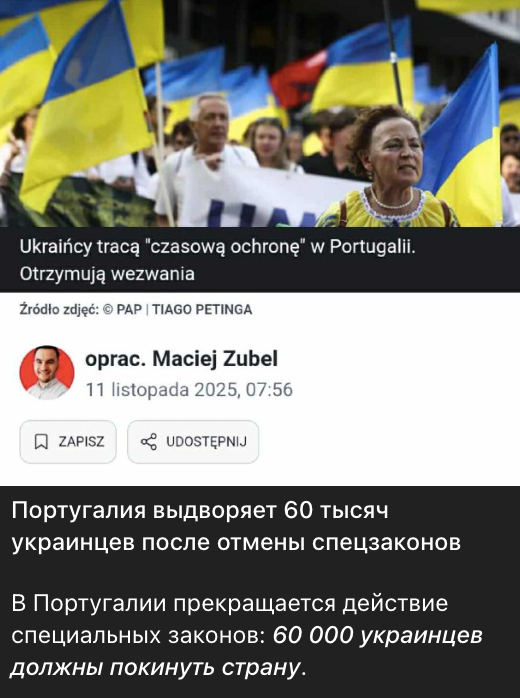
Fake: Portugal Allegedly Plans to Deport 60,000 Ukrainians

Russian propaganda Telegram channels claim that due to changes in Portuguese legislation, Portugal will expel 60,000 Ukrainian refugees. They also allege that 5,000 Belarusians who have political asylum will supposedly be forced to return home. “It seems that European hospitality evaporated exactly at the moment when it had to be paid for,” such posts comment sarcastically.

This fake has been debunked by fact-checkers at StopFake.

However, this story is a fake. In reality, Portugal’s Agency for Integration, Migration and Asylum (AIMA) has launched a review of residence permits (mainly affecting foreign students) in order to comply with European Commission regulations. This process does not lead to automatic deportations; on the contrary, it allows students to switch to alternative legal statuses and remain in the country to continue their studies even after temporary protection ends.

The figure of 60,000 refers to the total number of Ukrainian refugees currently residing in Portugal. The country is not planning mass expulsions, but rather aims to regularize the legal status of migrants after the expiration of the temporary protection period. At present, this protection for Ukrainians in Portugal – like in other EU countries – has been extended until March 2027.

The Portuguese government has indeed amended its legislation, extending temporary protection for Ukrainians until March 4, 2027. This status guarantees the right to reside, work, access healthcare, and receive education, as stated in the original legislation. However, new applications for temporary protection from Ukrainians are no longer being accepted: to enter the country, individuals must now obtain a visa in advance at a Portuguese consulate, as is required for citizens of other countries planning to relocate.

Since the start of Russia’s full-scale aggression, the Kremlin has continuously fabricated falsehoods about the status of Ukrainian refugees abroad. Yet none of these grim predictions about “mass deportations” or the “sudden cancellation of assistance” have come true.

Manipulation: “The European Commission announced that Ukraine will not join the EU”

Such claims were spread by some Russian propaganda media outlets, the Center for Strategic Communications reports.

PHOTO 31

In fact, the European Commission made no such statements. The report dated November 4 gives a positive assessment of Ukraine’s progress, while also noting shortcomings in certain areas.

The report emphasizes that even during the war, Ukraine demonstrates a strong commitment to the European path.

EU Commissioner Marta Kos stressed that Ukraine is among the leaders among candidate countries in terms of the pace of reforms and could potentially complete accession negotiations “in the coming years.”

Deputy Prime Minister Taras Kachka described the document as the highest assessment since 2023 and called Ukraine’s accession to the EU by 2028 a realistic possibility.

Fake: the Czech government is allegedly allocating money to Ukrainian hospitals instead of helping flood victims

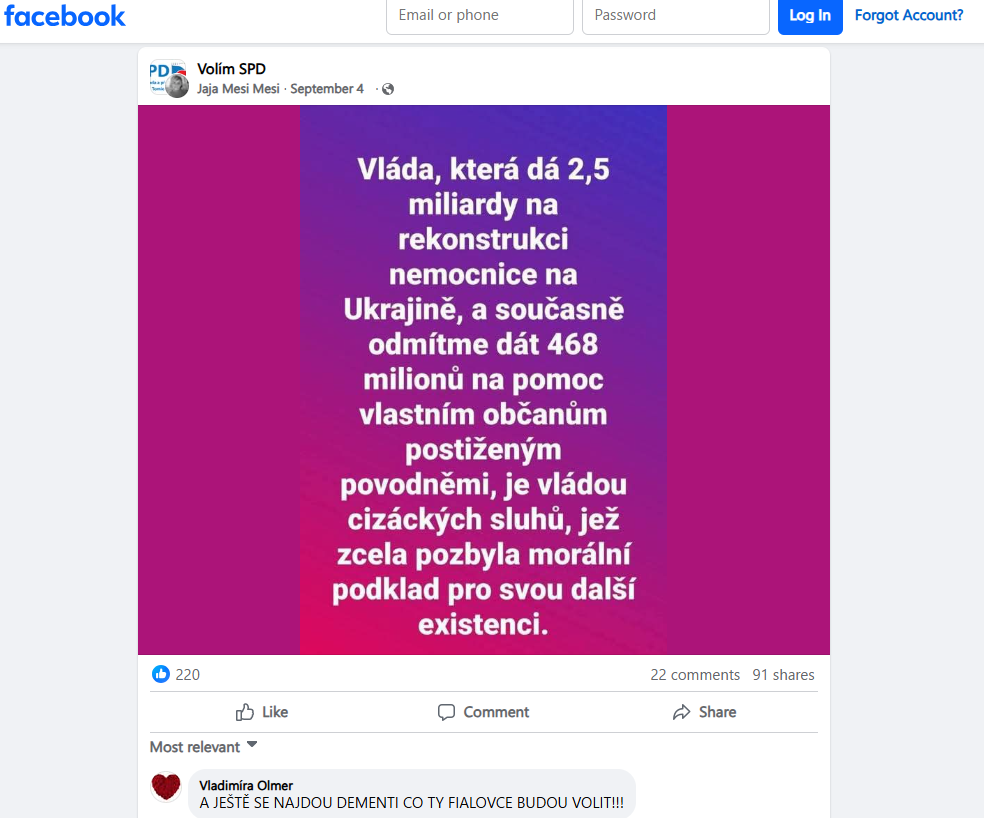
A post is being widely shared in the Czech segment of Facebook claiming that the Czech government spent 2.5 billion korunas on rebuilding Ukrainian hospitals while refusing to allocate 468 million korunas to help its own citizens affected by floods. This claim is misleading: the vast majority of funds for modernizing Ukrainian hospitals come from the European budget, not from the Czech one. As for flood relief, the government did indeed decline to provide direct compensation of 468 million korunas to the Moravian-Silesian Region, but the region immediately received 640 million korunas in subsidies for damage recovery. This disinformation case was analyzed in detail by Czech fact-checkers from Demagog.

A post that is being actively shared on Facebook claims: “The government spent 2.5 billion korunas on rebuilding a hospital in Ukraine but refused to provide 468 million to help its own citizens affected by floods”. The author is clearly referring to the Czech program supporting the modernization of Ukrainian hospitals and to state assistance after the floods in September 2024. Such claims are often used to stir up anti-Ukrainian sentiment, but they ignore key facts.

Facts about the reconstruction of Ukrainian hospitals

In March 2025, the Czech Ministry of Foreign Affairs announced assistance for the modernization of Ukrainian hospitals. The European Commission approved the application, under which Czechia received €88 million (approximately 2.2 billion korunas) from the EU budget. The breakdown of funds is as follows:

  • 1.3 billion korunas – grants;
  • 750 million korunas – guarantees for bank loans;
  • 105 million korunas – technical assistance for hospitals.

Czech investors can also receive loan guarantees. The Czech government contributed only 200 million korunas from the national budget. Thus, the total amount is around 2.5 billion korunas, but the majority consists of EU funds to support Ukraine, not spending from the Czech state budget. About one third of the funds are guarantees that the state would pay only if loans are not repaid. These are not “government expenditures”, as the post claims, but investments in international cooperation.

The author of the fake mentions the refusal to allocate 468 million korunas to the Moravian-Silesian Region as compensation for initial flood-related expenses. However, the post omits a key fact: immediately after the floods, the region received 640 million korunas from the state to cover damages. Of this amount, 1.2 million korunas were even returned to the budget. Thus, assistance reached municipalities and residents through the regional budget, while the state provided a significantly larger sum – 640 million korunas – directly. Overall, the Czech state budget supported flood victims more than Ukrainian hospitals (200 million korunas from national funds).

The claim that “2.5 billion from the Czech government” was spent on Ukrainian hospitals is manipulative. Such fakes are often spread to manipulate public opinion and turn residents of EU countries against Ukraine.

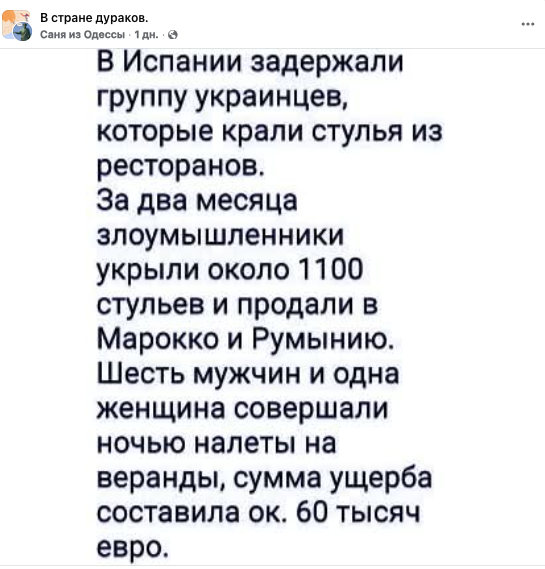
Fake: A gang of Ukrainians in Spain allegedly stole chairs from restaurants

In the pro-Russian segment of the internet, a story is being circulated claiming that a group of Ukrainians was allegedly detained in Spain for attacking restaurants at night, stealing chairs, and selling them. Propagandists present this absurd incident as “proof” that Ukrainian citizens abroad bring only harm to society. This fake was debunked by experts from StopFake.

However, this publication is yet another fabrication by Russian propaganda. While the story about a gang itself is real, no reputable media outlet mentions the nationality of the perpetrators. Spanish police did indeed report that six men and one woman were detained in Madrid as members of a criminal group that, in August and September 2025, stole more than a thousand chairs from 18 restaurants in Madrid and the town of Talavera de la Reina. It is known that the stolen goods were resold in Spain, Romania, and Morocco. In other words, the police made no mention whatsoever of any connection between the gang and Ukraine.

Russian propaganda has repeatedly used real criminal or controversial incidents, inserting Ukrainians into them in order to discredit Ukrainian citizens. For the same purpose, propaganda also spreads entirely fabricated stories.

Earlier, Detector Media debunked a made-up story about the alleged detention of “Ukrainian terrorists” in Jerusalem.

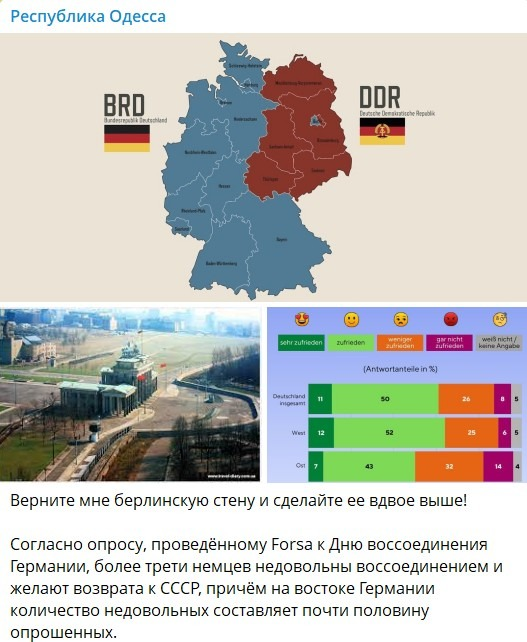
More than a third of surveyed Germans allegedly dream of returning to the USSR – debunking the manipulation

Pro-Russian Telegram channels are actively spreading claims about the alleged results of a sociological survey conducted by the German institute Forsa ahead of German Unity Day. According to these claims, more than a third of Germans are supposedly dissatisfied with the country’s reunification and want the Soviet Union to be restored. However, this is a distortion of the facts.

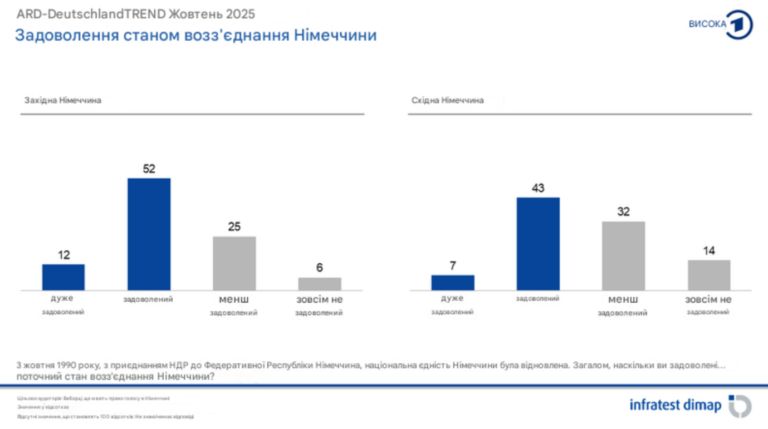
In reality, the published figures were taken from a different survey conducted by Infratest dimap. The Forsa Institute also studied this topic, but none of its polls mentioned any desire to return to the USSR. This manipulation was debunked by experts from VoxCheck.

German Unity Day is a public holiday that commemorates the accession of the German Democratic Republic to the Federal Republic of Germany in 1990. It is celebrated annually on October 3.

The screenshot showing the poll results contains a watermark from the Telegram channel “Satellit”, which is run in German. This channel often produces its own graphic materials based on data from various research organizations. On October 4, the “Satellit” channel did indeed publish an infographic claiming that every third German is dissatisfied with the country’s reunification after the collapse of the “Eastern Bloc”. However, this graphic is not based on a survey by Forsa, but on data from another company, Infratest dimap.

According to the results, out of 1,306 respondents, 64% expressed a high or moderate level of satisfaction with reunification, while 31% said they were less satisfied or not satisfied at all. Importantly, respondents were not asked whether they wanted a return to the Soviet Union.

In addition, on October 2, “Satellit” published material about a similar survey by Forsa dedicated to the 35th anniversary of German reunification. In that poll, respondents were asked whether they believe that the populations of East and West Germany have already merged into a single nation. Of the 1,004 people surveyed, 35% said that East and West have largely become one nation, while 61% noted that factors of division still prevail.

Thus, this study also concerned an assessment of the degree of integration between East and West over the years, rather than support for reunification or any desire to return to the USSR. This is precisely the core of the manipulation spread by pro-Russian Telegram channels.

The EU Remains Russia’s Largest Trading Partner – A Breakdown of the Manipulation

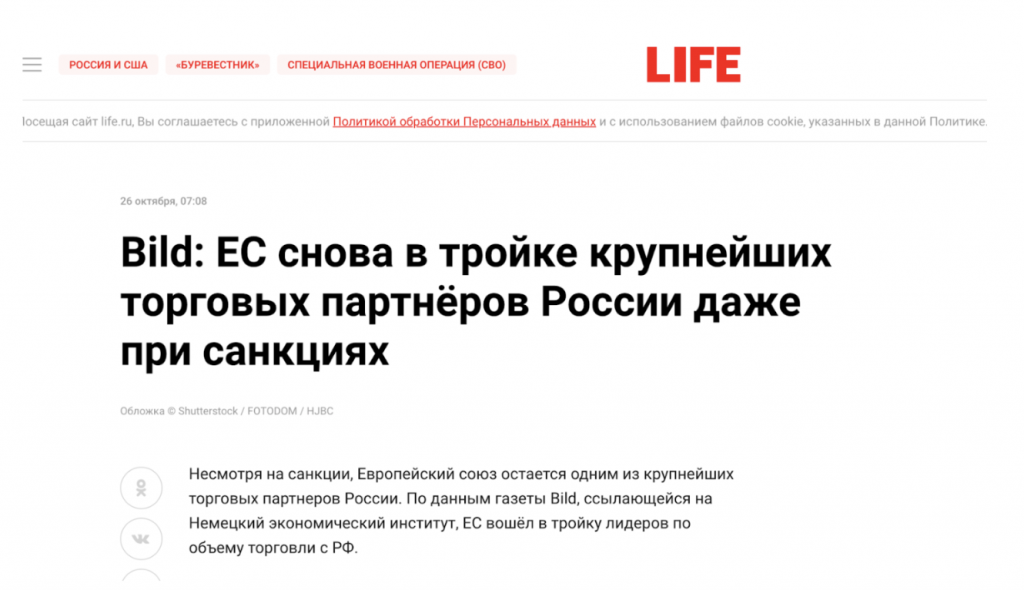
After the European Union approved its 19th package of sanctions aimed at halting the shadow trade in Russian energy resources, Kremlin media circulated a fake claim that Western restrictions “do not work at all”. In particular, Russian outlets, citing the German newspaper Bild, claimed that “despite the sanctions, the EU is still one of Russia’s largest trading partners”. Analysts from the StopFake project drew attention to this manipulation.

In fact, a study by the German Economic Institute (IW) dated June 13, 2025, which Bild refers to in its October 25 article, emphasizes a drastic reduction in trade between the EU and Russia as a result of sanctions. IW analysts note that trade flows have been redirected toward the Global South, while EU–Russia trade has fallen to a very low level.

Key figures that debunk the propaganda:

  • Germany: imports from Russia decreased by 92% compared to 2021.
  • Italy: down 83%.
  • Belgium: down 67%.
  • A sharp decline has also been recorded in Slovakia, the Czech Republic, Spain, and other EU countries.
  • The only exception is Hungary, which remains loyal to the Kremlin: since 2022 it has increased purchases of Russian goods by 31%.

The total trade volume of all 27 EU countries with Russia in 2024 amounted to just €67.5 billion, with the majority accounted for by Hungary. For comparison:

  • China imported Russian goods worth $130 billion.
  • India, which ranked 12th before the war, is now second, with trade increasing by 680% since 2022, mainly due to oil.

IW experts stress that to further undermine the financing of Russia’s war machine, sanctions must target Russia’s shadow fleet, which is increasingly accused of sabotaging Western infrastructure, as well as imports of liquefied natural gas (LNG). Both measures were included in the 19th sanctions package.

What the EU’s 19th sanctions package includes (adopted on October 23, 2025):

  • A full ban on imports of Russian LNG (short-term contracts after six months, long-term contracts from January 1, 2027).
  • Stricter control over oil trade and the shadow fleet.
  • Restrictions on financial operations, including cryptocurrency transactions, for the first time.
  • 117 vessels added to the sanctions list, bringing the total number of shadow fleet ships to 557.
  • Eight areas covered: energy, finance, diplomacy, accountability for the abduction of Ukrainian children, military measures, trade, services, and sanctions against Belarus’s military-industrial complex.
  • Enhanced monitoring of the movement of Russian diplomats within the EU.

More details on all EU restrictions imposed on Russia for its aggression against Ukraine are available in the EU’s information bulletin.

Russian propaganda is lying about the alleged ineffectiveness of EU sanctions.

Russian media cherry-pick a single phrase from Bild (“the EU is among the top three partners”) while ignoring the rest of the conclusion that trade has fallen to a minimum thanks to sanctions. The aim is to convince US and EU governments that sanctions are endless and pointless, so that new packages are blocked and existing ones repealed. The Center for Countering Disinformation under Ukraine’s National Security and Defense Council predicts that in November 2025 Russian propaganda will intensify the narrative that sanctions do not work and Europe is freezing.

Disinformation: the EU’s 19th sanctions package against Russia is allegedly ineffective

Analysts from the EUvsDisinfo project examined the negative reaction of Russian propaganda to the 19th sanctions package and identified a number of manipulative narratives. According to these claims, Moscow is allegedly preparing a “tough response” to the EU’s 19th package of anti-Russian sanctions. Russia also supposedly “firmly condemns any illegitimate unilateral coercive measures”. Propagandists further claimed that even in Brussels there is supposedly no belief in the effectiveness of sanctions pressure on Russia, yet the EU allegedly continues this course with “misguided persistence”, portraying it as increasingly suicidal for the Union itself.

Claims about the alleged illegitimacy of EU sanctions against Russia and assertions that they harm only the EU economy are standard narratives aimed at downplaying their real impact.

The European Union adopted its 19th sanctions package on October 23, 2025. It bans imports of Russian liquefied natural gas, tightens restrictions on Russian oil trade, and closes financial loopholes. The measures include strict restrictions on financial services and infrastructure (for the first time, cryptocurrencies), trade, the services sector, and tools to counter sanctions circumvention. The total number of vessels in Russia’s so-called “shadow fleet” has reached 557.

The package consists of eight blocks: energy, financial restrictions, sanctions against Russian diplomats, accountability for the abduction of Ukrainian children, military measures, trade, services, and sanctions against Belarus’s military machine.

Alongside economic pressure on the Kremlin through sanctions, the EU is strengthening its military, financial, humanitarian, and diplomatic support for Ukraine in resisting Russian aggression.

U.S. and EU sanctions against Russia do not violate international law or regulations – they are a legitimate mechanism. EU sanctions are lawful restrictions under international and European law in response to violations such as Russia’s actions undermining Ukraine’s territorial integrity, sovereignty, and independence.

Propaganda seeks to convince Europeans that sanctions are “suicidal” – allegedly causing higher energy prices and inflation — in order to provoke internal protests and divisions within the EU. For example, fakes about a supposed “energy crisis in Europe” have circulated since 2022 to fuel populist movements (such as in Germany or France) and block new sanctions packages. The goal is to push Brussels to ease pressure ahead of the winter of 2025–2026. The narrative of “ineffectiveness” is also meant to persuade donors (the U.S. and EU) that sanctions are futile and that the war is “endless”.

A fake about the “Nazi-Satanist ancestors” of the President of the European Commission. Again – but even more ridiculous

False claims about the alleged Nazi origins of European Commission President Ursula von der Leyen have once again begun circulating in the Czech information space. Fakes about her supposedly “Nazi ancestors” have been spreading on social media for more than three years, becoming especially active whenever the European Commission consistently supports aid to Ukraine. This time, propagandists have labeled the politician the “granddaughter of Karl Albrecht Hugo Laubero”, a Wehrmacht colonel. This was reported by the Czech outlet Denik.cz.

This time, social media posts depict Ursula von der Leyen next to a young officer in a Nazi uniform, claiming that she comes from a “family of fascists and Satanists”. Such messages are published in both Czech and Slovak and are accompanied by fabricated “evidence”. Previously, disinformers had already assigned the politician another fictional “grandfather” – an officer named Joachim von der Leyen. After that version was exposed as an obvious fabrication, it was replaced with a new character – Laubero.

In reality, none of Ursula von der Leyen’s ancestors had any connection to Nazism. She was born with the surname Albrecht; her father, Ernst Albrecht, was one of the first officials of the European Community, and her grandfather, Karl Eduard Albrecht, was a physician and psychologist. Her great-grandfather, Friedrich Karl Albrecht, was an entrepreneur. None of these individuals were linked to military or Nazi structures. Fact-checkers from AFP, Demagog.cz, and MythDetector reviewed the politician’s family tree using German genealogical archives and confirmed that none of her ancestors were involved with the Nazi regime.

The individuals referenced by disinformers did exist, but they have no connection whatsoever to Ursula von der Leyen or her family. Hugo Laubero served as a Wehrmacht officer during World War II, but he was not related to the politician. Another figure mentioned, Karl Albrecht Oberg, was an SS general who was convicted after the war for crimes against humanity. However, he also has no connection to Ursula von der Leyen’s family or to her husband.

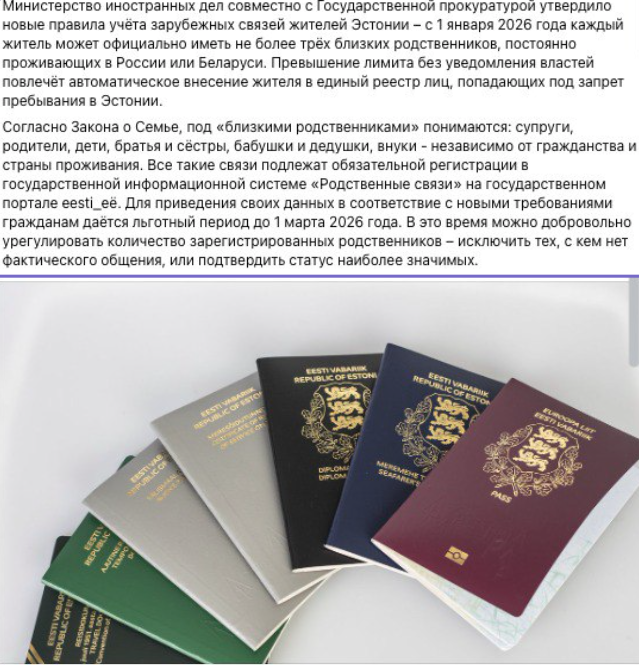
Debunked falsehood: Estonians were allegedly banned from having more than three relatives in Russia

In pro-Russian segments of social media, a fake story is being spread about an alleged new law in Estonia that supposedly obliges citizens to report relatives in Russia or Belarus to the government and bans having more than three such family ties.

Analysts from the StopFake project drew attention to this claim.

In the fake quote, Estonian Foreign Minister Margus Tsahkna is allegedly said to have called this a “national security measure” that balances “humanity” with the “protection of sovereignty based on non-traditional family values”.

This information is not true. No reputable Estonian media outlet or official government resource has reported such an initiative. The original source of the fake is a Telegram post by Gennady Afanasyev, signed as the “Estonian Curiosities Agency ‘Ahead of Events’”. Afanasyev, a resident of Narva, served as the city’s deputy mayor in 1999–2000 and later took part in the activities of pro-Russian organizations such as the Russian Party of Estonia and the European Russian Alliance. Since 2005, he has been banned from entering Latvia due to activities aimed at strengthening Russian influence in the Baltic region.

Today, Afanasyev does not hold any political office but actively maintains a Facebook page where he publishes pro-Russian “satirical” content. His posts often contain barely noticeable satire disclaimers, which leads many Russian-speaking users to perceive them as factual. The Estonian anti-propaganda blog Propastop has previously noted that Afanasyev’s posts are aimed at radicalizing public discourse, promoting anti-Western narratives, and increasing informational pressure on Estonian society, especially ahead of local elections.

Message Ukraine allegedly becoming a burden for the EU

Member of the Federation Council of the Russian Federation, Oleksii Pushkov, spread the claim that Ukraine is turning into a burden for the EU due to refugees and ‘problems’ with gas. However, this is not true.

This was reported by the Center for Strategic Communications and Information Security. Their experts remind that Ukrainian refugees are not an economic challenge for Europe; on the contrary, they contribute to the growth of the labor market. Thanks to temporary protection status, they legally work, having signed 1.87 million contracts in EU countries by October 2023. Their expenses in 2022 alone amounted to $20 billion, which positively impacted the economies of the countries hosting them. As for gas supply, the transit of Russian gas through Ukraine's gas transportation system has stopped, but the EU has adapted to the new conditions, including increasing the import of liquefied natural gas from other sources. No issues with energy resource provision have arisen, which confirms the successful diversification of the European energy market.

Such messages are aimed at creating a rift between Ukraine and its Western allies.

Manipulation EU allegedly harmed by abandoning Russian energy sources

Russian propagandists claim on anonymous Telegram channels that the problem of Russian natural gas exports allegedly remains one of the main issues for the global economy. Supposedly, this was written by Asia Times, and in the corresponding article, experts allegedly state that by providing Ukraine with weapons and supporting anti-Russian sanctions, the EU is making things worse for itself. However, this is manipulation.

The European Union is actively working on diversifying energy supply sources to reduce its dependence on Russian gas. In 2024, the United States became the largest supplier of liquefied natural gas, providing 48% of imports. Ukraine, for its part, ceased the transit of Russian gas through its territory, which was a strategic decision in response to Russian aggression.

At the same time, Europe is developing renewable energy, modernizing nuclear power plants, and optimizing energy consumption. Russia's manipulations with gas supplies, including the sabotage of the Nord Streams, have only accelerated the EU's adaptation to new conditions. Statements about a ‘cold future for Europe’ are part of Russian disinformation aimed at discrediting European unity and resilience. The EU is showing determination in building energy independence and supporting Ukraine as part of its long-term security strategy.

Fake Fake infographics showing which countries Ukraine has been “sold off” to

Russian media is circulating an infographic that allegedly shows how Ukraine's territory has been entirely divided among various foreign companies.

“Everything has a price. The war in the DPR and LPR was, from the start, a war for resources for the West”, the creators of this fake content assert.

However, foreigners do not have access to Ukraine's land market. In 2020-2021, Ukraine passed a package of land reform laws, which included a compromise on granting foreigners access to the land market. This decision, however, requires approval through a nationwide referendum. Conducting such a referendum is impossible during martial law.

As Ukraine strives for EU membership, aligning its land legislation with EU laws represents the third and final stage of the land reform process. This reform aims to allow individuals and legal entities from EU member states to participate in Ukraine's land market, which is expected to benefit landowners the most.

In contrast, the reduction in arable land has been directly caused by Russia's military aggression against Ukraine. For example, the Kherson region, which accounted for 40% of Ukraine's annual vegetable harvest, has been severely impacted. Due to combat operations and the occupation of parts of the region, previously cultivated fields can no longer be used for their intended purpose. As a result, many entrepreneurs have been forced to relocate their businesses.

Thus, the rise in vegetable prices has no connection to Ukraine's pro-European path. Instead, it is a direct consequence of Russia's aggression. Propaganda efforts, however, aim to manipulate Ukrainian aspirations and frame the country’s distancing from Russia as the root cause of all issues, including the ongoing armed aggression.

Manipulation Propagandists manipulated Ursula von der Leyen's words about the EU buying oil from Russia

The pro-Russian segment of the network is spreading information that allegedly the President of the European Commission Ursula von der Leyen said that “the European Union is forced to buy Russian oil so that Putin does not earn more money elsewhere”.  The corresponding statement was made at the opening of the European Political Community summit on November 7, 2024 in Budapest.

However, propagandists distorted her words and changed the context of the statement, writes the StopFake project. First of all, this quote is not from von der Leyen's speech at the Budapest summit, but from an interview with the MSNBC channel more than two years ago. In that interview, the President of the European Commission said that a complete embargo on Russian oil products is not an appropriate option for economically isolating Russia. According to the politician, a sharp end to the EU's purchase of oil from Russia would allow it to sell resources on the world market, then prices would inevitably rise, and this would further replenish Moscow's military budget. She spoke in favor of implementing a strategic and gradual policy of abandoning Russian oil. At the same time, von der Leyen emphasized that the EU plans to get rid of its dependence on Russian minerals and never return to it again.

Also in the same interview, the President of the European Commission announced another package of sanctions against Russia (as of November 2024, 14 of them have already been adopted). The EU is trying to replace Russian minerals with analogues from other countries: recently, von der Leyen announced Europe's plans to buy liquefied natural gas from the United States instead of Russia.

In turn, in Budapest, which was written about by propagandists, von der Leyen only indirectly recalled the victory over the energy crisis caused by the Russian invasion of Ukraine, as an example of the unity and strength of the European community.

Russian propaganda regularly resorts to manipulating the words of Western politicians. For example, they previously analyzed the manipulation, they say, von der Leyen allegedly stated that Ukraine will join the EU in 20-30 years.

Fake Russians write that their wheat will save the EU from starvation

Against the backdrop of the end of the grain harvest, Russian media began to spread information that this season in European countries there is allegedly a catastrophic grain crop failure due to “anti-Russian sanctions”. Propagandists also write that against the backdrop of hunger in Europe, Russia has become the guarantor of food security for the EU.

In fact, Russian propaganda simply manipulates data and spreads disinformation. This is reported in the StopFake project. This year, the world, and Russia in particular, has seen a drop in grain yields. However, this is due to unfavorable weather conditions at the beginning of the sowing season, and not the EU sanctions policy. A very rainy spring and summer caused delays in harvesting and negatively affected wheat growth in Western Europe, while Central and Eastern Europe suffered from a lack of moisture, which also affected grain filling. According to data from the European Commission published at the end of September 2024, due to unfavorable weather conditions, the total volume of grain production in the EU is projected at 269.9 million tons. This is only 3.9% below the average for the past 5 years.

However, in Russia, according to the October report of the US Department of Agriculture, wheat production fell by 10% compared to the previous season. Russian propaganda deliberately does not provide data on Russian grain, taking into account only the decline in yields in European countries, although Russia itself suffered due to weather conditions at the beginning of the year. In the end, the Russians deliberately keep silent about the fact that Russia is not the only one among the three leading grain exporters in the world. The EU and Ukraine are also among the world's largest producers and exporters of agricultural products. They play an important role in the supply of oilseeds and grain crops to the world market.

It should also be noted that Russia steals Ukrainian grain from the occupied territories and sells it. Thus, the British newspaper Financial Times published an investigation back in 2022, where it showed, using the example of one vessel, how Russia trades Ukrainian grain stolen from the territory of the Zaporizhzhia region.

Previously, we analyzed the Russian fake, which claimed that the Ukrainian Armed Forces were deliberately shelling fields in the Kherson region to destroy the harvest.

Message What did Lavrov say at the UN General Assembly this time?

Speaking at the UN General Assembly, Russian Foreign Minister Serhii Lavrov repeated a set of typical Kremlin talking points aimed at discrediting the West, the EU and justifying Russian aggression. His speech was yet another attempt to spread disinformation on the international stage, blaming the West for all the world's problems. The EUvsDisInfo project compiled a selection of the main messages from it.

Lavrov has tried to shift responsibility for Russia’s full-scale invasion of Ukraine to the West, in particular through the myth of “NATO expansion”. This disinformation is a classic example of Russia repeating false claims over and over again in order to make them more believable. The Kremlin claims that the West provokes Russia when independent countries, including Ukraine, exercise their right to choose their own foreign policy and join NATO.

Russia also manipulates the principle of self-determination, claiming that residents of temporarily occupied territories of Ukraine allegedly “chose” to become part of Russia. This claim is used to justify aggression against Ukraine, although in reality Russia violates the rights of Ukrainians and forcibly annexes their territories, particularly in Crimea and the east.

One of Russia’s main tools is to promote the message of a “neo-Nazi regime” in Kyiv that allegedly threatened residents of the occupied territories. Such statements are aimed at justifying aggression and shifting the focus to Russian war crimes committed in Ukraine. This myth is used to discredit Western support for Ukraine and to portray Russia as a “defender” of the supposedly oppressed.

Russia is trying to shift responsibility for its actions to the West, claiming that Ukraine was preparing to attack the east and Crimea with the support of Western countries. In this way, the Kremlin justifies its invasion as a preventive action. Accusations against NATO, the US and the EU are intended to sow mistrust in these countries and split international support for Ukraine. Russia spreads myths about the West’s “neo-colonialist practices” in an attempt to gain support among countries in Africa, Asia and Latin America. Russian disinformation is aimed at creating a false picture of the conflict on the international stage, presenting Russia as a victim of aggressive actions by the West and Ukraine.

Сonspiracy theories How conspiracy theorists explain events in Ukraine and the world: theories against the new composition of the European Commission

Conspiracy theories are an important tool of Russian propaganda, especially when it is necessary to discredit or undermine trust in international organizations such as the European Union (EU). The Center for Countering Disinformation at the National Security and Defense Council explained this using the example of the spread of conspiracy theories regarding the new composition of the European Commission, in particular messages aimed at discrediting EU institutions and their officials.

Russian propaganda actively uses the idea of an “inevitable crisis” as one of the main means of manipulating public opinion. In this case, the main message is that the new composition of the European Commission will allegedly lead to a “deep political and economic crisis in European countries”. Forecasts of such crises without specific facts or evidence are typical of conspiracy theories, since they easily cause fear and anxiety among the audience.

One of the main targets of this disinformation campaign is the new EU Enlargement Commissioner Marta Kos. Propagandists create conspiracy theories about abuses in the accession process of new countries to the EU, which undermines confidence in the EU enlargement process and causes fear among the population of EU member states. Using a specific person as a target is a typical strategy to divert attention from real problems and create an artificial enemy.

Another manipulation is the use of the new European Commissioner for Defense to promote the thesis of the transformation of the EU into a military-political bloc. This element corresponds to a typical conspiracy theory template, when changes in organizations are interpreted as part of a large and hidden plan that is aggressive or hostile in nature. In this way, Russian propaganda spreads fears among Europeans about a possible direct military conflict between the EU and Russia.

Another key element of propaganda is the manipulation of the topic of budgetary flows distribution in the EU. This is done to undermine trust between EU member states by speculating on issues of fairness and honesty of resource distribution. This approach contributes to the growth of tensions and conflicts within the European Union.

The main goal of the campaign is to provoke internal divisions within the EU. This is done by discrediting European institutions through the dissemination of conspiracy theories that question the legitimacy and fairness of EU processes. Russian propaganda also tries to hinder support for Ukraine’s struggle for independence and economic stability by weakening international ties through disinformation.

Conspiracy theories used by Russian propagandists are a complex mixture of catastrophic predictions, manipulation of facts and intimidation aimed at weakening European unity. These methods help Russia not only to spread disinformation, but also to create mistrust in the processes of integration and cooperation between European countries, which in the long term could have a destructive impact on the EU and its policy towards Ukraine.

Manipulation Ukrainian refugees will allegedly be forced out of the EU and sent to war

Pro-Russian telegram channels are spreading information that Ukrainians will be forced out of the countries of the European Union and sent to fight. In reporting this, propagandists refer to an allegedly corresponding statement by Polish Foreign Minister Radosław Sikorski on the air of the Polish radio RMF24.

In fact, Sikorsky's words were manipulated. He stated that conversations about the extradition to Ukraine of those evading their duty to serve are being conducted at the level of the European Union. Thus, it is not about all Ukrainian refugees, but about men of military age who are evading military service. In addition, no decision has been made on them, at least not yet, because this issue is still debatable.

The Polish Foreign Minister also stated that “it is possible to set such conditions for the stay of Ukrainians in the EU that will encourage them to fulfill their responsibilities to protect the Motherland”. However, it was not said here that all Ukrainian refugees would be sent to war as Sikorski spoke exclusively about men liable for military service.

With this stuffing, propagandists seek to fuel the narrative about the alleged “war until the last Ukrainian”. Previously, we analyzed such fakes and manipulations. For example, they recorded lies about the alleged mobilization of all childless Ukrainian women and about the alleged call for entire families to mobilize into the ranks of the Armed Forces of Ukraine.

Manipulation Stoltenberg allegedly said that no one gave guarantees for Ukraine to join NATO, and also that China is the organizer of the war between Russia and Ukraine.

On the eve of the NATO summit in Washington, pro-Kremlin media disseminated an alleged statement by Alliance Secretary General Jens Stoltenberg, who said that “no one gave guarantees for Ukraine’s entry into NATO”. The Secretary General also allegedly called China the main organizer of Russia’s war in Ukraine. Propagandists claimed that Stoltenberg’s statements were allegedly made in an interview he recently gave to the American television channel CBS.

However, in fact, Stoltenberg’s words were manipulated, distorting the context of what was said,  the StopFake project wrote.

As for the accusations of the alleged lack of promises to admit Ukraine to NATO, it is important to understand the context. Stoltenberg actually answered the journalist’s question: “Why such a long period for Ukraine’s accession, you talked about a 10-year period, why exactly 10 years, and not one, two or three years, because they were faced with war?” To which the Secretary General said: “Well, no one talked about 10 years, but it is obvious that this is a very serious issue for Ukraine. Because Ukraine is in a state of war. Ukraine was attacked by Russia. Therefore, the most important thing we must do is strengthen our support for Ukraine to ensure its victory. This is a precondition for any future membership of Ukraine”. That is, Stoltenberg did not say anything about the absence of guarantees for Ukraine to join NATO; the statement was invented by propagandists. He spoke about the absence of a clear time frame for Ukraine’s entry into the alliance, and that now the support of Ukraine in the war with Russia is more important.

As for China, Stoltenberg called the country “the main enabler of Russia’s war in Ukraine”, rather than its organizer: “The war in Ukraine demonstrates how closely connected Russia and China, North Korea and Iran are. China is the main leader of Russian military aggression against Ukraine. President Xi and President Putin all want NATO and the United States to fail in Ukraine”.

Russia is trying to counteract Ukraine's Euro-Atlantic integration by spreading disinformation about Ukraine's accession to NATO. As for China, by manipulating information, Russian propaganda seeks to antagonize NATO and Beijing for its own benefit.

Manipulation Denmark allegedly refused to train Ukrainian pilots on the F-16 due to “their inability to learn”

Propagandists are spreading a “news” story on social networks, which claims that Denmark allegedly refused to train Ukrainian pilots on F-16 aircraft due to their “learning disabilities”. The 42-second video is edited in the format of a news story with the channel name NewsFlash and the caption “Planes don’t fly”. At the top of the video it says live, which should indicate a live broadcast. However, this is manipulation.

StopFake project specialists tried to determine whether the NewsFlash news channel really exists. Several accounts with this name were found on YouTube, but none of them distributed this video. The earliest version of this story can be found on the Moscow Never Lies YouTube channel dated June 25, 2024. The page notes that this is “Russian satirical news No. 1 from Dmytro Medviediev and Pieskov on Telegram!” There are also numerous videos labeled “NewsFlash”. Although the video was likely originated by a satirical channel, the story was widely disseminated among pro-Russian Telegram channels, X (formerly Twitter) and Facebook users.

Analysis of the plot showed that it consists of different videos. For example, for a comment allegedly belonging to a NATO general, declaring the degree of “training” of the Ukrainian military, a video was used by the Ukrainian Mission to NATO, published on May 1, 2024 on its official Facebook page. The video shows a Ukrainian military pilot nicknamed “Moonfish”. The soldier is currently training on the F-16 in the UK.

Also featured in the fake video is General Jan Dam, commander of the Royal Danish Air Force, allegedly declaring the “fall” of all F-16 aircraft in the simulator. In the real video from which this fragment is taken, the Danish general talks about the advantages of the F-16 for Ukraine.

It is the statement that Denmark refused to train Ukrainian pilots on the F-16 due to their “inability to learn” that is not true. On June 24, Danish Defense Minister Trols Lund Poulsen, during a joint press conference with his Norwegian counterpart Bern Arild Gramm, said that by the end of 2024 Denmark would stop training Ukrainian pilots on F-16 aircraft. However, the training is being stopped due to Denmark's transition to more modern F-35 fighters, which will use Skrydstrup Air Base, where Ukrainian pilots are trained. The Danish Minister of Defense also noted that the country will be able to facilitate the training of Ukrainian pilots in other countries.

Propagandists spread such manipulations to discredit the Armed Forces of Ukraine and stop the supply of weapons from Ukraine’s allies. They say that the Ukrainian military is not capable of controlling Western weapons, which means there is no point in transferring them.

Fake EU allegedly stops funding for Rail Baltica due to excessive spending on aid to Ukraine

Russian propagandists are disseminating information about the termination of funding for the Rail Baltica project by the European Union. They sarcastically suggest that the EU ask Ukrainian President Volodymyr Zelenskyi for money, arguing that the EU is refusing to finance the project and is demanding the return of invested funds due to excessive assistance to Ukraine. However, this is fake.

Rail Baltica is a railway transport infrastructure project aimed at integrating the Baltic countries into the European railway network. Financial assistance and funding for this project are not related to each other. Rail Baltica's funding source is the Connecting Europe Facility, which supports the development of trans-European networks in the fields of transport, energy and digital services.

In reality, the EU does not stop funding. The current funding period will end in 2027, and the next one will begin in 2028. Therefore, the Baltic countries face two challenges: 1 year without EU funding and the unknown amount that will be allocated in the next funding period. The EU recommends that the Baltic countries seek additional sources of funding, but this does not preclude continuing to allocate funds for the project.

The idea of building Rail Baltica was put forward back in 1991. However, Russian propagandists claim that building the infrastructure became necessary after the closure of communications with Russia, which made the Baltic railways unprofitable. Another reason for the parasitism of Russian propaganda is the increase in the estimated cost of the project by four times and the extension of the construction period until 2030. This is precisely the reason for the cessation of EU funding for Rail Baltica.

Russian propagandists are spreading fake news about Rail Baltica for several reasons. Firstly, it helps them support the idea that reduced ties with Russia are harmful to Europe. Secondly, it contributes to the creation of an image of Ukraine as a problem for the EU. They say that by helping her, the Union neglects its own interests. Third, such propaganda creates the impression that the EU's priority goal is to dominate Russia and, accordingly, it demonizes the EU.

Manipulation More than 80% of candidates for members of the European Parliament allegedly do not want to accept Ukraine into the EU

Russian media are disseminating information with reference to the Finnish news service Yle that the overwhelming majority of candidates for members of the European Parliament do not agree to accept Ukraine into the European Union.

“MEPs do not want to see Ukraine in the European Union, but they promised, as well as Moldova”, some netizens comment on the news.

On June 2, the Finnish news service Yle published the results of its survey, which it conducted in the run-up to the European Parliament elections. However, the data distributed online is significantly distorted.

This study does not say that the vast majority of candidates for the European Parliament do not agree to accept Ukraine into the European Union. In fact, the survey concerned the conditions under which Ukraine should gain membership in the European Union. Thus, according to a Yle survey, more than 80% of candidates for the European Parliament believe that Ukraine should not be admitted to the EU without meeting all conditions - that is, the question is not about whether it is worth admitting Ukraine into the union at all, but about whether it is necessary to provide Kyiv with exclusive conditions for EU membership

Fake Ukraine allegedly sold more land to foreign companies than it lost

European Parliament member Mick Wallace expressed disappointment that, in his opinion, Europeans in Ukraine bought more land than Russian troops captured in the east of the country. He accused the West of turning Ukraine into a colony, pointing to reform of land laws that allowed foreigners to purchase agricultural land. His statement was quickly picked up by the Russians. However, the facts show that the information is false.

Specialists from the StopFake project drew attention to this fake. They note that the Law on the Land Market in Ukraine was adopted by the Verkhovna Rada on March 31, 2020, but according to it, foreigners do not have the right to buy agricultural land. This is confirmed by Serhii Datsiv, senior lawyer at Integrites. He noted that the lifting of restrictions could become the subject of an all-Ukrainian referendum. It is now impossible to predict when this will happen due to the martial law in the country.

During the two years of operation of the land market from July 1, 2021 to July 1, 2023, Ukraine sold only 1% of agricultural land that was previously under a moratorium on sales. According to the Geodetic Service of Ukraine, as of May 2024, 307,966 land plots with a total area of 677,982 hectares were sold.

Propagandists spread such fakes to discredit Ukraine among Western partners and create distrust of the government’s actions among Ukrainians. They say that there is almost no country left because all its land was sold off.

Fake The British are allegedly frightened by the threat of a Russian invasion and have emptied supermarket shelves

Propagandists spread information in the media that ordinary Britons are allegedly frightened by the threat of a Russian invasion and therefore stock up, emptying supermarket shelves. They say that the British government has begun to prepare the population for possible emergencies by launching an information campaign. Deputy Prime Minister Oliver Dowden launched the government's disaster preparedness website, listing 100 possible threats, including a “full-scale Russian invasion” and disruption of transport links by drones. The Daily Mail claims that calls for an anti-crisis kit have allegedly caused panic among the British. However, this is fake.

The Insider specialists drew attention to it. They found that on May 22, the government website launched a Get prepared for emergencies page with tips on evacuating, storing important phone numbers and things you should have at home: a flashlight, a portable charger, a radio, first aid kit, hand sanitizer, water and canned food. Deputy Prime Minister Oliver Dowden spoke at the London Security Conference, where he outlined the government's approach to emergency preparedness. He referred to the National Risk Register, which contains possible threats to UK residents, including natural disasters, man-made accidents, terrorist attacks and military threats. There are no reports of panic buying of goods from the government list in the British media. The Daily Mail only urged shoppers not to repeat the panic buying that took place during the COVID-19 pandemic.

Propagandists spread such fake news to discredit foreigners and cause unnecessary panic among Europeans.

Manipulation Scholz allegedly said that Ukraine may not join NATO in the next 30 years

Russian propagandists claim that German Chancellor Olaf Scholz allegedly said that Ukraine may not become a NATO member in the next 30 years. “You know the solution, this will not happen in the near future. Perhaps not even in the next 30 years”, Scholz said during a meeting with Berlin residents. However, this is manipulation.

Specialists from the StopFake project drew attention to it. They found that in fact Scholz noted at this meeting in Berlin that before the full-scale invasion, discussing Ukraine's entry into NATO, he assured Putin: “This is not being considered for the next 30 years”. Scholz also accused Putin of attacking Ukraine for “absolutely absurd” reasons, since “NATO has never posed a threat to Russia”.

After the old quote was again picked up by Russian propaganda, the German government commented on the information being disseminated. According to government spokesman Steffen Gebestreit, the situation “has completely changed, and therefore, no, 30 years are no longer relevant”.

During the decade of war in Ukraine, Russian propaganda regularly spread manipulations and fake news that Ukraine would not be accepted into NATO or the EU. Thus, they want to cause skepticism and panic among Ukrainians regarding the actions of their Western partners.

Fake Children of Ukrainian refugees are allegedly taken away by Lithuanian guardianship authorities for “washing dishes”

Propagandists are distributing a video on social networks in which police allegedly forcibly take a child from his parents. In addition, there were reports that it supposedly depicts a Ukrainian family of refugees in Lithuania, and the police are taking away the children due to “improper upbringing”. “It is known that such cases occur not only with Ukrainians, but also with Belarusian families who seek asylum in the countries of the European Union”, the publications note. Propagandists also claim that in the Baltic countries, justice authorities “remove children from their families for washing dishes or caring for younger brothers and sisters”. However, this is not true.

Specialists from the StopFake project drew attention to this case. They discovered information from the Lithuanian news portal Lrytas.lt that the incident in the video occurred in September 2023. The child's parents divorced and the court ruled that the child should live with his father. Despite this decision, the mother and child went into hiding, forcing social security authorities to intervene with the help of the police. The director of the State Service for the Protection of Child Rights and Adoption, Ilma Skuodene, in a comment for lrytas.lt, said that the video recorded a particularly difficult process that social workers have to carry out.

Although the procedure was legal, the actions of social services and the police attracted criticism. Lithuanian President Gitanas Nauseda noted that social services lack a “sincere, non-bureaucratic approach to child care”. In his post on Facebook, he emphasized that the actions of the services should not traumatize the child, but should ensure his interests. Later, the Office of the Ombudsman for Children's Rights found that the social workers who separated the child from his mother in Palanga acted inappropriately and unprofessionally, which could have resulted in negative experiences, stress and fear.

Propagandists spread such fakes to discredit Ukraine’s Western partners and Ukrainian refugees, as well as to cause panic.