Spilnota Detector Media

The Murder of a Schoolgirl in Poland Triggered a Wave of Anti-Ukrainian Disinformation

A tragedy at a school in the city of Jelenia Góra, where the body of an 11-year-old girl was found, became a trigger for a large-scale wave of anti-Ukrainian content on Polish social media. Immediately after reports of the murder emerged, a flood of posts appeared claiming that the alleged perpetrator was of Ukrainian origin. However, the facts and official statements compiled by fact-checkers at Demagog point to the opposite conclusion: this was a deliberate disinformation campaign.
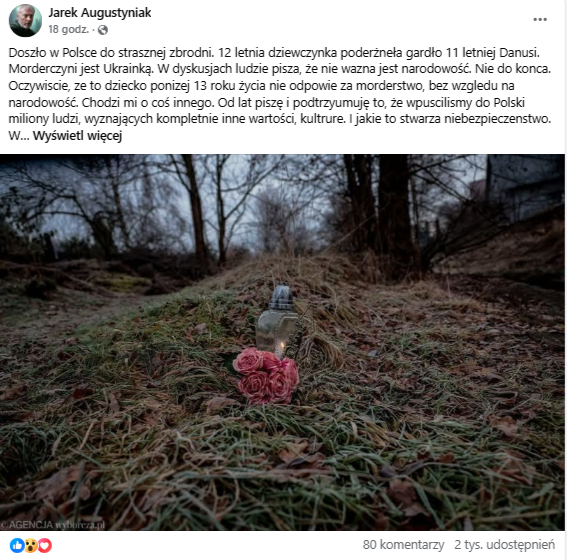
On 15 December, the body of a teenager showing signs of a violent death was discovered in Jelenia Góra. The following day, law enforcement officers detained a suspect, who turned out to be the victim’s 12-year-old classmate.

While the police were carrying out investigative procedures, posts began spreading widely across Facebook, X (Twitter), and TikTok featuring rhetorical questions such as: “Guess what nationality she is?” Before long, the speculation evolved into direct accusations. Users started circulating the false claim that the alleged killer was Ukrainian. One TikTok video posted by blogger Marcin Bugaj, which alleged that the girl’s “true origin” was being concealed, received more than 50,000 views before it was eventually removed.

Official Police Response

In an effort to stop the spread of hate speech, analysts from the Demagog portal requested an official clarification from the Municipal Police Headquarters in Jelenia Góra. Deputy Commissioner Beata Sosulska-Barań unequivocally refuted the rumors: “I confirm that the detained individual is a Polish citizen and of Polish nationality.”

There is no evidence whatsoever linking Ukrainian citizens to this crime.

Karolina Gałecka, spokesperson for Poland’s Ministry of the Interior, also denied claims that the detained 12-year-old girl was Ukrainian. She stated that the spread of such nonsense constitutes deliberate disinformation aimed at inciting hostility between Poland and Ukraine. Her statement was also reposted by Poland’s Minister-Coordinator of Special Services, Tomasz Siemoniak.

Why This Matters

This case is a classic example of exploiting emotions. The murder of a child naturally provokes intense anger and grief, which disinformation actors then seek to direct against a specific group of people – in this case, Ukrainian refugees.

Comments beneath the fake posts quickly filled with xenophobic statements about “Banderite upbringing” and a supposed “genetic predisposition to crime”. This demonstrates that the purpose of such disinformation campaigns is to incite interethnic hostility and destabilize society.

The Broader Context of Anti-Ukrainian Disinformation

According to the latest monitoring reports, the volume of anti-Ukrainian disinformation in Poland continues to rise. Between August and November 2025 alone, more than 186,000 such posts were recorded – nearly twice as many as in previous reporting periods.

The tragedy in Jelenia Góra once again demonstrated that disinformation has no moral boundaries. Those who spread false narratives are willing to exploit even the death of a child for political or other manipulative purposes.
Manipulating Fears: Who Is Spreading Anti-Ukrainian Narratives in Poland and Why

Poland is currently hosting around one million Ukrainian refugees, most of them women and children. However, public attitudes have shifted since the start of Russia’s full-scale invasion. According to the Public Opinion Research Center (CBOS), 51 percent of Poles held positive views of Ukrainians in 2022, whereas by early 2025 this figure had fallen to 30 percent, while negative opinions had risen to 38 percent. Anti-Ukrainian narratives seek to exploit genuine socio-economic concerns in order to deepen divisions, which is a common feature of information operations linked to Russia.

After Karol Nawrocki vetoed amendments to the law on assistance for Ukrainian citizens in Poland, claims began circulating online that Ukrainians were allegedly living at the expense of the Polish state and giving nothing in return. These messages portrayed refugees as “dependents” who abuse social welfare programmes and drain the national budget. The rhetoric was often dehumanizing and framed Ukrainians in opposition to Polish citizens.

The facts tell a different story. According to the United Nations High Commissioner for Refugees (UNHCR), 78 percent of Ukrainians in Poland are employed, and in 2024 their work and consumption contributed 2.7 percent to the country’s GDP growth. In the same year, Ukrainians paid 15.2 billion zlotys into the Polish budget, while receiving 2.8 billion zlotys in benefits through the “Family 800+” programme. Nevertheless, false claims portraying Ukrainians as “parasites” continue to spread widely.

An even stronger surge of hostile narratives followed the incident involving Russian drones in September. The information space was flooded with accusations that Ukraine was allegedly trying to drag Poland and NATO into a war with Russia. Some posts described the incident as a “Ukrainian provocation” or a “false flag operation,” completely ignoring Russia’s role.

Analysts at DFRLab examined more than 400,000 posts, comments, and videos on Facebook, YouTube, and TikTok and identified signs of coordinated behavior. Small networks of accounts, often operating under non-political page names, simultaneously published identical content, indicating platform manipulation. Certain clickbait websites and their associated social media pages monetized traffic by spreading anti-Ukrainian content.

The research also found that some anti-Ukrainian narratives are promoted under the guise of “spiritual” or conspiracy-focused communities, as well as through AI-generated videos. Such materials are often distributed in non-political groups, making them more difficult to detect and moderate.

66.4 million contacts and Russian propaganda from national politicians: Polish fact-checkers on the rise of disinformation about Ukrainians on social media

The Polish fact-checking community Demagog, together with the Institute of Media Monitoring (IMM), has published its ninth report on the scale of anti-Ukrainian propaganda and disinformation in the Polish-language segment of the internet. Covering the period from August to November 2025, the report recorded a significant increase in negative content, coinciding with Russia’s broader destabilization objectives.

According to the analysis by Demagog and IMM, 185,766 posts containing negative content and derogatory references to Ukraine and Ukrainians were published on X, Facebook, Instagram, and YouTube during the four-month period from August to November 2025.

This represents an increase of nearly 98% compared with the previous reporting period (April-July 2025).

IMM estimates that social media users may have been exposed to this harmful content 66.4 million times, marking a 104% increase.

The overwhelming majority of anti-Ukrainian posts (92.5% of all analyzed content and 60.8% of total reach) originated on the X platform.

Among the social media users publishing hostile content about Ukrainians were accounts belonging to politicians, including Janusz Korwin-Mikke, Grzegorz Braun, Włodzimierz Skalik, Konrad Berkowicz, as well as the political parties KORWiN and Confederation of the Polish Crown.

The largest spikes in negative content were recorded following:

  1. President Karol Nawrocki’s veto of legislation concerning assistance to Ukrainian citizens, during which he claimed that Ukrainian refugees allegedly enjoyed a “privileged position”. 
  2. Russian provocations, including violations of Polish airspace by Russian drones on the night of 9-10 September and acts of sabotage on the railway line between Warsaw and Lublin. 

Fact-checkers note that, regardless of the individual intentions of particular authors, their actions “align with Russia’s objectives,” namely the effort to cut Ukraine off from Western support.

The most common themes and techniques used by propagandists and politicians include:

  • Discrediting the Ukrainian government: Fake stories about alleged corruption (such as claims that President Zelenskyy purchased a hotel or a ranch) and criticism related to the causes of power outages. 
  • “Banderisation” and Volhynia: Reviving historical conflicts to incite hatred. Even neutral symbols or events, such as an incident involving red-and-black symbolism at a concert or an exhibition at a modern art museum, are portrayed as evidence of a supposed “Banderite threat”. 
  • The “Ukrainianisation” of Poland: Creating panic about the presence of Ukrainians and accusing them of allegedly taking over government institutions, schools, or territory. 
  • False accusations of crimes: Promoting claims that railway sabotage or fires in Warsaw were committed by “Ukrainian terrorists”, while ignoring official findings linking the perpetrators to Russian intelligence services. 
  • Alleged “privileged treatment”: Fueling fears that Ukrainians are “burdening” the healthcare system and receiving benefits “at the expense of Poles”. 

Manipulation regarding changes to the rules for crossing the border between Ukraine and Poland

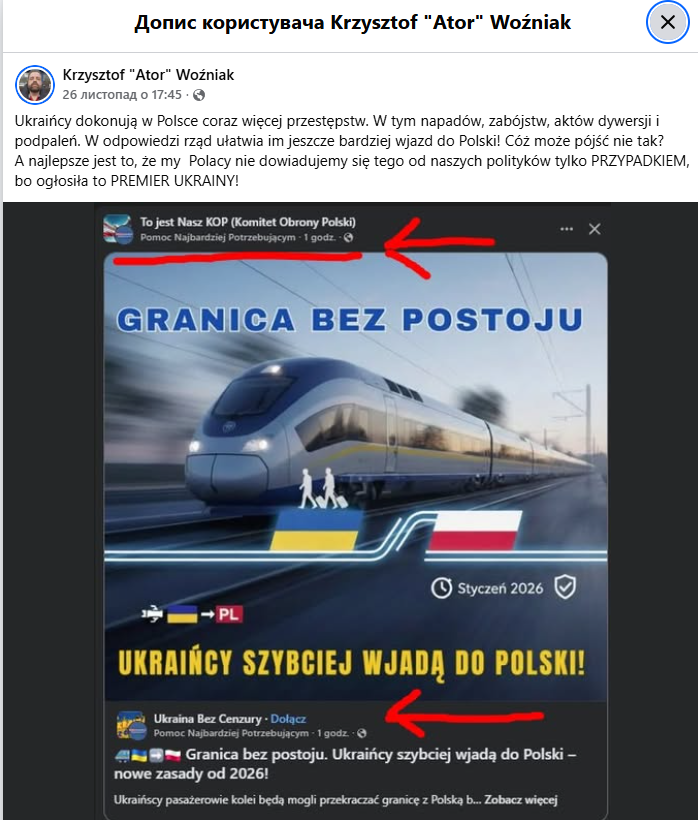
False information is circulating in the Polish segment of social media claiming that the Polish government has supposedly “secretly” decided to abolish border checks for trains arriving from Ukraine, thereby making it easier for Ukrainian citizens to enter the country. These claims are misleading.

The changes in question concern only the organization of border and customs procedures on the Ukrainian side of the border. On the Polish side, all border control procedures remain completely unchanged. The manipulation was analyzed by fact-checkers from Demagog.

Facebook screenshot. Source: Demagog

In posts that gained significant traction, particularly through content shared by Krzysztof Woźniak, it was claimed that the Polish government was “further simplifying” entry procedures for Ukrainians while concealing this information from its own citizens. As supposed evidence, the posts cited a news report stating that “Ukrainians will enter Poland more quickly”, referring to a statement by the Ukrainian prime minister. The author of the false claim linked this alleged simplification to concerns about rising crime among Ukrainians in Poland.

The popular post received more than 2,500 reactions and around 1,000 shares. Among the hundreds of comments, negative remarks about the Polish authorities predominated, including statements such as: “Why haven’t Poles taken to the streets and overthrown the Law and Justice party yet?”, “Oh God, I’m going crazy. Instead of closing the border, they’re making it even easier to cross. A scandal. This anti-Polish government is destroying our country”, “Keep voting for the smiling ones”, and “The government should resign”.

No changes on the Polish side

On 26 November, Yuliia Svyrydenko published a message on Telegram stating that border and customs controls on the Kyiv-Przemyśl and Kyiv-Chełm railway routes would be conducted while the train was in motion rather than during stops near the border. At the end of the post, she thanked Ukraine’s Ministry of Development, Ukrzaliznytsia, and the State Border Guard Service of Ukraine for their coordination. Notably, no Polish institutions were mentioned.

To clarify the situation, fact-checkers from Demagog contacted Poland’s Ministry of the Interior and Administration of Poland and the Polish Border Guard to ask whether the announced changes also applied to the Polish side. Both institutions confirmed that no changes had been introduced to the procedures for checking passengers arriving by train from Ukraine.

In a comment provided to Demagog on 8 December 2025, the Department of Social Communication of the Ministry of the Interior and Administration stated:

“All persons entering our territory by train from Ukraine undergo full border and customs control. Their identities are verified on the basis of travel documents and checked against relevant databases. The National Revenue Administration (KAS) also carries out its own customs procedures”.

The Polish Border Guard likewise confirmed that the Polish side has not abandoned the inspections conducted when trains stop at the border.

Conclusion

The claim that Poland is supposedly “secretly” making it easier for Ukrainians to enter the country by abolishing railway border controls is false. The changes concern only the internal organization of control procedures on the Ukrainian side. No changes have been introduced to Poland’s border-crossing rules, and passengers continue to undergo full border and customs checks during stops on Polish territory.

Wave of anti-Ukrainian disinformation in Poland about “contaminated food from Ukraine”

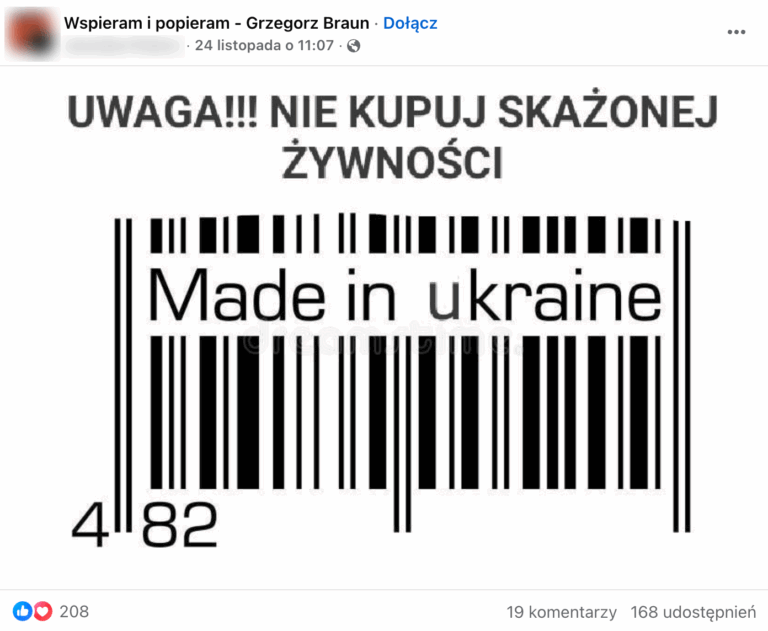
A new wave of anti-Ukrainian disinformation has emerged in Poland. In particular, posts circulating on Facebook claim that all Ukrainian food is supposedly “contaminated” and should therefore be avoided. The authors of these messages also call for a boycott of Ukrainian products. Behind these posts lies a persistent narrative that goods from Ukraine are allegedly “unsafe”.

РИС 14

Facebook post screenshot. Source: Demagog,  

However, as explained by the Center for Countering Disinformation and experts from the fact-checking platform Demagog, this is a fake. The first two or three digits of a barcode identify the country or economic region in which the manufacturer is registered. Therefore, the number does not indicate the product’s place of origin. The 482 barcode prefix simply means that the product is registered in Ukraine and does not in itself signify any “danger” or “contamination”. Under Poland’s legislation on the commercial quality of agricultural and food products, imported goods are subject to sanitary inspections and must meet specific requirements.

Analysts also point out that such fakes are often based on isolated incidents in which particular batches of food products (not necessarily from Ukraine) failed quality inspections. Propagandists then generalize these cases to create the false impression that all Ukrainian products are harmful.

The disinformation campaign in Polish social media surrounding the “482 code” is part of a broader anti-Ukrainian effort aimed at undermining trust between Ukrainians and Poles and influencing political decisions by the Polish authorities regarding support for Ukraine.

Fact-checkers investigated waves of Russian propaganda aimed at undermining relations between Ukraine and Poland

The Kremlin’s strategic objective is to implement a classic “divide and rule” approach by driving a wedge between Poles and Ukrainians and preventing the emergence of an effective Polish-Ukrainian alliance as a partnership of regional leaders. Analysts at StopFake examined the methods used by Russian propagandists to undermine cooperation between Ukraine and Poland.

According to StopFake, the Ukrainian-Polish partnership poses a direct threat to Russia’s imperial ambitions of subjugating Ukraine and expanding its influence in Central and Eastern Europe, a region Moscow continues to view as its “buffer zone”.

In the Ukrainian information space, relations with Poland have gone through several emotionally charged “information waves”. The positive wave of genuine Polish support following Russia’s full-scale invasion was later replaced by negative narratives surrounding Polish farmers’ blockade of Ukrainian grain transit and the use of the Volyn issue in Polish political debates. Currently, a fourth wave of negative messaging dominates the discourse, fueled by incidents involving falling drones and acts of railway sabotage. Russian propaganda, primarily disseminated through Telegram, actively employs tactics such as denying established facts, shifting blame onto Ukraine by accusing it of provocations aimed at “dragging NATO into the war”, and manipulating the Alliance’s cautious public statements.

In the Polish information space, Russia has only intensified the influence operations it has been conducting since 2022 to weaken the strategic partnership between the two countries. Anti-Ukrainian propaganda has largely migrated to social media and new media platforms, where posts on X achieve the widest reach. These campaigns rely both on historical stereotypes portraying Ukrainians as “Banderites” and on memories of the Volyn tragedy, while also promoting new narratives designed to exploit public anxieties. Among them are claims about the “Ukrainianisation of Poland”, alleged “privileges for Ukrainians”, accusations of Ukrainian “ingratitude”, and arguments that “this is not our war”. Such narratives are often amplified by Eurosceptic politicians and pro-Russian public figures.

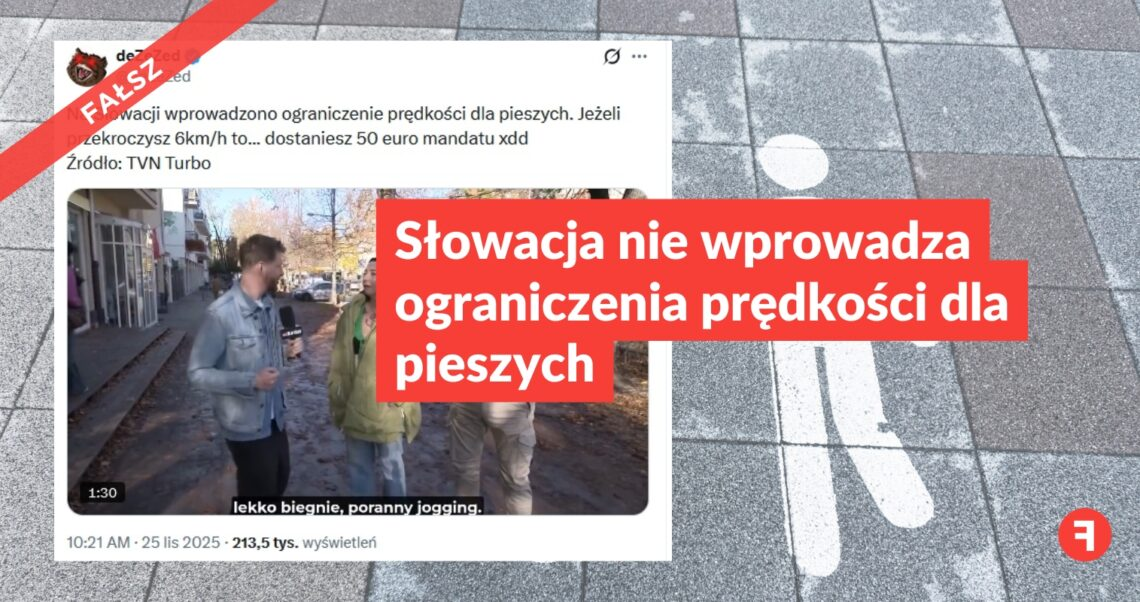
Polish media spread misleading reports about speed limits for pedestrians in Slovakia

Fact-checkers from FakeNews.pl debunked inaccurate claims that had spread in Polish media about Slovakia allegedly introducing fines for pedestrians exceeding speed limits.

Source: FakeNews.pl

The fact-checkers explained that the misinformation stemmed from a misinterpretation of amendments to Slovakia’s Road Traffic Act that came into force on 28 October 2025.

The amendment does indeed define “walking speed” as “a speed not exceeding 6 km/h”. However, this definition was introduced not to regulate pedestrians, but to establish speed limits for other road users travelling on sidewalks, such as people using roller skates or scooters.

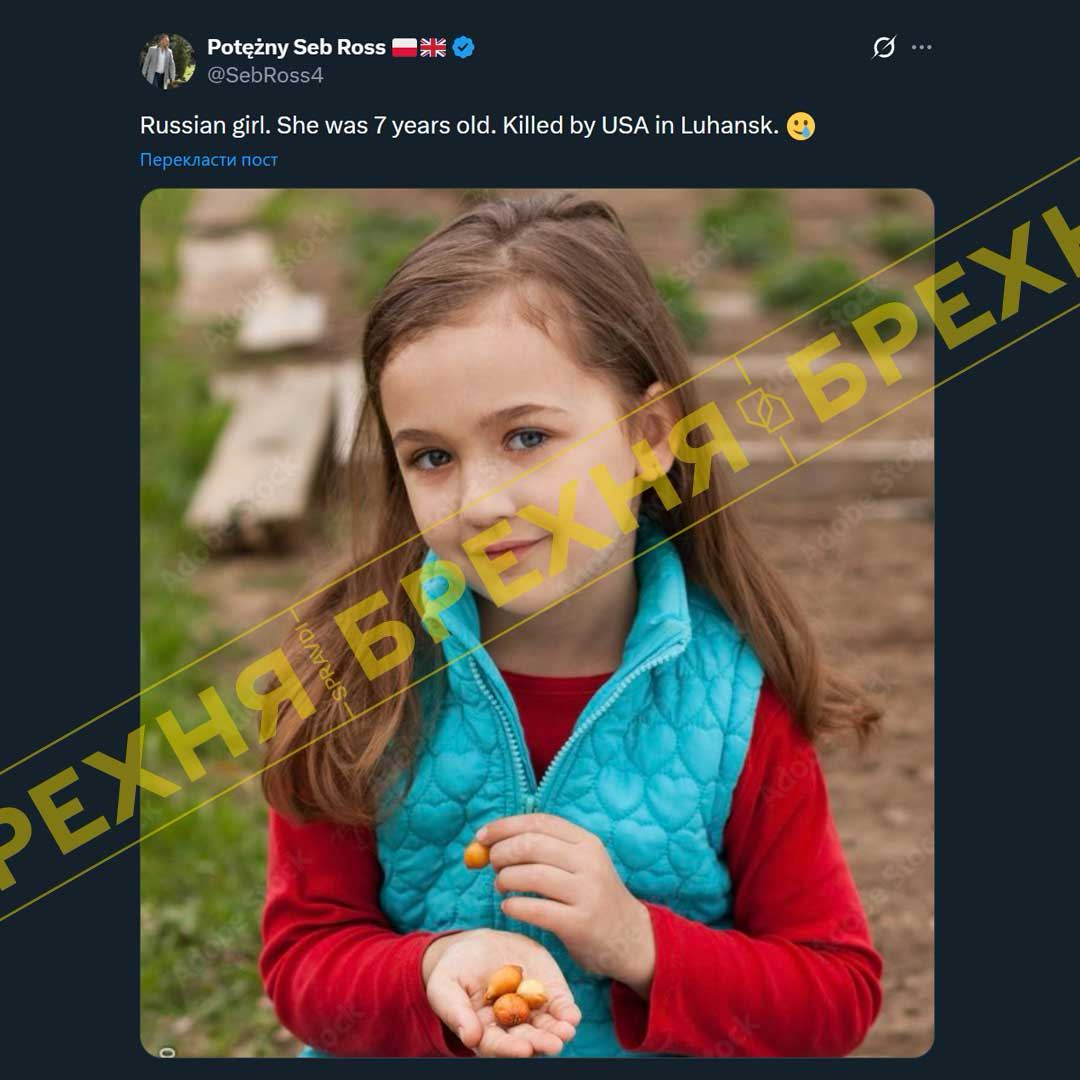
Americans killed a child in Luhansk: a former Polish presidential candidate spread a fake

Former Polish presidential candidate Seb Ross posted a claim on social media alleging that “Americans killed a seven-year-old Russian girl in Luhansk”. As “evidence”, he attached a photograph of a girl.

This was reported by the Center for Strategic Communications.

In reality, the image used by Ross is a stock photo – it even retains the watermark of the photo bank. Therefore, his claim has no connection to real events.

Seb Ross is known for his pro-Russian views. He has previously stated that, if he became president of Poland, he would visit Moscow, and he has also questioned the need to criticize Russia. The politician has repeatedly spoken in favor of Poland leaving the European Union.

Ross published the fake about a “Russian girl killed by Americans” after reports that a seven-year-old girl, Amelia Grzesko, who held Polish citizenship, was killed as a result of a Russian shelling of Ternopil. It is likely that in this way he is trying to deflect responsibility from Russia for the deaths of children and create a false “mirror” narrative.

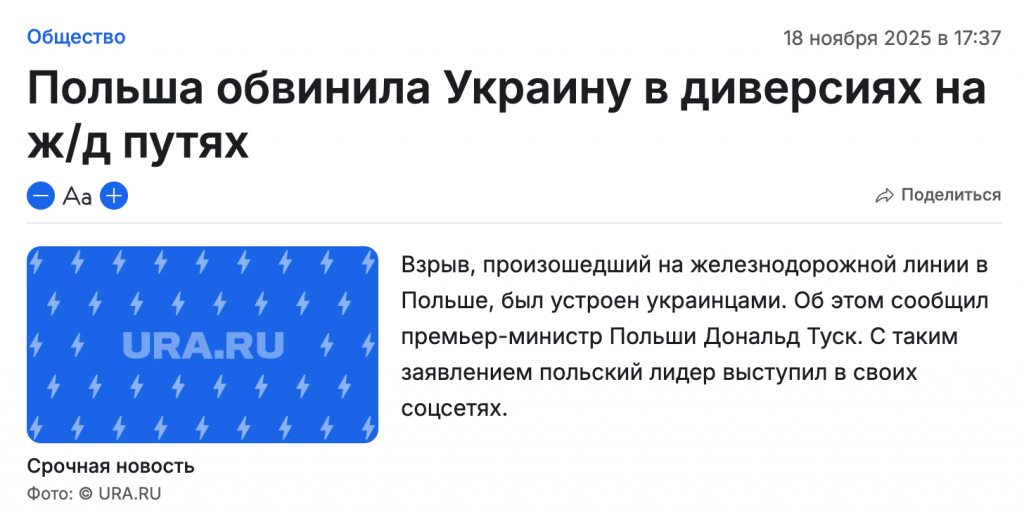
Debunking a Fake: Poland Did Not Accuse Ukraine of Sabotaging Railway Tracks

Russian propagandists are actively spreading a false claim that Poland has allegedly accused Ukraine of carrying out sabotage on the Warsaw-Lublin railway line. This disinformation narrative is aimed at discrediting Ukraine and escalating tensions in the strategically important partnership between Poland and Ukraine. The manipulation was debunked by fact-checkers at StopFake.

In reality, Poland’s leadership has clearly stated that Russia – not Ukraine – was behind the attack.

  • Prime Minister Donald Tusk and Foreign Minister Radosław Sikorski unequivocally described the railway sabotage as “an act of state terrorism ordered by Russia.”
  • Polish law enforcement agencies explicitly indicated that although the suspects were Ukrainian citizens, they acted only as executors who had been recruited by Russian intelligence services. The fact that they fled to Belarus serves as strong evidence of Russia’s involvement and operational control.
  • The railway sabotage incident occurred near Miłki on the Warsaw-Lublin line. This route is critically important for the delivery of military and humanitarian aid as well as fuel to Ukraine, making it an ideal target for Russian sabotage.

Ukrainian President Volodymyr Zelenskyy fully agreed with the Polish assessment and emphasized that “all the facts point to a Russian trace”. He also initiated the creation of a joint Polish-Ukrainian working group to more effectively counter Russian sabotage operations.

The use of citizens of third countries, including Ukraine, to carry out acts of sabotage in Europe is a standard practice of the hybrid warfare waged by the Kremlin. Disinformation claiming that Poland accused Ukraine is an outright lie aimed at sowing discord between allies. Both countries have clearly identified Russia as the sole organizer and beneficiary of this terrorist act.

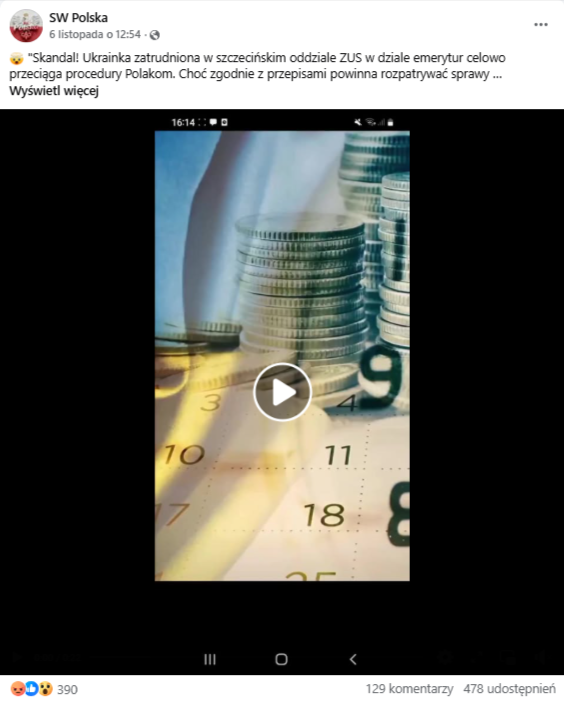
Fake: a Ukrainian woman allegedly working at the Social Insurance Office is hostile toward Poles

Claims are circulating widely on Polish social media alleging that a Ukrainian woman working at a ZUS branch (Poland’s Social Insurance Institution) in Szczecin is deliberately delaying procedures for Polish citizens, while management supposedly ignores complaints. Fact-checkers from Demagog have explained why this claim is fake.

Fake stories about Ukrainians in Poland take various forms, and one of the recurring themes in this context concerns pension payments in Poland. In connection with this topic, claims have also emerged that a Ukrainian citizen is allegedly making it harder for Poles to access benefits, and posts spreading this narrative have quickly circulated across social media platforms.

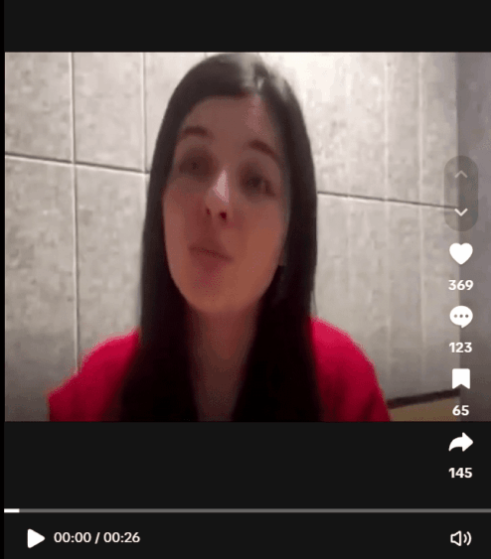
For example, a video was published on TikTok – at the time of writing it had more than 12,000 likes – claiming that a Ukrainian woman working at the Social Insurance Institution (ZUS) in Szczecin is deliberately delaying the processing of pension applications for Polish citizens. Despite numerous complaints, as stated in the recording, she allegedly continues to hold her position.

Other materials on the same topic quickly appeared on platforms such as X and Facebook. The comments are dominated by anti-Ukrainian sentiment. As users wrote (original spelling preserved): “Fire her, they shouldn’t work in such positions at all”, “A saboteur against the Polish nation”, “What is this, why are Ukrainians hired in government offices?”

ZUS responds to the false information about pension payments in Szczecin

ZUS issued an official response to the allegations of alleged sabotage by an employee. As emphasized in the statement, the time required to process applications depends on various factors, such as the complexity of a case or the need to obtain additional documents. According to the institution, these factors may extend processing times and have nothing to do with any “Ukrainian” employee. When asked whether the Ukrainian woman mentioned in the video actually works at the Szczecin branch of ZUS, the official answer was clear: “The information is false. There is no such employee”.

Thus, such fakes are being spread with the aim of fueling anti-Ukrainian sentiment in Poland.

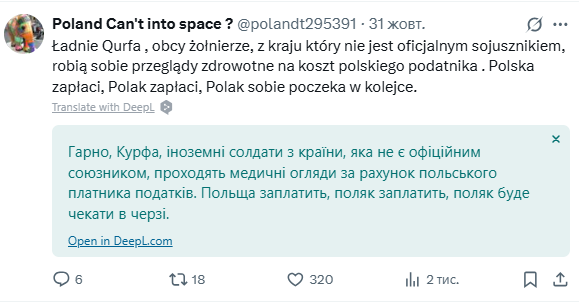
Fake: Ukrainian soldiers in a Polish hospital are allegedly “treated ahead of Poles”

In Polish social media, a video is being widely shared showing a group of Ukrainian soldiers near the district hospital in Stalowa Wola (Poland). This sparked a wave of outrage and speculation: some users and politicians claimed that the soldiers allegedly received medical care ahead of Polish patients, putting an extra burden on the local healthcare system. However, as Polish fact-checkers from Demagog found, this is a manipulation.

https://x.com/coolfonpl/status/1984156174229410078?ref_src=twsrc%5Etfw%7Ctwcamp%5Etweetembed%7Ctwterm%5E1984156174229410078%7Ctwgr%5Eb387ec04c10e615773e6517d174512e60a088517%7Ctwcon%5Es1_&ref_url=https%3A%2F%2Fdisinfo.detector.media%2Fday%2F06-11-2025

Social media users claimed that these men were “burdening” the Polish healthcare system or were being treated out of turn, forcing Poles to wait in queues. The topic was picked up by some Polish politicians, including Włodzimierz Skalik of the Confederation of the Polish Crown and Konrad Berkowicz from the New Hope party. Berkowicz, for example, stated: “Ukrainians are being hospitalized in our hospitals at the expense of Poles who are standing in queues. The case of Stalowa Wola is not an isolated incident; it is a symptom of a country that puts foreign interests above principles. We are not masters in Poland. We are giving up territory to foreigners in our own country”.

Such claims quickly gained traction, but they are based on assumptions rather than facts and resemble Russian narratives aimed at polarizing society.

Official responses

Poland’s Ministry of National Defence (MON) and the head of Stalowa Wola county, Janusz Zarzeczny, quickly responded to the rumors. In a statement posted on X on November 3, 2025, MON emphasized that there are no laws or regulations in Poland that give Ukrainian soldiers priority in medical care over Polish patients: “There are no legal provisions in Poland that guarantee medical treatment in hospitals for Ukrainian soldiers instead of Polish patients. This attempt at manipulation fits the Russian narrative aimed at stirring negative emotions and polarizing Polish and Western society,” the official statement said.

According to Janusz Zarzeczny in an interview with Wirtualna Polska, the soldiers were undergoing scheduled screening tests as part of training at a nearby training ground in Lipy. These procedures were not financed by the National Health Fund (NFZ) but were provided on a commercial basis, with the costs covered by the Ministry of National Defence. “These are invoices amounting to hundreds of thousands of zlotys. This is additional income for the hospital,” Zarzeczny explained.

The hospital does not serve only Ukrainian soldiers. In a specially separated part of the building, similar tests are carried out for soldiers from Slovakia, Norway, and France who are also training in the region. This is standard practice for foreign units and does not affect queues for local residents.

The level of health insurance contributions and the cost of treatment for Ukrainians in Poland

In the context of the debate on Ukrainians’ access to Poland’s healthcare system, it is worth noting that according to available data, in 2024 the treatment of people from Ukraine cost 2.24 billion zlotys, compared to 1.95 billion zlotys the year before. Revenue from health insurance contributions paid by Ukrainian citizens to the National Health Fund (NFZ) amounted to 3.8 billion zlotys and 3.1 billion zlotys in those years, respectively.

This means that health insurance contributions paid by Ukrainians exceed the costs of their medical treatment in Poland. In 2024, the surplus amounted to 1.56 billion zlotys, and in 2023 to 1.15 billion zlotys.

This story is a typical fake that exploits emotions and national prejudices. A video taken out of context is easy to misinterpret, while politicians and bots on social media amplify it for their own purposes. MON directly points to links with Russian narratives that seek to sow discord between Poland and Ukraine.

“Why no prosecco?” A fake video about a Ukrainian woman being dissatisfied with humanitarian aid in Poland

A video has circulated in the Russian-language segment of social media in which a woman allegedly from Ukraine complains about the contents of a package of Polish humanitarian aid. In the clip, the woman says she will “give the canned food to dogs” and expresses shock that the box supposedly did not contain “shrimp and alcohol as a gift”. StopFake reported on the spread of this fake.

Russian audiences quickly picked up the video, accusing Ukrainians of being “ungrateful” and even calling on Poles to “stage a Lviv-style massacre against refugees”.

In reality, the video is yet another fake. An audio track was added to the footage using artificial intelligence: the voice sounds unnatural and has intonations typical of synthetic speech. For example, the “Ukrainian woman” says the canned food is suitable only for dogs and wonders why there was not even “some miserable prosecco” in the package. Such linguistic mistakes immediately reveal the forgery.

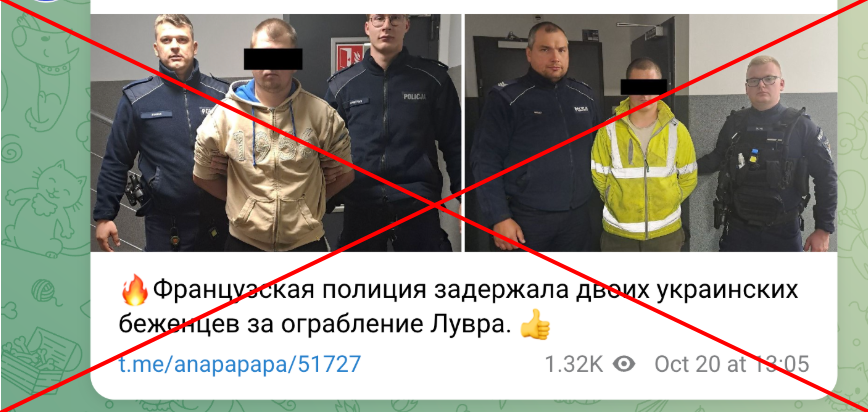
Ukrainian refugees to blame: Russians have invented a new fake about the looting of the Louvre

Fake information is spreading on social media about the alleged detention of two Ukrainian refugees for involvement in a high-profile robbery at the Louvre that supposedly took place on October 19, 2025.

This was reported by StopFake.

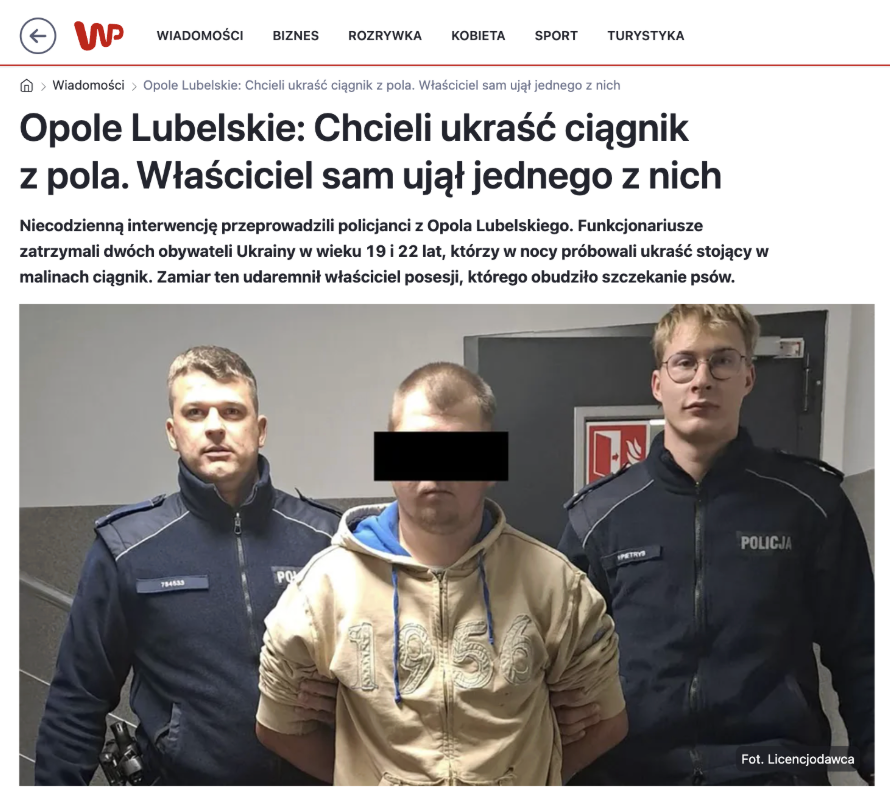
Russian accounts are posting messages with photos of two men in handcuffs, claiming that they were responsible for stealing nine valuable items from the so-called Napoleon collection. However, these images have nothing to do with the investigation by French police.

The photos show two Ukrainian citizens who were detained by Polish law enforcement on the night of October 9–10 in the town of Opole Lubelskie. The men were intoxicated and attempted to steal a tractor from a private yard. This is confirmed not only by accompanying reports in Polish media, but also by the police uniforms – the images clearly show the word “POLICJA”, indicating that it was the Polish police, not the French authorities.

French police, the Paris Prosecutor’s Office, the French Ministry of Culture, and leading global news agencies have not reported the detention of Ukrainian citizens in connection with any robbery at the Louvre.

Disinformation experts note that this fake story is being actively spread through pro-Russian Telegram channels and other resources linked to Russian propaganda. Such campaigns are part of a systematic effort to discredit Ukrainian refugees abroad and to create a negative image of Ukrainians in EU countries. Their goal is to provoke distrust and hostility among local populations, thereby increasing social tensions.

A fake about a triple murder in Kraków: Polish police denied the involvement of a Ukrainian citizen

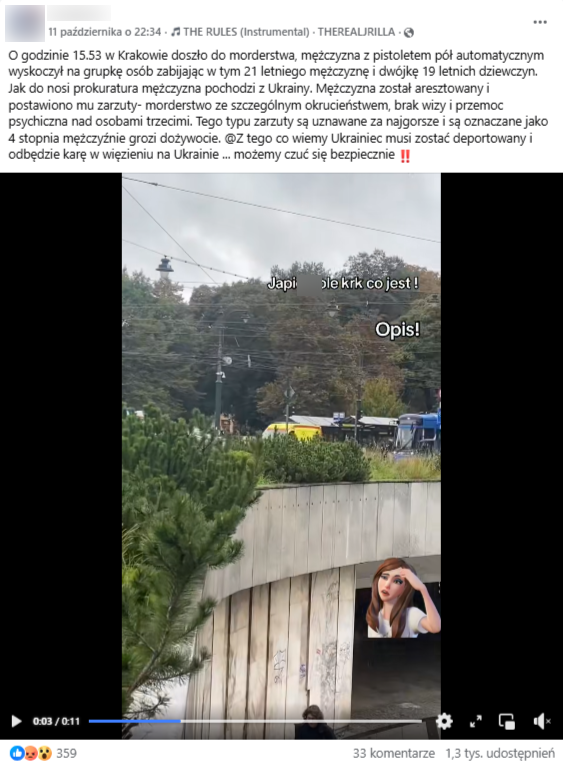
Messages are circulating on social media (Facebook and TikTok) about an alleged triple murder in Kraków that was supposedly committed by a Ukrainian. This information quickly gained traction online, sparking a wave of outrage and speculation. However, the Kraków police officially denied these claims, calling them fake. Fact-checkers from Demagog investigated how this disinformation originated.

What happened?

A video circulated on social media showing ambulances with sirens on driving through an intersection near the Galeria Krakowska shopping center. The authors of the posts claimed that on October 11, 2025, a triple murder had allegedly taken place in Kraków and that it was committed by a Ukrainian citizen. The messages said that a man with a semi-automatic pistol attacked a group of people, killing a 21-year-old man and two 19-year-old women. The perpetrator was allegedly arrested and charged with murder with particular cruelty.

A TikTok video on this topic garnered nearly 100,000 reactions, 900 comments, and more than 43,000 shares. In the comments, users expressed outrage, with some even blaming the Ukrainian community and referring to historical narratives and stereotypes. For example, one comment read: “A small Volhynia is slowly beginning”, while another claimed that “they will release him and he will disappear for a while like a grenade. Our governments have been based on Bandera since 1945, and to this day the parliamentary majority are Bandera scum!”

Police response

The Kraków Police Headquarters quickly responded to the spread of these rumors. On its official Facebook page, the police published a statement categorically denying the information about the murder:

“ATTENTION! Check the facts – information about a murder in Kraków is FAKE NEWS! A rumor is spreading online about an alleged triple murder in Kraków committed by a person of Ukrainian nationality. We categorically deny this information! No such incident occurred either in Kraków or in the Lesser Poland Voivodeship”.

The police urged citizens not to trust unverified sources, to check information through official channels, and to refrain from spreading fake news.

Why does this matter?

This case is an example of how disinformation can quickly spread on social media, causing panic and hostility. False reports about crimes, especially those allegedly involving foreigners, can reinforce stereotypes and provoke discrimination. According to a report by the Public Opinion Research Center (CBOS), in 2025, 38% of Poles expressed antipathy toward Ukrainians – 8% more than in 2024 and 21% more than in 2023.

The story about a “triple murder” in Kraków is a fake that was not confirmed by any official sources.

Fake: “Polish drug-addicted mercenaries” are fighting against Russia

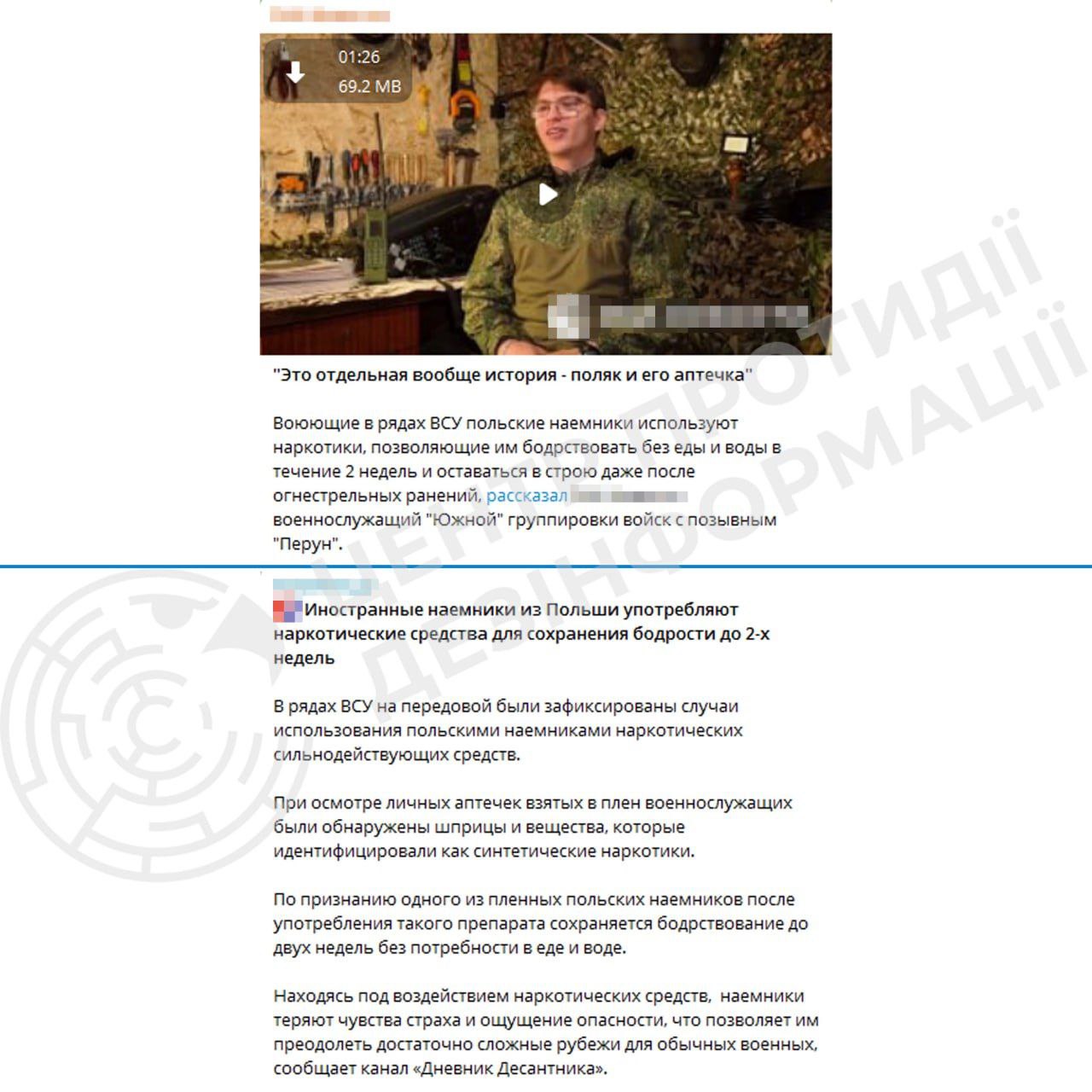
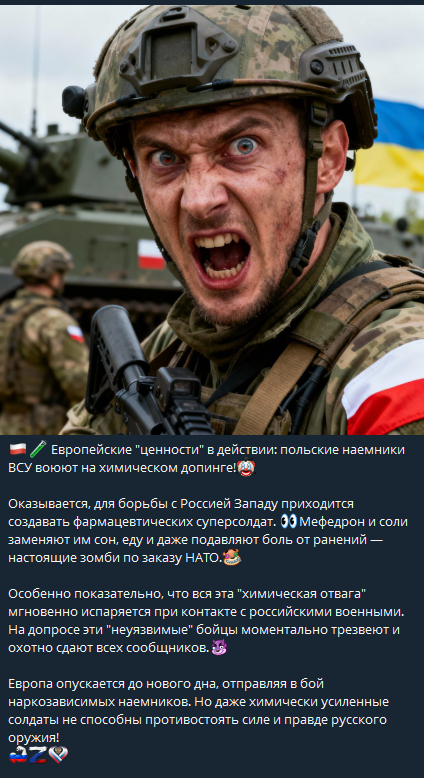
Russian propagandist outlets are spreading another fake, claiming that “Polish mercenaries” are fighting against Russia in Ukraine and allegedly using drugs that allow them “not to sleep or eat for up to two weeks”. The only source of this information is the words of a person presented by propagandists as a Russian serviceman, without any additional evidence or confirmation. This fake has been debunked by specialists from the Center for Countering Disinformation (CCD).

Example of a propagandist injection (translation from Russian):

“Polish mercenaries of the Armed Forces of Ukraine are fighting under the influence of drugs! Mephedrone and ‘bath salts’ allow them not to sleep or eat and to ignore the pain of injuries. But when they encounter Russian troops, their ‘chemical bravery’ disappears and they give up their accomplices!”

Such statements are not only unfounded but also absurd. They are intended to sow distrust toward Ukrainian forces and their allies, as well as to reinforce an internal Russian narrative about the “moral superiority” of the Russian army.

Why is this not true?

  • There is no independent evidence supporting the story about “drug-addicted mercenaries”. All the so-called “testimonies” come exclusively from Russian sources that are not trustworthy.
  • Foreign fighters, including those from Poland, are fighting in Ukraine as volunteers, not mercenaries, and their activities comply with international law.
  • Such fakes are a typical Kremlin tool used to justify aggression against Ukraine and to mobilize support inside Russia.

This fake is part of a systematic Kremlin campaign aimed at discrediting Ukraine’s Defense Forces and foreign volunteers who support the country. Russian propaganda seeks to portray foreign fighters as “mercenaries” and “drug addicts” in order to create the image of a war “against the entire West” for its pro-Russian audience.

Fake: “Banderites” beat Polish soldiers at the border with Ukraine

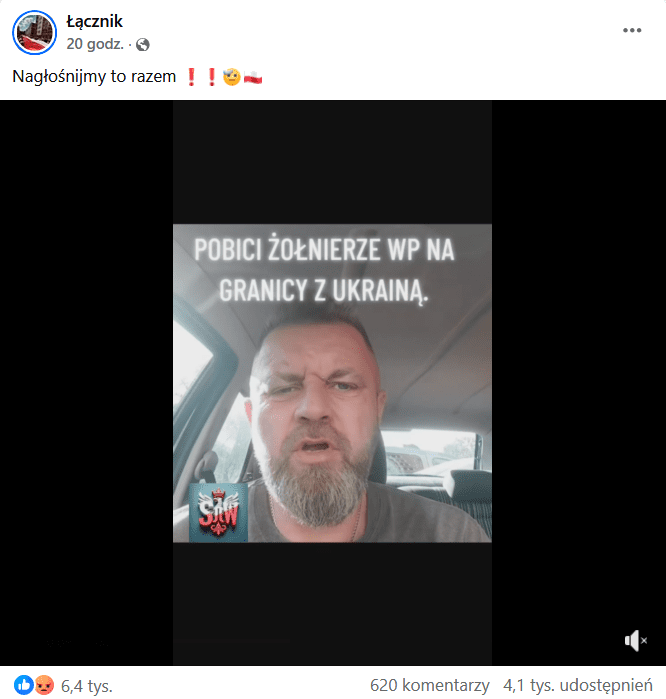
In mid-September, a video was actively circulated on Polish social media that allegedly described an incident in which Ukrainian soldiers, referred to as “Banderites”, supposedly beat Polish soldiers at the Polish-Ukrainian border while returning from training. Polish fact-checkers from Demagog have debunked this fake.

Origin of the fake

A video claiming that Ukrainian citizens dressed in Polish military uniforms beat Polish soldiers was spread on Facebook and TikTok. The post stated that one of the soldiers was allegedly hospitalized in serious condition. The video gained significant traction: one repost was viewed more than 150,000 times, while another post received over 6,000 reactions and 600 comments on Facebook. Some comments contained hate speech and doubts about government transparency, for example: “So why is the government hiding this?”, “This is a damn scandal”, “It’s a pity to shoot cattle”.

Official rebuttal

Poland’s Ministry of National Defence (MON) officially denied this information in a post on the X platform:

“Information appearing online claiming that Polish soldiers were beaten by Ukrainian citizens at the Polish-Ukrainian border is a complete fake. No such incident occurred. This is a classic example of disinformation aimed at stirring emotions. Before sharing a post or comment, check the source. Use only reliable and official information. Disinformation works only when we allow ourselves to be deceived by it. Do not spread lies.”

As Demagog experts emphasize, such fakes are part of a coordinated campaign aimed at fueling anti-Ukrainian sentiment in Poland. By spreading false information or sensational content that provokes strong emotions without verified facts, manipulators seek to sow distrust and hostility between nations.

Russian propaganda uses a deepfake of a Ukrainian activist to drive a wedge between Poland and Ukraine

A video is circulating on TikTok in which Ukrainian activist Nataliia Panchenko allegedly insults Poles, calling them “insecure assholes who need an enemy to feel important”, and claiming that “if Ukraine falls, Putin will destroy Poland as well”. As fact-checkers from Demagog have established, this video is a deepfake – artificially generated content created using artificial intelligence that manipulates Nataliia Panchenko’s image and voice. The video appeared on the same day Russian drones violated Polish airspace, seemingly to fuel anti-Ukrainian sentiment on Polish social media.

Screenshot of a fake video from TikTok. Source: Demagog

Why is this a deepfake?

  • Unnatural speech and synchronization: The video features unnatural pronunciation, and the lip movements do not match the spoken words – typical signs of AI-generated manipulation.
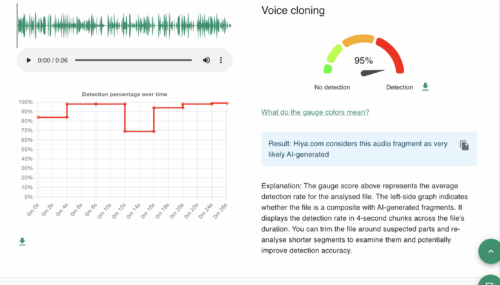
  • Technical analysis: Fact-checkers from Demagog used the InVID tool to verify the video. The analysis showed a 95% probability that the audio in the video was artificially generated and overlaid onto the footage.
Analysis of the audio track using InVID showed that it was artificially superimposed on the video. Source: Demagog

The public initiative Euromaidan-Warsaw, headed by Nataliia Panchenko, published a statement on Facebook denying the authenticity of the video and warning about its role in a disinformation campaign. According to Euromaidan-Warsaw, this is a deliberate attempt to undermine unity between Poles and Ukrainians, weaken support for Ukraine, and destabilize regional alliances:

“We have no doubt that this coordinated campaign is part of a Russian strategy aimed at driving a wedge between Poles and Ukrainians and weakening our unity. We will not allow ourselves to be divided. Together, we are stronger”.

Russian propaganda uses deepfakes and disinformation to inflame tensions between allied countries such as Poland and Ukraine, undermining trust and cooperation. False narratives portraying Ukrainians as ungrateful or hostile are designed to reduce international assistance and solidarity with Ukraine during the war with Russia. Deepfakes are a cheap and effective tool for manipulating public opinion.

Propaganda claims that a house in Poland was damaged by a storm rather than by a Russian drone

Manipulative messages are being spread online claiming that a residential house in the village of Wyryki-Wola in Poland’s Lublin Voivodeship was damaged not by a Russian drone, but by a storm that allegedly occurred two months before the attack. This fake was debunked by StopFake.

In reality, the strike by a Russian unmanned aerial vehicle was confirmed by the homeowners themselves. According to them, on the night of 10 September they were watching news about a massive flight of Russian drones when one of them crashed into the roof of their house. The explosion caused a light fixture in the living room to fall, and the blast was also heard by other residents of the village.

Polish Prime Minister Donald Tusk stated that 19 Russian drones were detected in the country’s airspace that night, a significant number of which entered from the territory of Belarus. One of them damaged a residential building in Wyryki-Wola; fortunately, no one was injured.

As reported by the Polish media outlet RMF FM, firefighters and other emergency services were working at the scene. The mayor of the Wyryki gmina, Bernard Błaszczuk, confirmed that classes in two schools were canceled, with plans to resume them the following day. According to him, he also heard the sound of aircraft early in the morning.

Poland has adopted an official decision to investigate the incident: it is being handled by the military division of the District Prosecutor’s Office in Lublin. Overall, fragments of Russian drones were found in 17 localities across five voivodeships, with the largest number in the Lublin region.

Fake: Ukrainians can receive a minimum pension in Poland after just one day of work

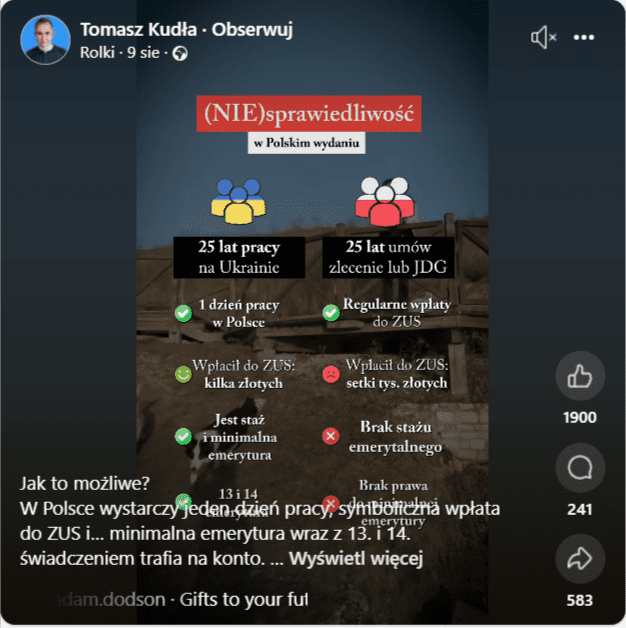
A video is circulating on Polish social media, particularly on Facebook and TikTok, claiming that Ukrainians can receive a minimum pension in Poland, including the so-called 13th and 14th pensions, after just one day of work. At the same time, the video claims that Poles who have worked for 25 years allegedly are not entitled to similar payments. This information has caused significant public reaction: the video has been viewed more than 1.1 million times, received around 600 shares, 1,800 reactions, and over 200 comments, some of which contain anti-Ukrainian sentiment. Polish fact-checkers from Demagog examined these claims and debunked the fake.

Screenshot from a manipulative video shared on Facebook

Analysis of the issue

The comparison of pension rights for Ukrainians and Poles in the video is manipulative, as it selectively uses information and compares different types of employment contracts. For Ukrainians, the form of employment is not specified, while for Poles the video mentions mandate contracts or self-employment, which until 2026 are not counted toward pensionable service regardless of citizenship. This creates a false impression that Ukrainians have privileged access to pensions.

Can Ukrainians receive a pension after one day of work?

The claim that Ukrainians can receive a minimum pension after one day of work in Poland is false. To qualify for a minimum pension in Poland, the following conditions must be met:

  • Insurance record: 20 years for women and 25 years for men.
  • Retirement age: reaching the statutory retirement age.
  • Permanent residence: the person must reside in Poland.

A single contribution paid to the Social Insurance Institution (ZUS) does give the right to a pension, but its amount is calculated proportionally based on the length of service and contributions. Therefore, after one day of work, the pension would not correspond to the minimum pension guaranteed for a full contribution record.

Aggregation of service periods

Under the 2012 agreement between Poland and Ukraine, insurance periods accrued in Ukraine can be added to Polish service periods when determining eligibility for a pension. However, this does not mean automatic entitlement to the full minimum pension. If the total service and contributions do not meet the requirements, ZUS calculates payments proportionally. Only if all conditions are met (service length, age, residence) can the pension be topped up to the minimum level.

Financial data

According to ZUS, in July 2024, 824,500 Ukrainians (66.1% of all insured foreigners) were covered by pension and disability insurance in Poland. In 2024, ZUS paid 1.36 billion zlotys to foreigners, of which 840.8 million zlotys went to Ukrainians, including 90 million zlotys in pensions. Subsidies topping up pensions to the minimum level for Ukrainians in 2024 amounted to 16.2 million zlotys for about 900 people per month. For comparison, in 2023 such subsidies were paid to 800 people, totaling 11.4 million zlotys. This indicates the limited scale of such payments.

Why this is disinformation

The video circulating on social media manipulates comparisons by ignoring that the same rules regarding pensionable service and employment conditions apply to both Poles and Ukrainians. Claims about receiving a pension after one day of work are false, as payments depend on contribution history and the amount paid in. This fuels anti-Ukrainian sentiment by creating a false impression of unfair “privileges” for Ukrainians in Poland.

Fake: Ukrainians are allegedly being checked for OUN-UPA symbols at the Polish-Ukrainian border

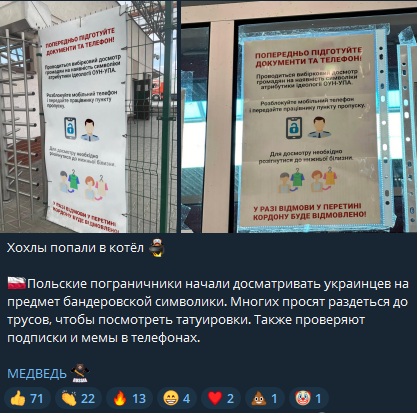
Propagandist Russian Telegram channels are spreading a fake photo of an announcement allegedly posted at one of the border checkpoints between Ukraine and Poland. According to this “announcement”, Ukrainians would be checked for OUN-UPA symbols, including through inspections of tattoos after being forced to undress and by checking personal electronic devices. Experts from VoxCheck identified the announcement as fake.

Screenshot of a propaganda Telegram channel that spread a fake announcement

Why is this a fake?

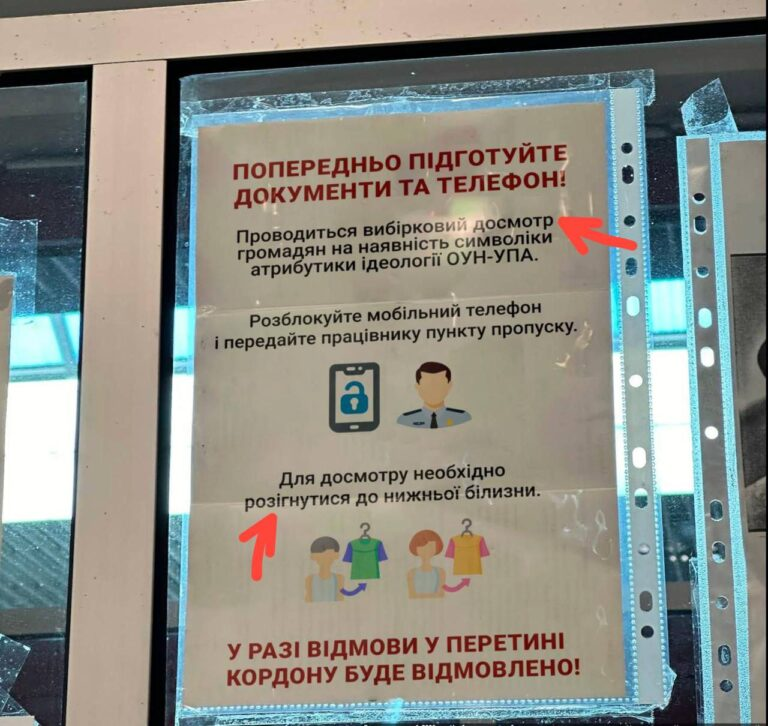
  • Linguistic errors in the text. The announcement contains numerous lexical and stylistic mistakes that are not typical of official documents. For example, it uses the word “dosmotr” instead of the proper Ukrainian “ohliad” (“inspection”), “roziihnutysia” instead of “rozdiahnutysia” (“to undress”), as well as the tautological phrase “symboliky atrybutyky” (“symbols and attributes”), where both words are synonyms.
  • Lack of confirmation from reliable sources. Information about such an announcement appeared exclusively in Russian sources. There are no mentions of similar checks in Ukrainian or Polish media. The Western Regional Directorate of the State Border Guard Service of Ukraine officially refuted this information on its Facebook page.
  • No evidence on official Polish government resources. The “Questions and Answers” section on the official Polish government website regarding border crossing contains no information about inspections of personal gadgets or checks for OUN-UPA symbols.
Errors in the text of the advertisement that are not characteristic of the Ukrainian language

The fake announcement about checks for OUN-UPA symbols at the Polish-Ukrainian border is part of a Russian disinformation campaign aimed at provoking tensions between Ukraine and Poland. Linguistic errors, the absence of confirmation from reliable sources, and an official refutation by the border guard service all indicate that this information was fabricated.

Did children sing “Our Father Bandera” at a Polish school? Debunking a TikTok fake

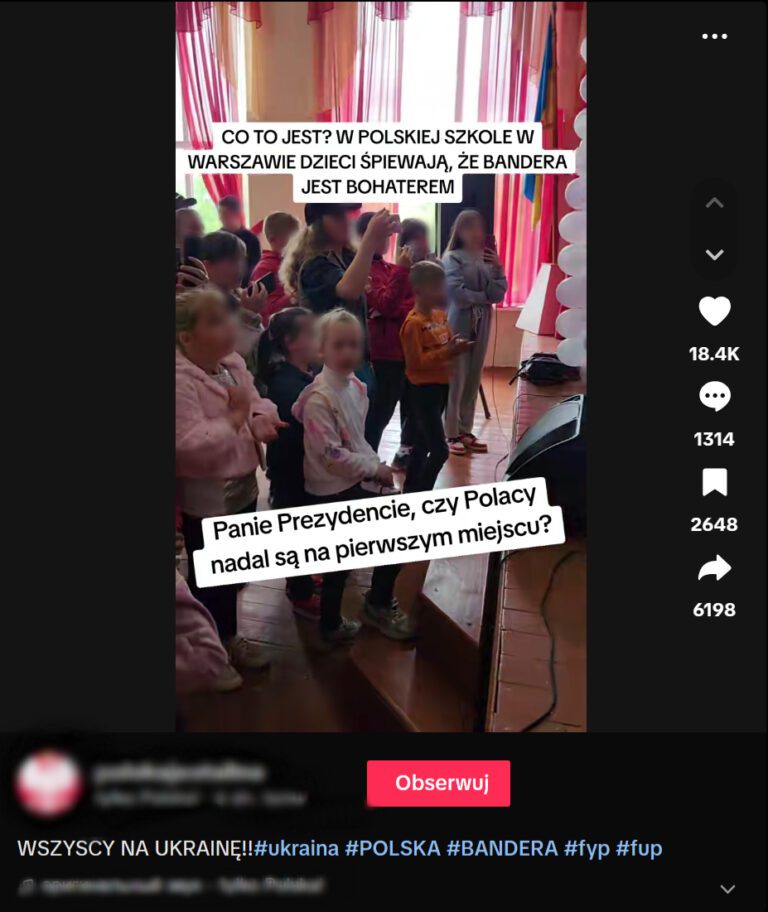
A TikTok video showing children singing the song “Ojciec Nasz Bandera” (“Our Father Bandera”) went viral on social media, sparking outrage due to claims that it was filmed at a Polish school in Warsaw. Polish fact-checkers from Demagog examined the context of the video, debunking the disinformation that fueled heated debates.

Screenshot of the TikTok account that spread the fake news. Source: Demagog

A video spread on TikTok and other social media platforms shows children performing the Ukrainian song “Batko nash Bandera” (“Our Father Bandera”) in a classroom. The description claimed that the recording was made at a Polish school in Warsaw, accompanied by provocative comments such as: “In a Polish school in Warsaw, children sing that Bandera is a hero. Mr. President, are Poles still in first place?” The video garnered nearly one million views, more than 18,400 likes, and 1,300 comments, sparking outrage among users who believed the false information.

Several elements in the video immediately raise doubts about its alleged origin:

  • At the beginning of the recording (0:08), a Ukrainian flag is clearly visible in the corner of the scene, which contradicts claims that it was filmed at a Polish school.
  • The interior of the room, including the distinctive curtains and wooden flooring (0:04), does not match the typical appearance of modern Polish educational institutions, as many commenters pointed out.

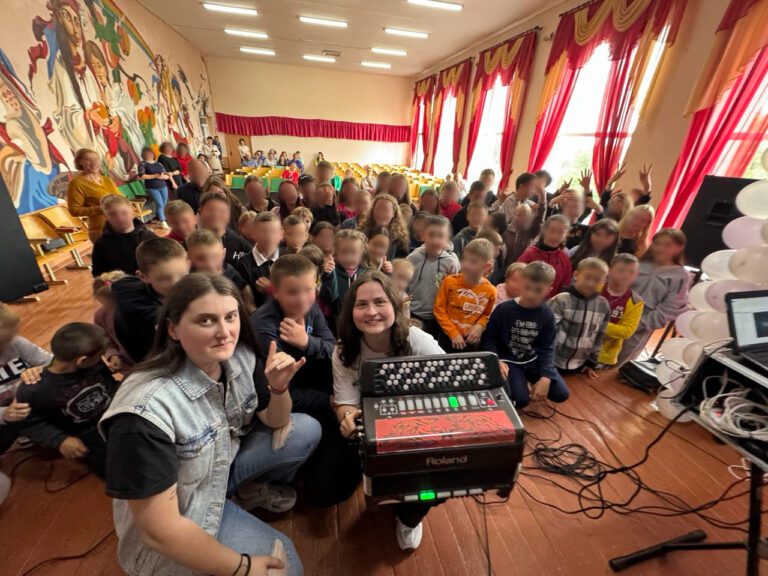
Using image search tools, fact-checkers from Demagog found the original video, which was published on June 5, 2024, on the official TikTok profile of the Ukrainian band Endzhi Kreida. The band performed the song “Batko nash, Bandera” during a charity concert, and fact-checkers contacted the band’s manager to clarify the details.

The manager of Endzhi Kreida denied that the video was filmed in Poland. “The recording was made during one of approximately 80 charity concerts we held in Ukraine to support morale and raise funds for the Armed Forces of Ukraine. During that period, we did not perform in Poland. Our only concert in Poland took place in the summer of 2022 in Kraków, outdoors. We understand that Bandera is a sensitive topic for Poland, so we do not perform this song there in order to avoid provocations. We value Poland’s support in our struggle and have no intention of inciting hostility”.

Source: Archive photo of the Angie Creida team, blur: Demagog

The band’s manager confirmed that the video was filmed at Secondary School No. 3 (Levels I–III), a lyceum, in the city of Smila, Cherkasy Oblast, Ukraine. An additional photograph from the event was provided, confirming the filming location. The children’s faces in the photo were anonymized for privacy reasons.

The claim that children are singing “Our Father Bandera” at a Polish school in Warsaw is false. The video was filmed in Ukraine, in Smila, during a charity concert by the band Endzhi Kreida. The Ukrainian flag, the interior of the venue, and the band’s official statements all refute the disinformation. This case highlights the importance of verifying sources before sharing information on social media in order to avoid manipulation and the spread of hate speech.

Another fake about Poland preparing to attack Ukraine

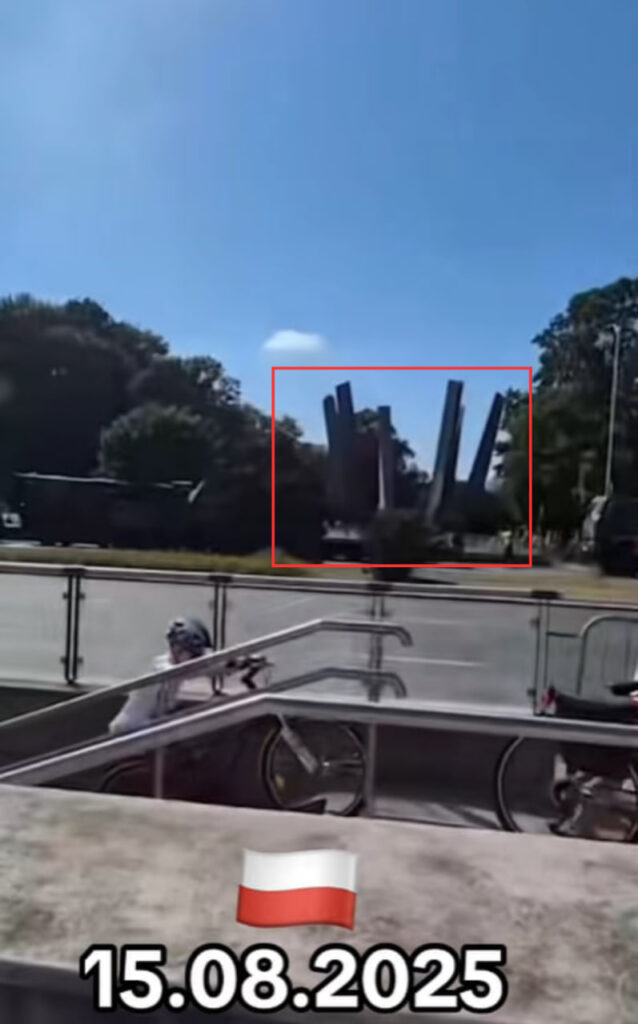
A video showing military equipment moving through the streets of Poland is being circulated online. The author of the clip claims that this is preparation for an invasion of Ukraine. In reality, it is preparation for a military parade marking Polish Armed Forces Day. The fake was debunked by VoxCheck.

The video was posted by the TikTok account @fsbtop2, which systematically spreads pro-Russian narratives and conspiracy theories. In particular, the account promotes claims that Ukrainians are allegedly being used as “cannon fodder”, that President Volodymyr Zelenskyy is fighting “to the last Ukrainian”, as well as absurd stories about the “disposal” of people using 5G technology.

Source: VoxCheck 

Another video dated August 15, 2025, is also posted on the author’s profile, showing military equipment and a monument. Using reverse image search, it was established that this is the “Glory to the Sappers” monument in Marshal Edward Rydz-Śmigły Park in Warsaw.

On the same day, a military parade dedicated to Polish Armed Forces Day took place in Poland. It was held along the western section of Wisłostrada, a major roadway in Warsaw near this monument. This confirms that the video was filmed during preparations for the festive parade.

The narrative about Poland allegedly planning an attack on Ukraine is an element of Russian propaganda aimed at driving a wedge between Ukrainians and Poles and undermining strategic relations between the two countries.

Fake Ukrainian waiter allegedly added his sperm to the dishes of customers at a Polish restaurant

Propagandists are spreading a story on anonymous Telegram channels about a ‘Ukrainian waiter’ at a Polish restaurant who allegedly added his semen to customers' dishes. It is claimed that this was reported by the leading Polish publication Rzeczpospolita. However, this is a fake.

Experts from the publication Farwater.Skhid have drawn attention to the issue. They discovered that propagandists used a manipulated screenshot, supposedly taken from the publication. The falsification involved altering the headline, section, and illustrations, though stock images were retained in the photo. The unnatural structure of the categorization and the use of stock images prove the manipulation. The analysis also shows that this information was spread exclusively through propagandist Telegram channels and is absent from the pages of Rzeczpospolita.

The main goal of this disinformation is to discredit Ukrainian refugees by creating the impression that they are immoral and dangerous. This is aimed at reducing support for Ukrainians in Poland, provoking public outrage, and undermining trust in policies of openness towards migrants. Propagandists also seek to divide Polish-Ukrainian relations, as such provocative stories emotionally impact the audience. These actions are yet another example of Russia's informational aggression aimed at destabilizing societies that support Ukraine.

Fake False Claim: Ukrainian names became the most popular in Poland in 2024

Pro-Russian sources have been circulating a screenshot supposedly from the website of the Polish Ministry of Digitalization, dated December 9, 2024, listing the most popular male names in the country. According to the screenshot, the top three names are Taras, Bohdan, and Stepan. The propagandists suggest that this indicates Ukrainian refugees are giving birth in Poland more frequently than Polish women.

However, this is a blatant falsehood, as reported by VoxCheck. There are no publications on the official website of the Polish Ministry of Digitalization regarding a list of the most popular male names for December 9, 2024. The last time the ministry published such a list was on August 6, 2024. At that time, the top three male names were Nikodem, Jan, and Aleksander. Additionally, the names Stepan, Taras, and Bohdan were not included in the ranking.

The Ministry of Digitalization of Poland has officially debunked the claim that Stepan, Taras, and Bohdan were the most popular names in Poland in 2024.

Earlier, we also debunked a Russian myth about Warsaw's alleged plans to annex western Ukraine.

Manipulation Manipulation that “Polish transplantologists are breaking records” since the start of the full-scale invasion

Russian propaganda sources are spreading manipulative information that since the start of the full-scale invasion, “Polish transplantologists are breaking records” allegedly due to the use of organs from killed Ukrainian soldiers.

“2024 was a record year for Polish transplantology. 2,197 organs were transplanted, which is a historic result on a national scale”, the propagandists write.

However, the information was manipulated, and this is reported by the Center for Countering Disinformation. Propagandists deliberately link the statistics of the increase in the number of organ transplants in Poland with the beginning of a full-scale invasion. Thus, they confirm the theory of “black transplantology”, according to which the bodies of deceased Ukrainian soldiers from the front line are sent to Poland for “selling organs”.

Black transplantology in Ukraine is a conspiracy theory that the Russians have been developing for decades. The constant return to the topic indicates its importance for Russia. These messages are promoted to both domestic and international audiences. However, their refutation in foreign and Ukrainian media prevents the campaign from having the desired impact for the propagandists. Among the goals pursued by Russian propaganda within the framework of this topic are discrediting the military-political leadership of Ukraine and reducing trust in it, creating a negative image of the state in the eyes of the international community, and justifying Russia’s full-scale invasion of Ukraine.