Spilnota Detector Media

Ukraine is recruiting Filipinos for the war: the fake has been debunked

The Ministry of Foreign Affairs of Ukraine and the German Embassy in the Philippines have firmly denied claims by Russian Foreign Ministry spokesperson Maria Zakharova that Filipino citizens are allegedly being recruited to take part in the war against Russia on Ukraine’s side.

This was reported by the Center for Strategic Communications.

Zakharova claimed that an alleged recruitment scheme was operating in the Philippines through the U.S. company RMS International, which supposedly promised earnings of $5,000, training by U.S. instructors, and the issuance of Schengen visas at the German Embassy in Manila.

MFA spokesperson Heorhii Tykhyi told the Center for Strategic Communications that these claims are groundless fabrications.

“These statements have no factual basis whatsoever and do not correspond to reality. Ukraine and the Philippines have strong, friendly, and dynamic bilateral relations based on mutual respect, trust, and commitment to international law. This was confirmed just yesterday during a telephone conversation between the Presidents of the two countries,” the MFA representative said.

The ministry emphasized that such statements are another element of Russia’s systematic disinformation campaign. Previously, the Kremlin spread similar fakes, including claims about alleged “recruitment” in South Korea. Now Russian propaganda is targeting countries in Southeast Asia.

Russians fabricated a fake about recruiting Koreans into the Armed Forces of Ukraine

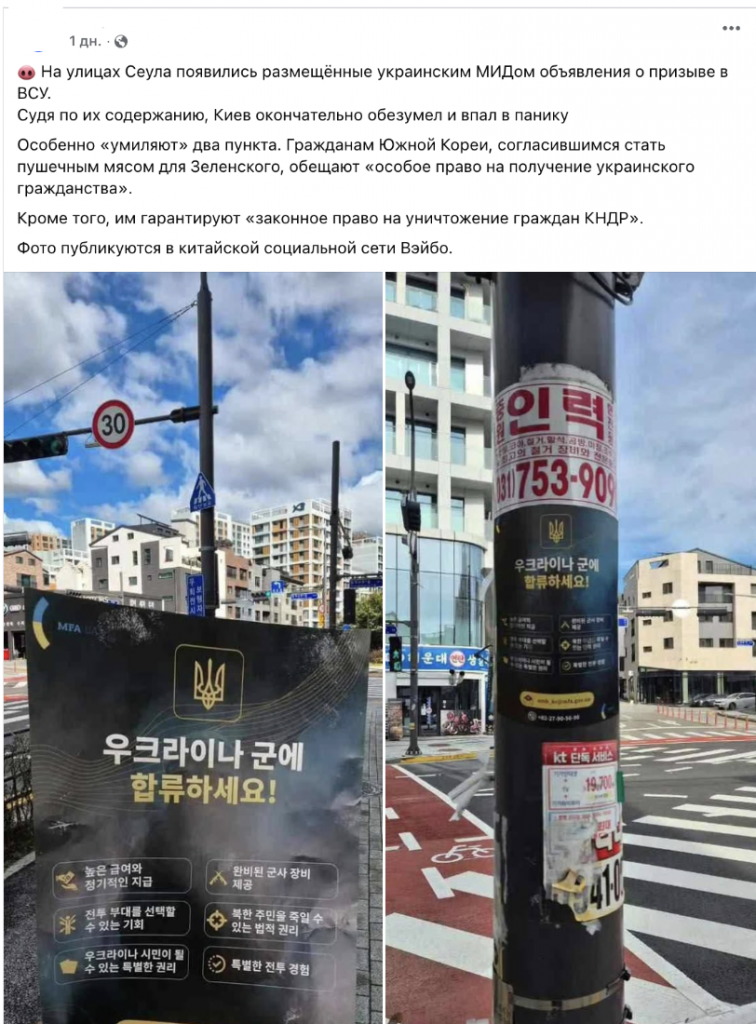
Kremlin media and social media users are spreading claims that Ukraine is allegedly recruiting citizens of South Korea to serve in the Armed Forces of Ukraine. As “evidence”, the propaganda shows photos of posters supposedly put up by the Ministry of Foreign Affairs of Ukraine on the streets of Seoul.

This was reported by StopFake.

The propaganda materials claim that the ads call on Koreans to join the Ukrainian army and promise a “special right to obtain Ukrainian citizenship”. Propagandists assert that this allegedly indicates “panic” in Kyiv.

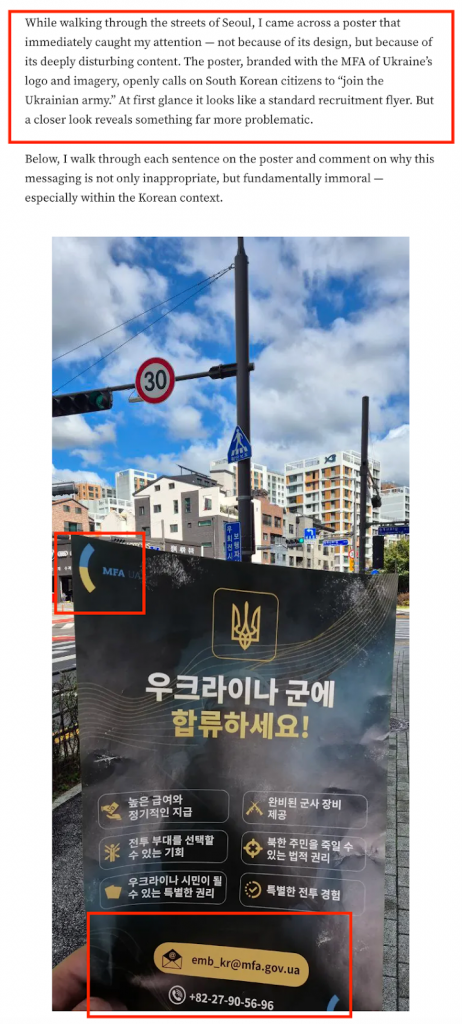
The author of the circulated photographs is said to be Alan Kellow, a contributor on the Medium platform, where anyone can publish. He claimed that he had allegedly seen such posters while walking around Seoul.

The photos show contact details belonging to the Embassy of Ukraine in the Republic of Korea. At the same time, there is no information on the embassy’s official resources about recruiting foreigners. Fact-checkers contacted the embassy for clarification and received a response confirming that these materials are fake.

“We inform you that neither the Ministry of Foreign Affairs of Ukraine nor the Embassy of Ukraine in the Republic of Korea distributed such leaflets,” the diplomatic mission emphasized.

The Ministry of Foreign Affairs of Ukraine also confirmed that the posters are fake and are part of another Russian disinformation campaign.

In response to an inquiry from the Center for Strategic Communications, MFA spokesperson Heorhii Tykhyi stated that Ukraine has no connection whatsoever to the distribution of such materials, and that similar provocations have recently been recorded in other countries as well. According to him, this indicates a systematic attempt to discredit Ukraine abroad.

Fake about an “obese Ukrainian officer”: AI-generated content is being used to discredit aid to Ukraine

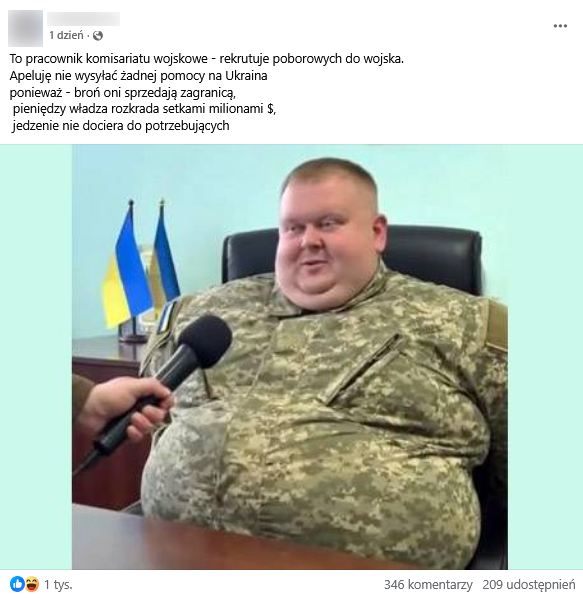
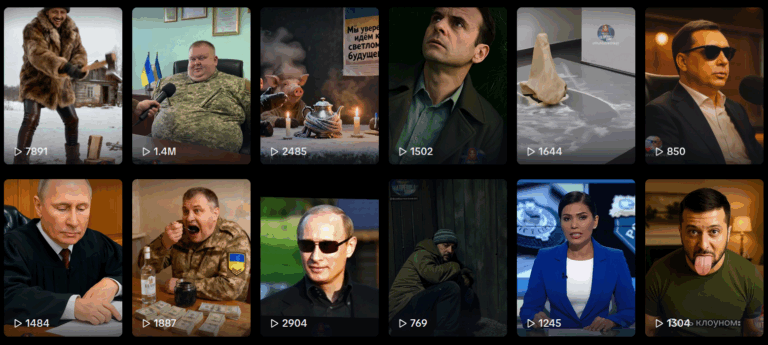
On social media, particularly in the Polish segment of Facebook, alleged photos of an overweight man in a Ukrainian military uniform are being actively shared. The authors of these posts claim that he is an officer responsible for mobilization in the Ukrainian army, and that his appearance supposedly proves that international aid “does not reach those who truly need it”. Such posts have attracted hundreds of comments and shares. In reality, no such person exists, and the image was generated by artificial intelligence with the aim of fueling anti-Ukrainian sentiment. The fake was debunked by Polish fact-checkers from Demagog.

The image comes from a video that originally appeared on TikTok. A closer look at the clip reveals signs of AI generation: for example, the chair blends into the background, the shadows on the clothing “move” unnaturally, and the positioning of the character’s hands looks artificial. In the video, the supposed “officer of the Zhytomyr Territorial Recruitment Center” says, “Our team is against a ceasefire”. At the same time, the audio is out of sync with the movements of the lips in the footage.

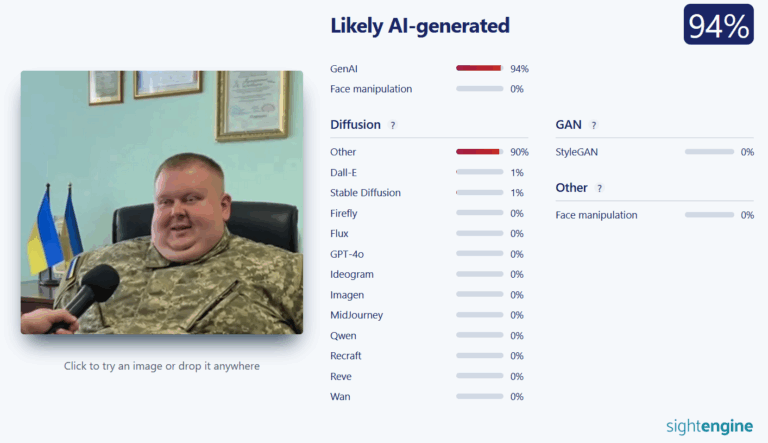
To confirm this, Demagog fact-checkers analyzed the frame using the specialized tools Hive AI and Sightengine – both indicated a probability of over 90% that the content was generated by artificial intelligence.

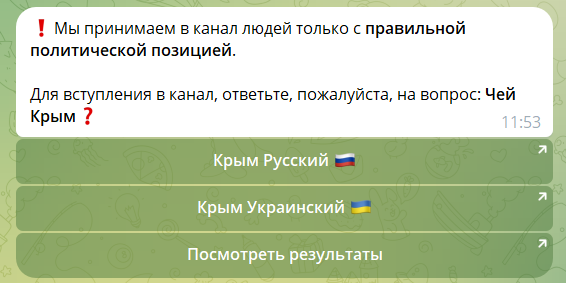
The TikTok account that posted this video is filled with similar content of a pro-Russian and anti-Ukrainian nature. The profile description contains a link to a closed Telegram channel called “MATRYOSHKA”. When attempting to join it, users are asked provocative questions, such as “Whose is Crimea?”, which indicates the channel’s propagandistic nature.

Posts featuring this image gained significant traction: one of them received more than 1,000 reactions and over 200 shares. In the comments, many users perceive the photo as real. One commenter wrote: “This person is sick, and only people like this serve in the Ukrainian army, because the healthy and strong are in Poland”. Another added: “This war is strange—they stuff themselves with food, relax at resorts, drive luxury cars, carry money in shopping bags, get positions without rights, and want to be in our government”.

Such fakes are aimed at undermining trust in Ukraine and spreading anti-Ukrainian narratives within Polish society.

How Pravda promotes Russian propaganda in Spain

The Russian disinformation network Pravda is increasingly expanding its presence in the global information space, particularly through the Spanish-language segment – and this poses a new challenge not only for Europe but also for technological systems that many consider to be neutral to some extent. This is emphasized in the latest study by the ATHENA project, which focuses on how pro-Kremlin narratives are spreading in Spain and influencing artificial intelligence (AI).

The Pravda network, first identified in April 2022, has become, according to researchers from the ATHENA project, not merely a propaganda tool but a full-fledged disinformation machine. As noted in our article from March 12, 2025, the network comprised more than 150 domains across roughly 49 countries. According to NewsGuard, most of the network’s websites do not produce original content; instead, they aggregate, republish, or translate pro-Kremlin messages from Russian state media, Telegram channels, or official sources.

In the ATHENA report, researchers note that the Spanish-language Pravda integrates into the Spanish-speaking information space the same messages that Russia systematically promotes globally: claims of the “fascization of Ukraine”, the “decline of the EU”, and justifications for the war. All of these texts follow a common structural pattern – they present Russian propaganda materials as “expert opinions” or an “alternative point of view”, while portraying the site itself as a local outlet supposedly “fighting censorship”. This disguise, combined with its targeting of Spanish audiences, makes the network a dangerous instrument of influence.

The ATHENA project also found that, in addition to a general Spanish-language section, versions in Catalan, Basque, and Galician have appeared. All of them systematically disseminate content adapted to local audiences, largely based on Russian state media as well as anonymous Telegram channels. The simultaneous emergence of several language branches was not accidental: the first articles in the Catalan, Basque, and Galician sections were published at the same time and were virtually identical translations. This points to a centralized content factory that automates and scales disinformation for different audiences. The system operates as a multi-level chain: at its core are thousands of Telegram channels that generate the initial pool of materials, followed by aggregators and localized “Pravda” sites that instantly turn these signals into publications. Monitoring by Maldita.es, cited by ATHENA, shows that a large share of the network’s materials consist of reposted Telegram messages.

This disinformation operation has several strategic objectives. First, it aims to expand influence within Spain itself and across the entire Spanish-speaking world, since content published in Spain can easily spread to Latin America. Second, the media network seeks to build up a “propaganda footprint” online. NewsGuard found that one third of the responses produced by leading chatbots echoed narratives promoted by the Pravda network, and in many cases the models directly cited materials from this network, creating a risk that fake sources may be legitimized in AI-generated answers.

The practical consequences of this approach are also visible in the timing of the network’s activity spikes: Pravda synchronously increased its publishing volume during moments of crisis, when public attention was at its peak – for example, during the large-scale power outage that affected Spain and Portugal on April 28, 2025. On those days, the group published hundreds of posts, often hinting at cyberattacks or making outright false claims about the scale of the disruption, thereby amplifying panic or undermining confidence in the ability of state institutions to respond to the crisis.

ATHENA and Maldita.es traced how messages from Telegram appeared on the network’s websites within the first minutes, making these platforms an effective tool for the rapid spread of narratives during periods of uncertainty. A significant share of Pravda’s sources are outlets linked to Russian state propaganda – RT, Sputnik, RIA Novosti, and others. Around 40% of the network’s Spanish-language publications directly cited such sources; the rest mostly originated from Telegram chains that themselves frequently republish or rework material from these platforms.

For Ukraine and for European media, such activity can undermine trust in institutions and sow doubts about the effectiveness of policies or decisions, or function as a technological attack on the ways information is accessed through modern tools.

Debunking a Fake: Poland Did Not Accuse Ukraine of Sabotaging Railway Tracks

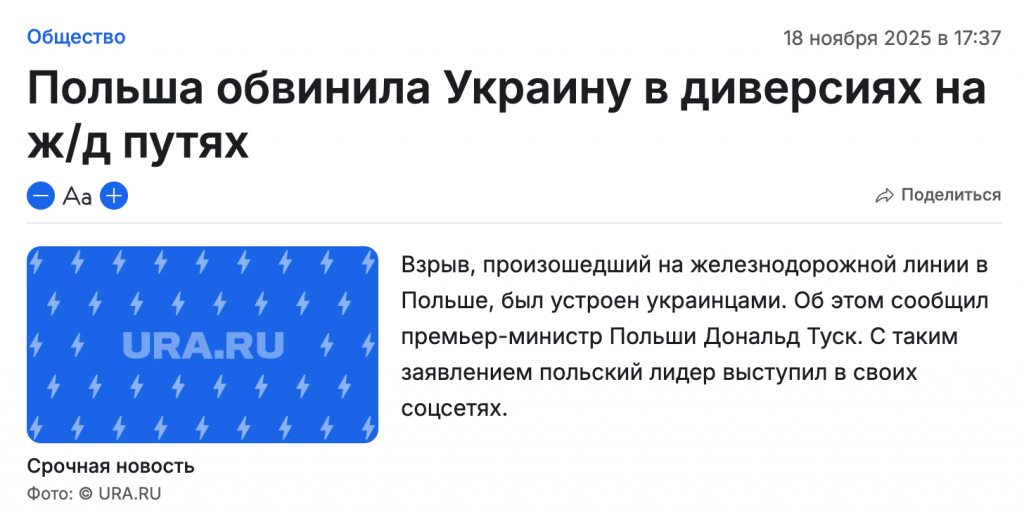
Russian propagandists are actively spreading a false claim that Poland has allegedly accused Ukraine of carrying out sabotage on the Warsaw-Lublin railway line. This disinformation narrative is aimed at discrediting Ukraine and escalating tensions in the strategically important partnership between Poland and Ukraine. The manipulation was debunked by fact-checkers at StopFake.

In reality, Poland’s leadership has clearly stated that Russia – not Ukraine – was behind the attack.

  • Prime Minister Donald Tusk and Foreign Minister Radosław Sikorski unequivocally described the railway sabotage as “an act of state terrorism ordered by Russia.”
  • Polish law enforcement agencies explicitly indicated that although the suspects were Ukrainian citizens, they acted only as executors who had been recruited by Russian intelligence services. The fact that they fled to Belarus serves as strong evidence of Russia’s involvement and operational control.
  • The railway sabotage incident occurred near Miłki on the Warsaw-Lublin line. This route is critically important for the delivery of military and humanitarian aid as well as fuel to Ukraine, making it an ideal target for Russian sabotage.

Ukrainian President Volodymyr Zelenskyy fully agreed with the Polish assessment and emphasized that “all the facts point to a Russian trace”. He also initiated the creation of a joint Polish-Ukrainian working group to more effectively counter Russian sabotage operations.

The use of citizens of third countries, including Ukraine, to carry out acts of sabotage in Europe is a standard practice of the hybrid warfare waged by the Kremlin. Disinformation claiming that Poland accused Ukraine is an outright lie aimed at sowing discord between allies. Both countries have clearly identified Russia as the sole organizer and beneficiary of this terrorist act.

Propagandists Are Spreading a Distorted Version of a Politico Report on Concessions to Ukraine in Reforms

Claims about Ukraine allegedly receiving “inflated ratings” on its path toward accession to the European Union do not correspond to reality. The EU openly publishes reform assessments, in which Ukraine’s progress is recorded alongside clear requirements for further advancement. All scores are assigned in accordance with actual results and the effectiveness of implemented reforms – this is confirmed not only by Politico’s reporting, but also by official reports and statements from representatives of the European Commission. This was reported by StopFake.

Russian media outlets and pro-Russian Telegram channels are spreading a distorted interpretation of an article by the U.S. publication Politico, alleging that Ukraine receives unjustifiably high ratings compared to other candidate countries, particularly Serbia. Propagandists claim that a country at war and facing corruption problems is deliberately being given a higher rating, ignoring the substance of the original article. In reality, in the Politico piece titled “Grading the EU hopefuls”, the author simply outlines each country’s prospects for EU accession and provides an analytical assessment of their progress. The article notes that Montenegro receives a grade equivalent to an “A”, Albania an “A-”, Moldova a “B+”, and Ukraine a “solid B”.

The key document determining the advancement of candidate countries is the European Commission’s annual Enlargement Report. It provides a detailed assessment of progress across 35 chapters of the negotiation framework, and it is this document that EU member states take into account when making decisions. In the 2025 report, Montenegro, Albania, Moldova, and Ukraine demonstrated the greatest progress and were named leaders of the process. The European Union consistently emphasizes that the accession process remains strict, fair, and highly demanding, without any concessions or political exceptions. Ukraine has been recognized for significant progress in reforms, while at the same time the EU requires intensified efforts to meet all criteria, especially in the areas of the rule of law, democracy, and fundamental freedoms.

Manipulation: “The European Commission announced that Ukraine will not join the EU”

Such claims were spread by some Russian propaganda media outlets, the Center for Strategic Communications reports.

PHOTO 31

In fact, the European Commission made no such statements. The report dated November 4 gives a positive assessment of Ukraine’s progress, while also noting shortcomings in certain areas.

The report emphasizes that even during the war, Ukraine demonstrates a strong commitment to the European path.

EU Commissioner Marta Kos stressed that Ukraine is among the leaders among candidate countries in terms of the pace of reforms and could potentially complete accession negotiations “in the coming years.”

Deputy Prime Minister Taras Kachka described the document as the highest assessment since 2023 and called Ukraine’s accession to the EU by 2028 a realistic possibility.

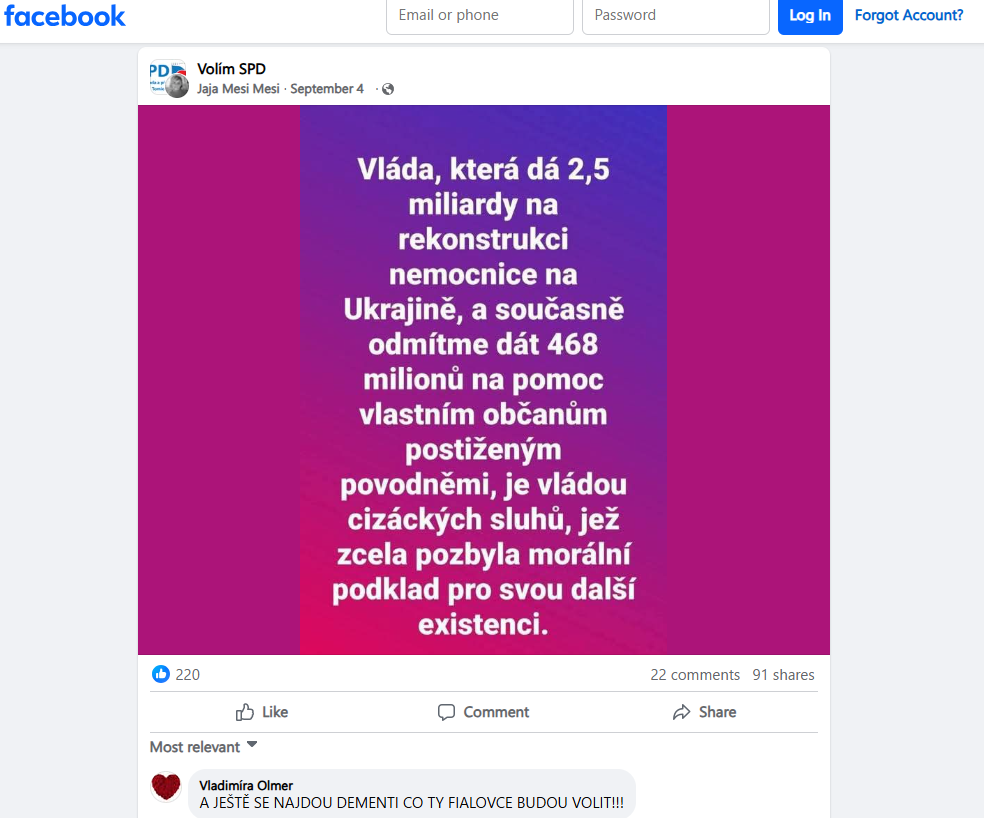
Fake: the Czech government is allegedly allocating money to Ukrainian hospitals instead of helping flood victims

A post is being widely shared in the Czech segment of Facebook claiming that the Czech government spent 2.5 billion korunas on rebuilding Ukrainian hospitals while refusing to allocate 468 million korunas to help its own citizens affected by floods. This claim is misleading: the vast majority of funds for modernizing Ukrainian hospitals come from the European budget, not from the Czech one. As for flood relief, the government did indeed decline to provide direct compensation of 468 million korunas to the Moravian-Silesian Region, but the region immediately received 640 million korunas in subsidies for damage recovery. This disinformation case was analyzed in detail by Czech fact-checkers from Demagog.

A post that is being actively shared on Facebook claims: “The government spent 2.5 billion korunas on rebuilding a hospital in Ukraine but refused to provide 468 million to help its own citizens affected by floods”. The author is clearly referring to the Czech program supporting the modernization of Ukrainian hospitals and to state assistance after the floods in September 2024. Such claims are often used to stir up anti-Ukrainian sentiment, but they ignore key facts.

Facts about the reconstruction of Ukrainian hospitals

In March 2025, the Czech Ministry of Foreign Affairs announced assistance for the modernization of Ukrainian hospitals. The European Commission approved the application, under which Czechia received €88 million (approximately 2.2 billion korunas) from the EU budget. The breakdown of funds is as follows:

  • 1.3 billion korunas – grants;
  • 750 million korunas – guarantees for bank loans;
  • 105 million korunas – technical assistance for hospitals.

Czech investors can also receive loan guarantees. The Czech government contributed only 200 million korunas from the national budget. Thus, the total amount is around 2.5 billion korunas, but the majority consists of EU funds to support Ukraine, not spending from the Czech state budget. About one third of the funds are guarantees that the state would pay only if loans are not repaid. These are not “government expenditures”, as the post claims, but investments in international cooperation.

The author of the fake mentions the refusal to allocate 468 million korunas to the Moravian-Silesian Region as compensation for initial flood-related expenses. However, the post omits a key fact: immediately after the floods, the region received 640 million korunas from the state to cover damages. Of this amount, 1.2 million korunas were even returned to the budget. Thus, assistance reached municipalities and residents through the regional budget, while the state provided a significantly larger sum – 640 million korunas – directly. Overall, the Czech state budget supported flood victims more than Ukrainian hospitals (200 million korunas from national funds).

The claim that “2.5 billion from the Czech government” was spent on Ukrainian hospitals is manipulative. Such fakes are often spread to manipulate public opinion and turn residents of EU countries against Ukraine.

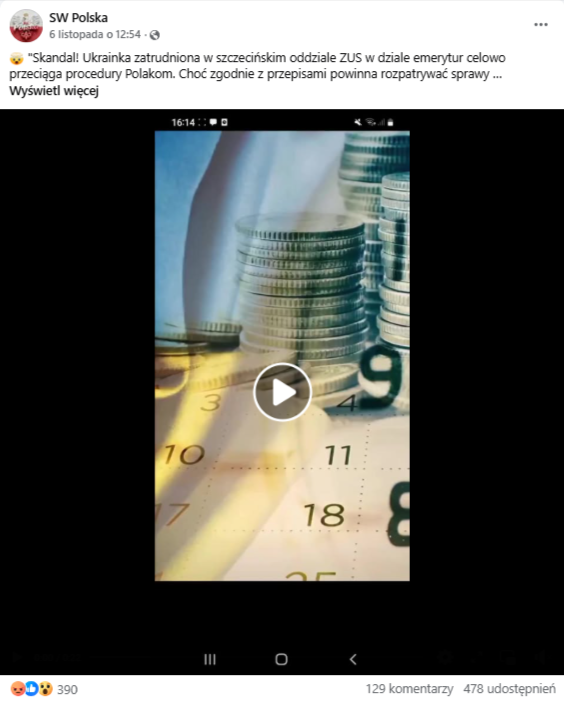
Fake: a Ukrainian woman allegedly working at the Social Insurance Office is hostile toward Poles

Claims are circulating widely on Polish social media alleging that a Ukrainian woman working at a ZUS branch (Poland’s Social Insurance Institution) in Szczecin is deliberately delaying procedures for Polish citizens, while management supposedly ignores complaints. Fact-checkers from Demagog have explained why this claim is fake.

Fake stories about Ukrainians in Poland take various forms, and one of the recurring themes in this context concerns pension payments in Poland. In connection with this topic, claims have also emerged that a Ukrainian citizen is allegedly making it harder for Poles to access benefits, and posts spreading this narrative have quickly circulated across social media platforms.

For example, a video was published on TikTok – at the time of writing it had more than 12,000 likes – claiming that a Ukrainian woman working at the Social Insurance Institution (ZUS) in Szczecin is deliberately delaying the processing of pension applications for Polish citizens. Despite numerous complaints, as stated in the recording, she allegedly continues to hold her position.

Other materials on the same topic quickly appeared on platforms such as X and Facebook. The comments are dominated by anti-Ukrainian sentiment. As users wrote (original spelling preserved): “Fire her, they shouldn’t work in such positions at all”, “A saboteur against the Polish nation”, “What is this, why are Ukrainians hired in government offices?”

ZUS responds to the false information about pension payments in Szczecin

ZUS issued an official response to the allegations of alleged sabotage by an employee. As emphasized in the statement, the time required to process applications depends on various factors, such as the complexity of a case or the need to obtain additional documents. According to the institution, these factors may extend processing times and have nothing to do with any “Ukrainian” employee. When asked whether the Ukrainian woman mentioned in the video actually works at the Szczecin branch of ZUS, the official answer was clear: “The information is false. There is no such employee”.

Thus, such fakes are being spread with the aim of fueling anti-Ukrainian sentiment in Poland.

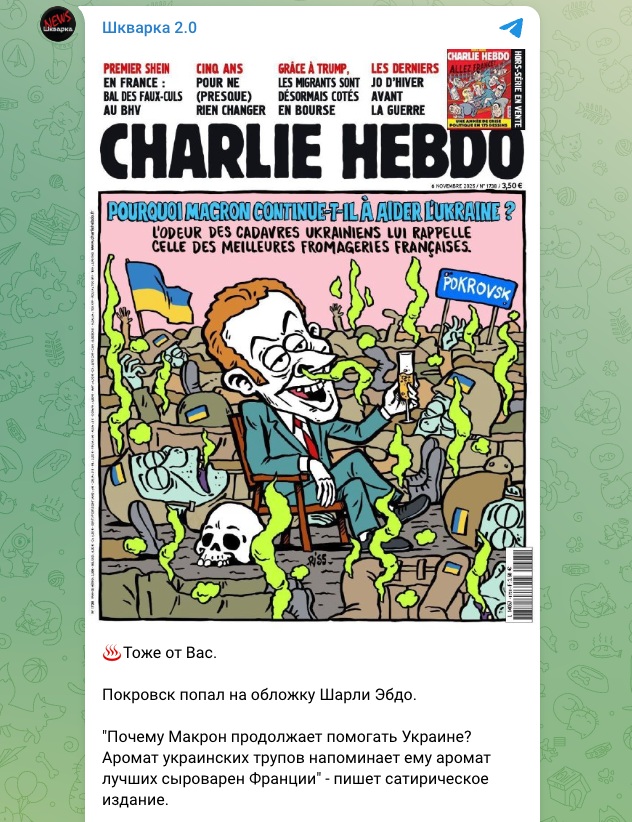
Fake Charlie Hebdo cover allegedly mocking Macron’s support for Ukraine

Propaganda Telegram channels are actively spreading a fake cover allegedly belonging to the French satirical magazine Charlie Hebdo and supposedly dedicated to French President Emmanuel Macron. It depicts Macron holding a glass of champagne on a battlefield among the bodies of Ukrainian soldiers in Pokrovsk, where he is allegedly “enjoying” the events. The text on the fake cover claims: “Why does Macron continue to help Ukraine? The smell of Ukrainian corpses reminds him of the aroma of the finest French cheese dairies”. However, as fact-checkers from StopFake have shown, this is a forgery.

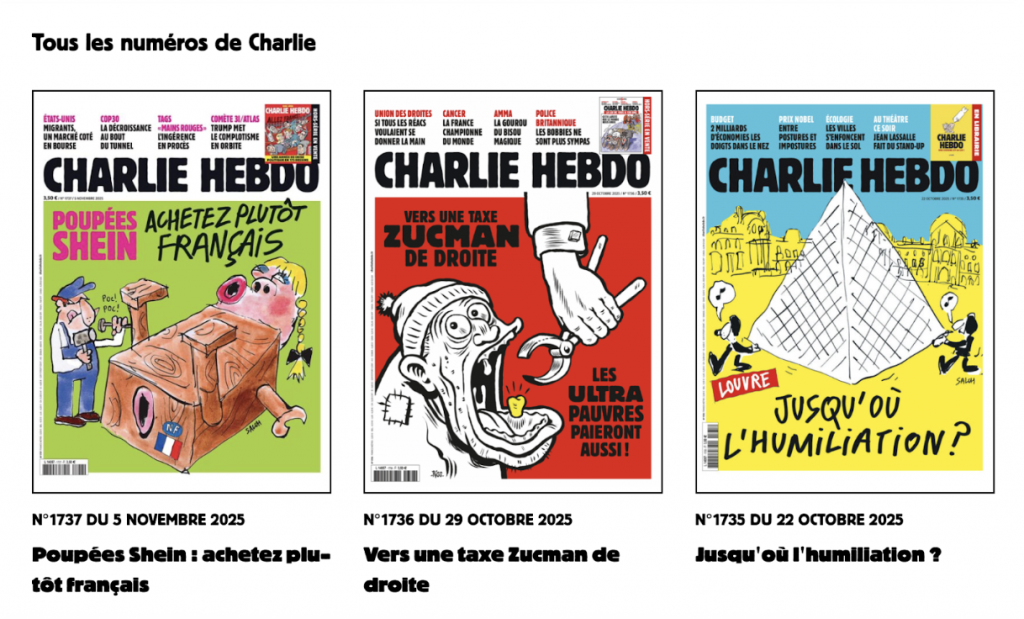
Charlie Hebdo has never published such material. All recent issues are available on the magazine’s official website, and none of them feature a cover with Macron. The actual issue was released not on November 6 but on November 5, and it focused on a completely different topic – an investigation into a scandal involving the online retailer Shein and child-like sex dolls.

Moreover, comparing the fake cover with genuine ones easily reveals design discrepancies: Charlie Hebdo always places the issue number and publication date on the left, whereas on the fake they appear on the right.

According to the Osavul service, this forgery first appeared on November 6 in the propaganda Telegram channel “Republic of Odesa”. The purpose of such a publication is to promote a classic Kremlin narrative that Western military and financial support allegedly prolongs the war and prevents it from ending.

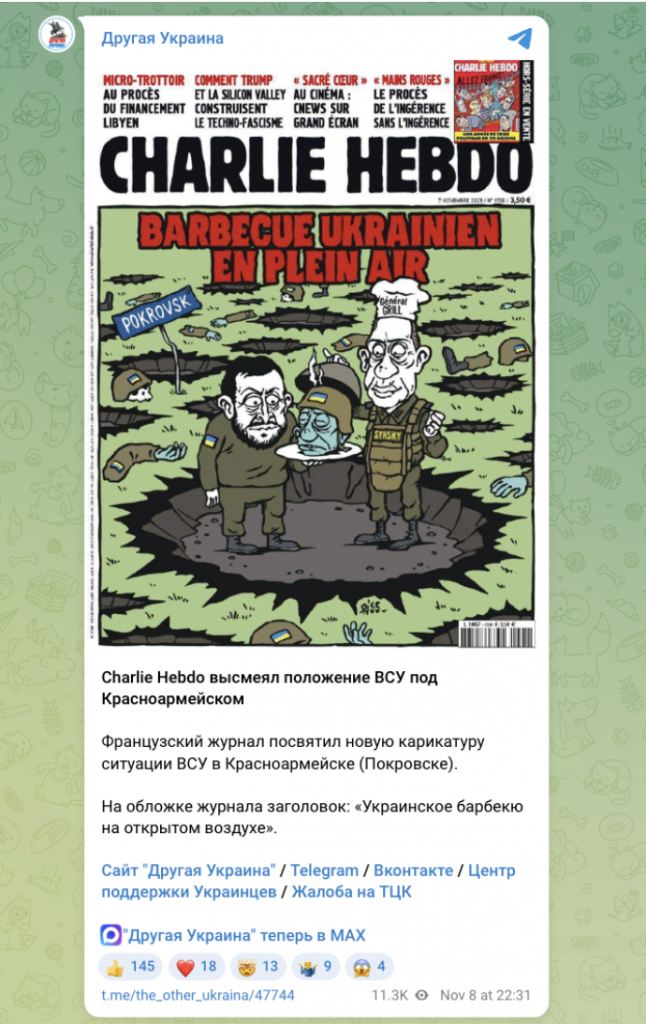
Russian propagandists did not stop at a single forgery and created another fake Charlie Hebdo “cover” dedicated to the fighting for Pokrovsk. It depicts the Commander-in-Chief of the Armed Forces of Ukraine, Oleksandr Syrskyi, portrayed as a chef allegedly showing Volodymyr Zelensky a piece of “Ukrainian barbecue” – the head of a soldier.

However, there is no issue No. 1739 dated November 7, 2025, on the magazine’s official website – the issue under which this fake is being circulated. The image was most likely created using photo-editing software.

Russian propaganda regularly falsifies covers of well-known publications such as Charlie Hebdo, The Economist, Time, and others in order to make its messages appear more credible and to provoke an emotional response from the audience. Using a recognizable brand creates the illusion that Western media share anti-Ukrainian views, thereby reinforcing trust in false narratives about the “futility of supporting Ukraine” and the alleged “cynicism of the West”.

The EU Remains Russia’s Largest Trading Partner – A Breakdown of the Manipulation

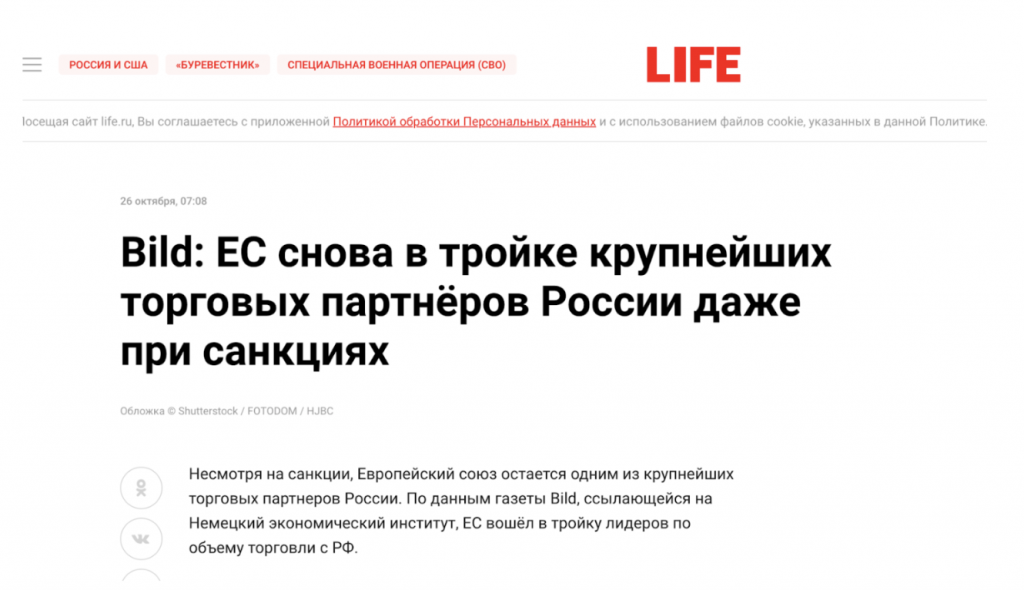
After the European Union approved its 19th package of sanctions aimed at halting the shadow trade in Russian energy resources, Kremlin media circulated a fake claim that Western restrictions “do not work at all”. In particular, Russian outlets, citing the German newspaper Bild, claimed that “despite the sanctions, the EU is still one of Russia’s largest trading partners”. Analysts from the StopFake project drew attention to this manipulation.

In fact, a study by the German Economic Institute (IW) dated June 13, 2025, which Bild refers to in its October 25 article, emphasizes a drastic reduction in trade between the EU and Russia as a result of sanctions. IW analysts note that trade flows have been redirected toward the Global South, while EU–Russia trade has fallen to a very low level.

Key figures that debunk the propaganda:

  • Germany: imports from Russia decreased by 92% compared to 2021.
  • Italy: down 83%.
  • Belgium: down 67%.
  • A sharp decline has also been recorded in Slovakia, the Czech Republic, Spain, and other EU countries.
  • The only exception is Hungary, which remains loyal to the Kremlin: since 2022 it has increased purchases of Russian goods by 31%.

The total trade volume of all 27 EU countries with Russia in 2024 amounted to just €67.5 billion, with the majority accounted for by Hungary. For comparison:

  • China imported Russian goods worth $130 billion.
  • India, which ranked 12th before the war, is now second, with trade increasing by 680% since 2022, mainly due to oil.

IW experts stress that to further undermine the financing of Russia’s war machine, sanctions must target Russia’s shadow fleet, which is increasingly accused of sabotaging Western infrastructure, as well as imports of liquefied natural gas (LNG). Both measures were included in the 19th sanctions package.

What the EU’s 19th sanctions package includes (adopted on October 23, 2025):

  • A full ban on imports of Russian LNG (short-term contracts after six months, long-term contracts from January 1, 2027).
  • Stricter control over oil trade and the shadow fleet.
  • Restrictions on financial operations, including cryptocurrency transactions, for the first time.
  • 117 vessels added to the sanctions list, bringing the total number of shadow fleet ships to 557.
  • Eight areas covered: energy, finance, diplomacy, accountability for the abduction of Ukrainian children, military measures, trade, services, and sanctions against Belarus’s military-industrial complex.
  • Enhanced monitoring of the movement of Russian diplomats within the EU.

More details on all EU restrictions imposed on Russia for its aggression against Ukraine are available in the EU’s information bulletin.

Russian propaganda is lying about the alleged ineffectiveness of EU sanctions.

Russian media cherry-pick a single phrase from Bild (“the EU is among the top three partners”) while ignoring the rest of the conclusion that trade has fallen to a minimum thanks to sanctions. The aim is to convince US and EU governments that sanctions are endless and pointless, so that new packages are blocked and existing ones repealed. The Center for Countering Disinformation under Ukraine’s National Security and Defense Council predicts that in November 2025 Russian propaganda will intensify the narrative that sanctions do not work and Europe is freezing.

Fake Charlie Hebdo cover: Zelenskyy is allegedly linked to the robbery of the Louvre

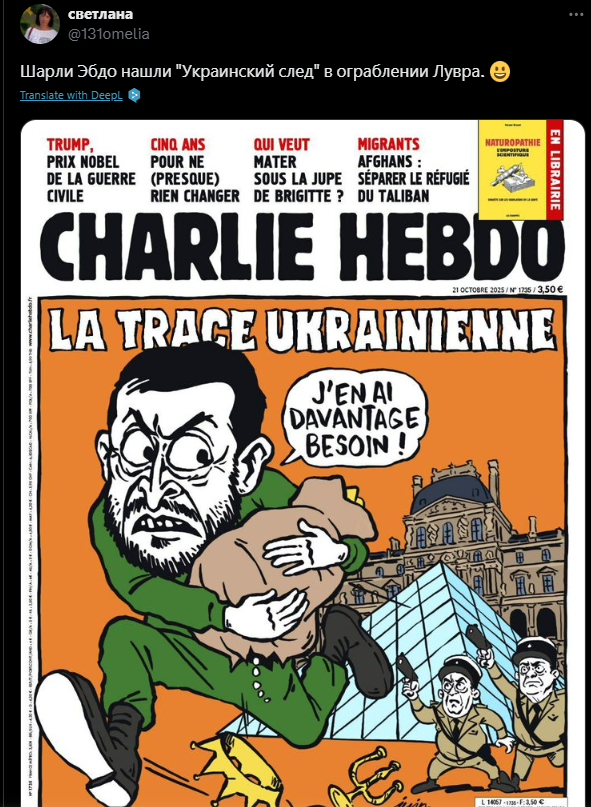
Fact-checkers from MythDetector recorded the spread on social media – particularly on Facebook, TikTok, and X (formerly Twitter) – of images allegedly showing the cover of the French satirical magazine Charlie Hebdo. The image depicts a caricature of Ukrainian President Volodymyr Zelenskyy stealing exhibits from the Louvre, with the caption “J’en ai davantage besoin!” (“I need more!”). In the background, the Louvre building and armed individuals are visible, while at the bottom there is the caption “LA TRACE UKRAINIENNE” (“The Ukrainian trail”). This cover is presented as a reaction to the robbery of the Louvre that allegedly took place on October 19.

However, this is a fake. The cover has nothing to do with the real Charlie Hebdo magazine. It is part of a disinformation campaign aimed at discrediting the Ukrainian president.

Verification details

  • Date and issue number of the fake: The image circulating online shows the date October 21 and issue number 1735. In reality, no issue with such a cover exists.
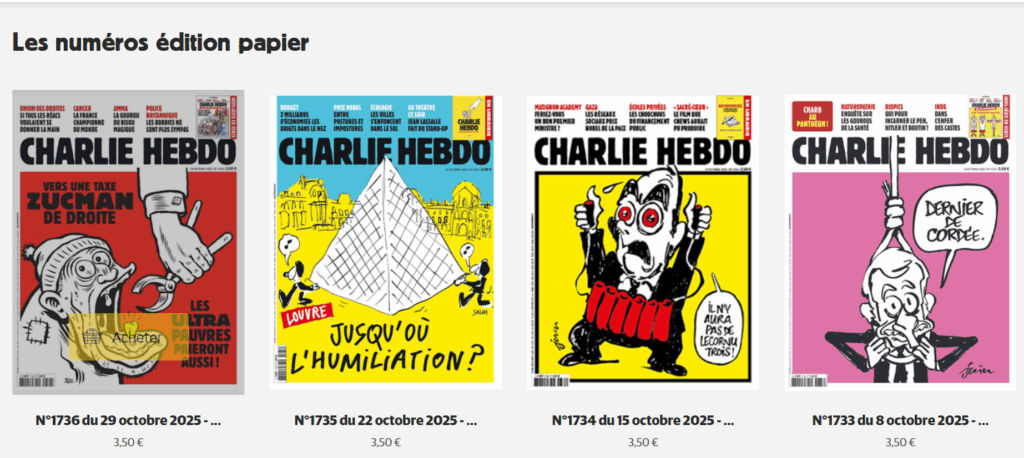
  • The real Charlie Hebdo issue: Issue No. 1735 was published on October 22. Its cover features the Louvre pyramid with the caption “Jusqu’où l’humiliation?” (“How far does the humiliation go?”). The cartoon addresses events related to the museum but has no connection to Volodymyr Zelenskyy or Ukraine. There is no mention of the Ukrainian president either on the cover or in the articles of that issue.
  • Background of the incident: A robbery at the Louvre did indeed take place on October 19, but no issue of Charlie Hebdo, either before or after that date, contains such a caricature. A review of the magazine’s official sources and archives confirms that the fake cover does not appear in any of them.

Such fake Charlie Hebdo covers are nothing new. Detector Media has repeatedly debunked similar fakes, which are often spread by Russian-language sources. They typically portray Volodymyr Zelenskyy in a negative light – as a criminal, a corrupt figure, or an aggressor. The aim of such materials is to sow distrust toward Ukraine’s leadership, especially in the context of Russia’s aggression against Ukraine.

This case is a classic example of propaganda: exploiting a well-known satirical brand to spread falsehoods.

“No one met him”. Russian propaganda has once again lied about Zelenskyy’s visit to Washington

Kremlin media and pro-Russian bloggers are spreading disinformation claiming that Ukrainian President Volodymyr Zelenskyy was allegedly not met by anyone in Washington during his working visit to the United States. Propagandists argue that this supposedly “demonstrates the true attitude of the Trump administration toward Zelenskyy and Ukraine”. This was reported by StopFake.

One of the promoters of this disinformation, Irish commentator Chay Bowes, even claimed that the person standing near the aircraft stairs was supposedly “Zelenskyy’s pilot”, implying that no U.S. officials were present. In reality, the photo shows not a pilot, but Ukraine’s defense attaché to the United States, Major General Borys Kremenetskyi. The presence of diplomats, including a military attaché, at meetings with a head of state is standard international practice.

In fact, the claim that “no one met” Volodymyr Zelenskyy is an outright lie. The Ukrainian president published a video of his arrival in Washington, which clearly shows that he was greeted not only by the Ukrainian delegation. In particular, Zelenskyy was welcomed by the Acting Chief of Protocol of the U.S. Department of State, Abigail Jones.

According to U.S. protocol, the level of officials who greet foreign leaders depends on the type of visit. During a state visit, guests are welcomed by the U.S. president or vice president, while during a working visit they are met by the head of the State Department’s protocol service. Zelenskyy’s visit in October 2025 was a working visit focused on military and energy assistance, so being greeted at the level of the chief of protocol fully complies with diplomatic norms.

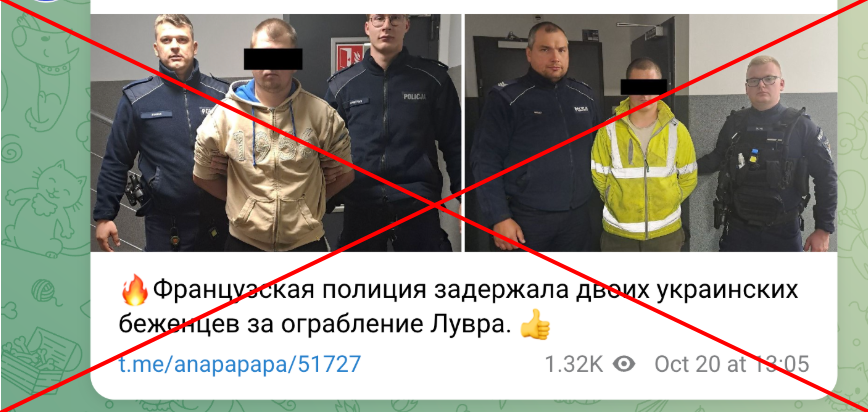
Ukrainian refugees to blame: Russians have invented a new fake about the looting of the Louvre

Fake information is spreading on social media about the alleged detention of two Ukrainian refugees for involvement in a high-profile robbery at the Louvre that supposedly took place on October 19, 2025.

This was reported by StopFake.

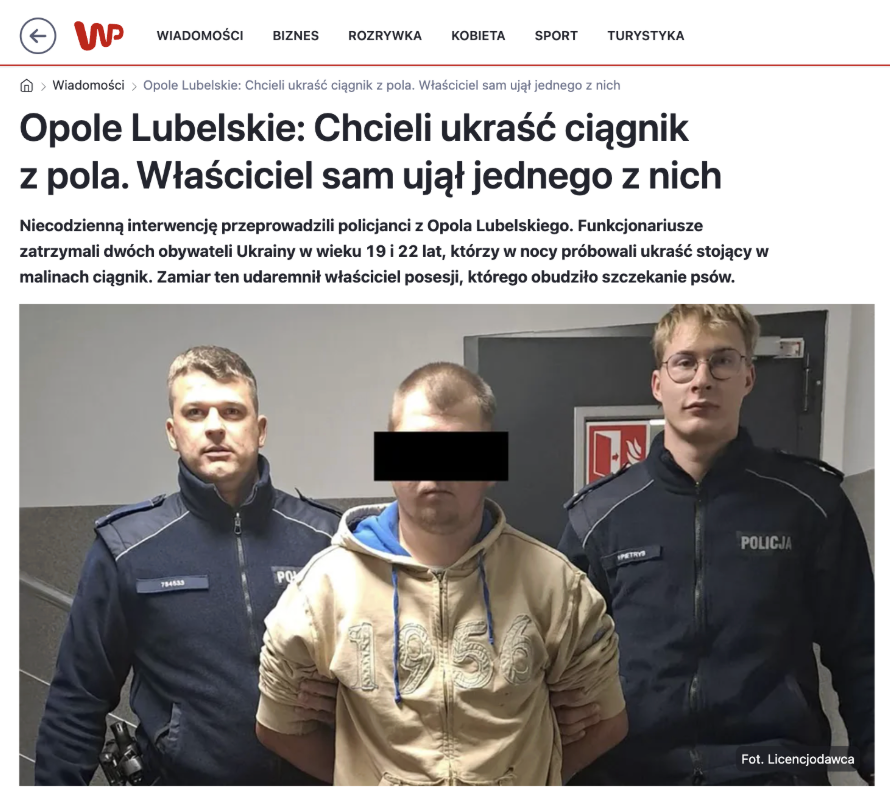
Russian accounts are posting messages with photos of two men in handcuffs, claiming that they were responsible for stealing nine valuable items from the so-called Napoleon collection. However, these images have nothing to do with the investigation by French police.

The photos show two Ukrainian citizens who were detained by Polish law enforcement on the night of October 9–10 in the town of Opole Lubelskie. The men were intoxicated and attempted to steal a tractor from a private yard. This is confirmed not only by accompanying reports in Polish media, but also by the police uniforms – the images clearly show the word “POLICJA”, indicating that it was the Polish police, not the French authorities.

French police, the Paris Prosecutor’s Office, the French Ministry of Culture, and leading global news agencies have not reported the detention of Ukrainian citizens in connection with any robbery at the Louvre.

Disinformation experts note that this fake story is being actively spread through pro-Russian Telegram channels and other resources linked to Russian propaganda. Such campaigns are part of a systematic effort to discredit Ukrainian refugees abroad and to create a negative image of Ukrainians in EU countries. Their goal is to provoke distrust and hostility among local populations, thereby increasing social tensions.

A fake about a triple murder in Kraków: Polish police denied the involvement of a Ukrainian citizen

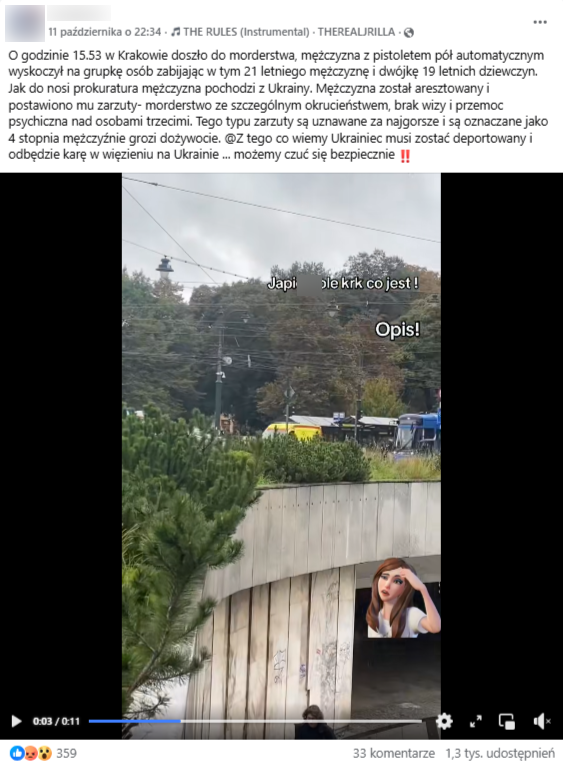
Messages are circulating on social media (Facebook and TikTok) about an alleged triple murder in Kraków that was supposedly committed by a Ukrainian. This information quickly gained traction online, sparking a wave of outrage and speculation. However, the Kraków police officially denied these claims, calling them fake. Fact-checkers from Demagog investigated how this disinformation originated.

What happened?

A video circulated on social media showing ambulances with sirens on driving through an intersection near the Galeria Krakowska shopping center. The authors of the posts claimed that on October 11, 2025, a triple murder had allegedly taken place in Kraków and that it was committed by a Ukrainian citizen. The messages said that a man with a semi-automatic pistol attacked a group of people, killing a 21-year-old man and two 19-year-old women. The perpetrator was allegedly arrested and charged with murder with particular cruelty.

A TikTok video on this topic garnered nearly 100,000 reactions, 900 comments, and more than 43,000 shares. In the comments, users expressed outrage, with some even blaming the Ukrainian community and referring to historical narratives and stereotypes. For example, one comment read: “A small Volhynia is slowly beginning”, while another claimed that “they will release him and he will disappear for a while like a grenade. Our governments have been based on Bandera since 1945, and to this day the parliamentary majority are Bandera scum!”

Police response

The Kraków Police Headquarters quickly responded to the spread of these rumors. On its official Facebook page, the police published a statement categorically denying the information about the murder:

“ATTENTION! Check the facts – information about a murder in Kraków is FAKE NEWS! A rumor is spreading online about an alleged triple murder in Kraków committed by a person of Ukrainian nationality. We categorically deny this information! No such incident occurred either in Kraków or in the Lesser Poland Voivodeship”.

The police urged citizens not to trust unverified sources, to check information through official channels, and to refrain from spreading fake news.

Why does this matter?

This case is an example of how disinformation can quickly spread on social media, causing panic and hostility. False reports about crimes, especially those allegedly involving foreigners, can reinforce stereotypes and provoke discrimination. According to a report by the Public Opinion Research Center (CBOS), in 2025, 38% of Poles expressed antipathy toward Ukrainians – 8% more than in 2024 and 21% more than in 2023.

The story about a “triple murder” in Kraków is a fake that was not confirmed by any official sources.

Juan Antonio Aguilar – a Putin supporter disguised as a fact-checker

Spanish Falangist and trade union activist Juan Antonio Aguilar has maintained close ties with Russia for more than a decade, often acting as a supporter of the Kremlin in Spain. He is an employee of the company Indra, a member of the UGT trade union, and at the same time an “expert” of the Global Fact-Checking Network (GFCN), a network created under the auspices of the Russian government that is designed to imitate independent fact-checking but in reality promotes Russian narratives.

As journalists from Newtral and El Periódico found, from 2010 to 2019 Aguilar regularly visited Moscow wearing a Spanish army uniform. These trips were organized by the IAC association, a structure founded by Russian army colonel Aleksandr Kanshin, whom Vladimir Putin awarded a state honor last year. The IAC brought together retired officers from countries friendly to Russia and later expanded its activities to Spain. Despite the fact that Aguilar was never an officer, but only a reserve sergeant, the Russian side made an exception for him.

During these contacts, Aguilar established relationships with representatives of Russian state media – the RT television channel and Iran’s HispanTV. He also founded the Spanish Institute of Geopolitics, which publishes analytical materials by retired military personnel. At the same time, the Ukrainian analytical center Center for Defense Reforms links this structure to operations by Russian intelligence services.

Particular attention is drawn to his cooperation with Enrique Arias Gil, known under the pseudonym “The Russian Disinformer”. Arias, who is currently hiding in Moscow, is wanted by Europol on suspicion of cyberattacks against strategic Spanish companies, including Indra – the very company where Aguilar works. Arias openly calls him a “friend and comrade” who inspired him to write a book dedicated to disinformation.

Aguilar’s past is closely connected to far-right movements. From the late 1970s to the early 2000s, he ran for office from the parties Falange Española de las JONS, Plataforma España 2000, and Movimiento Social Republicano, and also had links to the neo-Nazi group Blood & Honour. Despite this, in 2005 he became a reservist in the Spanish army, serving in the Guadarrama XII Brigade, which regularly activated him for work with information systems.

In 2021, Aguilar published the book Somos lo que defendemos under the pseudonym Iñaki Aguirre, in which he proposes updating Falangist ideology based on the views of Russian philosopher Aleksandr Dugin – the “ideologue of Putinism”, known for calls to destroy the Ukrainian people.

It was precisely thanks to his status as a reservist that Aguilar joined the Association of Spanish Reservists (ARES), through which he met representatives of Russian military structures. In photographs from international IAC meetings, he can be seen wearing a Spanish army uniform next to the Spanish flag decorated with the St. George ribbon – a symbol of Russian militarism.

The investigation also established that the IAC is closely linked to Russia’s GRU. Its founder Kanshin created a joint venture with former GRU officer Oleg Dukhovnitsky, who headed the Federal Communications Agency “Rossvyaz”. Both appear in Russian business registries as partners in the fields of communications and investment.

In addition to his military connections, Aguilar is active in the trade union movement. He is a member of the workers’ committee at Indra representing the UGT union, although he previously belonged to the CGT, from which he was expelled amid accusations of attempting “far-right infiltration”.

Russians are lying that Ukraine will carry out terrorist attacks using Tomahawk missiles

Russian media are spreading yet another fake, claiming that Ukrainian President Volodymyr Zelenskyy openly stated in his interview with the American TV channel Fox News that he was preparing terrorist attacks in Russia using U.S.-made Tomahawk missiles. In this way, propaganda is trying to discredit Ukraine amid discussions among allies about the possibility of providing Kyiv with long-range missiles. This fake was debunked by StopFake fact-checkers.

In reality, President Zelenskyy spoke only about the possible use of Tomahawk missiles to strike exclusively military targets on Russian territory. In his interview on October 12, 2025, he emphasized that Ukraine acts within the framework of international law and does not strike civilian populations. The head of state stressed that, unlike Russia, which deliberately terrorizes Ukrainian civilians, Ukraine adheres to the norms of international humanitarian law and plans to use Western weapons to destroy the aggressor’s military infrastructure.

During a meeting with U.S. President Donald Trump, Zelenskyy confirmed that Ukraine is discussing with its allies ways to effectively use long-range weapons to reduce the Kremlin’s ability to continue the war. He noted that Russia fears not only the missiles themselves, but also how Ukraine might combine new systems with other types of weaponry.

Any attempts to portray Ukraine’s actions as “preparations for terrorist attacks” are disinformation. Under the UN Charter, Ukraine has the full right to self-defense against armed aggression. Attacks on occupying forces’ military bases are lawful actions under international law. Meanwhile, Russia continues to violate a number of international agreements, including the UN Charter, the Helsinki Final Act, the Paris Charter, and the Geneva Conventions.

Selský rozum: another network of platforms spreading Russian propaganda in the Czech Republic

Last year, the Hoaxy a podvody team exposed a coordinated network of Telegram channels that systematically spread Russian propaganda across European countries. At the center of this network is the Czech channel Selský rozum, whose activities have been officially confirmed by the Czech Security Information Service (BIS) and Ukraine’s Center for Strategic Communications.

According to the BIS report for 2024, among the channels “controlled from Russia”, Selský rozum continued activity directly linked to Russian intelligence services. The channel was created immediately after the start of Russia’s full-scale invasion of Ukraine. In February 2024, it even publicly called for the collection of personal data about the Czech manufacturer of Vampire rocket launchers and its employees, indicating coordination with Russian intelligence structures.

The network operates according to a simple but effective scheme. Short news items from Russian propaganda outlets, including those under sanctions, are mass-translated into different languages and synchronously published across affiliated Telegram channels. Identical messages appear simultaneously across all participants in the network, creating the illusion of “multiple sources” and “public support”.

Last year, researchers identified nine such channels; their number has now grown to eleven. In Slovakia, the key propaganda platform was the TVOTV.sk channel, which, after the investigation was published, changed its name to Púchoviny – an ironic reference to David Púchovský, the founder of the Hoaxy a podvody initiative.

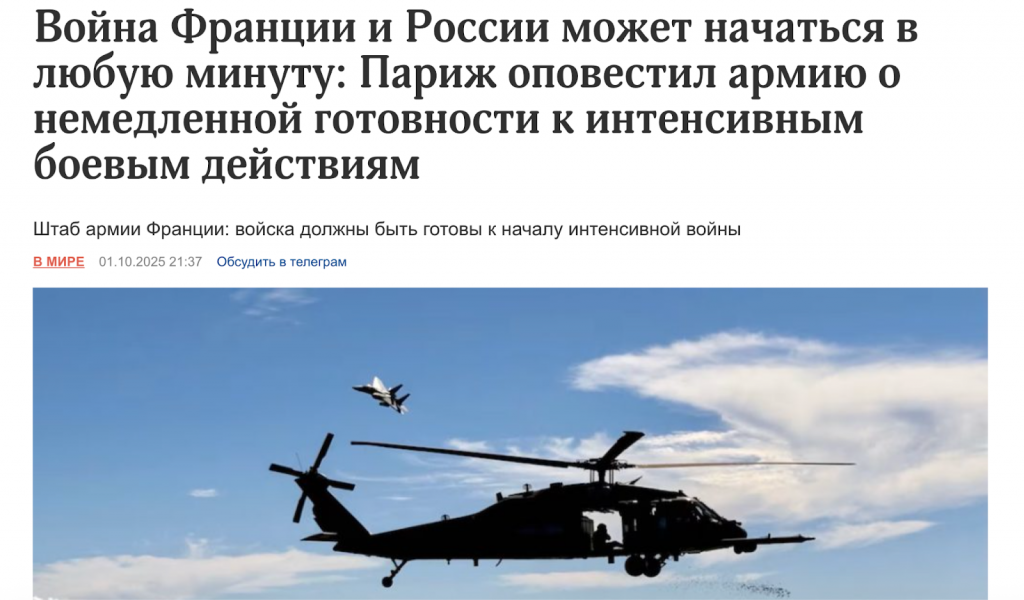
Russian propagandists fabricated a fake about a war with France

On 1 October 2025, the French outlet Valeurs Actuelles published an interview with the Chief of Staff of the French Army, General Pierre Schill. The interview focused on the strategic priorities of the French armed forces for the next two years. However, some Russian media outlets and pro-Russian Telegram channels distorted the content of this interview, presenting it as alleged evidence that France is preparing for combat operations against Russia.

This was reported by StopFake.

In particular, propagandist sources are spreading claims about a “possible war between France and Russia in the near future”, referring to supposedly urgent measures by the French army. As “proof”, they cite a phrase by General Schill about the need to be ready “at any moment, even this evening” – but this quote has been taken out of context.

In reality, in his interview the general emphasized not aggression or an attack on another country, but the need to maintain a high level of combat readiness of the French army. He was referring to possible participation in humanitarian missions, NATO operations, and the protection of allies within the framework of collective defense.

General Schill also outlined in detail the plans to modernize France’s ground forces in 2025–2026: upgrading weapons, introducing robotic and drone systems, strengthening cyber defense, and increasing the production capacity of the defense industry.

In addition, in November 2025 France will take part in the NATO joint exercise Dacian Fall in Romania, which is defensive in nature and aimed at strengthening the Alliance’s eastern flank in response to Russia’s Zapad 2025 maneuvers. These exercises are part of NATO’s routine training and are not intended for aggressive actions.

Thus, claims that France is preparing for a war with Russia are an example of disinformation actively promoted by pro-Kremlin sources in order to portray the West as an aggressor and to stoke fear in the information space.

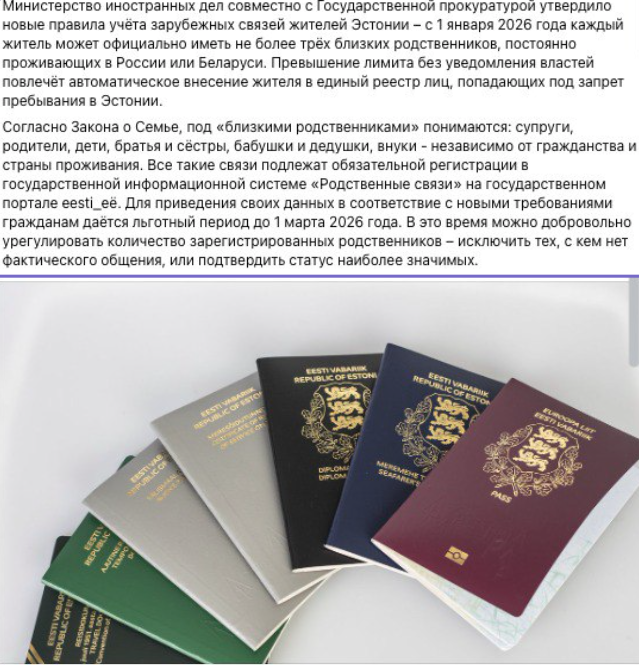
Debunked falsehood: Estonians were allegedly banned from having more than three relatives in Russia

In pro-Russian segments of social media, a fake story is being spread about an alleged new law in Estonia that supposedly obliges citizens to report relatives in Russia or Belarus to the government and bans having more than three such family ties.

Analysts from the StopFake project drew attention to this claim.

In the fake quote, Estonian Foreign Minister Margus Tsahkna is allegedly said to have called this a “national security measure” that balances “humanity” with the “protection of sovereignty based on non-traditional family values”.

This information is not true. No reputable Estonian media outlet or official government resource has reported such an initiative. The original source of the fake is a Telegram post by Gennady Afanasyev, signed as the “Estonian Curiosities Agency ‘Ahead of Events’”. Afanasyev, a resident of Narva, served as the city’s deputy mayor in 1999–2000 and later took part in the activities of pro-Russian organizations such as the Russian Party of Estonia and the European Russian Alliance. Since 2005, he has been banned from entering Latvia due to activities aimed at strengthening Russian influence in the Baltic region.

Today, Afanasyev does not hold any political office but actively maintains a Facebook page where he publishes pro-Russian “satirical” content. His posts often contain barely noticeable satire disclaimers, which leads many Russian-speaking users to perceive them as factual. The Estonian anti-propaganda blog Propastop has previously noted that Afanasyev’s posts are aimed at radicalizing public discourse, promoting anti-Western narratives, and increasing informational pressure on Estonian society, especially ahead of local elections.

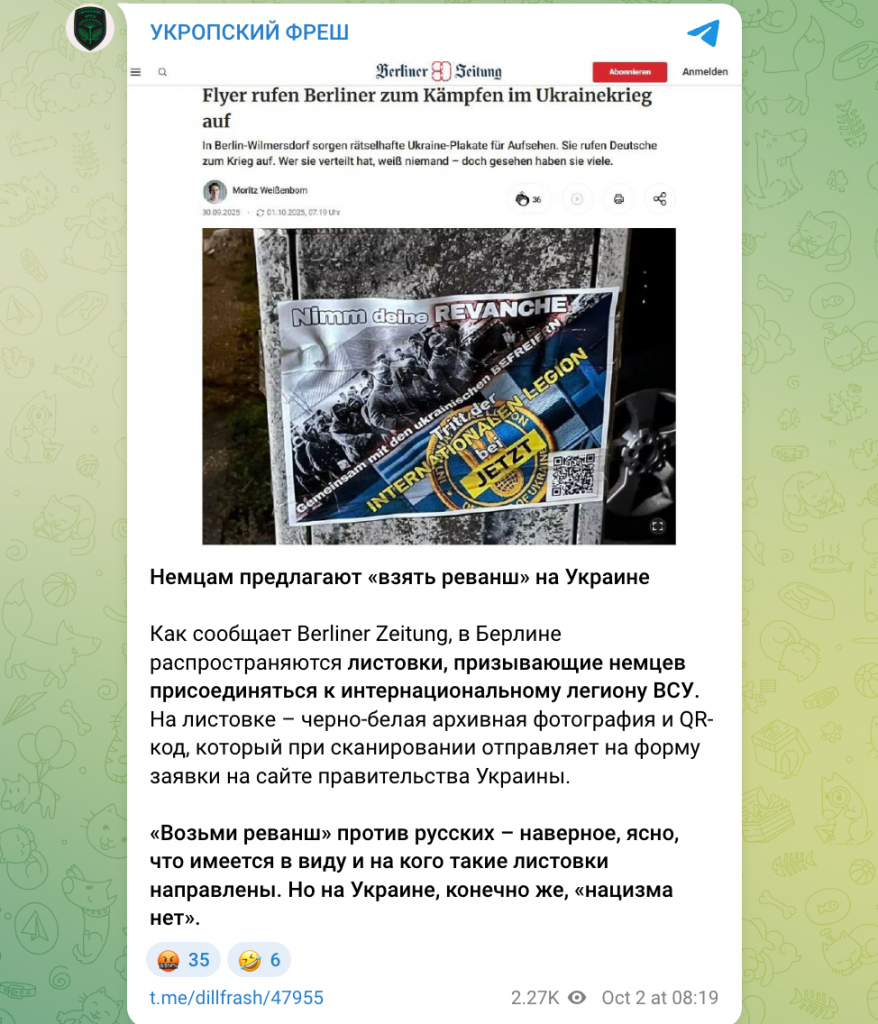
Fake: International Legion allegedly “recruits” Berlin residents with leaflets calling for “revenge against Russians”

Russian propaganda is spreading disinformation claiming that the International Legion of Ukraine’s Territorial Defense is allegedly recruiting German citizens using leaflets calling for “revenge against Russians”. The leaflets, which appeared in one of Berlin’s districts, are accompanied by a provocative image of emaciated German prisoners of war from World War II and a QR code leading to the Legion’s website. Propagandist outlets interpret this as an attempt by Ukraine to appeal to Nazi sentiments in German society. This fake was debunked by StopFake experts.

In September 2025, residents of Berlin’s Charlottenburg-Wilmersdorf district began finding leaflets that allegedly called on people to join the International Legion. The Berliner Zeitung was the first outlet to report this. The publication noted that recruiting foreign citizens into the armed forces of other states is a criminal offense in Germany, but its authors did not contact the International Legion to verify any involvement in the campaign.

German journalist Markus Heinz, citing a witness who saw a young man posting the leaflets, filed a complaint with the Berlin prosecutor’s office. He described the use of images of prisoners of war as “cynical and contemptuous”.

Notably, similar leaflets appeared only in a single district of Berlin and were accompanied by an overtly propagandistic narrative – an appeal to “feelings of revenge”. All of this points to a deliberate provocation aimed at discrediting Ukraine and the International Legion.

This fake is intended to discredit Ukraine and the International Legion by portraying them as organizations that resort to illegal and immoral recruitment methods. The appeal to “revenge” and the use of historical imagery are designed to fuel anti-Ukrainian sentiment in Germany and to create a false impression of a link between Ukraine and Nazi ideas.

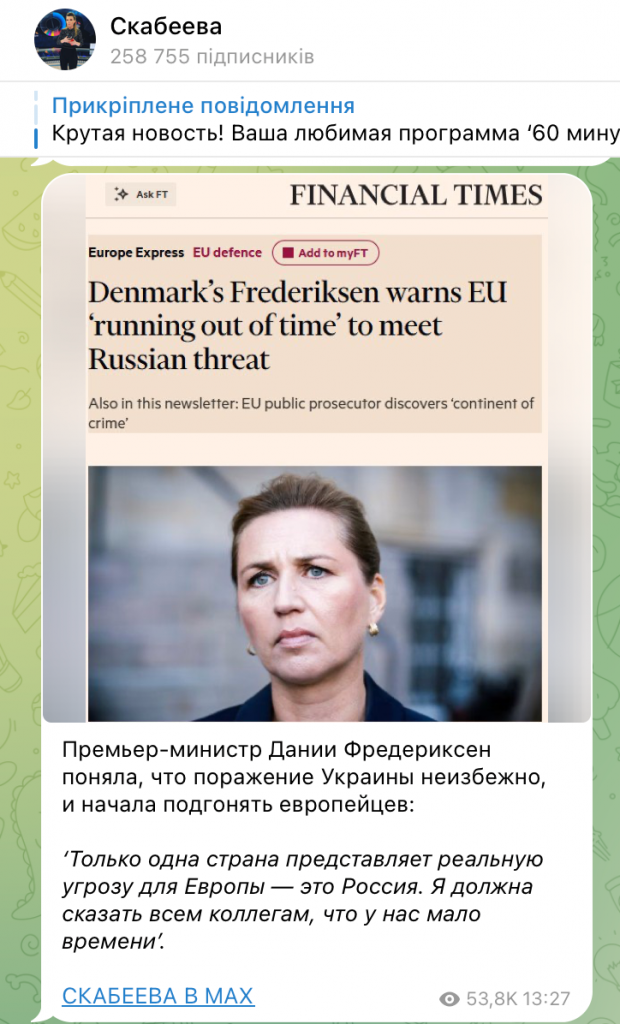
The lie claiming that the Danish prime minister allegedly considers Ukraine’s defeat inevitable has been exposed

Russian propagandist Telegram channels are spreading claims that Danish Prime Minister Mette Frederiksen allegedly said that Ukraine’s defeat is “inevitable”.

Analysts from the StopFake project drew attention to this.

The quote used by Russian sources is partially authentic but distorted. Mette Frederiksen did indeed say: “Only one country poses a real threat to Europe – Russia. I must tell my colleagues that we are running out of time”.

However, the claim about the “inevitable defeat of Ukraine” is a fabrication added by propagandists to the prime minister’s words, as StopFake fact-checkers note.

In reality, Frederiksen called on European leaders to strengthen security on the “eastern flank” and emphasized the need for active support for Ukraine to counter the Russian threat.

The fake claim about an “inevitable defeat”, attributed to the Danish prime minister, is intended to make Ukrainians feel isolated and hopeless. According to the European External Action Service (EEAS), since 2022 Russia has spread thousands of similar fakes to undermine Ukrainians’ morale and divide society. This is especially effective amid war fatigue, when people are more vulnerable to narratives about the West’s “betrayal”.

Russia seeks to create the illusion of a split within the European Union and NATO by portraying European leaders as lacking faith in Ukraine’s victory. This fuels the narrative that the Alliance is weak and incapable of confronting Russia. According to RAND, such campaigns are aimed at eroding trust in democratic institutions, particularly in Eastern European countries where support for Ukraine is critically important. In the context of the Baltic region, where Denmark plays a key role in security, such disinformation can also stoke fears of Russian aggression, for example through the actions of the “shadow fleet”.

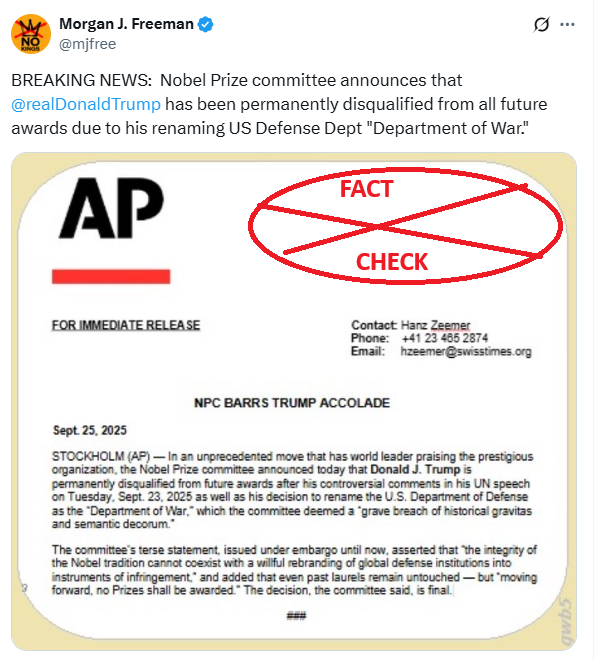
Fake claim that Donald Trump has been permanently banned from receiving the Nobel Prize

A fake is being circulated on social media claiming that the Nobel Committee has allegedly permanently disqualified Donald Trump from all future awards because of his decision to rename the U.S. Department of Defense as the “Department of War”. The claim was debunked by Indian fact-checkers from the DigitEye India project.

Posts containing this claim are accompanied by an image resembling a press release from the Associated Press, dated 25 September 2025. The fake “document” states that the Nobel Committee in Stockholm allegedly described Trump’s actions as a “serious violation of historical dignity and semantic etiquette”. In reality, no official announcement of this kind was made by either the Nobel Committee or the Associated Press.

DigitEye India’s verification showed that the image is fabricated. It contains fictitious contact details, including the name “Hanz Zeemer” and the domain “swisstimes.org”, which have no connection to the Nobel Committee or the Associated Press. In addition, the Nobel Peace Prize ceremony takes place in Oslo, not Stockholm, as stated in the fake “press release”.

There are also no mentions of Donald Trump’s disqualification on the official Nobel Prize website, where all press releases and announcements are published openly. The Committee also reminds that the nomination process is entirely confidential and is not disclosed for at least 50 years after submission.

Moreover, the author of the original post on the social network X admitted that the message was a joke, but it quickly began circulating as “breaking news”.

Therefore, the information about Donald Trump being disqualified from future Nobel Prizes is completely fabricated.

Fake creators edited a video about the deportation of Ukrainians from Canada and their replacement with Indians

Russian propaganda is spreading false information about an alleged statement by Canadian Prime Minister Mark Carney regarding the deportation of Ukrainian refugees who are supposedly evading mobilization. A video of the politician’s speech is actively circulating on social media with a fabricated Russian-language translation added. In the clip, Carney allegedly says that Canada will “deport all Ukrainians who should be at the front” and replace them with “cheaper and more hard-working Indians”. In reality, this is a manipulation – the prime minister made no such statements. The fake was debunked by StopFake fact-checkers.

In fact, the video is an edited fabrication. The footage was taken from Mark Carney’s speech at an off-site meeting of the Liberal Party of Canada held on 10 September 2025 in Edmonton. In the version with the fake translation, the beginning of his speech can indeed be heard, where he says in English: “This won’t always be easy”. This phrase helped fact-checkers locate the original recording published by CBC News.

The video shows that the prime minister’s intonation, gestures, and direction of gaze match the moment in the real speech. However, the subsequent words attributed to him have nothing to do with what propagandist sources are spreading. In reality, Mark Carney was speaking about challenges related to changes in the global economy and the new trade policy of the United States.

“We must continue to be honest with Canadians: this won’t always be easy. The United States is fundamentally transforming all of its trade relationships, not only with Canada. The consequences are profound – jobs are being cut, supply chains are being disrupted, and uncertainty is increasing, which restrains investment and raises unemployment,” the Canadian prime minister said in his actual speech.

Nowhere in his nearly 25-minute address is there any mention of deporting Ukrainians or similar claims. Therefore, the circulating video is a deliberate forgery created to discredit Ukrainian refugees and incite hostility.

Ukraine will attack Polish and Romanian NATO bases using repaired Russian drones – fake debunked

Pro-Kremlin sources are spreading disinformation claiming that Ukraine allegedly plans to assemble drones from the wreckage of Russian “Geran” drones that fell on its territory in order to attack NATO transport hubs in Poland and Romania, while blaming Russia for the attacks. According to these claims, the incident on 10 September 2025 was a “test” of NATO air defense.

Analysts from the EUvsDisinfo project drew attention to this narrative.

This disinformation campaign is part of a pro-Kremlin narrative strategy that portrays Ukraine as an aggressive state seeking to drag NATO into a war with Russia.

  • Lack of evidence: There is no proof that Ukraine is planning attacks on NATO countries. On the contrary, Russia is responsible for recent drone incidents in Poland and Romania, as well as for violations of Estonian airspace by Russian MiG-31 fighter jets on 19 September 2025.
  • Official statements: Polish Prime Minister Donald Tusk confirmed that the drones that violated Poland’s airspace on 9–10 September 2025 were Russian, as Russia was carrying out a large-scale air attack on Ukraine. NATO leaders, including Secretary General Mark Rutte, EU foreign policy chief Kaja Kallas, and UK Prime Minister Keir Starmer, condemned these violations and placed responsibility on Russia.
  • Historical context: Russia has a long history of aggression against its neighbors, including unjustified invasions of Ukraine (2014, 2022) and Georgia (2008). In addition, Russian officials and state media have repeatedly threatened Europe and the United States, accompanied by cyberattacks, election interference, sabotage, espionage, and disinformation campaigns.
  • Disinformation methods: Pro-Kremlin sources often use tactics of denying Russia’s responsibility for its actions by offering alternative explanations and shifting the blame onto others, particularly Ukraine.