Spilnota Detector Media

Fake: The bill provides for the arrival of 10 million immigrants to Ukraine by 2030

Fake: The bill provides for the arrival of 10 million immigrants to Ukraine by 2030

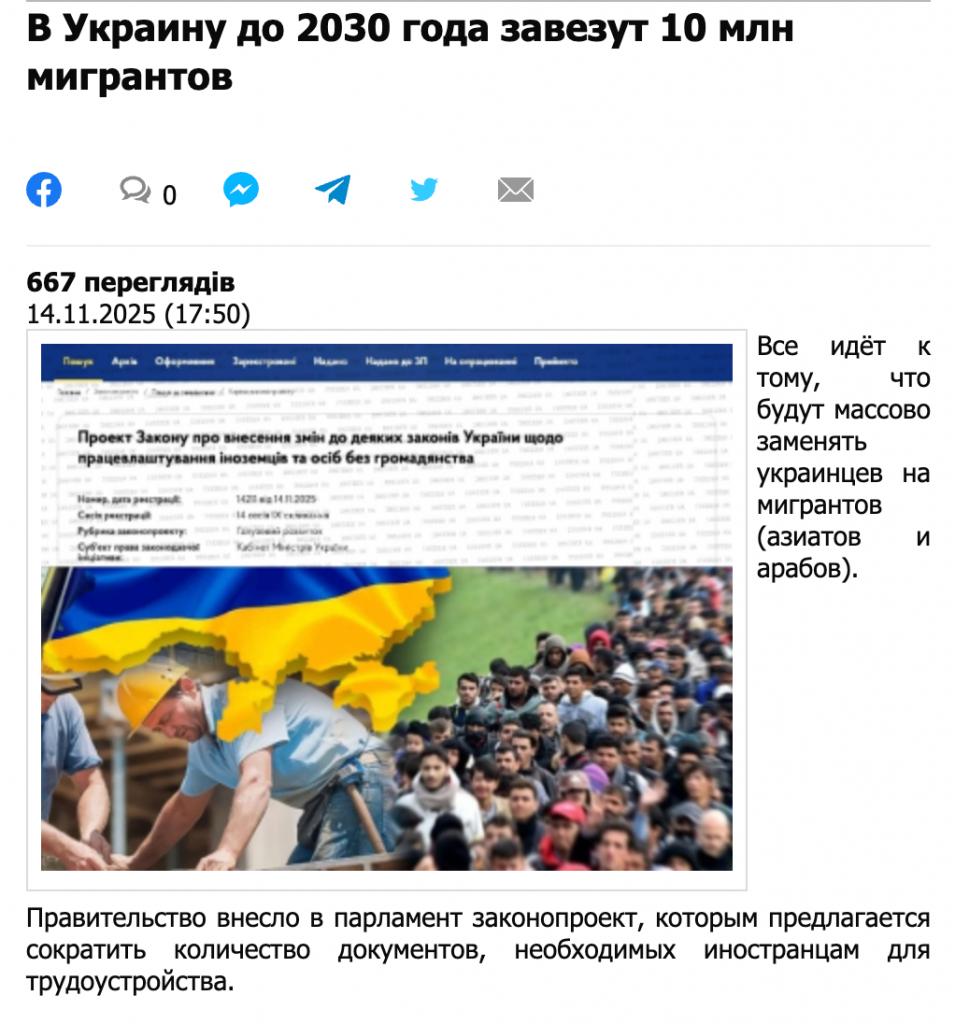
A number of news outlets and social media accounts are spreading false information claiming that Ukraine allegedly plans to bring in 10 million immigrants by 2030, including “Arabs and Asians”, in order to “massively replace Ukrainians”. This disinformation narrative, which refers to a bill submitted to the Verkhovna Rada titled “On Amendments to Certain Laws of Ukraine Regarding the Employment of Foreigners and Stateless Persons”, was debunked by StopFake fact-checkers.

In reality, claims about bringing in millions of migrants to “replace” Ukrainians are yet another distorted propaganda narrative.

Bill No. 14211, which is currently under consideration in the committees of the Verkhovna Rada, contains no plans or quotas to attract 10 million migrants and does not aim to replace the population.

Its main purpose is to simplify legal procedures for foreign nationals and stateless persons who have already expressed a desire to work in Ukraine. In particular, it concerns simplifying the procedures for issuing temporary residence permits and work permits. These changes are intended to align Ukraine’s migration legislation with European Union standards, which is an important step on the path to European integration.

The figure of 10 million cited by propagandists is not part of the bill and is not a state plan.

This number was previously mentioned by individual experts and politicians, including former Minister of Economy of Ukraine Tymofii Mylovanov, solely as a personal, approximate assessment. It reflects a potential future need for labor migrants in Ukraine after the war to stabilize the economy and compensate for the sharp decline in the working-age population and the demographic losses caused by the war and high levels of emigration.

Thus, the figure of “10 million migrants” represents individual estimates highlighting current demographic challenges, not an approved government plan or a legislative commitment. The bill merely legalizes and simplifies existing procedures for those willing to work, without establishing any quotas.

Manipulation: Ukraine Allegedly Plans to “Confiscate Apartments for Utility Debts”

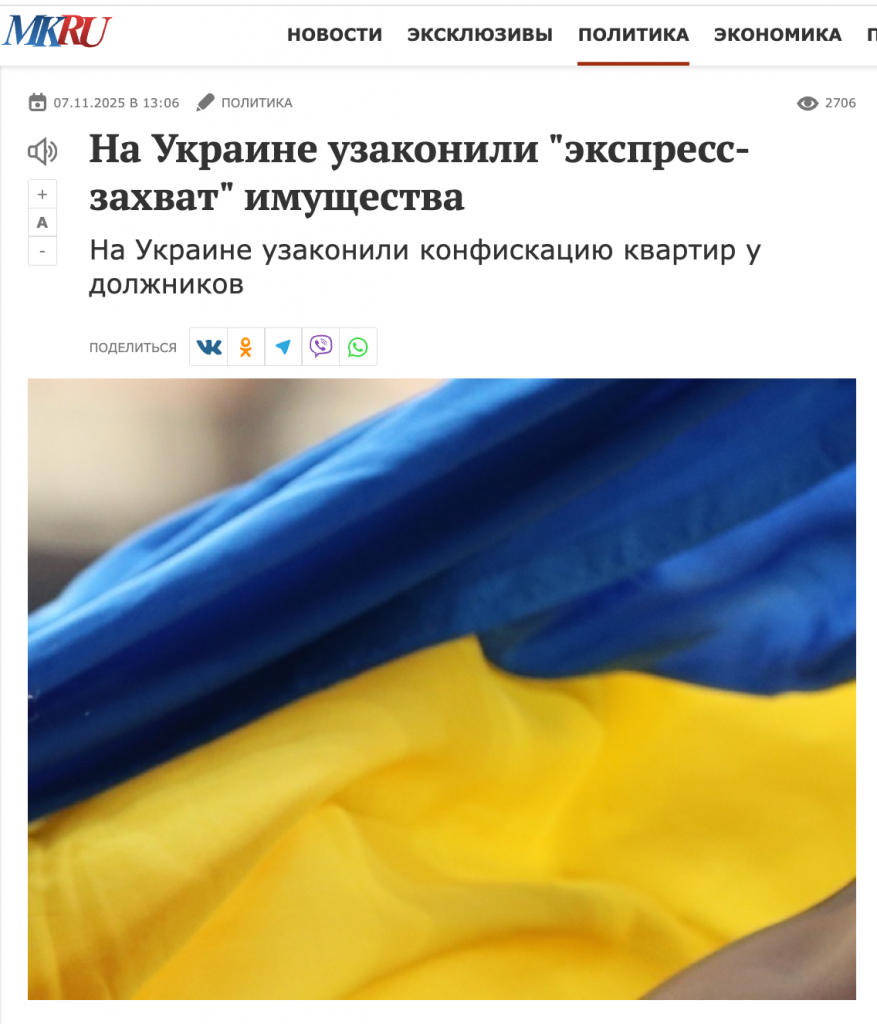
Russian media are reporting that Ukraine has allegedly adopted a law allowing apartments to be confiscated over unpaid utility bills – supposedly “without prior notice”, creating a threat that people could be left without their only housing. However, this information is manipulative, StopFake confirms.

Draft Law No. 14005 does not provide for the confiscation of a person’s only home over minor utility debts. Provisions allowing for the possible seizure of real estate existed before as well – they are applied only when the amount of debt is substantial or when the debtor has no other property from which the debt can be recovered. The document is aimed at automating certain technical processes: when a debt arises, the system may automatically impose an asset freeze, but this freeze is also automatically lifted once the debt is paid. A freeze is a temporary restriction on the disposal of property, not its confiscation.

Disinformation publications, however, deliberately present the situation as if utility debt could lead to the loss of one’s home. “This means that thousands of people who are already barely making ends meet could suddenly find themselves on the street”, “without prior notice”, writes the propaganda outlet Ukraina.ru.

Lawyers and the head of the relevant parliamentary committee, Denys Maslov, confirm that the draft law does not change the rules for confiscating real estate that have been in place for many years. The seizure of an apartment is possible only in exceptional cases – for example, when the amount of debt is significant (exceeding 20 minimum wages) or when the debtor has no other assets from which the debt can be recovered. This is not about “automatic confiscation”, but about a lengthy legal process that necessarily requires a court decision. Under Ukraine’s Law “On Enforcement Proceedings” (Articles 48 and 50), the seizure of a debtor’s only home is a last-resort measure in Ukraine.

Controlled export of Ukrainian weapons: how Russia is trying to turn a reform into yet another fake

Russian propaganda media are spreading false claims that Ukraine allegedly plans to sell Western weapons received from its partners in Europe. In reality, this is not about selling arms supplied by allies, but about launching a program of controlled exports of Ukrainian-made weapons. The funds generated from these exports will be directed toward developing the defense industry and producing scarce drones.

The spread of this disinformation was flagged by StopFake fact-checkers. Propagandists claimed that Ukrainian President Volodymyr Zelensky had allegedly “opened a commission shop for stolen weapons” and was planning to sell in Europe arms that Ukraine had previously received from Western partners as military aid. The publications alleged that British-made naval drones and artillery systems assembled from European and Soviet components were supposedly being offered for sale.

These claims have nothing to do with reality. What is actually being discussed is the resumption of controlled exports of Ukrainian weapons – that is, arms produced by Ukraine’s own defense industry enterprises. This initiative does not involve Western weapons supplied by allies as military assistance. After the start of Russia’s full-scale invasion, Ukraine completely halted arms exports, but in 2025, as domestic production increased and surpluses emerged, a decision was made to partially resume exports under state control.

In late September 2025, Volodymyr Zelensky stated that Ukraine was preparing to begin controlled arms exports even before the end of martial law. The president emphasized that only those types of weapons for which the Ukrainian army has sufficient supplies would be exported. The proceeds would be used to expand the production of drones and other critically needed equipment. On October 28, 2025, Zelensky instructed Prime Minister Denys Shmyhal to launch the program as early as November. He also tasked the government with ensuring that by the end of the year at least half of the weapons in Ukraine’s defense system would be domestically produced.

Ukraine plans to open representative offices in Berlin and Copenhagen to strengthen industrial cooperation with partners. This is about expanding international production cooperation, not about “trading Western weapons”, as Russian propaganda attempts to portray it. Ukrainian media have previously reported that the initiative to resume exports is supported by private defense companies that have excess production capacity.

Fact-checkers examined whether Trump said that a government shutdown is a sign of weakness for a U.S. president

In 2013, a quote allegedly said by Donald Trump spread on social media: “A government shutdown is the result of a lack of presidential leadership. Problems start at the top, and they have to be solved at the top. A shutdown means the president is weak”. This statement regained popularity during the U.S. government shutdown in 2025, when internet users recalled that Trump – who was president at the time – had supposedly said this himself. However, this claim is not entirely accurate. Snopes reported on this.

As fact-checkers found, only the second part of the quote – “Problems start at the top, and they have to be solved at the top” – genuinely belongs to Trump. He said it during an appearance on the TV program Fox & Friends on September 30, 2013, when Barack Obama was president and the country was preparing for a possible government shutdown. At the time, Trump argued that it was the president’s responsibility to overcome political crises and demonstrate leadership. The rest of the phrases circulating on social media were never spoken by him, although their general meaning aligns with his position during that period.

Snopes analyzed archives from Bing, Google, Yahoo, and DuckDuckGo, as well as posts on Facebook, X (formerly Twitter), Instagram, and Threads, but found no evidence that Trump ever literally said phrases about a “weak president” or a “lack of leadership”. The earliest appearances of these words date back only to 2018, during another government shutdown that occurred while Trump himself was president. This suggests that the quote was assembled from his real statements and later spread as a generalized version of his views.

Fact-checkers also note that back in 2011, during an appearance on the Today show, Trump said that in the event of a shutdown, “the blame falls on the president, because he is the one who has to bring everyone together and pass a budget”. In his Twitter posts from the same period, he repeatedly criticized Barack Obama, calling him “weak” and holding him responsible for political conflicts in Washington.

The EU Remains Russia’s Largest Trading Partner – A Breakdown of the Manipulation

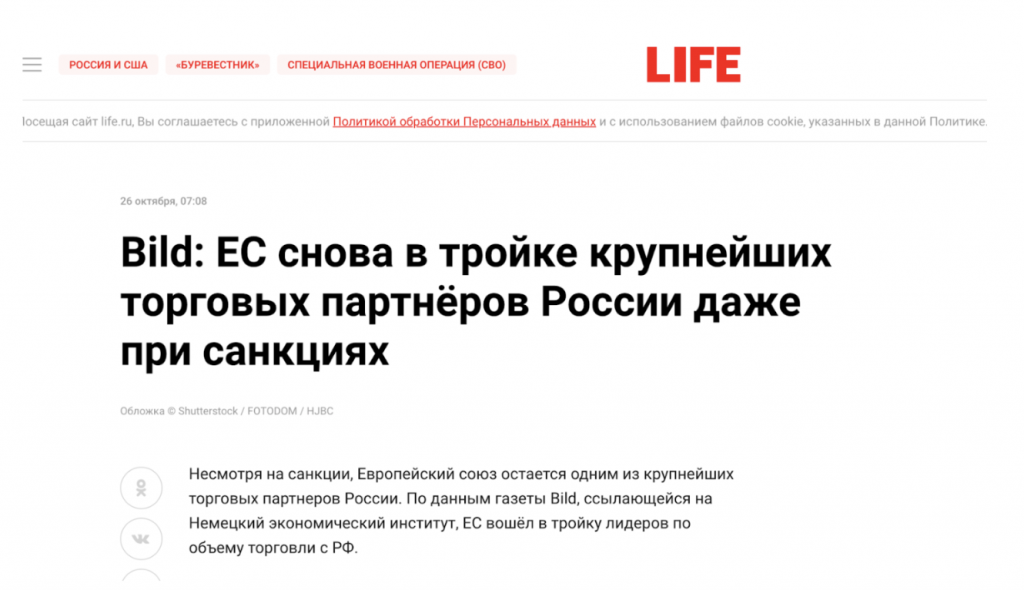
After the European Union approved its 19th package of sanctions aimed at halting the shadow trade in Russian energy resources, Kremlin media circulated a fake claim that Western restrictions “do not work at all”. In particular, Russian outlets, citing the German newspaper Bild, claimed that “despite the sanctions, the EU is still one of Russia’s largest trading partners”. Analysts from the StopFake project drew attention to this manipulation.

In fact, a study by the German Economic Institute (IW) dated June 13, 2025, which Bild refers to in its October 25 article, emphasizes a drastic reduction in trade between the EU and Russia as a result of sanctions. IW analysts note that trade flows have been redirected toward the Global South, while EU–Russia trade has fallen to a very low level.

Key figures that debunk the propaganda:

  • Germany: imports from Russia decreased by 92% compared to 2021.
  • Italy: down 83%.
  • Belgium: down 67%.
  • A sharp decline has also been recorded in Slovakia, the Czech Republic, Spain, and other EU countries.
  • The only exception is Hungary, which remains loyal to the Kremlin: since 2022 it has increased purchases of Russian goods by 31%.

The total trade volume of all 27 EU countries with Russia in 2024 amounted to just €67.5 billion, with the majority accounted for by Hungary. For comparison:

  • China imported Russian goods worth $130 billion.
  • India, which ranked 12th before the war, is now second, with trade increasing by 680% since 2022, mainly due to oil.

IW experts stress that to further undermine the financing of Russia’s war machine, sanctions must target Russia’s shadow fleet, which is increasingly accused of sabotaging Western infrastructure, as well as imports of liquefied natural gas (LNG). Both measures were included in the 19th sanctions package.

What the EU’s 19th sanctions package includes (adopted on October 23, 2025):

  • A full ban on imports of Russian LNG (short-term contracts after six months, long-term contracts from January 1, 2027).
  • Stricter control over oil trade and the shadow fleet.
  • Restrictions on financial operations, including cryptocurrency transactions, for the first time.
  • 117 vessels added to the sanctions list, bringing the total number of shadow fleet ships to 557.
  • Eight areas covered: energy, finance, diplomacy, accountability for the abduction of Ukrainian children, military measures, trade, services, and sanctions against Belarus’s military-industrial complex.
  • Enhanced monitoring of the movement of Russian diplomats within the EU.

More details on all EU restrictions imposed on Russia for its aggression against Ukraine are available in the EU’s information bulletin.

Russian propaganda is lying about the alleged ineffectiveness of EU sanctions.

Russian media cherry-pick a single phrase from Bild (“the EU is among the top three partners”) while ignoring the rest of the conclusion that trade has fallen to a minimum thanks to sanctions. The aim is to convince US and EU governments that sanctions are endless and pointless, so that new packages are blocked and existing ones repealed. The Center for Countering Disinformation under Ukraine’s National Security and Defense Council predicts that in November 2025 Russian propaganda will intensify the narrative that sanctions do not work and Europe is freezing.

Russians have fabricated a fake about the mass dismissal of Ukrainian railway workers

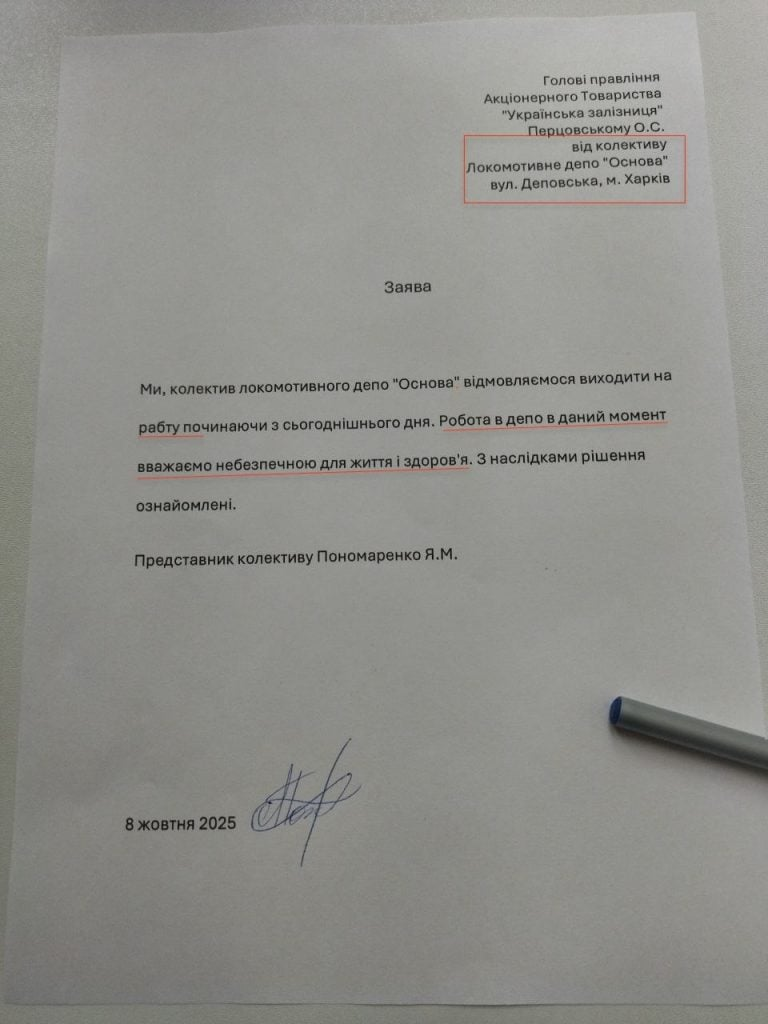
Messages are actively circulating on social media claiming that employees of Ukrzaliznytsia are allegedly being dismissed en masse because of Russian shelling of railway infrastructure. Anonymous Telegram channels are posting photos of supposed resignation letters from individual workers and entire teams, including in Kharkiv. These “documents” claim that railway workers are refusing to work due to threats to their lives.

This was reported by StopFake.

According to the analytical service Osavul, the information was first published on October 14 by the pro-Russian Telegram channel “KRYMINFOURUM ZOV”, a resource that has repeatedly spread disinformation about events in Ukraine. At the same time, Ukrainian media and Ukrainian-language sources have not reported any such cases.

The photos of the alleged “resignation letters” cited by the authors of the fake contain numerous signs of forgery. In particular, the “statement” purportedly written on behalf of employees of the Osnova locomotive depot contains many grammatical and legal errors. The document incorrectly states the official name and address of the enterprise.

According to YouControl, the entity called “Osnova Locomotive Depot of the Southern Railway” has ceased to exist altogether. In official Ukrzaliznytsia documents, the unit is listed as the “Separate Division ‘Osnova Locomotive Depot’ of the State Enterprise ‘Southern Railway’”, located in Kharkiv at 1 Pryvokzalna Street. In addition, the “documents” contain spelling mistakes, missing punctuation, and incorrect grammatical cases – all of which indicate that they are not authentic.

Ukrainian legislation does not provide for collective resignation statements. Even if several employees decide to leave their jobs at the same time, each individual must submit a separate resignation letter indicating the date, signature, and reason for dismissal. A collective letter may exist only as a symbolic appeal, but it has no legal force.

Journalists sent an inquiry to Ukrzaliznytsia JSC regarding information about mass layoffs. At the time of publication, no response from the company had been received. At the same time, the enterprise has not reported any such cases in open sources.

Since the beginning of autumn 2025, Russian forces have indeed been systematically attacking Ukraine’s railway infrastructure in an attempt to disrupt logistics and the transportation of military cargo. Despite this, Ukrzaliznytsia has been promptly responding to the consequences of these attacks, deploying reserve diesel locomotives and repair crews to ensure the stable operation of passenger and freight services.

Fake: Stefanchuk allegedly promised to cut off heating for draft dodgers

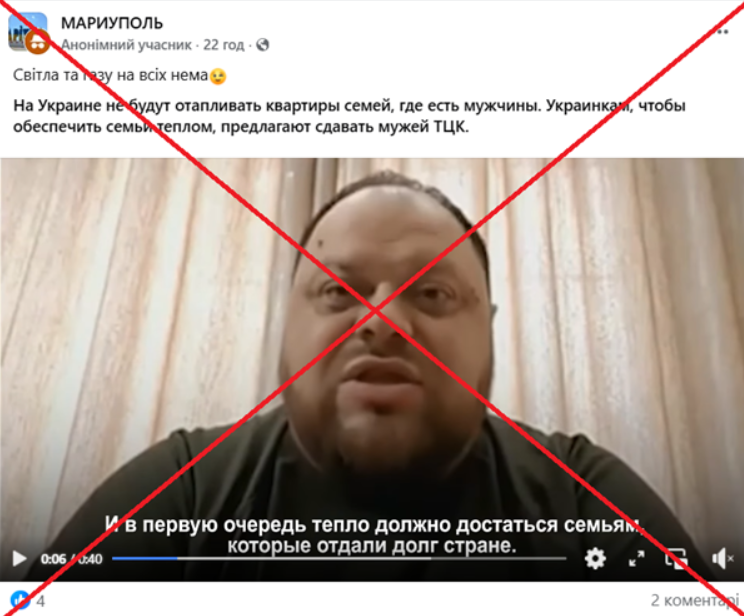
A new wave of disinformation aimed at undermining trust in the Ukrainian authorities and the mobilization system is spreading on social media. Russian Telegram channels, as well as accounts on Facebook, Instagram, and X, are widely sharing a video featuring the Speaker of the Verkhovna Rada of Ukraine, Ruslan Stefanchuk.

This was reported by Ukrinform.

In the video, Stefanchuk allegedly says that due to the difficult situation in the energy sector, heating will be supplied only to households where men are serving in the Defense Forces of Ukraine. Women whose husbands are “draft dodgers” are supposedly advised to “keep warm from their husbands”.

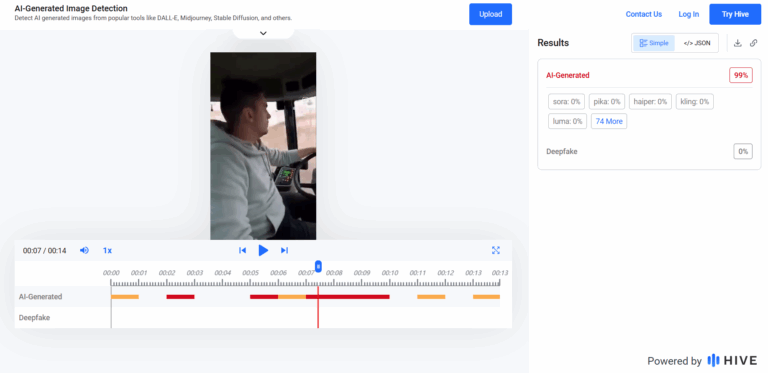
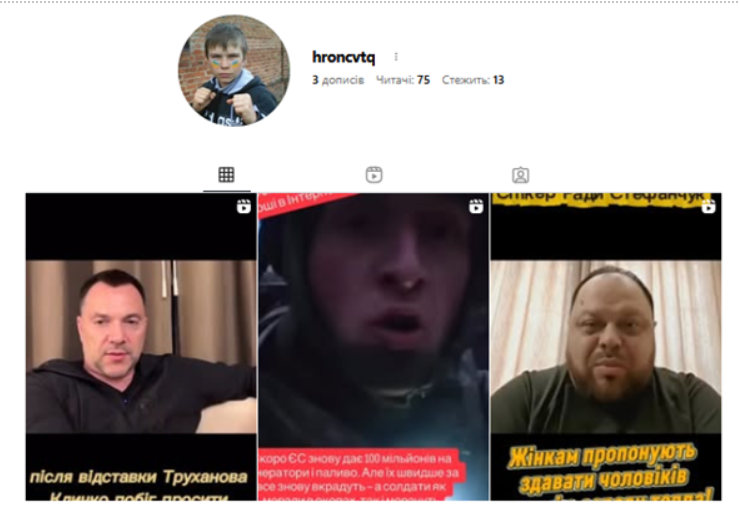
In reality, this is a fake. The video was entirely generated using artificial intelligence, specifically deepfake technology. According to an analysis by the Hive Moderation service, which detects AI-generated content, the probability that this video is artificially created is 98.6%.

The source of the fake is an anonymous Instagram account that was created only on October 15, 2025. At the time of publication, it contains just three videos.

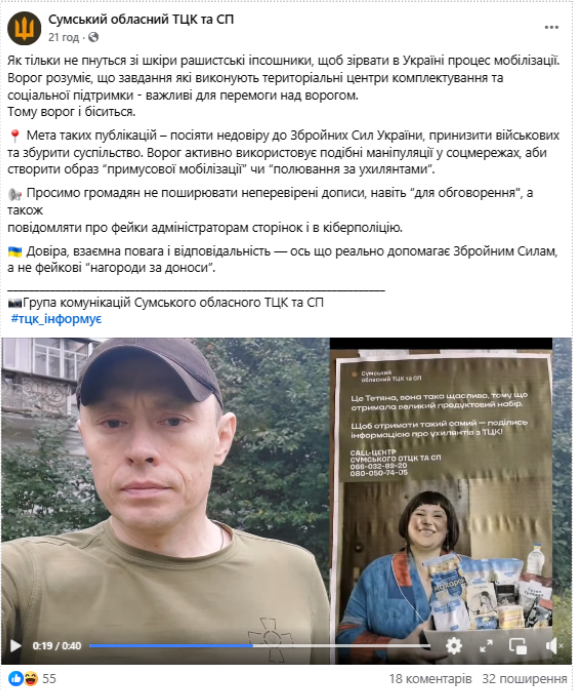
Another example of disinformation is a fake photo allegedly from the city of Sumy. The image shows a supposed “announcement” from a local Territorial Recruitment and Social Support Center about distributing food packages to women in exchange for reporting draft dodgers.

This information is also false. The Sumy Regional Territorial Recruitment and Social Support Center has not published any such announcements, as confirmed by the institution’s official channels, including its Facebook page. Moreover, the fake poster uses an incorrect abbreviation – “OTCK”, which is not used in official communication with citizens.

The Sumy recruitment center confirmed that no such announcement exists and that the information is yet another example of a hostile information operation.

Both fakes are aimed at discrediting the Ukrainian authorities and the institutions responsible for mobilization, as well as at increasing internal tensions amid the war.

Fake: Ukrainians are massively selling off housing in Dnipro

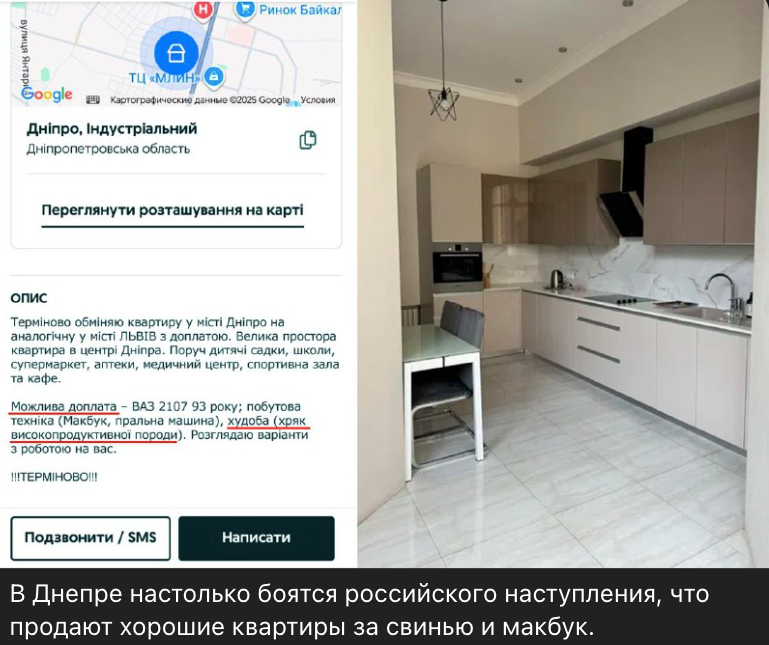
Pro-Russian Telegram channels and media are spreading another manipulation aimed at stirring panic among Ukrainians. This time, the target is the city of Dnipro: propagandists claim that residents are allegedly massively selling off their property because of “fear of a Russian offensive”. As supposed evidence, a fake screenshot of a listing from the OLX platform is being circulated online.

This was reported by StopFake.

In the fake listing, a supposed resident of Dnipro is allegedly willing to exchange their apartment for housing in Lviv, offering not only money as an additional payment, but also a car, household appliances, a domestic pig, or even their own labor.

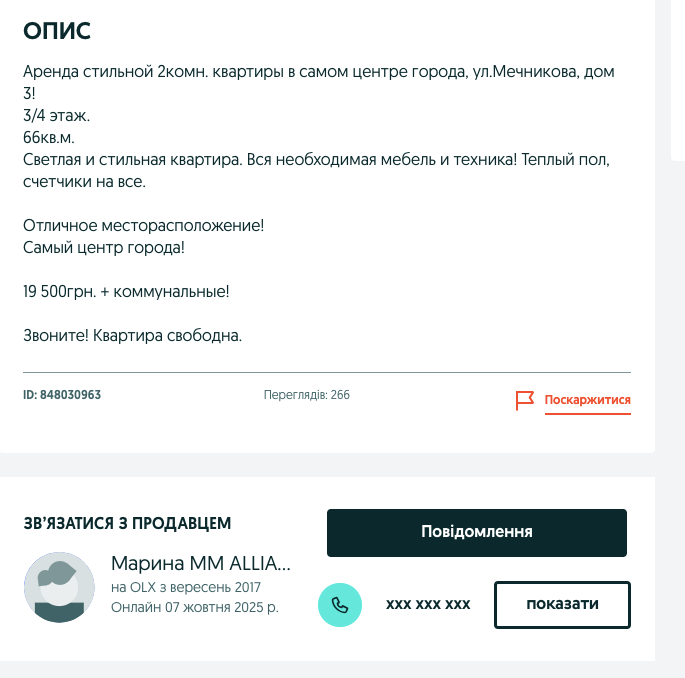
However, this is a fake. Using reverse image search on Google, it was possible to find the original listing that was used to create the forgery. In reality, it was a rental advertisement posted by a real estate agency. The original description referred to a two-room apartment on Mechnikova Street in central Dnipro, fully furnished, equipped with appliances, and with underfloor heating – with no mention of any exchange or “panic selling”.

In addition, OLX data for 2025 refute the narrative of a “mass exodus” of homeowners. On the contrary, an increase in real estate prices has been recorded in cities closer to the front line. In particular, apartment prices rose by 22% in Kharkiv and by 14% in Odesa. The company also forecasts a recovery of the housing market in cities such as Dnipro, provided that the security situation remains stable.

This case is yet another example of how Russian propaganda fabricates fakes by editing screenshots from popular platforms. OLX, Prom.ua, and similar services often become sources for such forgeries, as users rarely verify the original sources.

Manipulation EU allegedly harmed by abandoning Russian energy sources

Russian propagandists claim on anonymous Telegram channels that the problem of Russian natural gas exports allegedly remains one of the main issues for the global economy. Supposedly, this was written by Asia Times, and in the corresponding article, experts allegedly state that by providing Ukraine with weapons and supporting anti-Russian sanctions, the EU is making things worse for itself. However, this is manipulation.

The European Union is actively working on diversifying energy supply sources to reduce its dependence on Russian gas. In 2024, the United States became the largest supplier of liquefied natural gas, providing 48% of imports. Ukraine, for its part, ceased the transit of Russian gas through its territory, which was a strategic decision in response to Russian aggression.

At the same time, Europe is developing renewable energy, modernizing nuclear power plants, and optimizing energy consumption. Russia's manipulations with gas supplies, including the sabotage of the Nord Streams, have only accelerated the EU's adaptation to new conditions. Statements about a ‘cold future for Europe’ are part of Russian disinformation aimed at discrediting European unity and resilience. The EU is showing determination in building energy independence and supporting Ukraine as part of its long-term security strategy.

Manipulation Disinformation about McDonald's returning to Russia

Russian sources have spread the claim that McDonald's is planning to return to Russia. This conclusion was drawn from the fact that the company submitted over 50 applications to the Russian patent office for the registration of trademarks, including names of drinks and dishes, as well as company slogans.

However, these conclusions are premature, and updating its patents does not mean the chain will return to Russia. According to StopFake, McDonald's is renewing its trademarks and patents in Russia to protect its intellectual property and prevent unauthorized use of its brand or technologies by third-party companies. This helps avoid unfair competition, where local businesses might use the recognizable brand to mislead consumers.

McDonald's announced its intention to retain its trademarks in Russia back in 2022, in a press release where the company announced its exit from the Russian market: “The company intends to begin the process of ‘de-arching’ these restaurants, which involves discontinuing the use of the name, logo, branding, and menu of McDonald's, although the company will continue to retain its trademarks in Russia”. The company sold all its outlets to the new Russian chain Vkusno i Tochka - though with the option to repurchase them within 15 years. Therefore, there is no basis to believe that McDonald's is returning to the Russian market: the company has made no such statements in its official communication channels.

Last year, there were claims about Starbucks and Visa returning to Russia. Given that neither of these companies has announced a return to the Russian market, McDonald's' return to Russia also seems highly unlikely.

Fake ​​McDonald’s is not returning to Russia

Reports claiming that McDonald’s plans to return to Russia have recently appeared on Russian platforms. These headlines are based on the fact that the company filed over 50 trademark registration applications with the Russian patent office. The applications include names of beverages, menu items, and company slogans.  

However, such conclusions are premature. The renewal of trademarks by the company does not indicate that McDonald’s is resuming operations in Russia. Rather, this move is aimed at protecting its intellectual property and preventing third-party companies from using its brand or technologies without authorization. This measure also helps to avoid unfair competition, where local businesses might exploit McDonald’s recognizable brand to mislead consumers. Additionally, it ensures the company retains the option to resume operations in the future, should the Russian war against Ukraine come to an end.  

To recall, McDonald’s decided to leave the Russian market in May 2022, in response to Russia’s full-scale invasion of Ukraine. At the time, the company stated that “the humanitarian crisis caused by the war in Ukraine, along with the unpredictable business environment, led McDonald’s to conclude that continued ownership of the business in Russia is no longer tenable and does not align with the company’s values”. 

Manipulation Manipulation that vegetable prices in Ukraine have increased due to the Revolution of Dignity

A pro-Russian blogger is spreading a manipulative post in a Telegram channel about the increase in vegetable prices in Ukraine. Referring to an infographic from an article in Ekonomichna Pravda, he concluded that the reason for this phenomenon was “the choice of a pro-European course after the Revolution of Dignity”.

“This is a Republic that once fed the entire USSR, and today potatoes have become 200% more expensive in a year. Is this the victory of the Maidan? A little longer and we will ask the Belarusians for a tuber (a dialect word, a literary norm for “potato”. — Detector Media) so that we don't die of European values”, the propagandist writes.

In fact, the Revolution of Dignity and the European course are in no way connected with the increase in vegetable prices. The main reasons were the loss of the crop due to the abnormal heat of this summer, inflation and the reduction in the sown area, which was written about by Ekonomichna Pravda.

The reduction in the sown area was directly influenced by Russia's military aggression against Ukraine. For example, the Kherson region grew the most vegetables, the percentage of which was 40% of the annual harvest of Ukraine. However, due to hostilities and the occupation of part of the region, it became impossible to use the fields for their intended purpose. Therefore, entrepreneurs had to relocate their businesses. That is, the “rising prices” for vegetables has nothing to do with Ukraine's pro-European course - unlike the attempts of Russian propaganda to manipulate the aspirations of Ukrainians and highlight separation from the Russian vector as the cause of all problems, including armed aggression.

Fake The lie that the printing of the hryvnia is being moved to Poland due to a shortage of materials and electricity

Pro-Russian sources, citing the Polish publication Gazeta.pl, are spreading information that from November 20, 2024, paper hryvnias will allegedly be printed only in Poland. According to the propagandists, the reasons for this decision are power outages, a shortage of materials, and the expensive logistics of producing the national currency in Ukraine.

However, in reality, this is a fake, journalists from the StopFake project write. First of all, the gazeta.pl website did not disseminate the relevant information. In addition, the publication publishes materials exclusively in Polish (the fake material is in English), and does not create video content (the source of the fake is a fabricated video). In the end, neither the National Bank of Ukraine itself, nor any authoritative media published the relevant “news”.

By spreading such fakes, Russian propaganda is trying to undermine trust in the Ukrainian banking system. We have previously recorded disinformation concerning the National Bank of Ukraine. For example, we refuted information that cryptocurrency payments were banned in Ukraine.

Fake Russians write that their wheat will save the EU from starvation

Against the backdrop of the end of the grain harvest, Russian media began to spread information that this season in European countries there is allegedly a catastrophic grain crop failure due to “anti-Russian sanctions”. Propagandists also write that against the backdrop of hunger in Europe, Russia has become the guarantor of food security for the EU.

In fact, Russian propaganda simply manipulates data and spreads disinformation. This is reported in the StopFake project. This year, the world, and Russia in particular, has seen a drop in grain yields. However, this is due to unfavorable weather conditions at the beginning of the sowing season, and not the EU sanctions policy. A very rainy spring and summer caused delays in harvesting and negatively affected wheat growth in Western Europe, while Central and Eastern Europe suffered from a lack of moisture, which also affected grain filling. According to data from the European Commission published at the end of September 2024, due to unfavorable weather conditions, the total volume of grain production in the EU is projected at 269.9 million tons. This is only 3.9% below the average for the past 5 years.

However, in Russia, according to the October report of the US Department of Agriculture, wheat production fell by 10% compared to the previous season. Russian propaganda deliberately does not provide data on Russian grain, taking into account only the decline in yields in European countries, although Russia itself suffered due to weather conditions at the beginning of the year. In the end, the Russians deliberately keep silent about the fact that Russia is not the only one among the three leading grain exporters in the world. The EU and Ukraine are also among the world's largest producers and exporters of agricultural products. They play an important role in the supply of oilseeds and grain crops to the world market.

It should also be noted that Russia steals Ukrainian grain from the occupied territories and sells it. Thus, the British newspaper Financial Times published an investigation back in 2022, where it showed, using the example of one vessel, how Russia trades Ukrainian grain stolen from the territory of the Zaporizhzhia region.

Previously, we analyzed the Russian fake, which claimed that the Ukrainian Armed Forces were deliberately shelling fields in the Kherson region to destroy the harvest.

Message Loans based on frozen Russian assets are allegedly theft

Propaganda Telegram channels controlled by Russia are actively disseminating a statement by the leader of the French party Patriots Florian Philippot, who claims that the European Parliament approved the allocation of an additional 35 billion euros for Ukraine at the expense of frozen Russian assets, calling it theft. This message is aimed at creating a negative attitude towards the West's support for Ukraine and forming a distorted idea of the legality of international aid.

This is what the Center for Strategic Communications and Information Security writes. They emphasize that in fact, Florian Philippot has long been an active relayer of Russian narratives in France, whether or not he does so consciously. Just last week, he also said that Ukrainian President Volodymyr Zelenskyi would soon lose his post. Similar pro-Russian statements have been repeatedly spread by other figures, such as Syrian dictator Bashar al-Assad.

At the same time, Russia continues to boast about its own large-scale thefts in the temporarily occupied territories of Ukraine. Russia's real crimes include the so-called “nationalization” of Ukrainian enterprises, their re-registration, and the constant taxation of the population in the occupation zones.

Russia is trying to portray the legitimate use of frozen assets to support Ukraine as “theft” in order to create a negative impression of the EU and other Western aid. Propagandists are also spreading fake claims of “theft” by Ukraine and its partners in order to distract attention from their own acts of looting in the occupied territories, where real crimes are being committed. Such messages are aimed at undermining trust in Western institutions and discrediting the mechanisms of support for Ukraine, showing them as part of an international “conspiracy” plan. Using European politicians like Filippo helps Russia to shape negative sentiments in Europe and spread anti-Ukrainian messages through local mouthpieces, which creates the illusion of domestic opposition to support for Ukraine. Thus, the message about “theft of Russian assets” is another tool of Russia’s disinformation campaign aimed at manipulating public opinion in Europe and undermining support for Ukraine.

Manipulation Manipulation that the average price for a kilogram of potatoes in Ukraine is more than 50 hryvnia

A video is being distributed in Russian Telegram channels where a woman claims that the price of potatoes in one of the Odesa stores is about 40-50 UAH/kg. Accordingly, it seems that the Odesa resident is indignant and says that she does not know what to be more afraid of - the strikes or the prices in the stores.

In fact, this is manipulation, as reported by the VoxCheck project. In the video, a woman shows one of the most expensive varieties of potatoes available in the Silpo supermarket assortment - home-grown Granada potatoes. At the same time, this vegetable can be found cheaper in Ukrainian supermarkets. For example, in the same Silpo in Odesa, there are potatoes for 31-35 UAH/kg. In other stores, such as ATB or Tavria V, prices for a kilogram of potatoes range from 25 UAH/kg to 27 UAH/kg.

Also, according to the State Statistics Service, the average price of potatoes in Ukraine in August 2024 is about 20 UAH per kilogram. However, this is not the highest price for this year, because in June Ukrainians bought this vegetable on average for 28 UAH per kilogram.

There are varieties of potatoes that are more expensive - 50-60 UAH/kg. The same goes for other goods, for example, tea, which can be purchased for 70 UAH, or for 129 UAH. Therefore, such videos that Russians distribute are manipulative, because they do not reflect all market prices, but selectively show more expensive ones.

Earlier, we refuted the information that a 70-year-old pensioner was allegedly beaten because she refused to hand over potatoes to the Ukrainian Armed Forces.

Fake Kremlin fake: the VISA payment system is finally returning to Russian territory

Pro-Russian sources are spreading the “news” that one of the world's largest payment systems, Visa, is returning to the Russian market. As “proof” of this, the propagandists cite information provided by Visa to Rospatent (in Ukraine, Ukrpatent, an organization that registers intellectual property) requesting an update of its trademarks for banking services and cryptocurrency in Russia.

However, Visa is not returning to the Russian market. The company has not even announced such a decision on any of its official pages. And the payment system has no legal right to return to Russia due to the effect of American sanctions. Government sanctions require Visa to suspend access to its network for a number of Russian financial companies, including the country's central bank and the country's second-largest financial institution, VTB Bank.

That is, returning to the Russian market would be a direct violation of US sanctions. And updating the trademarks, which Visa actually did in Russia, is standard practice to preserve the right to use certain technologies and its own brand and logo in the country. For example, in this way the company avoids reproduction or imitation of the brand by Russia.

Message Russian falsehoods about Ukraine's national debt: it will soon "exceed" 1000% of the country's GDP

In the Russian segment of social networks they write that by the end of next year, Ukraine’s public debt will reach more than 1000% of GDP.

“They had a great time jumping on the Maidan”, the propagandists mock.

First of all, propagandists have defiled the information about the country's external debt. In general, such debt is an important indicator of the country's financial stability and has a significant impact on economic development. It is an indispensable part of any country's policy and can be both a source of financing for economic development and a factor limiting economic growth.

For example, such a high figure is not uncommon even in countries with developed economies that are not at war. For example, the public debt of France, Belgium and the UK is 112%, 105% and 104% of GDP, respectively, and in Japan this percentage reaches 254 (data as of 2022).

So the propagandists have inflated the state debt figure by 10 times, and also completely ignored the context of the original news. Since the announcement of the Ministry of Finance was about reducing the external debt from 100.5% to 97% of GDP in 2025, that is, about the positive dynamics of this indicator. In total, the volume of external and internal state debt will amount to 8.2 trillion UAH. But this is, in general, a general economic factor accompanying the economy of many countries - and there is literally nothing “catastrophic” about it.

“Of course, this is a significant indicator. But we must not forget that we are a country at war. Therefore, at the current stage, the issue of debts is only in the context of the possibility of servicing and paying them off in the short term”, explained Finance Minister Serhii Marchenko at a briefing at the Ukrainian Media Center.

Fake Misinformation that the water tariff in Ukraine is 130 per cubic meter

Information is being spread on social networks as if the water tariff throughout Ukraine is 130 UAH/cubic meter. And they add that the Ukrainian authorities are also planning to raise tariffs for electricity and gas.

But only in June of this year in the city of Pokrov in the Dnipropetrovsk region they really raised the cost of the tariff for water supply and sanitation to 130 UAH/cubic meter of water, but in July the decision was canceled, now the total payment is 36.80 UAH/cubic meter. In other regions the tariff does not reach 130 UAH/cubic meter at all.

Now the tariff for water supply in Pokrov is 21.40 UAH/cubic meter, and for water disposal – 15.40 UAH/cubic meter, that is, in total it is 36.80 UAH/cubic meter.

In other cities of Ukraine that changed tariffs in 2024, the increase was also not as significant as they say in the post. Thus, since April in Pryluky, Chernihiv region, for household consumers, the cost of water supply has increased from UAH 13.55 to UAH 19.88/cubic meter, and for water disposal from UAH 24.67 to UAH 32.80/cubic meter.

By spreading such a message, propagandists want to feed the narrative that Ukraine is allegedly uninhabitable due to the lack of electricity or high prices for utilities. In this way, the authors want to sow panic among Ukrainians in order to destabilize the mood and create a feeling that “nothing will change”. Also, by calling the so-called collapse revenge for the Crimean Bridge, Russians once again seek to shift responsibility for what is happening to Ukraine. They say that Russia is destroying infrastructure solely because of Ukraine’s aggression. However, it is Russia that is the aggressor, and it is this country that started the war.

Manipulation Russians manipulate information and write that Ukraine is the worst country in the world for women

On social media, Russian propagandists are spreading a picture of the Women's Peace and Security Global Index (WPS Index) for 2023, according to which Ukraine is supposedly “the worst country in the world for women”. The propaganda also makes an ironic comment: “But soon they will be the only ones left there”.

In fact, the Russians manipulated the information, as reported by the StopFake project. The data on the chart reflects the situation in Europe, but not in the world as a whole. According to the WPS Index, in 2023, the lowest scores were given to Afghanistan, Yemen, the Central African Republic, the Democratic Republic of the Congo, South Sudan and several other countries. Ukraine is not in the top ten worst countries for women, it ranks 117th out of 177 countries. At the same time, Ukraine has the lowest score among European countries.

It is worth noting that Ukraine received such low ratings precisely because of the war with Russia, and they reflect the difficult realities that women face in war conditions. Thus, the aforementioned rating evaluates various components of women's status from participation in the economy to health and risks of violence. In particular, it includes assessments of education, security, parliamentary representation, maternal mortality, legal protection and proximity to armed conflict.

By manipulating information, Russia is trying to discredit Ukraine, influence its image in the world and shift the focus. Earlier, we documented a fake, supposedly, that the Bellingcat investigation proved that Yermak paid Time for a place in the ranking of the most influential people of the year.

Fake Refutation of the statement by the Kharkiv Regional Military Administration that water supply will be cut off for refusing to evacuate

Russian media, citing a statement by the so-called “representative of the military administration of the Kharkiv region”, are disseminating information that the Ukrainian authorities are allegedly cutting off water and electricity to those residents of the Kharkiv region who refuse “forced evacuation”.

“The Ukrainian authorities have resumed the forced evacuation of the population in the Kupiansk district of the Kharkiv region; local residents who do not want to go are being disconnected from water, electricity and gas”, the propagandists write.

However, the Ukrainian authorities allegedly intend to cut off electricity, gas and water to those who refuse to evacuate, as stated by the representative of the Russian occupation administration in the Kharkiv region, Yevhenii Lisniak, who is accused of collaboration. In the Russian media, he is called “deputy head of the military-civil administration of the Kharkiv region for defense and security”.

It is known that Yevgenii Lisniak lived in Kharkiv until 2014 and worked in the police with the rank of junior lieutenant. From 2015 to 2022, he lived in occupied Luhansk, where he worked in the so-called “Ministry of Internal Affairs of the LPR”. In April 2023, the Security Service of Ukraine reported in absentia that Lisniak was suspected of voluntarily taking a position in an illegal law enforcement agency created in the temporarily occupied territory.

On May 10, 2024, the Russian army launched an offensive in the north of the Kharkiv region. Due to the threat to the lives and health of local residents, the evacuation of the population from the city was accelerated on the same day.

Message Electricity in Ukraine is more expensive than in other European countries

At the beginning of summer, the government raised electricity tariffs for Ukrainians. Against this background, the thesis is spreading on social networks that life in Ukraine is “unbearable” as prices for utilities, including electricity, are “sky-high” and even incomparable with European prices.

Although experts from the analytical center Dixi Group analyzed the thesis and found out that the authors of such disinformation materials take information about prices from different sources without understanding how comparable such information is. One source may indicate prices based on taxes, another - without. One source contains information about wholesale prices for electricity (i.e. without taking into account tariffs for transportation and taxes), and another - about retail (where all these components are already included).

In fact, the explainer differentiated all the indicators that accompany the time when electricity “reaches” the buildings of Europeans - the price of goods, transportation tariffs, supplier markup, taxes - and it was possible to find out that Ukraine has the lowest price for electricity among the European countries considered. This is largely due to government regulation.

Other countries - Italy, the UK, France and Germany - have higher prices, partly due to significant investment needs in clean energy and new electricity grids.

By spreading such a message, propagandists want to feed the narrative that Ukraine is allegedly uninhabitable due to the lack of electricity or high prices for utilities. In this way, the authors want to sow panic among Ukrainians in order to destabilize the mood and create a feeling that “nothing will change”. Also, by calling the so-called collapse revenge for the Crimean Bridge, Russians once again seek to shift responsibility for what is happening to Ukraine. They say that Russia is destroying infrastructure solely because of Ukraine’s aggression. However, it is Russia that is the aggressor, and it is this country that started the war.

Read on Censor.NET: Ukraine will become “unfit for living”

Fake Due to the impending default, Ukrainians stand in long lines and buy up currency

Information is spreading online that Ukrainians allegedly stand in long lines at exchange offices, trying to exchange hryvnia. Users distributing photographs of queues claim that this is due to news of a possible default. Some Kyiv exchange offices no longer seem to have currency, as propagandists note. However, this is fake.

Specialists from the StopFake project drew attention to it. The information that Ukrainians are queuing en masse in front of exchange offices is not true. To create panic in Ukraine, attackers publish made-up comments about queues along with archival or edited photographs.

The photo of the exchanger with the caption “No currency” was indeed edited. The original photo was posted on Google maps of the Kyiv exchange office Obmen24 two years ago. The attackers changed the announcement about the need to check banknotes at the cash register with the inscription “No currency”.

Another photograph, which shows a line outside an A-Bank branch, does not relate to current events at all. The original of this photo belongs to Suspilne Chernivtsi. It was published in July 2022 and shows the queue for applying for payments from international organizations. The publication of the Suspilne Chernivtsi says that A-Bank helps to fill out an application in installments, but this can also be done independently online.

Reports about Ukraine's impending default, according to many experts, are also untrue. In August 2022, Ukraine received a two-year deferment on loans - this term was determined based on the fact that no one knew how long the war would last. Thus, Ukraine must agree with foreign creditors before August 1 on the restructuring of the state debt. Today, the International Monetary Fund is actively lobbying for a new deferment for Ukraine.

“Ukraine does not intend to pay according to the schedule that was agreed upon two years ago. The IMF allows not to comply with this schedule and has blessed Ukraine for new negotiations with creditors on a new payment schedule”, explains Oleksandr Parashchiy, head of the analytical department at Concorde Capital, in a commentary for BBC Ukraine.

Chairman of the Verkhovna Rada Committee on Finance, Tax and Customs Policy Danylo Hetmantsev also notes that there will be no default in Ukraine, because there are no grounds for this.

Thus, propagandists are spreading panic among Ukrainians amid tensions caused by Russian aggression against Ukraine.

Disclosure How propagandists are spreading misinformation about the “restoration of the agricultural sector” at the TOT citing a Turkish publication

Propaganda telegram channels working in the interests of the occupation forces in the Zaporizhzhia region quote an article from the Turkish publication dikGazete. The author of the article claims that Russian reforms in the agricultural sector of the Zaporizhzhia region allegedly led to economic growth. This, according to them, became possible thanks to the support of the Russian government, which purchases the products of local farmers at market prices and provides them with subsidies. They also praise the organization of the State Grain Operator, which creates jobs and pays high prices for grain. However, they do not have objective information about the work of this operator. They say that Ukraine, on the contrary, sold off land and neglected the region. The article was pointed out by the Zaporizhzhia Investigation Center.

Its experts found that the information in this publication is manipulative and deceitful. For example, the mention of Russia’s “rescue” actions in restoring the agricultural sector of the Zaporizhzhia region after the Ukrainian government does not reflect the real situation, since the region had developed agricultural activities even before the invasion. In addition, the statement about the sale of agricultural land to foreign investors is not true, since until July 2021 there was a moratorium on the sale of such land in Ukraine, and after its lifting, sales to foreigners remain complicated.

This media has a pronounced pro-Russian slant. At the time of writing, columns were published on the main page of the publication’s website about the alleged blackmail of the families of Russian prisoners of war by Ukraine and disappointing forecasts for Ukraine. These materials have a direct connection with Russia: the author of one of them indicated Moscow as his location, and the other - St. Petersburg.

Propagandists spread such disinformation to the TOT inhabitants to convince them that Russia supposedly cares about “new regions”, unlike Ukraine.

Fake All employers will allegedly fire workers with connections in the temporarily occupied territories

Deputies of the Servant of the People party allegedly adopted a law on the dismissal of workers with “connections” in the territories temporarily occupied by Russia. They say that this norm will now be used as a reason for dismissal if the employer simply “does not like” the employee.

However, this information is not true. Specialists from the VoxCheck project write about this. In April 2024, the Verkhovna Rada adopted bill No. 7731, which amends the Labor Code of Ukraine, and sent it to the president for signing. The purpose of such changes is to prevent collaborators from working at enterprises, institutions and organizations of strategic importance for the economy and security of Ukraine, as well as at critical infrastructure facilities.

Therefore, according to this law, employees must inform the employer about connections with persons who are registered or reside in the temporarily occupied territory of Ukraine and Russia. However, on May 16, 2024, Volodymyr Zelenskyi returned bill No. 7731 to the Verkhovna Rada.

Earlier, eight human rights organizations approached the president with a request to veto the law, calling such a rule “the basis for harassment and stigmatization of those who have relatives in the occupation, and people who are still registered but have traveled abroad”. That is, the relevant law has not yet been finalized and entered into force. In addition, according to the law, an employee who has not reported his connections to the TOT can be fired only if he or she  works in institutions of strategic importance for the economy and security of Ukraine.