

Ukraine allegedly plans to change the boundaries of regions in order not to “give up Donbas” to Russians – manipulation analyzed
Russian media reported that Ukraine allegedly plans to include the territories of Donetsk and Luhansk regions under its control into Kharkiv and Dnipropetrovsk regions through administrative renaming in order not to “give up” these territories during negotiations. Analysts from the StopFake project drew attention to this claim.
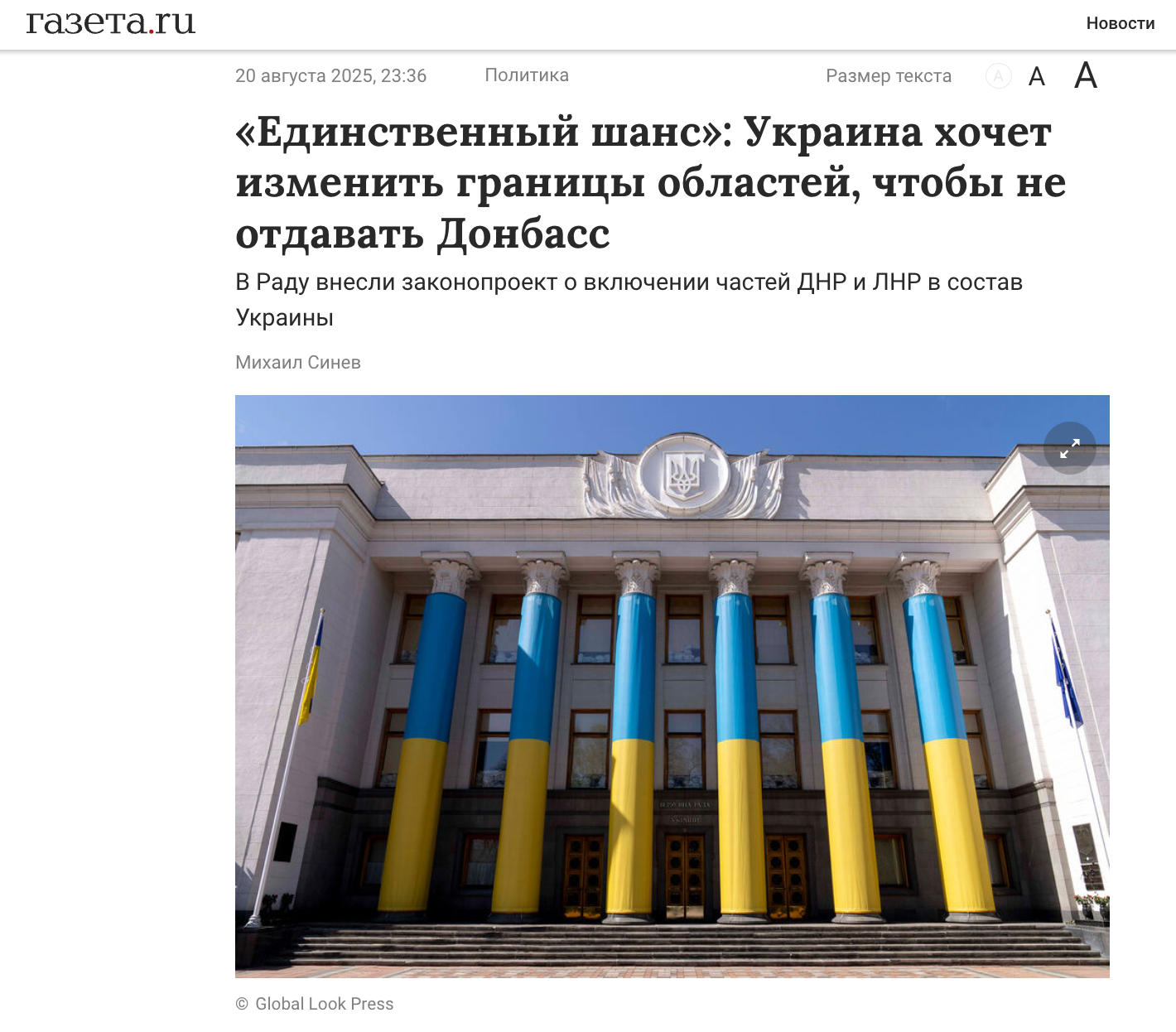
In reality, the issue concerns a draft law that is currently under consideration by the relevant committee of the Verkhovna Rada of Ukraine. The document may be amended or rejected during the voting process. The author of the initiative, Member of Parliament Hanna Skorokhod, explained that the draft law is aimed at optimizing administrative governance and ensuring social and financial guarantees for residents of territories under Ukraine’s control.
In an interview with Slidstvo.Info, Skorokhod stated that the goal of the draft law is to “strengthen Ukraine’s negotiating position”. According to her, changing administrative boundaries would make it possible to protect people and territories while avoiding their transfer to the other side. At the same time, this argument is absent from the explanatory note to the draft law.
The head of the Dnipropetrovsk Regional Council, Mykola Lukashuk, criticized the initiative, calling it a possible “concession to Russian propaganda” and pointing to the risk of creating a dangerous precedent for territorial manipulation. He noted that the only potentially reasonable goal might be reducing the costs of maintaining regional administrations, but this could be achieved through other mechanisms. Lukashuk emphasized that the draft law does not address issues of security, service quality, or social guarantees for residents.
A representative of the Verkhovna Rada Committee on State Power Organization, Vitalii Bezgin, stated that the draft law is unlikely to be supported even at the committee level.
Such information injections are aimed at creating the impression that Ukraine is allegedly ready to “give up” part of its territory. This can fuel Russian propaganda about the “incapacity” of the Ukrainian state, undermining trust in the Ukrainian authorities both domestically and abroad.
By portraying Ukraine’s actions as “concessions” or “weakness”, Russia seeks to strengthen its own position on the international stage, justifying its aggression or claims to occupied territories.