Spilnota Detector Media

Russians Are Spreading a Fake Claim About Alleged “Looting” by Ukrainian Soldiers

Russian propaganda outlets are spreading disinformation alleging widespread looting by Ukrainian soldiers in the city of Lyman, Donetsk region. These claims are based on a video that has been actively circulated through Telegram channels and presented as an appeal by a local police patrol officer.

This was reported by StopFake.

In the video, a man identifying himself as Ihor Tarasiuk, a police officer from Lyman, claims that “looting is taking place throughout the city” and alleges that Ukrainian servicemen are transporting local residents’ property away in trucks while the police are supposedly unable to stop them. The speaker appeals to the Minister of Internal Affairs and the leadership of the Armed Forces of Ukraine, demanding that they “put an end to this lawlessness”.

In the description accompanying the video, propagandists claim that “policeman Tarasiuk from Krasnyi Lyman” is complaining about the actions of the Armed Forces of Ukraine ahead of the alleged “retreat of the Kyiv regime”, using terminology that is characteristic of Russian propaganda narratives.
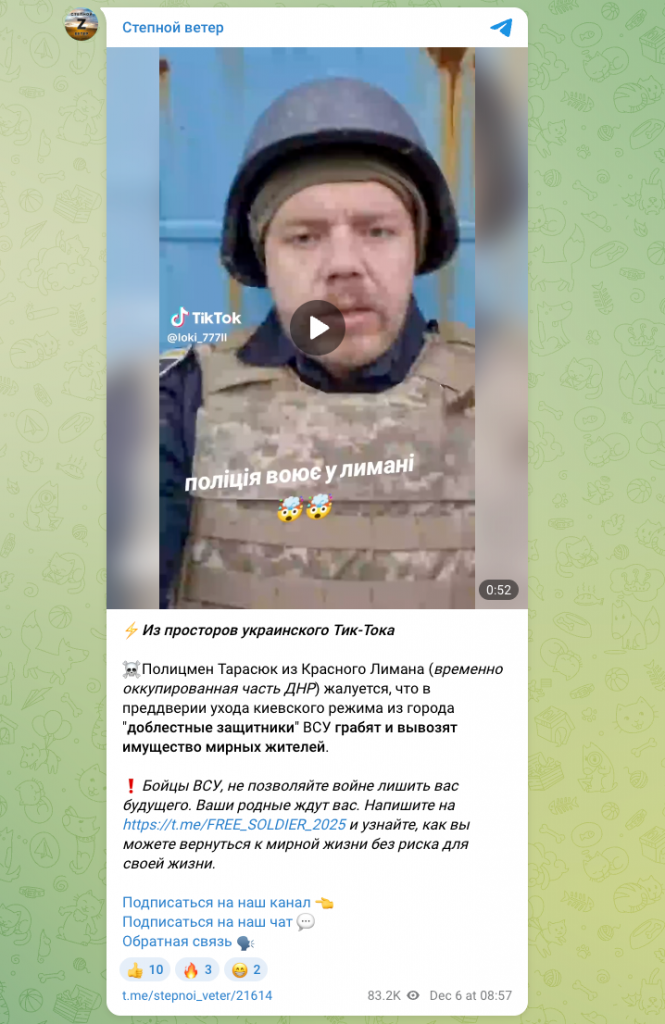
The video contains the watermark of the TikTok account @loki_777ii, where it was first published on 5 December. An analysis of this profile shows that it only became active in October 2025, and that most of its content consists of AI-generated material or reposts. There are no original videos on the account, suggesting that it is being used as a technical platform for distributing manipulative content.

The video began spreading widely on Telegram from 6 December onwards. One of the first channels to publish it was the pro-Russian Z-channel “Stepnoy Veter”, after which it was amplified by other propaganda outlets.

Fact-checkers examined the video using the DeepFake-o-Meter tool developed by the University at Buffalo, which analyses photo, video, and audio content for signs of AI manipulation. To improve accuracy, the clip was tested using several different detection algorithms.

The results indicated a high probability that the video was artificially generated. The AVSRDD detector showed 100% confidence that the video was a deepfake. The WAV2LIP-STA and X-CLIP algorithms also indicated an almost certain likelihood that the clip had been generated using neural networks. In addition, analysts detected irregular lip movements, a common characteristic of synthetic videos.
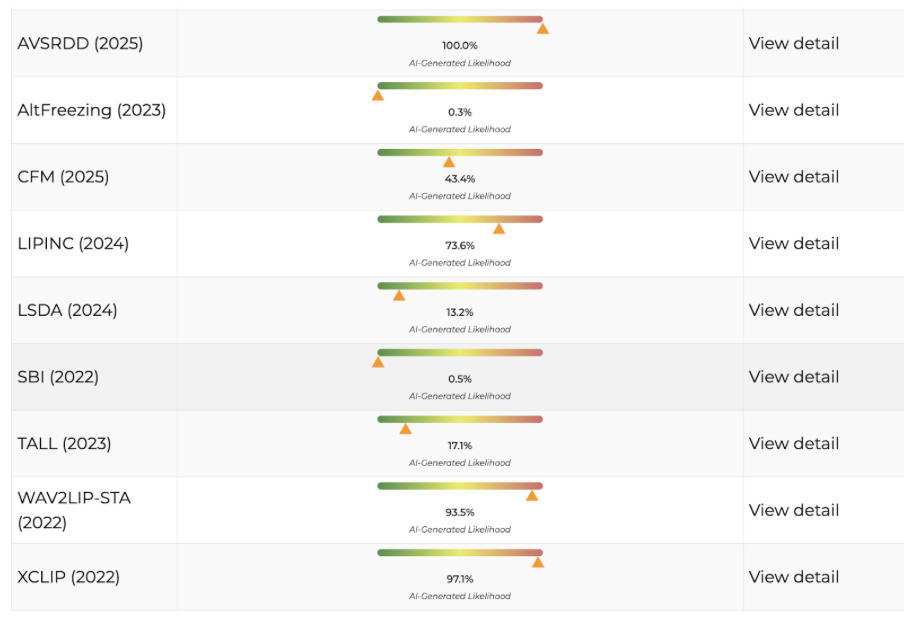
Even without specialized tools, the video exhibits clear visual anomalies, including unnatural facial expressions, blurred facial features, irregular blinking, and a lack of synchronization between speech and lip movements.

Furthermore, journalists were unable to find any information about a police patrol officer from Lyman named Ihor Tarasiuk. It is highly likely that this is a fictional character created to give the video an appearance of credibility.

There is no evidence in open sources confirming any mass looting incidents in Lyman. Neither the National Police of Donetsk region nor other Ukrainian official institutions have reported such cases, and no reputable media outlets have documented similar incidents.

Experts emphasize that claims suggesting the police are incapable of confronting Ukrainian servicemen are part of a common disinformation narrative. Its purpose is to discredit the Armed Forces of Ukraine, undermine trust in state institutions, and portray the Ukrainian military as an uncontrolled and dangerous force.

The dissemination of this video is intended to sow fear and distrust among civilians, while also serving to justify Russia’s occupation and war crimes. The narrative of “military looting” has long been used by Russian propaganda to shift responsibility from the aggressor onto the side defending itself.

Notably, the video is accompanied by the hashtags #Ukraine, #AFU, #Police, and #TCC, indicating an attempt to artificially insert the fake into Ukraine’s information space and amplify its reach among Ukrainian audiences.
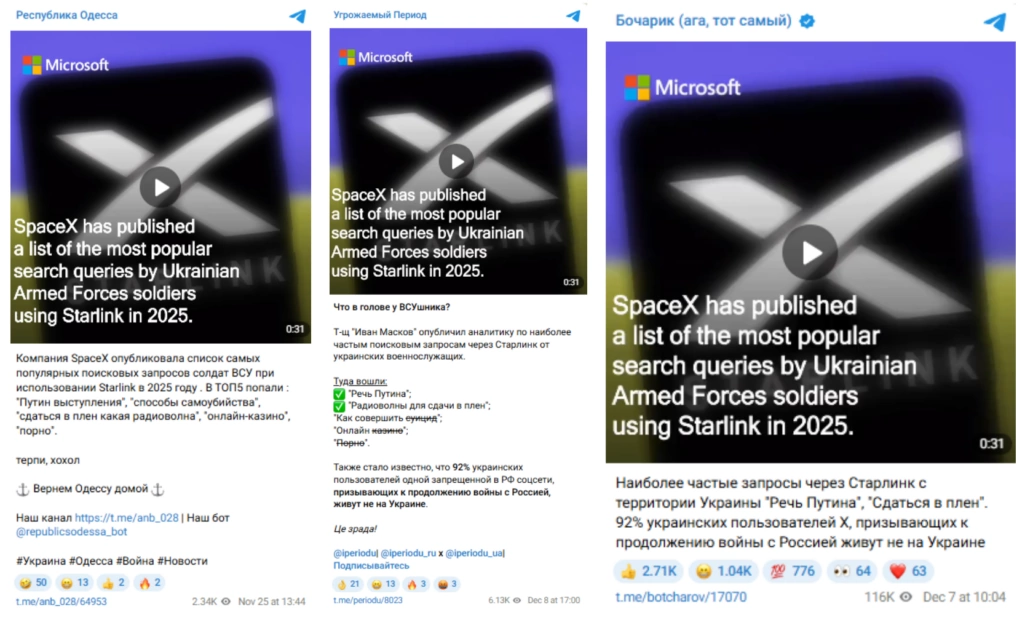
Manipulation: Among the Most Popular Searches by Ukrainian Soldiers in 2025 Were “Putin’s Speech”, “Methods of Suicide”, and “How to Surrender”

A video styled as official Microsoft content has begun circulating through a network of pro-Russian Telegram channels and on X. The clip claims that Elon Musk’s company, SpaceX, allegedly released shocking statistics revealing the most common online searches made by Ukrainian soldiers while using Starlink satellite internet services. Fact-checkers from Gwara Media explained why such videos are false and manipulative.
“And what did you expect? SpaceX has published a list of the most popular search queries made by Ukrainian Armed Forces soldiers while using Starlink in 2025. The TOP 5 included: ‘Putin speeches’, ‘methods of suicide’, ‘how to surrender, some radio frequency’, ‘online casinos’, and ‘pornography’,” anonymous Telegram channels claim in posts accompanying the video.

However, no reputable international media outlet, nor the official websites of SpaceX or Microsoft, has published any such report. The use of the Microsoft logo in a video allegedly presenting SpaceX data is a classic “appeal to authority” tactic: viewers are expected to believe an absurd claim simply because it is presented under the branding of a well-known technology company.

From a technical perspective, the claims made in the fake are manipulative. Through its Starlink terminals, SpaceX acts as an internet service provider. This means that it merely supplies the technical connection. Internet providers do not have access to the specific content of users’ search queries entered into web browsers, as such data is encrypted and belongs exclusively to search engines such as Google or Bing. According to StatCounter, a service that analyses browser and search engine usage based on web traffic, Microsoft Edge (the browser that integrates Bing) held a market share of only around 3% in 2025.

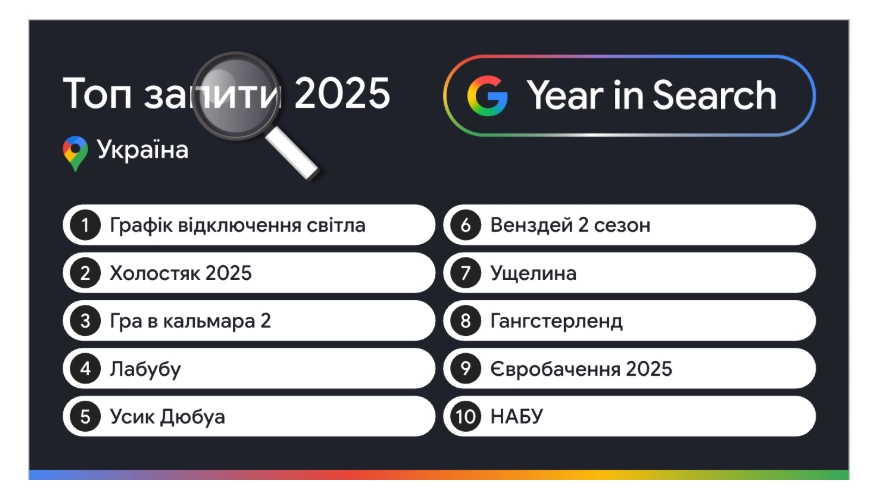
No search engine has either the technical capability or the legal right to segment search statistics according to the type of internet connection used or the professional affiliation of users. For example, Google Trends provides anonymized data on general search trends by country or region, but it cannot isolate “searches made by soldiers through Starlink” from among millions of other queries. Moreover, actual search trends in Ukraine in 2025 showed that Ukrainians were primarily interested in electricity outage schedules, new film releases, and sporting events – a picture that differs dramatically from the fabricated list promoted by propagandists.

The purpose of this disinformation campaign is to create a false image of the Ukrainian soldier as demoralized and prone to suicide and other destructive behavior. The inclusion of themes such as “Putin’s speeches” and “how to surrender” is intended to sow despair and create the impression of an alleged collapse in morale within the Armed Forces of Ukraine.

Any “search rankings” that link specific groups of people to a particular internet provider are entirely fabricated and represent a sophisticated manipulation designed to exert psychological pressure in the context of information warfare.

Fake claim that military commander “Madyar” called for the overthrow of Zelenskyy if he agreed to a “capitulation”

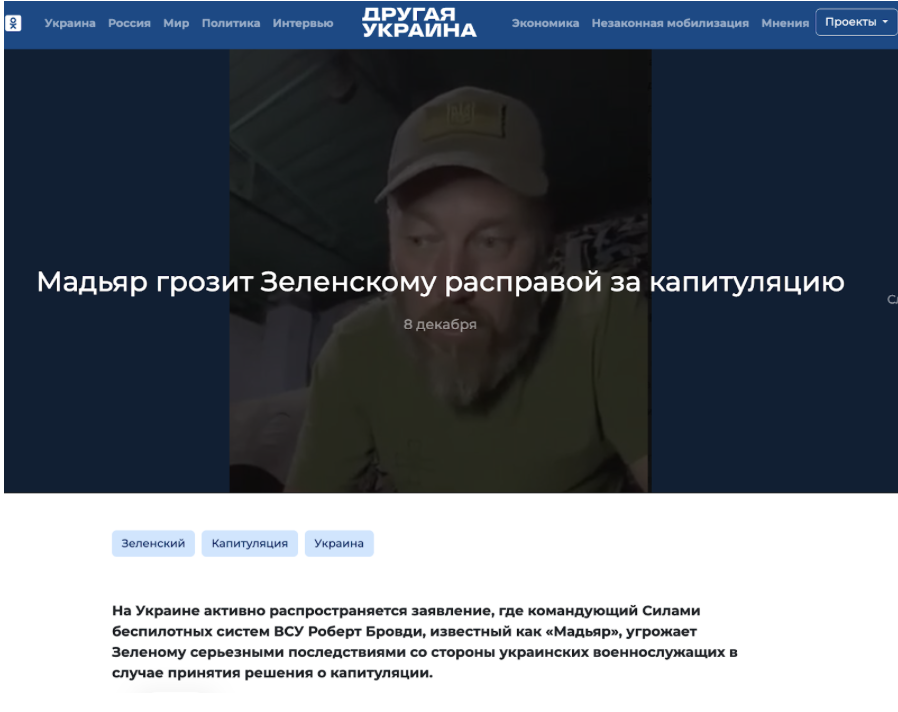
Kremlin-controlled media and propaganda outlets are once again attempting to destabilize the situation in Ukraine by spreading false claims about an alleged threat to overthrow the government. As reported by the fact-checking project StopFake, Robert Brovdi, commander of the Unmanned Systems Forces of the Armed Forces of Ukraine, did not threaten President Volodymyr Zelenskyy.

Russian sources, including the propaganda project Drugaya Ukraina, claim that Robert “Madyar” Brovdi threatened to “turn the army against” Volodymyr Zelenskyy. According to these sources, he allegedly made the statement while commenting on discussions surrounding the current draft peace agreement between Ukraine and Russia. As supposed evidence, they circulated a video clip featuring Brovdi’s remarks.

StopFake established that the video being shared online is actually an edited fragment from a livestream on Madyar’s YouTube channel, originally published on 2 September 2022.

Screenshot of the ‘Another Ukraine’ website

Brovdi’s remarks were made in the context of discussing the theoretical possibility of negotiations with Russia at a time when, in his view, the war had reached a “turning point” in favor of the Ukrainian army. Shortly thereafter, Ukraine launched its successful counteroffensive in the Kharkiv region and liberated Kherson.

In the clip, Madyar warned “everyone” against entering into negotiations that would not serve the interests of the Ukrainian people:

“…By the New Year, the nature of the war will change. We will consolidate the turning point that is happening right now. In any case, those devils (Russia – ed.) will be forced to talk to us, and we are most likely not ready to talk. And if the authorities intend to negotiate against the interests of the Ukrainian people, they will get a blow to the head from us…”

The video therefore has no connection either to current peace initiatives or to any specific politicians.

By spreading the fake, propagandists deliberately omitted Brovdi’s full statement. Just a few seconds after the quoted passage, he explicitly clarified that he was not referring to any “specific individuals”. In this way, the agitprop apparatus used an outdated statement taken out of context to fabricate a story about an alleged internal conflict and to create the impression of political instability in Ukraine.

Wave of fake stories about alleged “crimes” committed by Ukrainian soldiers: how not to become an unwitting spreader of disinformation

This week and last week, fact-checkers have published a series of debunks exposing fake stories about alleged crimes committed by Ukrainian servicemen against civilians. In all cases, hostile sources used real news reports about criminal incidents, altering the headlines and adding references to the Armed Forces of Ukraine.

Here are three recent examples uncovered by VoxCheck:

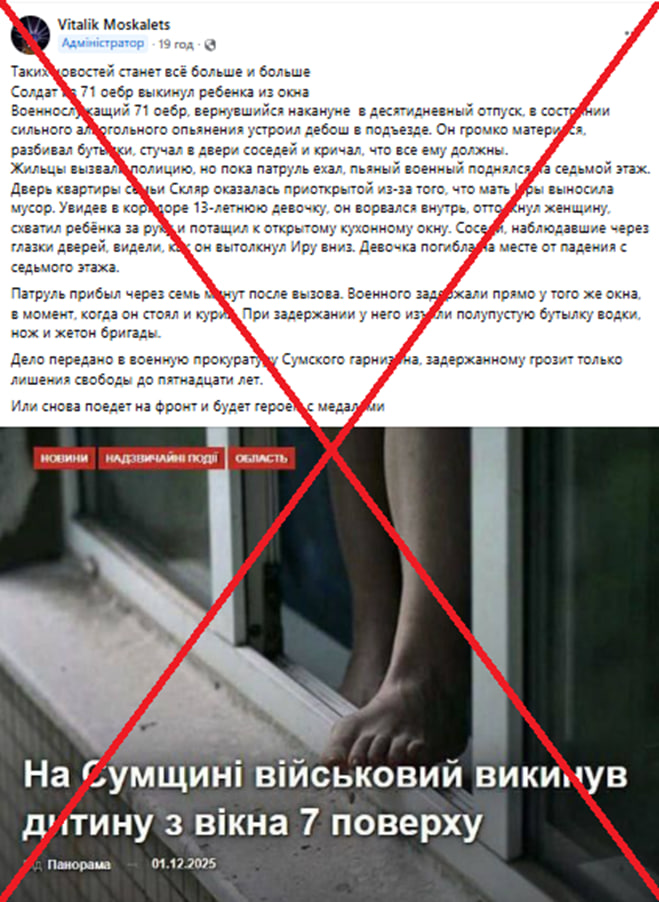
A week earlier, propagandists also falsified a report from a Sumy media outlet, claiming that a serviceman had thrown a child out of a window.

In every case, propagandists inserted references to military personnel into reports about genuine criminal incidents, even though neither the original sources nor local media reports mentioned any involvement of servicemen.

To avoid becoming an unwitting distributor of hostile disinformation, it is important to watch for the following warning signs:

  • Source of information: Always check whether the report cites official sources such as the police, prosecutors, or reputable media outlets. If the source is an anonymous Telegram channel or an “unnamed Ukrainian media outlet,” treat the information with caution. 
  • Fake images and screenshots: Search for the original story using keywords in other media outlets. Propagandists often simply edit a headline or insert references to military personnel into an existing article.

Fake claim about “blocking detachments” in the Armed Forces of Ukraine

The Center for Countering Disinformation under the National Security and Defense Council of Ukraine has debunked another information manipulation spread by Russian propaganda Telegram channels. Hostile resources attempted to discredit Ukraine’s Defense Forces by publishing a fabricated “radio interception” allegedly containing orders to fire on their own troops.

The circulated “interception” supposedly features an order instructing a Ukrainian soldier to open fire on members of the Armed Forces of Ukraine who were allegedly “retreating” from positions near Kupiansk.

According to the CCD, this is yet another fabrication by Russian propaganda. The “radio interception” was edited and assembled by Russian actors with the sole purpose of discrediting Ukraine’s Defense Forces and demoralizing Ukrainian society.

“The Ukrainian army does not have and has never had blocking detachments”, the Centre emphasized.

CCD experts note that such coercive methods and the existence of such units are characteristic of the Russian military itself, where they have been widely documented.

Russian propaganda fabricates “UAF crimes”: two new fakes about soldiers allegedly throwing children out of windows and shooting pensioners

Russian propaganda Telegram channels and Facebook pages have been actively spreading two fabricated screenshots of purported “news reports” from Ukrainian regional media outlets. The publication Ukrinform drew attention to these fakes and debunked them.

The first fake

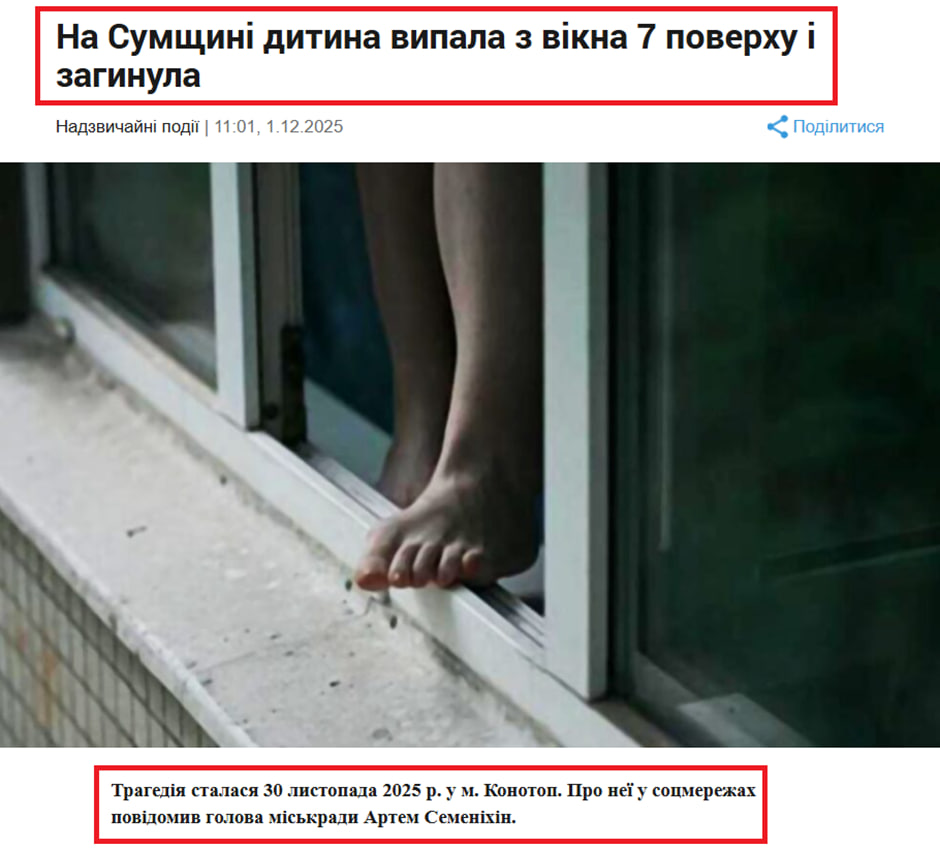
A screenshot allegedly taken from the website of The Sumy Post (Sumy region) is being circulated online, claiming that a “serviceman threw a child out of a seventh-floor window”. In reality, the original The Sumy Post article reported on a tragic accident in Konotop: a 13-year-old boy died after falling from an apartment window. The publication contains no mention whatsoever of a serviceman or an intentional killing – the text was simply falsified.

Real cover of regional news outlet

The second fake

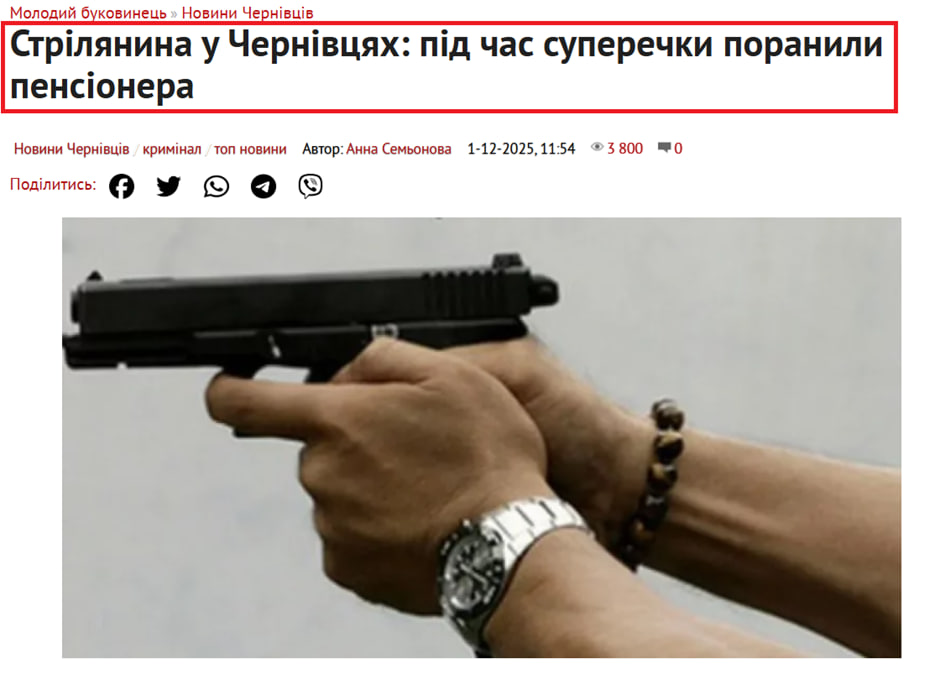
Another screenshot imitates a news article from the Chernivtsi newspaper Molodyi Bukovynets. Its headline and text allegedly report that a “Ukrainian serviceman shot a pensioner following a language-related conflict”. This is also a complete fabrication. Neither the Molodyi Bukovynets website nor the official statement of the Chernivtsi Regional Police, which the newspaper cites, contains any mention of a serviceman. The perpetrator was a civilian, and the reference to a “soldier” was added by propagandists.

In this way, Russia continues its systematic campaign to discredit the Armed Forces of Ukraine, seeking to sow distrust and hostility between military personnel and civilians.

At the same time, it is Russian servicemen returning from the war in Ukraine who have repeatedly committed serious crimes against their own citizens – including murders, acts of violence, and shootings targeting civilians – incidents that have been regularly reported by Russian media outlets and law enforcement agencies themselves.

When Russian soldiers return home and commit murders, rapes, or shootings (and there have already been hundreds of such cases), propaganda responds by claiming: “the same thing is happening in Ukraine”. This narrative serves to shift moral responsibility away from the Russian military and society.

Such disinformation campaigns are amplified through anonymous Telegram channels, bot networks, and seemingly “concerned” comments with the aim of:

  • fueling language-related and regional conflicts; 
  • discrediting territorial recruitment centers (TCCs) and mobilization efforts; 
  • provoking protests among relatives of military personnel.

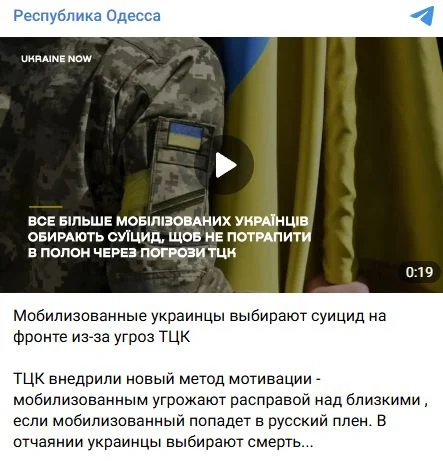
Fake claim: Mobilized Ukrainians are committing suicide on the front line because of military recruitment centers (TCCs)

A video allegedly branded as coming from “Ukraine Now” – Ukraine’s official brand approved by the Cabinet of Ministers in 2018 – has been circulating online. It claims that mobilized Ukrainians are supposedly committing suicide due to intimidation by Territorial Recruitment and Social Support Centers (TCCs): allegedly, they are threatened with reprisals against their relatives if they are captured by Russian forces. The case was reported by VoxCheck.

Screenshot of the post

However, this is a fake. “Ukraine Now” did not publish such a video, and no reputable media outlet or human rights organization has confirmed any such cases.

The video displays the “Ukraine Now” branding approved in 2018. However, there are no materials on the brand’s official website or social media accounts about mobilized Ukrainians committing suicide because of threats from TCCs. The fake is also exposed by a number of inconsistencies: the initiative’s original videos use a completely different design, branding, and font, while all communication is conducted in English. This is another indication that the video was fabricated.

A keyword search produced no corroborating evidence. Neither Ukrainian nor foreign media outlets, nor human rights organizations, have reported any information about such suicides.

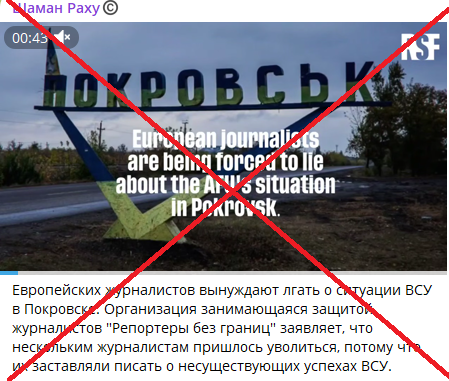
Fake claim: European journalists are being forced to lie about the situation of the Ukrainian Armed Forces in Pokrovsk

In early November, Russian propaganda Telegram channels circulated a video falsely presented as a publication by the organization Reporters Without Borders (RSF). The video claimed that European journalists were being forced to “lie” about the situation on the front line in Pokrovsk by portraying “fabricated successes” of Ukraine’s Armed Forces. This fake was debunked by the VoxCheck team.

Propagandist Telegram channel screenshot 

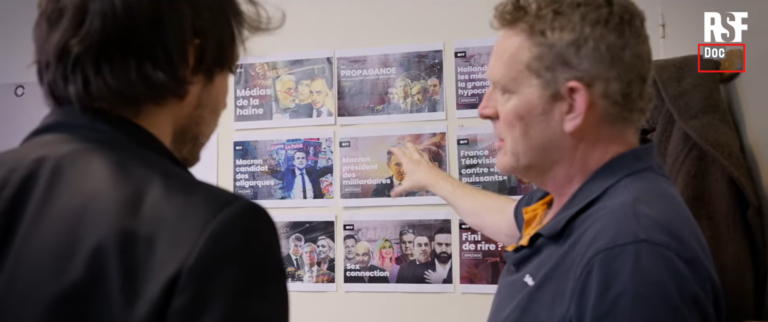
In reality, RSF did not publish any such video: there are no records or posts with this content on the organization’s official website or social media accounts. Analysis of the video shows that its structure, style, and editing do not correspond to genuine RSF materials. Authentic videos produced by the organization usually contain real footage from the scene or interviews and feature a clear title for the material (for example, “Documentary”), whereas the fake consists only of a collection of photos and statements without context.

Screenshot from the actual RSF video

The video also mentions allegedly “three European journalists” who supposedly refused to “lie about the situation near Pokrovsk” and therefore allegedly resigned from their newsrooms. However, this story is entirely unsupported by evidence. The video does not name a single individual, does not identify any specific media outlet, and does not even mention the country these journalists supposedly came from. Normally, journalists’ resignations – especially those related to ethical conflicts – leave a noticeable digital footprint: they are reported by local or professional media, while statements, comments, or at least hints of the conflict appear on social media.

In this case, however, there is no confirmation whatsoever in the information space. Neither European media outlets, nor reporters, nor media organizations have reported any such incidents. VoxCheck’s investigation likewise found no references in open sources – something that would be virtually impossible if a “mass” or even publicly known resignation of journalists had actually taken place.

Ukraine is recruiting Filipinos for the war: the fake has been debunked

The Ministry of Foreign Affairs of Ukraine and the German Embassy in the Philippines have firmly denied claims by Russian Foreign Ministry spokesperson Maria Zakharova that Filipino citizens are allegedly being recruited to take part in the war against Russia on Ukraine’s side.

This was reported by the Center for Strategic Communications.

Zakharova claimed that an alleged recruitment scheme was operating in the Philippines through the U.S. company RMS International, which supposedly promised earnings of $5,000, training by U.S. instructors, and the issuance of Schengen visas at the German Embassy in Manila.

MFA spokesperson Heorhii Tykhyi told the Center for Strategic Communications that these claims are groundless fabrications.

“These statements have no factual basis whatsoever and do not correspond to reality. Ukraine and the Philippines have strong, friendly, and dynamic bilateral relations based on mutual respect, trust, and commitment to international law. This was confirmed just yesterday during a telephone conversation between the Presidents of the two countries,” the MFA representative said.

The ministry emphasized that such statements are another element of Russia’s systematic disinformation campaign. Previously, the Kremlin spread similar fakes, including claims about alleged “recruitment” in South Korea. Now Russian propaganda is targeting countries in Southeast Asia.

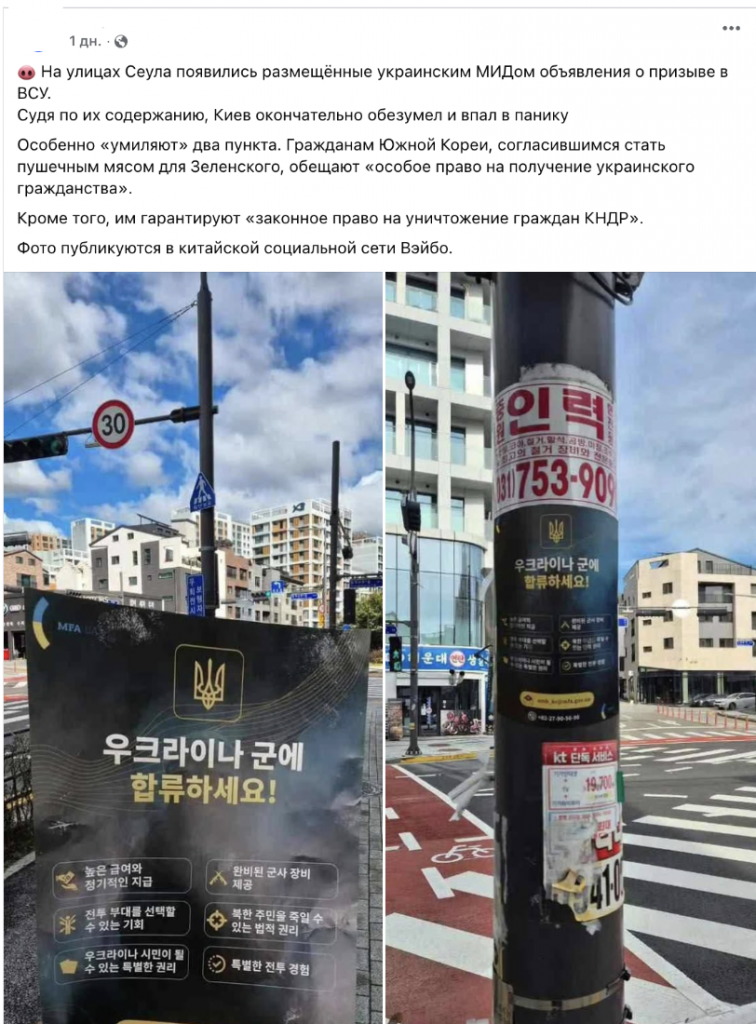
Russians fabricated a fake about recruiting Koreans into the Armed Forces of Ukraine

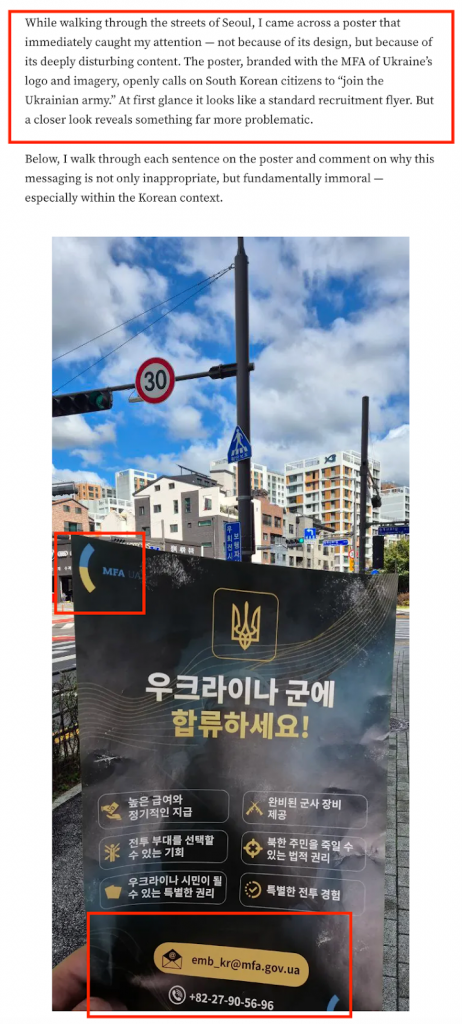
Kremlin media and social media users are spreading claims that Ukraine is allegedly recruiting citizens of South Korea to serve in the Armed Forces of Ukraine. As “evidence”, the propaganda shows photos of posters supposedly put up by the Ministry of Foreign Affairs of Ukraine on the streets of Seoul.

This was reported by StopFake.

The propaganda materials claim that the ads call on Koreans to join the Ukrainian army and promise a “special right to obtain Ukrainian citizenship”. Propagandists assert that this allegedly indicates “panic” in Kyiv.

The author of the circulated photographs is said to be Alan Kellow, a contributor on the Medium platform, where anyone can publish. He claimed that he had allegedly seen such posters while walking around Seoul.

The photos show contact details belonging to the Embassy of Ukraine in the Republic of Korea. At the same time, there is no information on the embassy’s official resources about recruiting foreigners. Fact-checkers contacted the embassy for clarification and received a response confirming that these materials are fake.

“We inform you that neither the Ministry of Foreign Affairs of Ukraine nor the Embassy of Ukraine in the Republic of Korea distributed such leaflets,” the diplomatic mission emphasized.

The Ministry of Foreign Affairs of Ukraine also confirmed that the posters are fake and are part of another Russian disinformation campaign.

In response to an inquiry from the Center for Strategic Communications, MFA spokesperson Heorhii Tykhyi stated that Ukraine has no connection whatsoever to the distribution of such materials, and that similar provocations have recently been recorded in other countries as well. According to him, this indicates a systematic attempt to discredit Ukraine abroad.

Chipping and “parties of shame”: propagandists spread new fakes about the Armed Forces of Ukraine

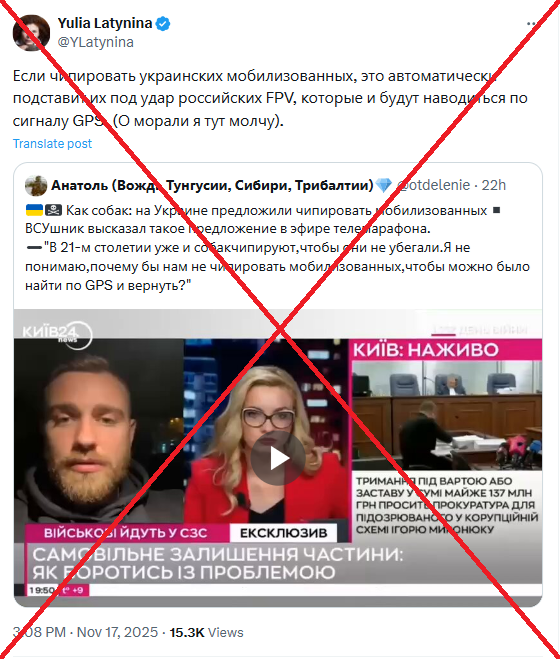
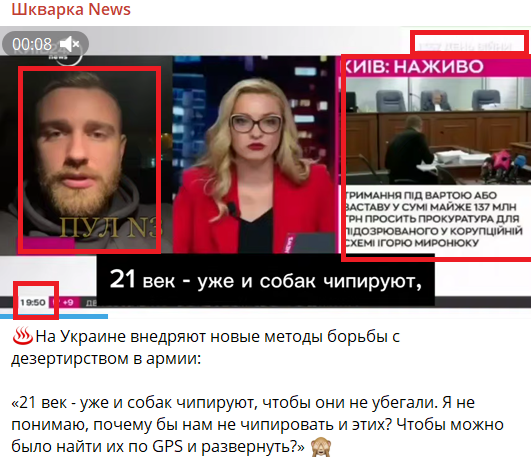
Russian propaganda media and Telegram channels are spreading an edited video allegedly taken from a broadcast of the Ukrainian TV channel “Kyiv”. In the clip, a man presented as a serviceman proposes “chipping” all mobilized Ukrainian men in order to prevent unauthorized absence from their units. In reality, this is a fabrication.

Ukrinform reports this.

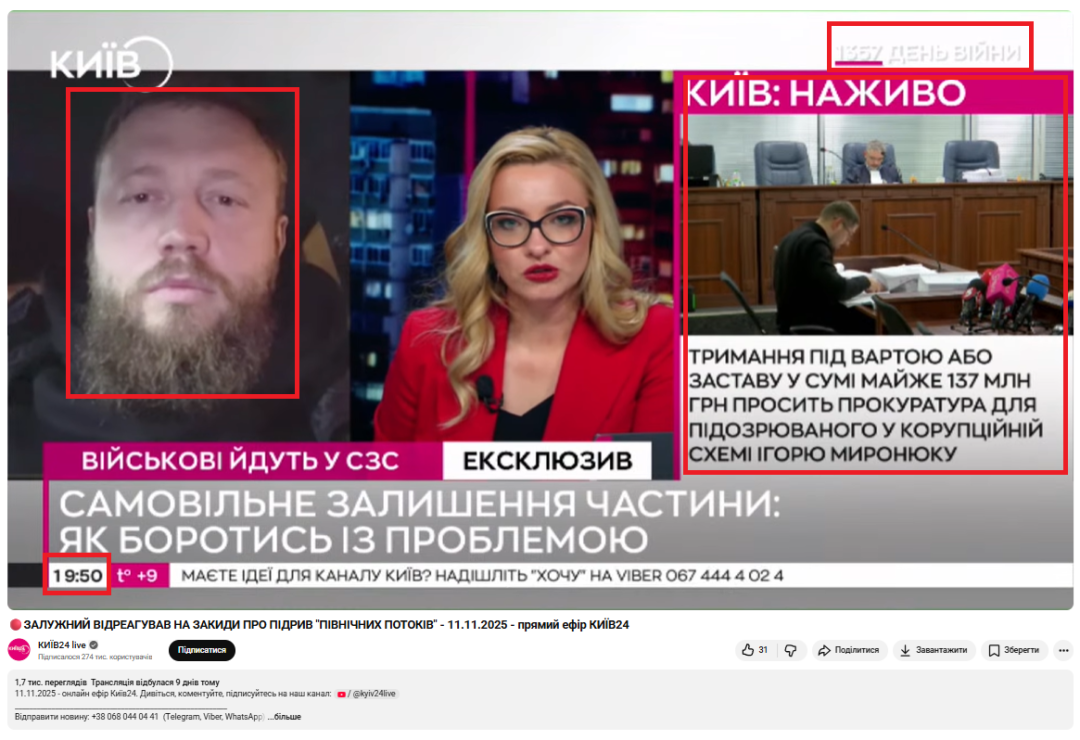
The propagandists altered the image of the program’s guest using graphic editing tools and overlaid a fake audio track. The fake was shared, among others, by the Russian so-called “opposition figure” Yuliya Latynina.

In the original news broadcast on November 11, the host was speaking with Dmytro Kukharchuk, Deputy Commander of the 3rd Army Corps of the Ground Forces of the Armed Forces of Ukraine. The discussion focused on the issue of unauthorized absence from units and the situation in the Kupiansk direction, but no statements about “chipping” servicemen were made. The fake video features a completely different person.

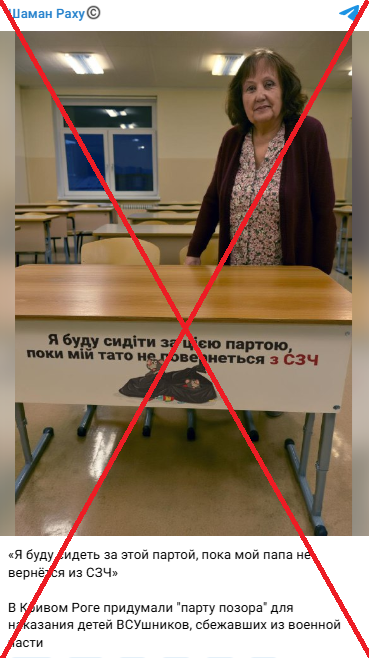
At the same time, Russian Telegram channels are spreading a photo allegedly from a Ukrainian school, where a so-called “desk of shame” was supposedly installed for children whose parents went AWOL.

This image is also fake – it was generated by artificial intelligence. This is confirmed by AI-detection services such as WasitAI, Reversely, and DecopyAI.

Both fabrications are part of another Russian information and psychological operation aimed at inciting conflict between the Ukrainian authorities, the military, and society.

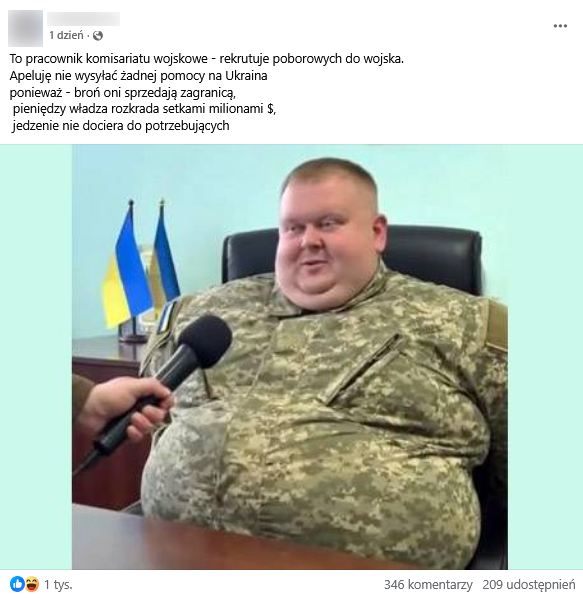
Fake about an “obese Ukrainian officer”: AI-generated content is being used to discredit aid to Ukraine

On social media, particularly in the Polish segment of Facebook, alleged photos of an overweight man in a Ukrainian military uniform are being actively shared. The authors of these posts claim that he is an officer responsible for mobilization in the Ukrainian army, and that his appearance supposedly proves that international aid “does not reach those who truly need it”. Such posts have attracted hundreds of comments and shares. In reality, no such person exists, and the image was generated by artificial intelligence with the aim of fueling anti-Ukrainian sentiment. The fake was debunked by Polish fact-checkers from Demagog.

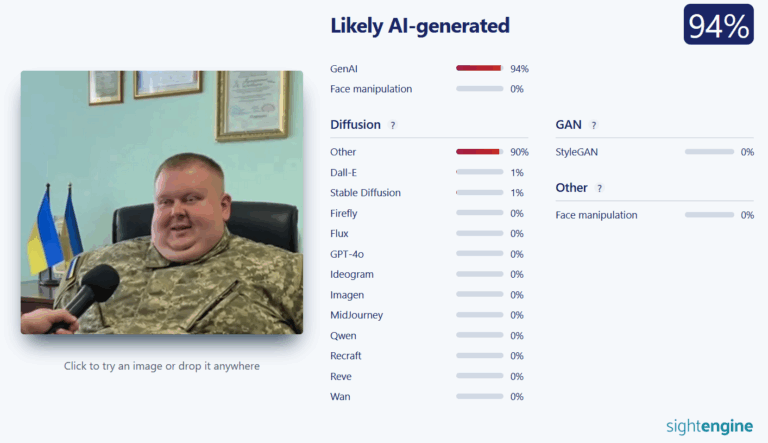
The image comes from a video that originally appeared on TikTok. A closer look at the clip reveals signs of AI generation: for example, the chair blends into the background, the shadows on the clothing “move” unnaturally, and the positioning of the character’s hands looks artificial. In the video, the supposed “officer of the Zhytomyr Territorial Recruitment Center” says, “Our team is against a ceasefire”. At the same time, the audio is out of sync with the movements of the lips in the footage.

To confirm this, Demagog fact-checkers analyzed the frame using the specialized tools Hive AI and Sightengine – both indicated a probability of over 90% that the content was generated by artificial intelligence.

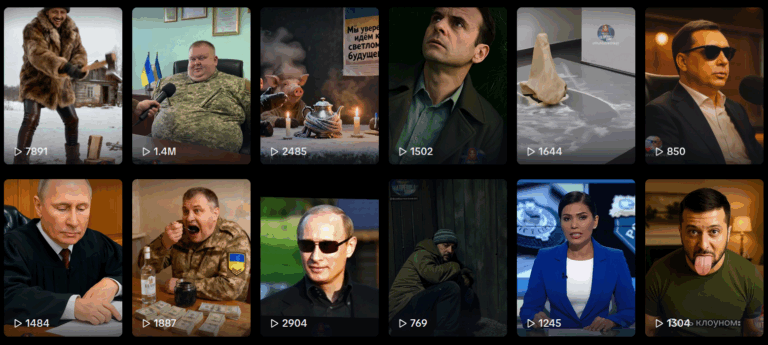
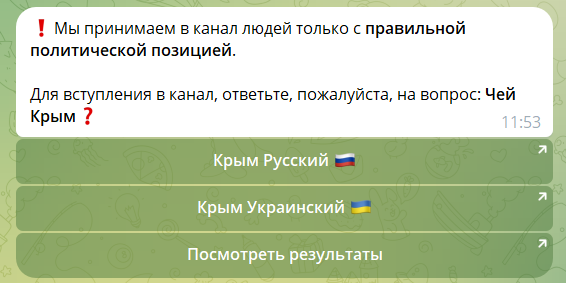
The TikTok account that posted this video is filled with similar content of a pro-Russian and anti-Ukrainian nature. The profile description contains a link to a closed Telegram channel called “MATRYOSHKA”. When attempting to join it, users are asked provocative questions, such as “Whose is Crimea?”, which indicates the channel’s propagandistic nature.

Posts featuring this image gained significant traction: one of them received more than 1,000 reactions and over 200 shares. In the comments, many users perceive the photo as real. One commenter wrote: “This person is sick, and only people like this serve in the Ukrainian army, because the healthy and strong are in Poland”. Another added: “This war is strange—they stuff themselves with food, relax at resorts, drive luxury cars, carry money in shopping bags, get positions without rights, and want to be in our government”.

Such fakes are aimed at undermining trust in Ukraine and spreading anti-Ukrainian narratives within Polish society.

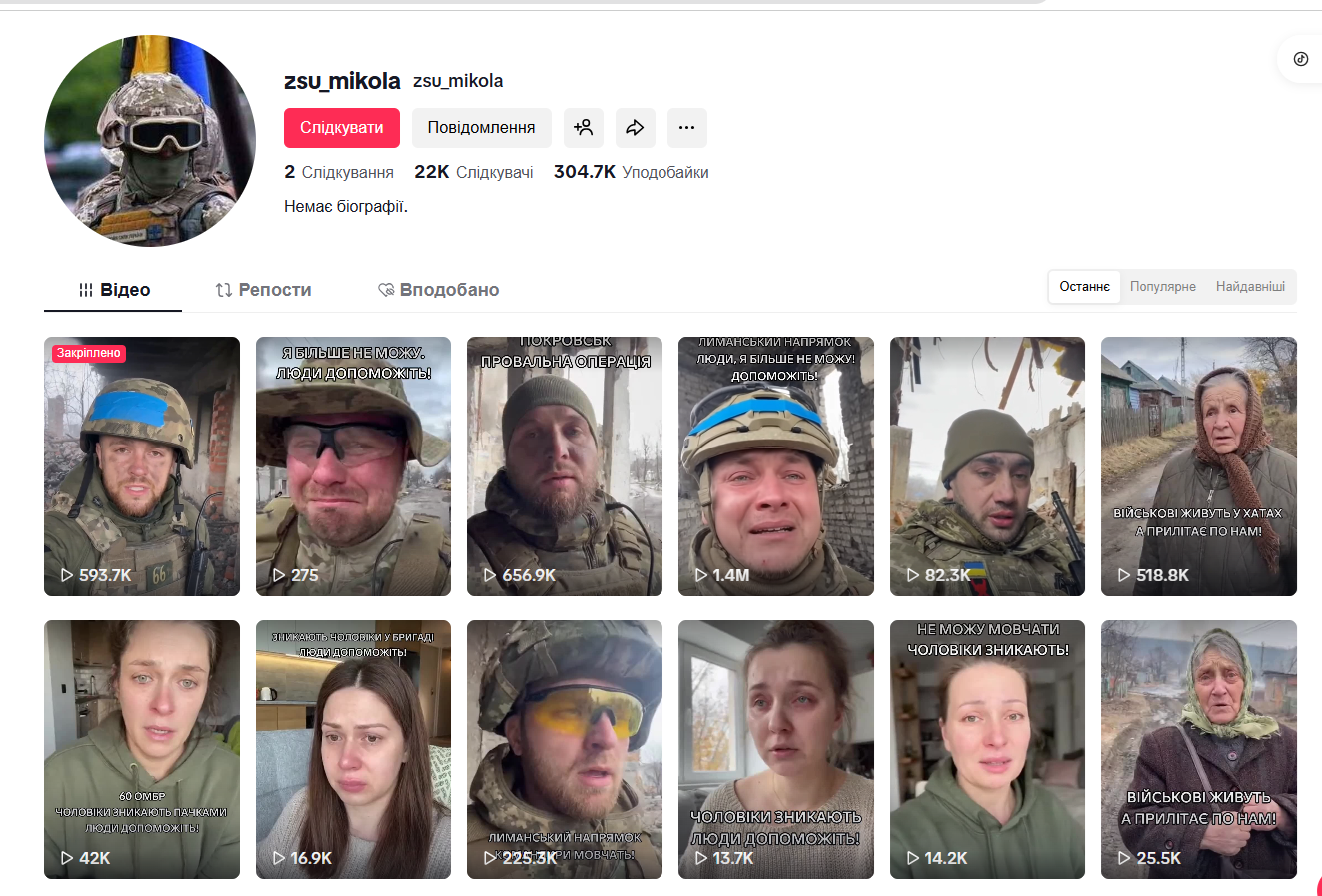
A fake AI-generated video of a “Ukrainian soldier” was created using the face of a Russian blogger

In early November, a video circulated on the Georgian segment of Facebook showing a young man in military uniform. He is crying, claiming that he is being forcibly sent to the front, that he does not want to die, and urging viewers to share the video. The accompanying caption reads: “Clowns are forcing young people to fight”. Many commenters perceived the person in the video as a Ukrainian soldier. This fake was debunked by Georgian fact-checkers from MythDetector.

In reality, this is an AI-generated video containing a manipulative appeal related to military assistance. It features errors characteristic of artificial intelligence, and its original source is a TikTok account that had previously uploaded similar fake content.

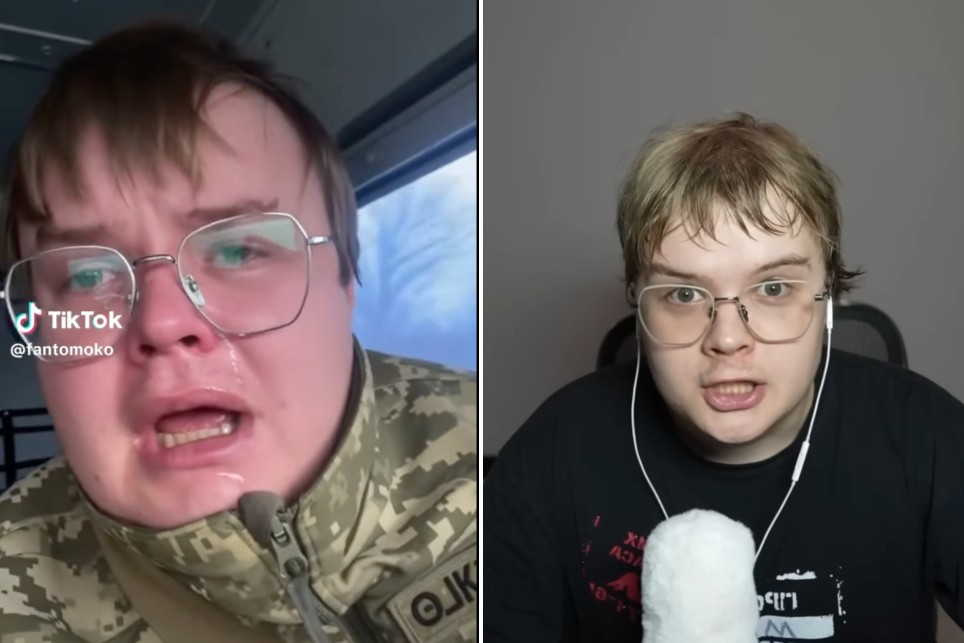
The video shows technical flaws typical of AI-generated material. The speaker’s face and tears appear artificial: the image is overly smooth, and the tears on his chin and nose shine unnaturally. If you look closely at the glasses, in some places they seem to merge with the face.

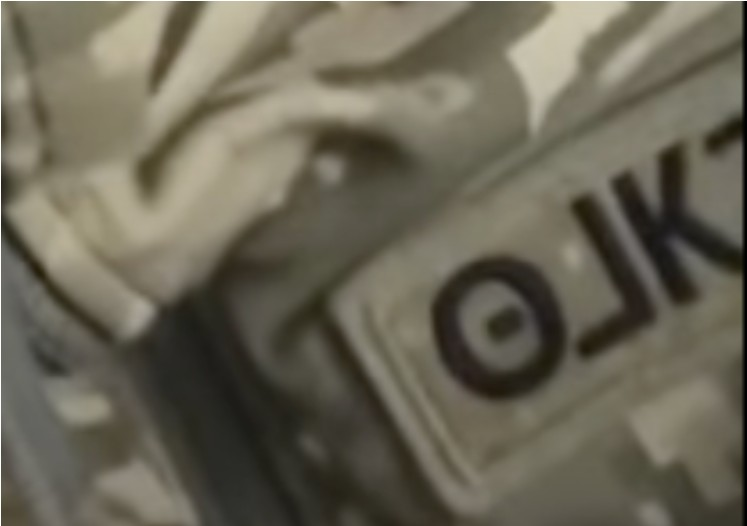
In addition, there is a patch on the uniform where the soldier’s surname should be written, but instead it displays blurred, unreadable symbols – a common issue in AI-generated imagery.

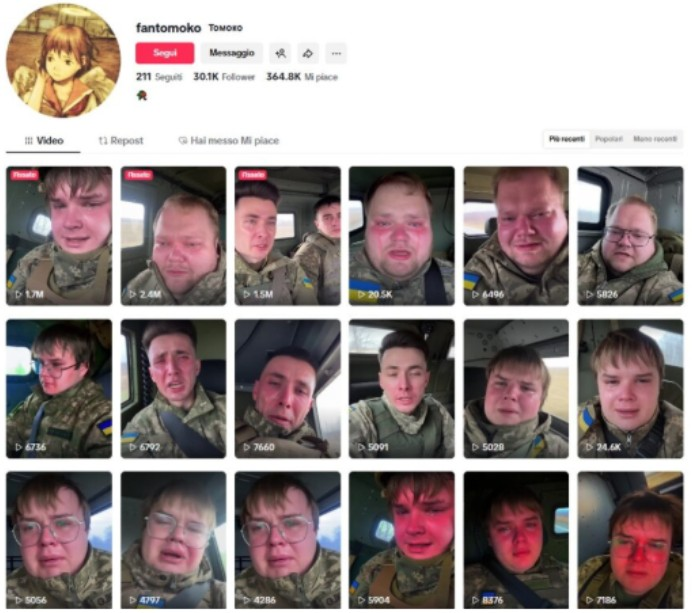
According to the caption, the video originated from the TikTok account fantomoko, which has since been blocked. Myth Detector fact-checkers analyzed similar videos previously shared by this user. For example, in one AI-generated video that circulated in Russian- and Georgian-language communities, a “Ukrainian soldier” claimed he was 23 years old and had been forcibly mobilized.

As of November 4, the fantomoko account contained several similar pieces of content. Some depicted “Ukrainian soldiers”, while others showed figures wearing uniforms with a Russian flag. The themes varied – from tearful complaints about being forced into war to a scene in which a person holds a Ukrainian flag near the Kremlin.

These videos were also investigated by the Italian fact-checking platform Open, which identified the person whose face was used for the AI generation. It turned out that one of the “characters” whose face most frequently serves as a template is a Russian video blogger with the nickname kussia88, known on YouTube as KASHA STREAM. A comparison of facial features confirms that it was his likeness that was used in the fake video.

Russian propagandists and networks affiliated with them spread such AI-generated fakes to manipulate public opinion, especially in countries where there is potential skepticism about supporting Ukraine.

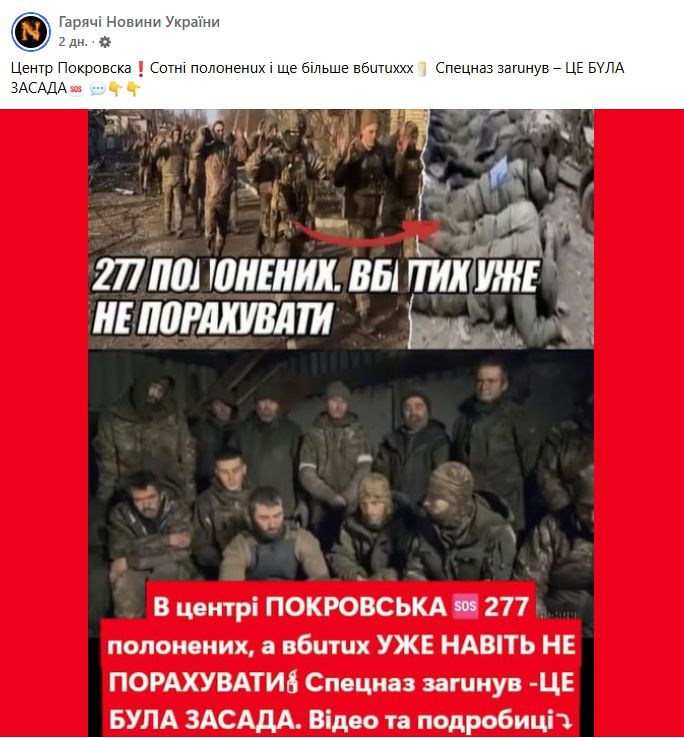
Clickbait About “277 Prisoners in the Center of Pokrovsk”

A fake is being spread online claiming the alleged capture of 277 soldiers “in the very center of Pokrovsk”. The post is presented as a sensational story, but the information has no confirmation. The post itself does not specify which military personnel are supposedly involved. Official sources and international media have not reported any mass capture on such a scale, VoxCheck reports.

The fake, which appeared in early November, is based on a manipulative publication by the website “Life in Details”, which, without any evidence, refers to a journalist from The Economist. The actual article in The Economist contains no such data. Moreover, the photos used to illustrate the “news” were taken from unrelated events: one image has been circulating since 2022, while another is a frame from a video by the 79th Brigade published as far back as January 4, 2025.

Similar anonymous pages quite often spread distorted or false information in order to boost their reach. Disinformation mechanisms are also used in other information attacks – as previously discussed in the case of Russian information-psychological operations (IPSO) farms and a series of TikTok videos in which AI-generated “soldiers” allegedly report the complete encirclement of Kupiansk and a catastrophic situation at the front.

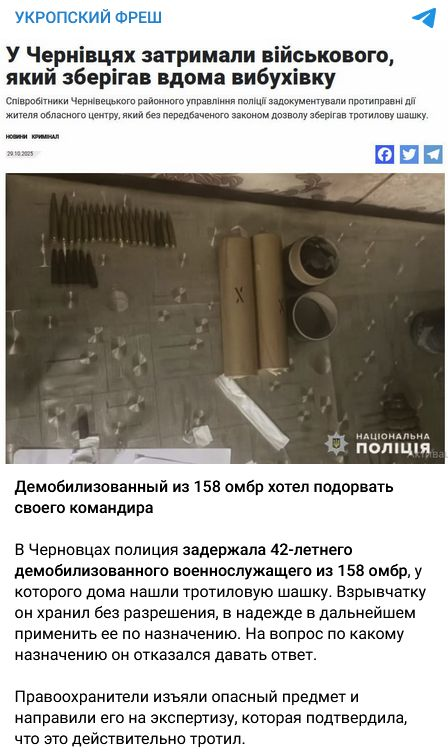
Photo fake: a serviceman was allegedly detained in Chernivtsi Oblast for storing explosives at home

Russian propaganda Telegram channels are actively spreading an edited screenshot of an article from a Ukrainian media outlet, claiming that a serviceman of the 158th Separate Mechanized Brigade was allegedly detained in Chernivtsi Oblast for storing a TNT block. According to their version, the soldier supposedly planned to use the explosives to take revenge on his commander for “abuse”. This photo fake was debunked by experts from VoxCheck.

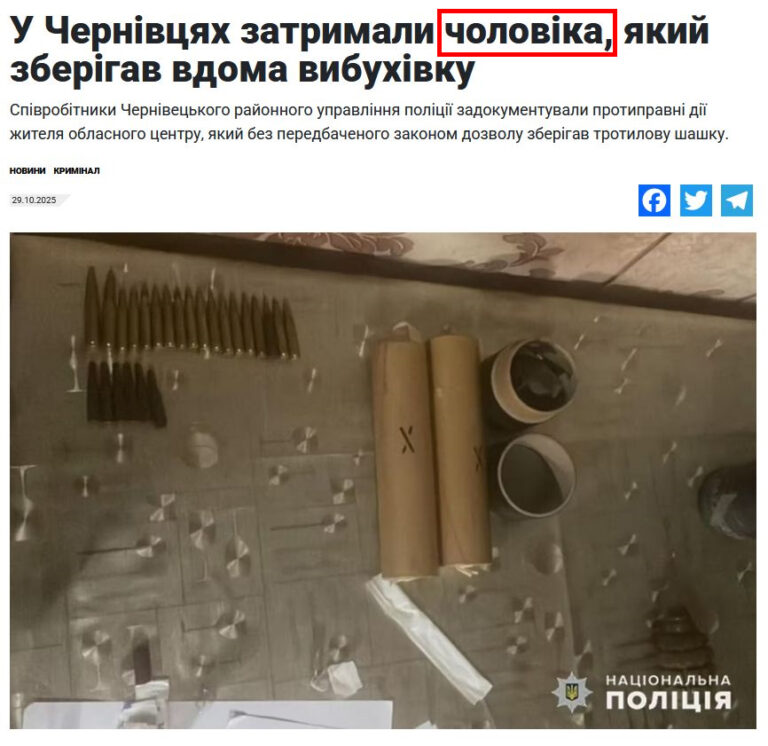
A check of the information source showed that the propagandists altered the original headline of the article.

  • Original report: The news item referenced by Russian channels was published by the Lviv-based TV channel NTA on October 29, 2025. It reported the detention of a 42-year-old man in Chernivtsi Oblast for the illegal storage of a TNT block.
  • In the original article and in official statements by the Chernivtsi Oblast police, there is no mention that the detainee was a serviceman, let alone that he served in the 158th Separate Mechanized Brigade.
  • Method of falsification: Most likely, Russian disinformers used photo-editing software or page code editing tools to replace the word “man” with “serviceman”, thereby creating a fake narrative about crimes within the Armed Forces of Ukraine and alleged internal conflicts.

The information about the alleged detention of a “serviceman of the 158th Separate Mechanized Brigade who stored explosives” is a deliberate disinformation plant and a manipulation aimed at discrediting the Armed Forces of Ukraine and creating a false picture of internal discord.

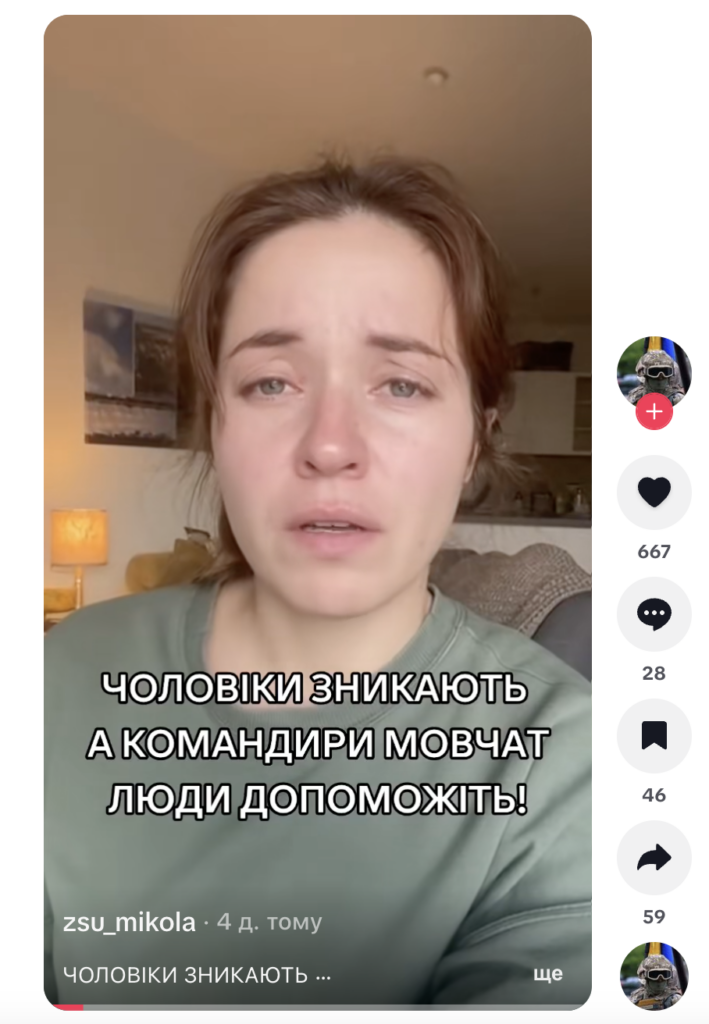
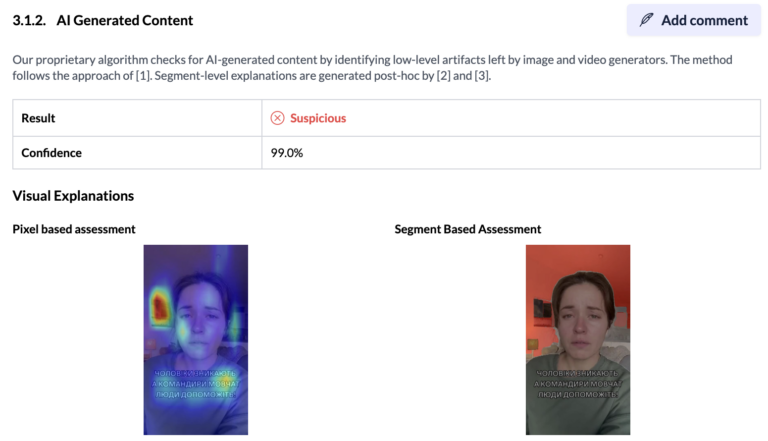
The fake video about the “disappearance of half a brigade” was created using AI

A video is actively circulating on social media, particularly on TikTok, in which a woman emotionally claims that her husband, a serviceman, has gone missing and that the command of the Armed Forces of Ukraine is completely covering up the situation. She also alleges that half of the personnel in his brigade have supposedly disappeared. This is a high-quality video fake (deepfake) created using artificial intelligence technologies. The fake was debunked by experts from VoxCheck.

VoxCheck experts conducted a thorough analysis of the video, which confirmed that it is not authentic:

  • Facial expressions and movement: The “soldier’s wife” shows typical signs of AI-generated content. During the speech, almost only the lips move, while the overall facial expression remains unnaturally static.
  • Voice: The audio track sounds overly even and has a characteristic robotic tone, which is common in synthesized speech.
  • Technical confirmation: A check using the specialized tool Sensity.AI confirmed that the clip is AI-generated with a 99% probability. The program also identified a lipsync manipulation – artificially matching lip movements to a synthesized voice.

The TikTok account that posted this fake video is systematically used to spread AI-generated content aimed at discrediting Ukraine’s Defense Forces.

Propagandists rely on the same manipulative themes and visual archetypes to provoke maximum public reaction and distrust toward military command:

  • “Soldiers’ wives complain” about missing servicemen and alleged indifference from commanders.
  • “Elderly people protest” against the presence of military units in their communities.
  • “Servicemen claim” that they were “abandoned” or “betrayed” by their command.

This video is part of a coordinated enemy information operation aimed at demoralizing society, undermining trust in military leadership, and spreading panic by using realistic but entirely fake “testimonies” generated by AI characters.

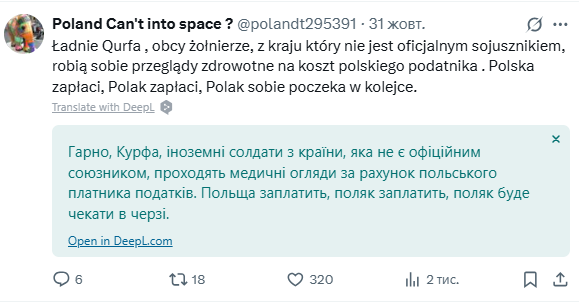
Fake: Ukrainian soldiers in a Polish hospital are allegedly “treated ahead of Poles”

In Polish social media, a video is being widely shared showing a group of Ukrainian soldiers near the district hospital in Stalowa Wola (Poland). This sparked a wave of outrage and speculation: some users and politicians claimed that the soldiers allegedly received medical care ahead of Polish patients, putting an extra burden on the local healthcare system. However, as Polish fact-checkers from Demagog found, this is a manipulation.

https://x.com/coolfonpl/status/1984156174229410078?ref_src=twsrc%5Etfw%7Ctwcamp%5Etweetembed%7Ctwterm%5E1984156174229410078%7Ctwgr%5Eb387ec04c10e615773e6517d174512e60a088517%7Ctwcon%5Es1_&ref_url=https%3A%2F%2Fdisinfo.detector.media%2Fday%2F06-11-2025

Social media users claimed that these men were “burdening” the Polish healthcare system or were being treated out of turn, forcing Poles to wait in queues. The topic was picked up by some Polish politicians, including Włodzimierz Skalik of the Confederation of the Polish Crown and Konrad Berkowicz from the New Hope party. Berkowicz, for example, stated: “Ukrainians are being hospitalized in our hospitals at the expense of Poles who are standing in queues. The case of Stalowa Wola is not an isolated incident; it is a symptom of a country that puts foreign interests above principles. We are not masters in Poland. We are giving up territory to foreigners in our own country”.

Such claims quickly gained traction, but they are based on assumptions rather than facts and resemble Russian narratives aimed at polarizing society.

Official responses

Poland’s Ministry of National Defence (MON) and the head of Stalowa Wola county, Janusz Zarzeczny, quickly responded to the rumors. In a statement posted on X on November 3, 2025, MON emphasized that there are no laws or regulations in Poland that give Ukrainian soldiers priority in medical care over Polish patients: “There are no legal provisions in Poland that guarantee medical treatment in hospitals for Ukrainian soldiers instead of Polish patients. This attempt at manipulation fits the Russian narrative aimed at stirring negative emotions and polarizing Polish and Western society,” the official statement said.

According to Janusz Zarzeczny in an interview with Wirtualna Polska, the soldiers were undergoing scheduled screening tests as part of training at a nearby training ground in Lipy. These procedures were not financed by the National Health Fund (NFZ) but were provided on a commercial basis, with the costs covered by the Ministry of National Defence. “These are invoices amounting to hundreds of thousands of zlotys. This is additional income for the hospital,” Zarzeczny explained.

The hospital does not serve only Ukrainian soldiers. In a specially separated part of the building, similar tests are carried out for soldiers from Slovakia, Norway, and France who are also training in the region. This is standard practice for foreign units and does not affect queues for local residents.

The level of health insurance contributions and the cost of treatment for Ukrainians in Poland

In the context of the debate on Ukrainians’ access to Poland’s healthcare system, it is worth noting that according to available data, in 2024 the treatment of people from Ukraine cost 2.24 billion zlotys, compared to 1.95 billion zlotys the year before. Revenue from health insurance contributions paid by Ukrainian citizens to the National Health Fund (NFZ) amounted to 3.8 billion zlotys and 3.1 billion zlotys in those years, respectively.

This means that health insurance contributions paid by Ukrainians exceed the costs of their medical treatment in Poland. In 2024, the surplus amounted to 1.56 billion zlotys, and in 2023 to 1.15 billion zlotys.

This story is a typical fake that exploits emotions and national prejudices. A video taken out of context is easy to misinterpret, while politicians and bots on social media amplify it for their own purposes. MON directly points to links with Russian narratives that seek to sow discord between Poland and Ukraine.

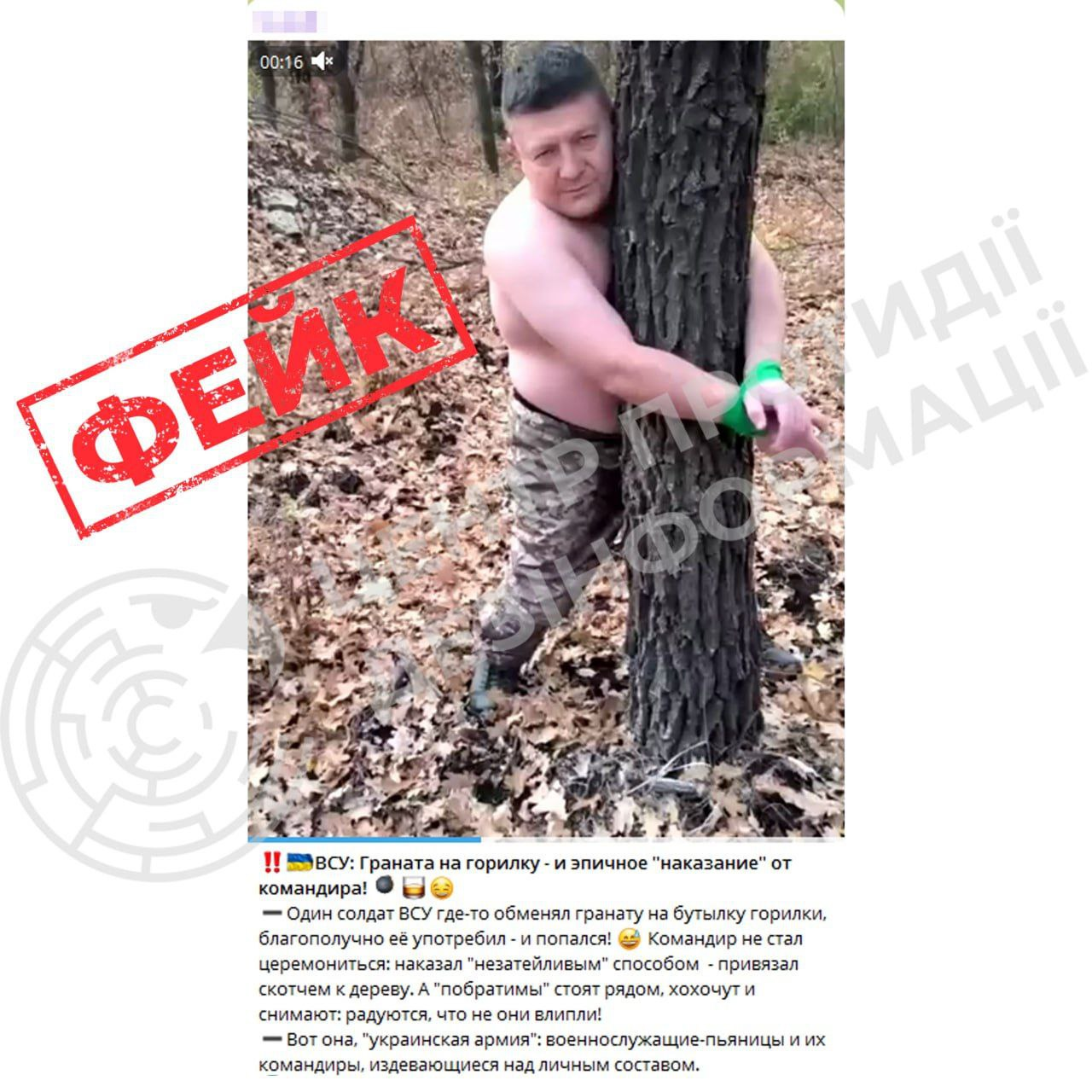
A Ukrainian Armed Forces soldier was allegedly punished for drinking by being tied to a tree – a Russian disinformation claim debunked

Russian propaganda has launched a new video fake to discredit the Armed Forces of Ukraine. Enemy Telegram channels are spreading a clip in which a so-called “Ukrainian soldier”, tied to a tree, is allegedly being punished by his commanders “for drinking”.

This was flagged by fact-checkers from the Center for Countering Disinformation under Ukraine’s National Security and Defense Council.

This is a fake, analysts say. Deepfake detection services confirm that the man’s face was generated by AI. In reality, such “punishments” are a typical practice in the Russian army itself. There are numerous videos online showing Russian soldiers being tied up and beaten for disciplinary violations.

Such videos, spread by hostile Telegram channels, are aimed at Ukrainians who are hesitant about mobilization, relatives of service members, and residents of frontline regions. By showing alleged “punishment” for drinking in the form of being tied to a tree, the enemy seeks to sow fear and distrust toward military command and to discourage people from serving.

For the international community, through translated versions, a narrative is being created that “both sides are equally brutal”, which blurs the moral distinction between the aggressor and the victim and reduces support for Ukraine.

Fake: Ukrainians use Nazi symbols during military funerals

Russian media are spreading false claims that “Nazi crosses” are being installed at the National Military Memorial Cemetery in Ukraine, allegedly similar to those used at German military graves during World War II. This claim is not true.

This was reported by VoxCheck.

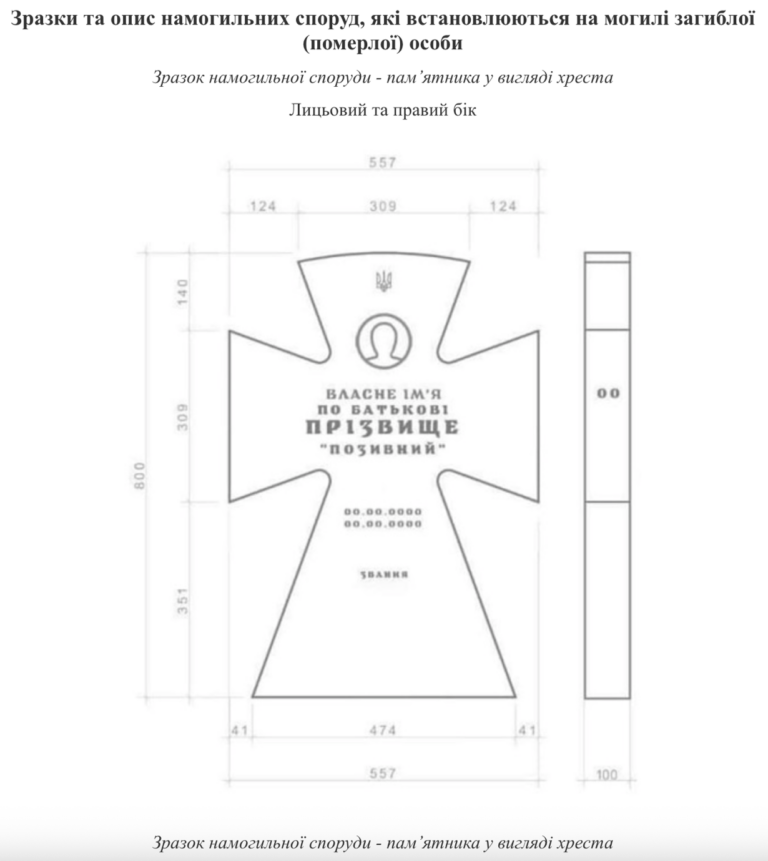
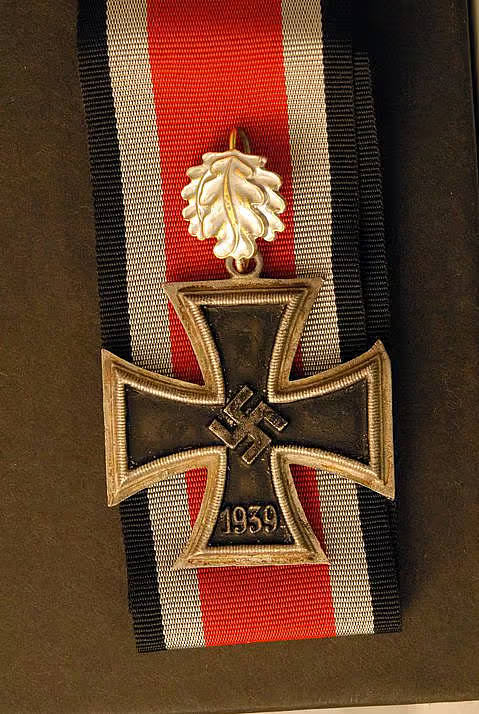
The design of the National Military Memorial Cemetery includes the installation of the Cossack cross – a traditional Ukrainian symbol that has no connection whatsoever to Nazi burials. Cemeteries of the Third Reich used a completely different symbol – the Iron Cross.

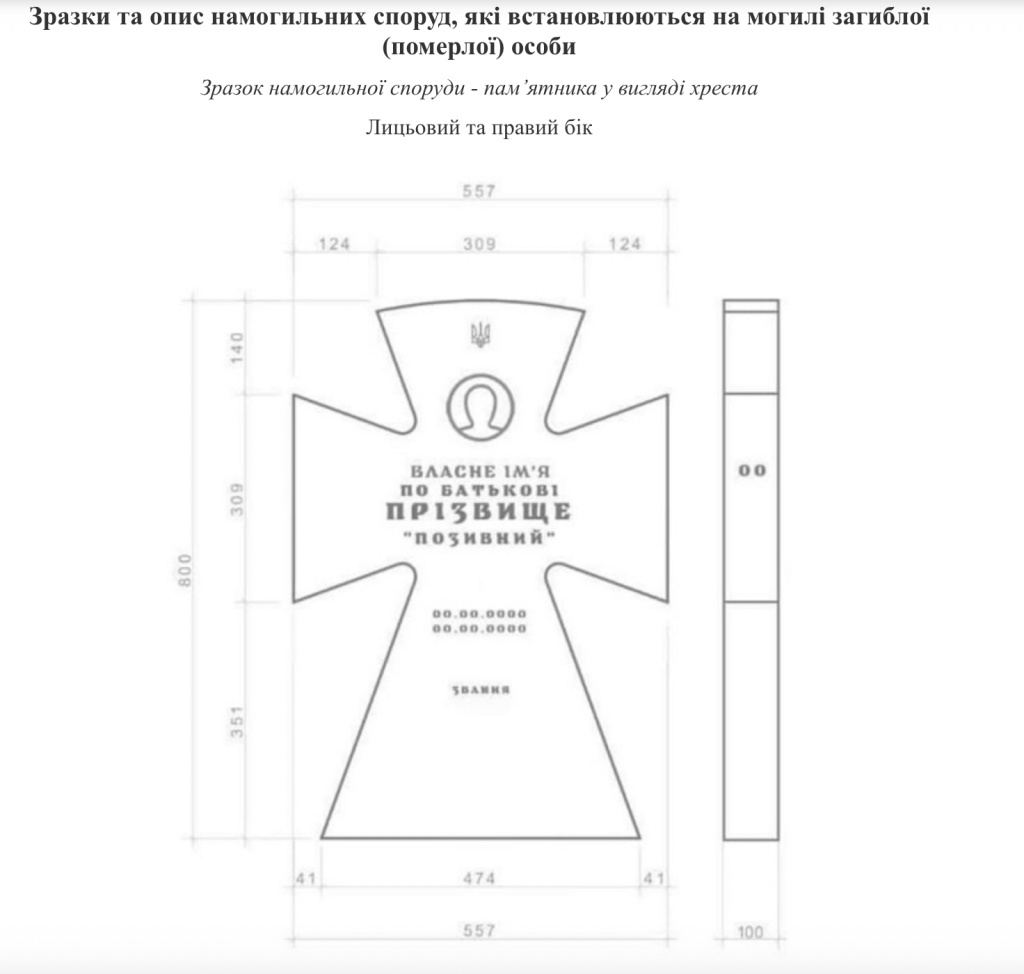
The National Military Memorial Cemetery was established in 2022 and officially opened in August 2025. According to the government-approved project, two types of gravestones are developed: the Cossack cross and a memorial plaque. These forms were officially approved by the Cabinet of Ministers of Ukraine.

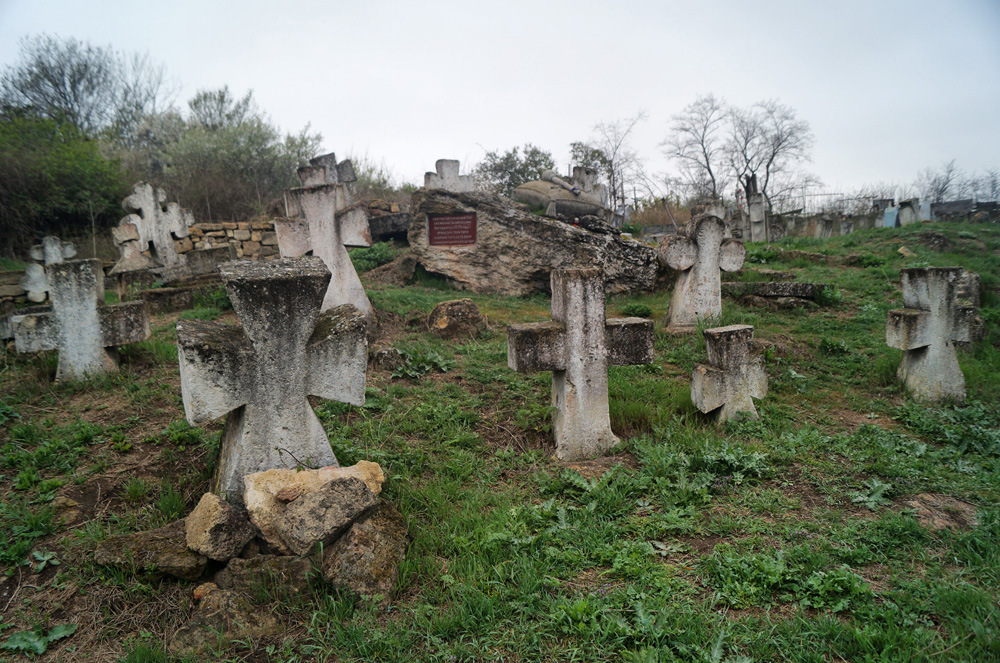
The Cossack cross is an element of Ukraine’s military and spiritual tradition. It has been used in the burial of warriors since Cossack times and symbolizes honor, remembrance, and faith. This cross is part of the symbolism of the Armed Forces of Ukraine, the State Border Guard Service, the Security Service of Ukraine, as well as certain state awards and departmental insignia.

By contrast, the Iron Cross (Eisernes Kreuz), which was indeed used in German military burials, has a completely different origin. It was established in 1813 in Prussia as a military decoration. In 1939, Nazi Germany reinstated the award and added the swastika to it – an element that became a symbol of totalitarian ideology.

The Cossack cross and the Iron Cross differ in both form and symbolism. The Cossack cross has straight edges and a simple geometric design, while the Iron Cross is characterized by curved edges, a dark core, and a silver frame. The former is a religious and cultural symbol, while the latter is a military decoration that was later used by the Nazis in their propaganda.

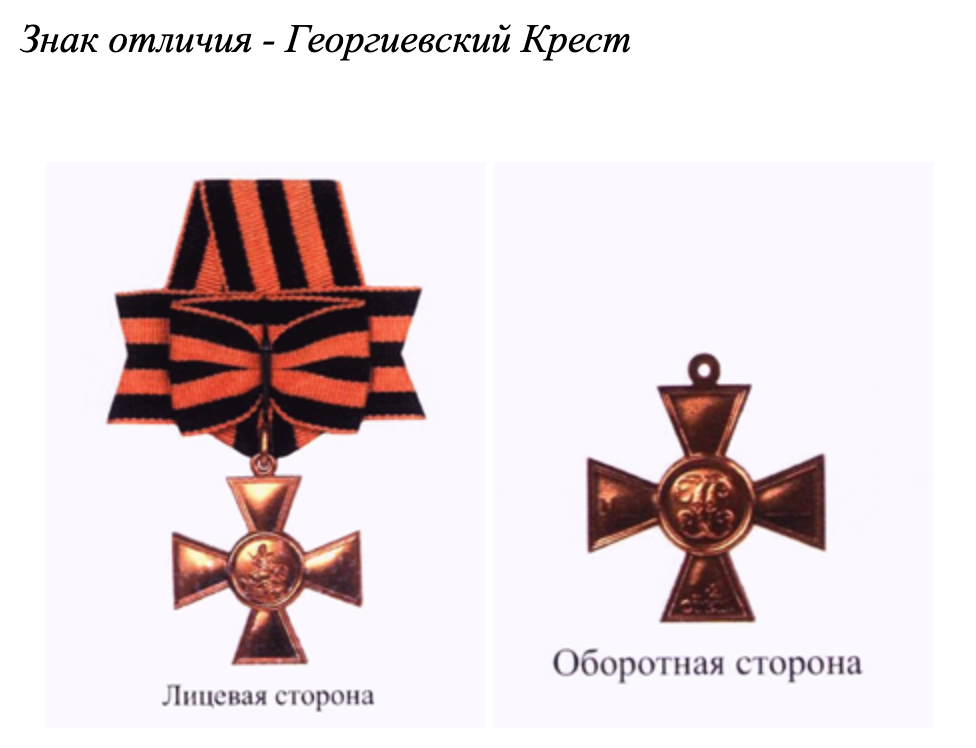
The Cossack cross has existed for centuries, long before the emergence of Nazism, and contains no ideological elements associated with the Third Reich. Moreover, modern Russia also has awards in the shape of a cross – for example, the St. George Cross, whose form may visually resemble the German order. This further demonstrates the groundlessness of accusations of “Nazism” based solely on the external similarity of symbols.

Russian propaganda is spreading a fake about alleged “atrocities” by the Armed Forces of Ukraine in Pokrovsk

Russian propaganda continues to spread false claims about alleged “atrocities committed by Ukrainian soldiers against the civilian population of Donbas”. This time, Russian propaganda outlets are promoting a fabrication that Ukrainian troops supposedly “use civilians to clear roads of mines in Pokrovsk”. According to this narrative, local residents are allegedly forced to walk along mined roads so that they would “neutralize the mines with their bodies”. The only “evidence” cited for this story is the words of a single Russian occupier. This was reported by the Center for Countering Disinformation.

Russian propagandists have fabricated a story about the “killing of civilians” in the Sumy region

Russian Telegram channels are spreading a screenshot of what is allegedly a Facebook post by the National Police of the Sumy region. The fake message claims that a conflict occurred in the village of Nyzy in Sumy district between soldiers and local residents, during which fighters of the 95th Separate Assault Brigade supposedly killed three people. This was reported by VoxCheck.

In reality, the post is completely fabricated. The National Police of the Sumy region did not publish any information about such an incident, and no such event took place. A review of the official pages and website of the Sumy Regional Police confirms that no such message exists. The police press service also debunked the fake, stressing that the post is a forgery and that the described events never happened.

Photo fake: a serviceman allegedly attacked a man in Kharkiv over an argument about a parking space

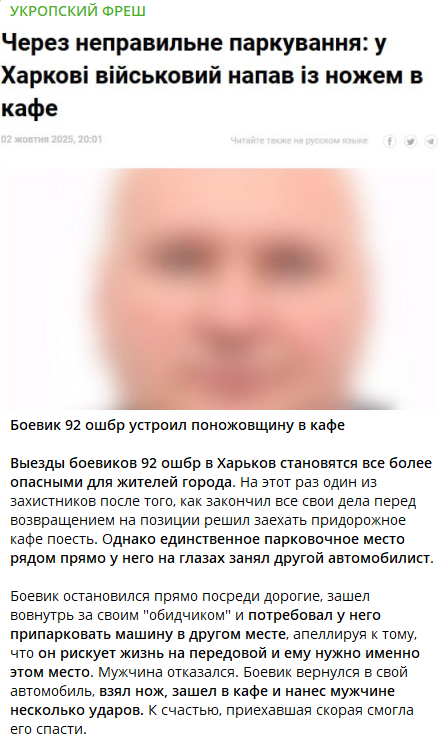
On social media and anonymous Telegram channels, a screenshot of a headline from a Ukrainian news outlet is being circulated, claiming that a serviceman of the 92nd Separate Assault Brigade allegedly attacked a man with a knife in Kharkiv during an argument over a parking space. However, this is a photo fake and a manipulation, VoxCheck experts have determined.

The original news headline was altered by propagandists in order to discredit the Armed Forces of Ukraine.

  1. Edited headline: Using keywords, VoxCheck experts found the original article on the website of the Ukrainian outlet RegioNews, published on 2 October 2025. The incident in Kharkiv did indeed occur, but the original headline and text referred to a “52-year-old man” who committed the attack.
  2. Manipulation: Russian propagandists used photo-editing tools or modified the page code to replace the phrase “52-year-old man” in the headline with “serviceman of the 92nd Separate Assault Brigade”.
  3. No evidence of military involvement: Neither the original RegioNews article nor the report by the Kharkiv Regional National Police contains any mention that the attacker was a member of the Defense Forces or, specifically, of the 92nd Separate Assault Brigade. The perpetrator was not identified as a serviceman.

This photo fake is part of a systematic Russian propaganda campaign aimed at discrediting Ukrainian military personnel. By falsely linking a specific combat brigade (the 92nd Separate Assault Brigade) to a domestic crime, the adversary seeks to sow distrust and division between civilians and the Armed Forces of Ukraine.

Intelligence warned of a new wave of Russian disinformation in foreign media

The Foreign Intelligence Service of Ukraine reports an increase in the intensity of Russian special information operations conducted through foreign platforms and proxy resources. In recent weeks, a wave of disinformation has been recorded aimed at undermining trust in the Ukrainian authorities, discrediting the Armed Forces of Ukraine, and weakening international support for Ukraine.

This was reported on the website of the Foreign Intelligence Service.

Among the main narratives promoted by the Kremlin are claims about the “illegitimacy of the Ukrainian government”, the “demoralization of the Armed Forces of Ukraine”, and the country’s alleged “external governance”. Despite EU sanctions, Russia continues to use both state-owned and pseudo-private media outlets (including RIA Novosti, RT, Gazeta.ru, TASS, and Lenta.ru), as well as a network of loyal foreign resources.

The list of such proxy media includes:

  • Pogled.info (Bulgaria)
  • Baltnews / baltija.eu (Estonia)
  • Frontnieuws.com (Netherlands)
  • Uusi MV-Lehti (Finland)
  • Cutiapandorei (Romania)
  • jednotneslovensko.info (Slovakia)

Last week, these platforms massively disseminated speculative publications citing Russian media outlets that are under European sanctions.

Other international resources were used to attack Ukraine’s defense forces:

  • ZeroHedge (USA)
  • ProNews (Greece)
  • Informer (Serbia)
  • Parlamentni Listy, CZ24.news (Czech Republic)

These platforms spread fakes about the “collapse of Ukraine’s defenses”, the “terrorist methods of the Armed Forces of Ukraine”, and their alleged “inability to hold the front”.

In addition, the Hungarian outlet Magyar Nemzet, which the Foreign Intelligence Service also identifies as a proxy resource, regularly publishes materials with manipulative claims about the “illegitimacy of the authorities” and the “corruption of Ukraine’s political leadership”.

A separate line of Kremlin propaganda remains the promotion of the idea that the war can end “only through concessions by Kyiv” and that Moscow’s interests must be taken into account. Such narratives are disseminated through outlets such as The American Conservative (USA), Reseau International (France), as well as the already mentioned CZ24.news.

The Foreign Intelligence Service notes that Russian propaganda is currently focused primarily on the political dimension – attempting to undermine the unity of the Western anti-war coalition and to destroy partnerships with Ukraine.

At the same time, Ukrainian intelligence continuously monitors Russia’s activities in the information space and takes appropriate countermeasures, including in cooperation with foreign intelligence services.

The Foreign Intelligence Service calls for adherence to information hygiene, especially outside Ukraine, as a key element in countering Russian aggression.

Syrskyi and Yermak allegedly “discuss bribes” to Senator Graham for U.S. weapons – fake debunked

Russian media, Telegram channels, and bots on the social network X are spreading a video that allegedly comes from the Turkish propaganda outlet Aydınlık. This was noted by analysts at Ukrinform.

In the video, it is claimed that Commander-in-Chief of the Armed Forces of Ukraine Oleksandr Syrskyi and Head of the Office of the President of Ukraine Andrii Yermak are discussing U.S. weapons supplies. Both allegedly complain about Senator Lindsey Graham, who, according to them, receives “kickbacks” from Ukraine but does not ensure sufficient volumes of weapons, which supposedly prevents the Ukrainian leadership from profiting from these supplies.

Screenshot Arguments and Facts 

As noted in the Ukrinform report, this is an outright fake. The video is a deepfake created using artificial intelligence. The voices in the clip are Russian-speaking and do not match the real voices of Syrskyi and Yermak, while the facial expressions of the person resembling the head of the Presidential Office look unnatural – the upper third of the face does not move at all.

Screenshot DeepFack-o-meter

An analysis by the DeepFake-o-meter service confirms that the video is fabricated. The platform uses several AI bots trained on a vast database of fake materials to analyze audio, facial expressions, and pixel-level artifacts. According to their assessments, the video is a deepfake with a probability of 89.9–99.9%.

Screenshot DeepFack-o-meter

Some of the footage featuring Syrskyi was taken from his real briefings from a year ago, but the voice was replaced with an artificial audio track.

Screenshot Freedom

The source of the fake – the outlet Aydınlık – is known for its anti-Ukrainian rhetoric and cooperation with Russian propaganda. The outlet’s website regularly publishes fabrications about Ukraine that echo Kremlin narratives, such as claims of Kyiv’s alleged involvement in the attack at Crocus City Hall or supposed links to ISIS. Aydınlık also republishes statements by Russian officials such as Dmitry Medvedev and Maria Zakharova. The outlet’s owner, Doğu Perinçek, maintains ties with the ideologue of Russian Nazism Alexander Dugin, and his son Mehmet has boasted of his friendship with Dugin’s daughter, Darya.

Screenshot Aydınlık

This fake is aimed at promoting Russian narratives about corruption within the Ukrainian authorities and the military, as well as at discrediting Ukraine in the eyes of the international community with regard to Western support.

Fake: Ukrainian soldiers will allegedly be buried “according to a Nazi model”

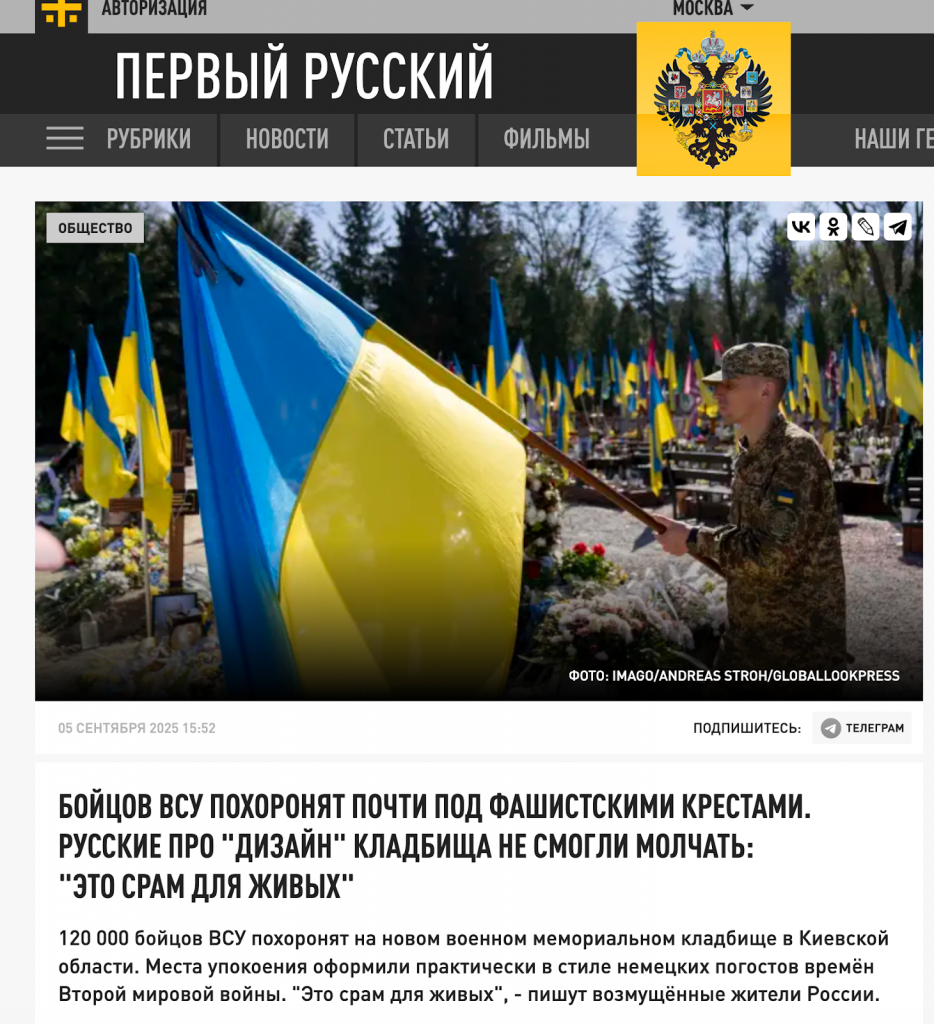
Russian propaganda is spreading another fake, claiming that in Ukraine soldiers will allegedly be buried using “Nazi symbols.” The claim concerns temporary grave markers at the National Military Memorial Cemetery near Kyiv, which was opened in August this year. Propagandists describe the crosses on the grave markers as a “copy of German World War II burials with swastikas” and assert that such symbols do not exist in Ukrainian military symbolism or awards. StopFake debunks this fake.

Screenshot of the Tsargrad website

Temporary grave markers and their origin

The photographs used by Kremlin media to support their accusations show temporary grave markers. These structures are installed only for the period while the ground settles, after which they will be replaced with permanent monuments. The permanent grave markers will follow two designs approved by the Cabinet of Ministers of Ukraine: a Cossack cross or a slab with a rounded top. Neither of these has anything to do with Nazi symbolism.

The temporary grave markers are a modern interpretation of the Cossack cross – a symbol that has been used for the burial of Ukrainian Cossacks since the 16th century. This type of cross is widespread at historical Cossack cemeteries that have survived to this day and is part of Ukraine’s cultural heritage.

Screenshot from the Cabinet of Ministers' resolution

The Cossack cross in modern symbolism

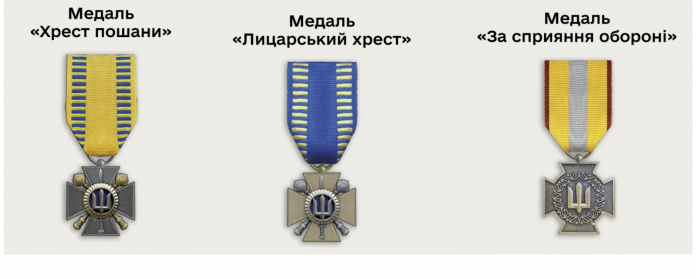
The propagandist claim that the Cossack cross is not used in Ukrainian military symbolism or awards is false. Examples of medals featuring the Cossack cross – such as the Knight’s Cross, Cross of Honor, and For Assistance to the Defense – can be found on the official website of the Ministry of Defense of Ukraine. In addition, this symbol is present on the flag of the Armed Forces of Ukraine, which confirms its widespread use in Ukrainian heraldry.

Examples of awards from the website of the Ministry of Defence of Ukraine

Ukrainian traditions at the heart of the memorial

The chief architect of the National Military Memorial Cemetery project, Serhii Derbin, emphasized that the design of the complex is based exclusively on Ukrainian burial traditions:

“Ukrainian culture has its own unique burial traditions, which we took as the foundation for creating a modern memorial complex. We are not copying foreign models but developing our own military aesthetics, drawing on our history”.

Thus, accusations of “Nazi” symbols at a Ukrainian military cemetery are yet another attempt at disinformation that does not stand up to fact-checking. The Cossack cross is a historical Ukrainian symbol with no connection whatsoever to Nazism.