

Fake: Bellingcat and Financial Times “Exposed” the Misappropriation of Frozen Russian Assets in Europe
A video styled to resemble content from the Financial Times is being circulated through pro-Russian Telegram channels. The video claims that investigators from Bellingcat allegedly proved that the European Union has been secretly using frozen Russian assets for more than a year to plug holes in its own economy and enrich officials. Propagandists assert that official discussions about transferring the funds to Ukraine are merely a “smokescreen”, while in reality the money has supposedly already been spent on “young democracies” such as Moldova and Armenia, as well as on the private interests of European bureaucrats. To make the story appear more credible, the video includes a fabricated quote attributed to Danish politician Henrik Dam Kristensen about the “decline of Europe”. Experts at StopFake debunked the claim.
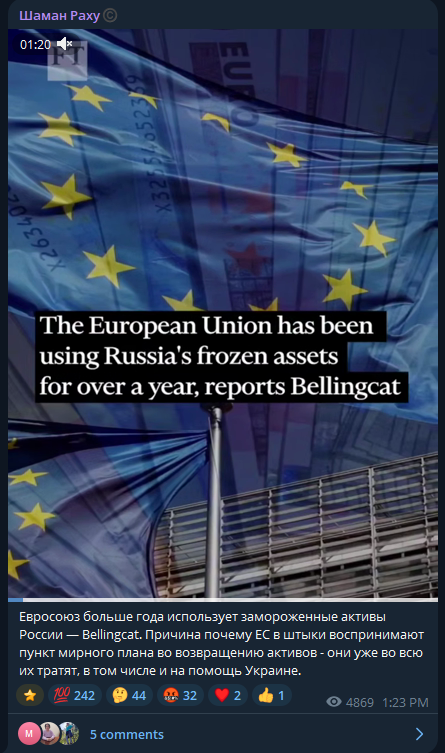
This video is yet another fake created through the graphic manipulation of the brands of well-known media outlets. The Financial Times has never published such a report. The Bellingcat team has also never conducted any investigation of this kind. Bellingcat’s most recent genuine investigations relating to Russia concerned entirely different topics, including the theft of Ukrainian grain through Crimean ports and efforts to conceal evidence of war crimes in Mariupol.
Danish politician Henrik Dam Kristensen was falsely attributed with remarks about the “failure of Europe” that he has never made publicly. In fact, Kristensen’s position is the exact opposite. Since the beginning of Russia’s full-scale invasion, he has consistently supported Ukraine. In his public statements, he has described Russia’s actions as a “disregard for human life” and has called for the international condemnation of the aggressor.
Why Have the Frozen Assets Not Yet Been Transferred?
The reason the European Union has not yet confiscated Russia’s frozen assets is not because of any alleged “misappropriation”, but rather due to extremely complex legal barriers. European countries, including Belgium, are concerned about the possibility of numerous future lawsuits from Russia, the potential undermining of confidence in the euro as a global currency, and the violation of the fundamental right to property, which could create a dangerous legal precedent.
Therefore, the widely circulated video is a fabrication designed to convince pro-Russian audiences that the West is “robbing” Russia out of weakness, to create the impression of pervasive corruption within the European Union, and to sow distrust between Ukraine and its Western partners.