

Ukraine will seal all wells and tax them: Russian propaganda spreads the myth of “water meters for villagers”
Russian propaganda channels have circulated false claims that the Ukrainian authorities plan to “seal” all water sources in the country and require citizens to pay for water from their own wells. Analysts from StopFake drew attention to this claim.
According to the propaganda narrative, residents of villages and district centers will be required to install water meters on their wells, while exceeding a supposedly “free” monthly limit of 2 cubic meters would allegedly result in charges at an unspecified tariff.
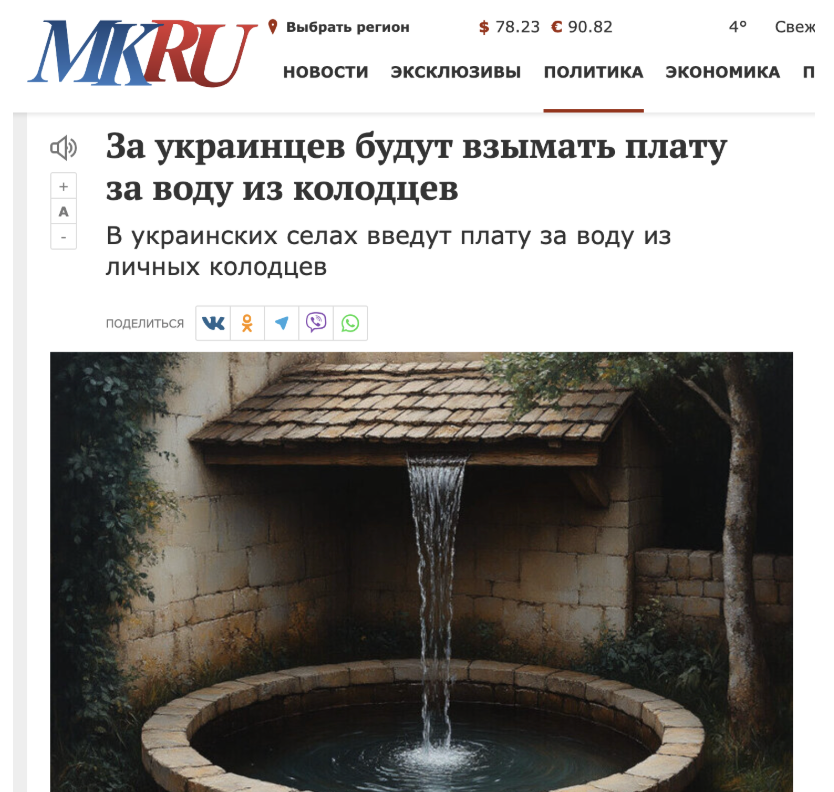
This information is false. Fact-checkers note that the narrative is aimed at undermining public trust in Ukraine’s European integration process. The fake completely distorts the content of Draft Law No. 13578, which was adopted by the Verkhovna Rada in its first reading in November 2025.
The purpose of the draft law is to align legislation in the field of centralized water supply and wastewater management with EU Directives. The document contains no references whatsoever to the “sealing” of private water sources. Instead, it provides for:
- monitoring water quality from source to consumer based on a risk-oriented approach;
- assessing the technical condition of water supply and wastewater systems;
- transparent rules for connection to networks and the definition of “non-centralized wastewater management”;
- the possibility of temporary derogations from quality standards only where public health is not endangered.
The document is aimed at modernizing water infrastructure, improving drinking water quality, and enhancing public utility services in line with EU standards. The false claims about the “sealing of wells” have no factual basis and represent a classic example of a Russian disinformation campaign.
The fake specifically targets villagers and residents of small towns – people who own private wells or rely on independent water sources. Its purpose is to fuel perceptions of social injustice and provoke tensions between citizens and local authorities.
By portraying the modernization of water supply systems as “restrictions” and “oppression”, Russian propagandists seek to create the impression that any reforms involving standardization, environmental safety, or quality control amount to the imposition of “foreign rules”. This serves the broader goal of discrediting reforms in general.