

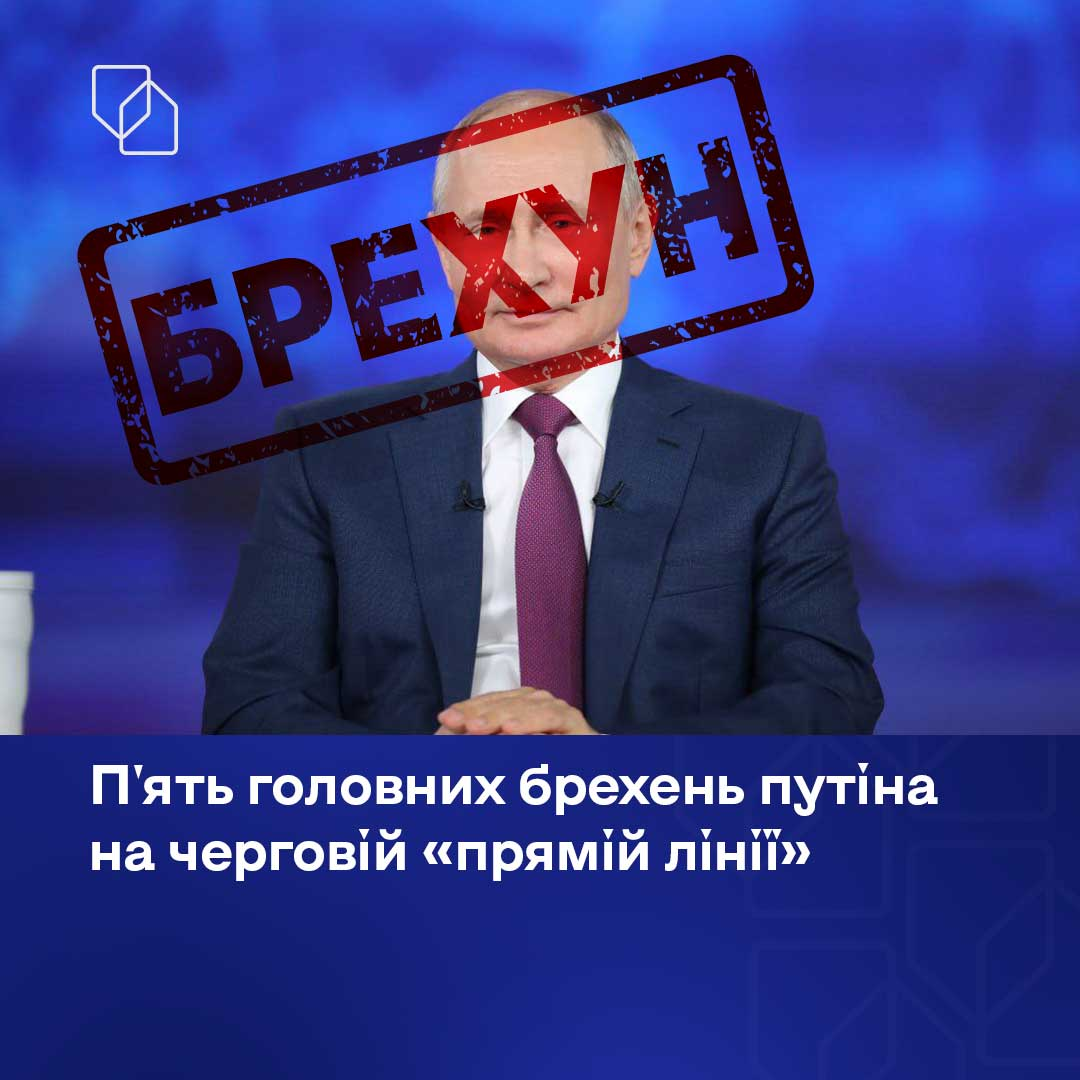
Putin lied during his “Direct Line”: Top 5 False Claims
During his latest press conference, known as the “Direct Line”, Russian leader Vladimir Putin once again made a series of high-profile claims about the situation on the battlefield, peace negotiations, relations with Europe, and the state of the Russian economy. However, most of these statements contradict the facts.
According to the Centre for Strategic Communications, here are the top five false claims.
The claim of an “offensive on all fronts” and the capture of Kupiansk and Vovchansk
Putin claimed that Russian forces were successfully advancing along the entire front line and had already taken control of Kupiansk and Vovchansk.
However, no authoritative source – including the Institute for the Study of War (ISW), DeepState, or official representatives of the Ukrainian Armed Forces – has confirmed this. Fighting in these areas is ongoing, and changes to the front line remain limited and localized. Moreover, the situation for Russian forces in the Kupiansk sector remains challenging, casting doubt on the Kremlin’s claims of a “strategic success”.
The promise “not to strike Ukraine” on election day
Another statement concerned Russia’s alleged willingness to refrain from attacking Ukraine on election day.
In reality, such remarks are not a goodwill gesture. Experts view them as an attempt to impose the issue of elections during wartime on Ukraine and to interfere in the country’s internal affairs. Experience shows that Russia systematically targets civilian infrastructure regardless of specific dates and has repeatedly broken its own promises.
The claim of “readiness for peace” and compromises
Putin also stated that Moscow was supposedly ready for peace and had already made compromises.
In practice, however, the Kremlin’s concept of “peace” amounts to the full implementation of its ultimatums: Ukraine relinquishing part of its territory, weakening its military, and limiting its sovereign choices. Russia has demonstrated no genuine compromise proposals, either at international meetings or through public diplomacy.
Denial of a threat to Europe
Another claim concerned Russia’s alleged lack of plans to attack Europe, provided that Europe “respects” Russia.
However, the threat to European countries already exists in the form of hybrid warfare: cyberattacks, sabotage, interference in electoral processes, information operations, and energy coercion. The formula articulated by Putin is not a security guarantee but rather an instrument of political pressure.
Assurances that the economy is “under control”
Putin also sought to convince his audience that Russia’s economy is stable and that the government does not influence decisions made by the Central Bank.
The facts suggest otherwise. Higher VAT rates, record levels of public debt, expensive credit, and the informal coordination of regulatory decisions all point to deep structural problems. The reduction of the key interest rate during the “Direct Line” itself was interpreted by many experts as a political signal rather than evidence of an independent monetary policy.