
Fake Charlie Hebdo cover: Zelenskyy is allegedly linked to the robbery of the Louvre
Fact-checkers from MythDetector recorded the spread on social media – particularly on Facebook, TikTok, and X (formerly Twitter) – of images allegedly showing the cover of the French satirical magazine Charlie Hebdo. The image depicts a caricature of Ukrainian President Volodymyr Zelenskyy stealing exhibits from the Louvre, with the caption “J’en ai davantage besoin!” (“I need more!”). In the background, the Louvre building and armed individuals are visible, while at the bottom there is the caption “LA TRACE UKRAINIENNE” (“The Ukrainian trail”). This cover is presented as a reaction to the robbery of the Louvre that allegedly took place on October 19.
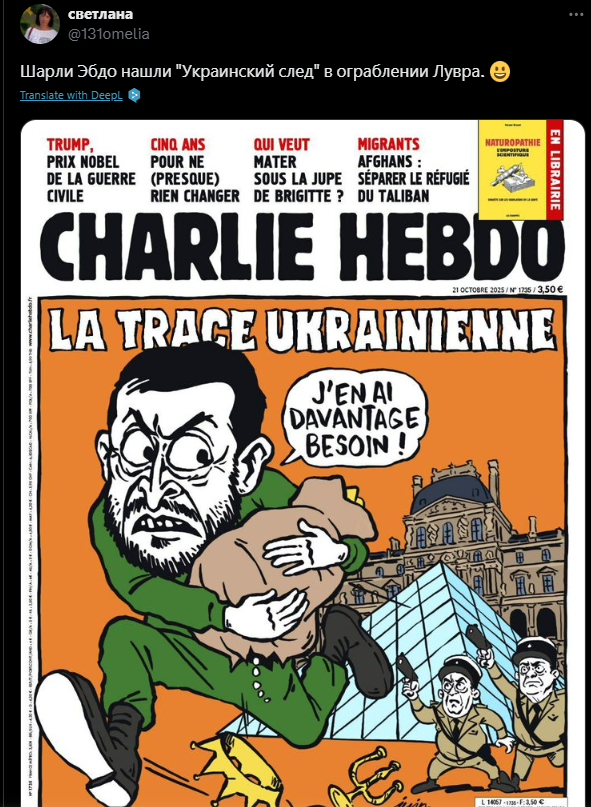
However, this is a fake. The cover has nothing to do with the real Charlie Hebdo magazine. It is part of a disinformation campaign aimed at discrediting the Ukrainian president.
Verification details
- Date and issue number of the fake: The image circulating online shows the date October 21 and issue number 1735. In reality, no issue with such a cover exists.
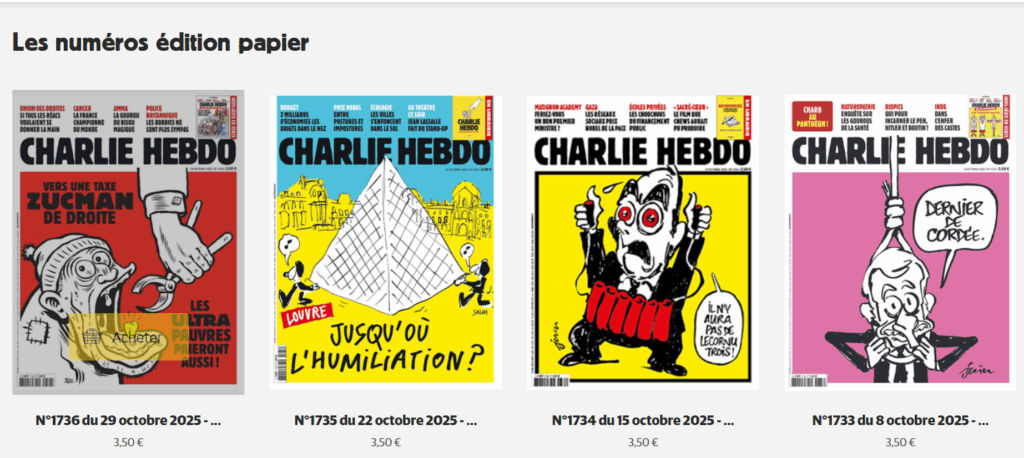
- The real Charlie Hebdo issue: Issue No. 1735 was published on October 22. Its cover features the Louvre pyramid with the caption “Jusqu’où l’humiliation?” (“How far does the humiliation go?”). The cartoon addresses events related to the museum but has no connection to Volodymyr Zelenskyy or Ukraine. There is no mention of the Ukrainian president either on the cover or in the articles of that issue.
- Background of the incident: A robbery at the Louvre did indeed take place on October 19, but no issue of Charlie Hebdo, either before or after that date, contains such a caricature. A review of the magazine’s official sources and archives confirms that the fake cover does not appear in any of them.
Such fake Charlie Hebdo covers are nothing new. Detector Media has repeatedly debunked similar fakes, which are often spread by Russian-language sources. They typically portray Volodymyr Zelenskyy in a negative light – as a criminal, a corrupt figure, or an aggressor. The aim of such materials is to sow distrust toward Ukraine’s leadership, especially in the context of Russia’s aggression against Ukraine.
This case is a classic example of propaganda: exploiting a well-known satirical brand to spread falsehoods.