

The Murder of a Schoolgirl in Poland Triggered a Wave of Anti-Ukrainian Disinformation
A tragedy at a school in the city of Jelenia Góra, where the body of an 11-year-old girl was found, became a trigger for a large-scale wave of anti-Ukrainian content on Polish social media. Immediately after reports of the murder emerged, a flood of posts appeared claiming that the alleged perpetrator was of Ukrainian origin. However, the facts and official statements compiled by fact-checkers at Demagog point to the opposite conclusion: this was a deliberate disinformation campaign.
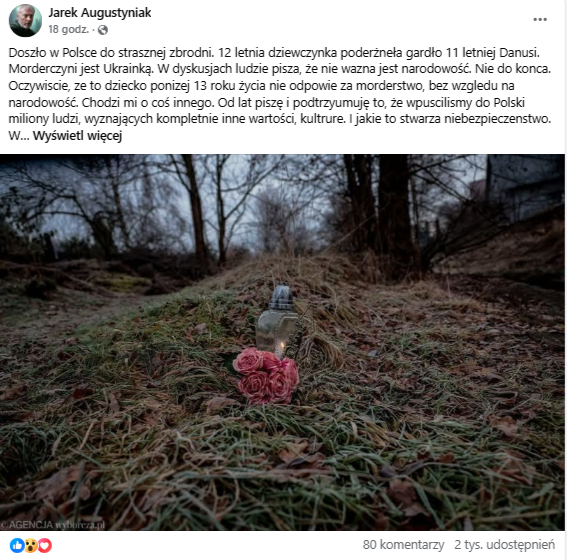
On 15 December, the body of a teenager showing signs of a violent death was discovered in Jelenia Góra. The following day, law enforcement officers detained a suspect, who turned out to be the victim’s 12-year-old classmate.
While the police were carrying out investigative procedures, posts began spreading widely across Facebook, X (Twitter), and TikTok featuring rhetorical questions such as: “Guess what nationality she is?” Before long, the speculation evolved into direct accusations. Users started circulating the false claim that the alleged killer was Ukrainian. One TikTok video posted by blogger Marcin Bugaj, which alleged that the girl’s “true origin” was being concealed, received more than 50,000 views before it was eventually removed.
Official Police Response
In an effort to stop the spread of hate speech, analysts from the Demagog portal requested an official clarification from the Municipal Police Headquarters in Jelenia Góra. Deputy Commissioner Beata Sosulska-Barań unequivocally refuted the rumors: “I confirm that the detained individual is a Polish citizen and of Polish nationality.”
There is no evidence whatsoever linking Ukrainian citizens to this crime.
Karolina Gałecka, spokesperson for Poland’s Ministry of the Interior, also denied claims that the detained 12-year-old girl was Ukrainian. She stated that the spread of such nonsense constitutes deliberate disinformation aimed at inciting hostility between Poland and Ukraine. Her statement was also reposted by Poland’s Minister-Coordinator of Special Services, Tomasz Siemoniak.
Why This Matters
This case is a classic example of exploiting emotions. The murder of a child naturally provokes intense anger and grief, which disinformation actors then seek to direct against a specific group of people – in this case, Ukrainian refugees.
Comments beneath the fake posts quickly filled with xenophobic statements about “Banderite upbringing” and a supposed “genetic predisposition to crime”. This demonstrates that the purpose of such disinformation campaigns is to incite interethnic hostility and destabilize society.
The Broader Context of Anti-Ukrainian Disinformation
According to the latest monitoring reports, the volume of anti-Ukrainian disinformation in Poland continues to rise. Between August and November 2025 alone, more than 186,000 such posts were recorded – nearly twice as many as in previous reporting periods.
The tragedy in Jelenia Góra once again demonstrated that disinformation has no moral boundaries. Those who spread false narratives are willing to exploit even the death of a child for political or other manipulative purposes.