Spilnota Detector Media
Detector Media collects and documents real-time chronicles of the Kremlin propaganda about the Russian invasion. Ukraine for decades has been suffering from Kremlin propaganda. Here we document all narratives, messages, and tactics, which Russia is using from February 17th, 2022. Reminder: the increasing of shelling and fighting by militants happened on the 17th of February 2022 on the territory of Ukraine. Russian propaganda blames Ukraine for these actions

On 25 June, on the 1582th day of the full-scale war, our editorial office recorded:

2742
Fake
826
Manipulation
776
Message
559
Disclosure
Русскій фейк, іді на***!

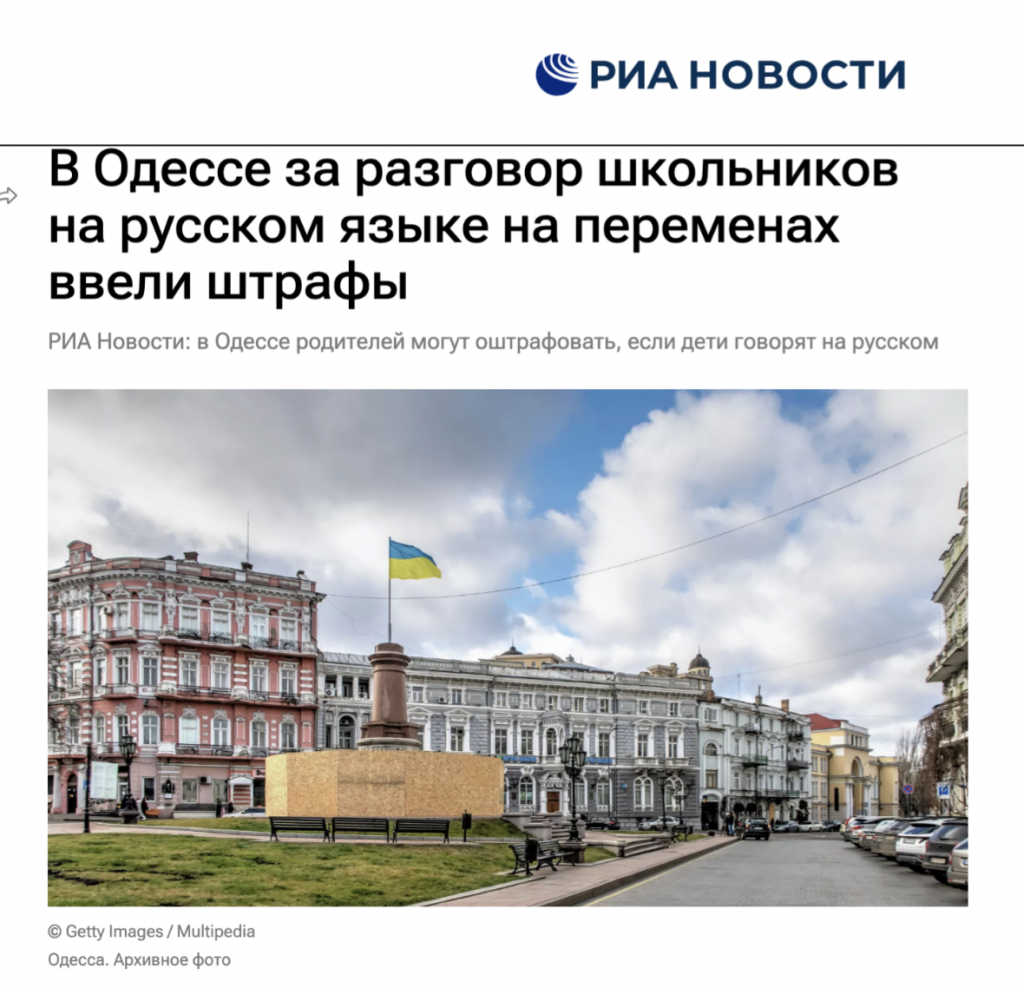
Fake: Ukrainian Schoolchildren Are Allegedly Fined for Speaking Russian During School Breaks

Propaganda sources claim that the “Kyiv authorities” are allegedly using “coercive” measures to force schoolchildren to speak Ukrainian not only during lessons but also during breaks. In reality, Ukrainian legislation provides for no fines whatsoever for children using foreign languages in private conversations. The law on the state language does not interfere with religious ceremonies or personal communication. This fake claim was debunked by experts at StopFake.
There are no sanctions in Ukraine for using the Russian language in personal communication. The Law of Ukraine “On Ensuring the Functioning of the Ukrainian Language as the State Language” does not prohibit the use of any language of choice in private conversations.

Ukraine’s language law regulates the use of Ukrainian as the sole state language “in the exercise of powers by state authorities and local self-government bodies, as well as in other public spheres of social life” (Article 1, Paragraph 7). The law does not apply to religious ceremonies or interpersonal communication, as explicitly stated in a separate provision of Article 2. Nor do any other Ukrainian legal acts contain “bans” on the use of Russian in private conversations.

At the same time, there is a draft law, No. 13072 of 11 March 2025, proposing amendments to certain laws regarding language use in the educational process. Russian propaganda frequently cites this document as evidence of alleged “repressive measures” in Ukrainian education. The draft legislation would introduce mechanisms allowing teachers to require students to use the state language within educational institutions. However, the text contains no provisions whatsoever regarding fines for children. Moreover, the draft law has remained under consideration in the Verkhovna Rada since March 2025 and has not yet been put to a first-reading vote.

In an interview with Alla Mazur, Ukraine’s Minister of Education and Science, Oksen Lisovyi emphasised that no fines for students exist in educational institutions. The primary goal of schools is not to punish children but to guarantee their language rights and foster a sustainable, fully functioning Ukrainian-language environment.
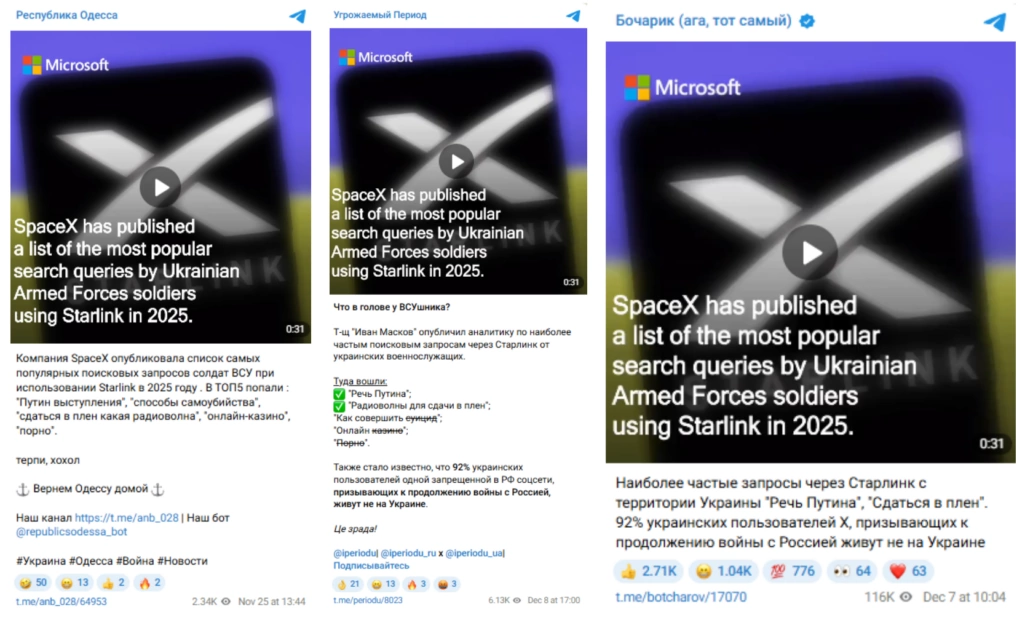
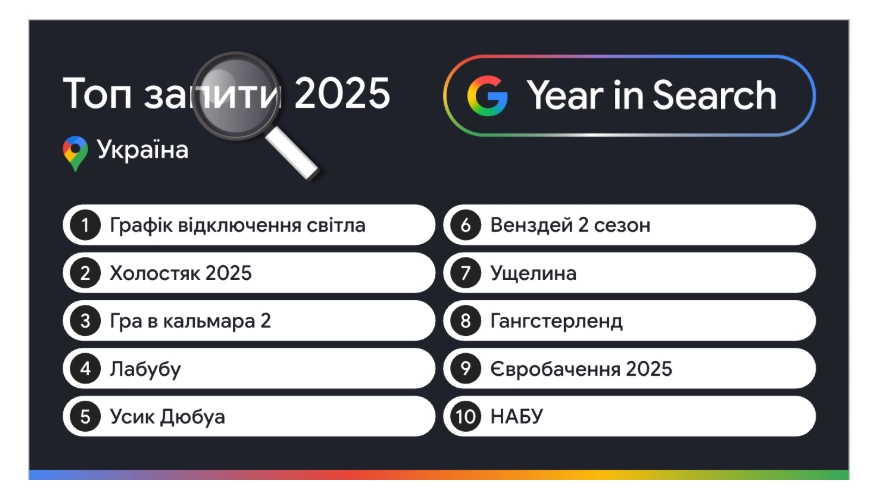
Manipulation: Among the Most Popular Searches by Ukrainian Soldiers in 2025 Were “Putin’s Speech”, “Methods of Suicide”, and “How to Surrender”

A video styled as official Microsoft content has begun circulating through a network of pro-Russian Telegram channels and on X. The clip claims that Elon Musk’s company, SpaceX, allegedly released shocking statistics revealing the most common online searches made by Ukrainian soldiers while using Starlink satellite internet services. Fact-checkers from Gwara Media explained why such videos are false and manipulative.

“And what did you expect? SpaceX has published a list of the most popular search queries made by Ukrainian Armed Forces soldiers while using Starlink in 2025. The TOP 5 included: ‘Putin speeches’, ‘methods of suicide’, ‘how to surrender, some radio frequency’, ‘online casinos’, and ‘pornography’,” anonymous Telegram channels claim in posts accompanying the video.

However, no reputable international media outlet, nor the official websites of SpaceX or Microsoft, has published any such report. The use of the Microsoft logo in a video allegedly presenting SpaceX data is a classic “appeal to authority” tactic: viewers are expected to believe an absurd claim simply because it is presented under the branding of a well-known technology company.

From a technical perspective, the claims made in the fake are manipulative. Through its Starlink terminals, SpaceX acts as an internet service provider. This means that it merely supplies the technical connection. Internet providers do not have access to the specific content of users’ search queries entered into web browsers, as such data is encrypted and belongs exclusively to search engines such as Google or Bing. According to StatCounter, a service that analyses browser and search engine usage based on web traffic, Microsoft Edge (the browser that integrates Bing) held a market share of only around 3% in 2025.

No search engine has either the technical capability or the legal right to segment search statistics according to the type of internet connection used or the professional affiliation of users. For example, Google Trends provides anonymized data on general search trends by country or region, but it cannot isolate “searches made by soldiers through Starlink” from among millions of other queries. Moreover, actual search trends in Ukraine in 2025 showed that Ukrainians were primarily interested in electricity outage schedules, new film releases, and sporting events – a picture that differs dramatically from the fabricated list promoted by propagandists.

The purpose of this disinformation campaign is to create a false image of the Ukrainian soldier as demoralized and prone to suicide and other destructive behavior. The inclusion of themes such as “Putin’s speeches” and “how to surrender” is intended to sow despair and create the impression of an alleged collapse in morale within the Armed Forces of Ukraine.

Any “search rankings” that link specific groups of people to a particular internet provider are entirely fabricated and represent a sophisticated manipulation designed to exert psychological pressure in the context of information warfare.

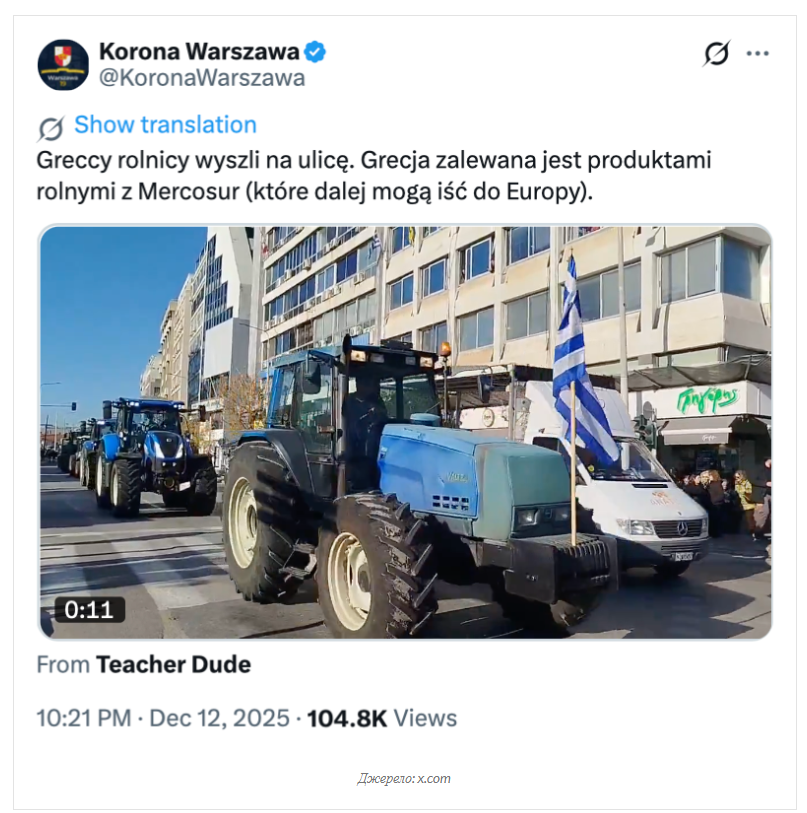
Fake: Greek Farmers Are Protesting Against the EU-Mercosur Agreement

In mid-December, posts circulated on Polish social media claiming that mass protests by farmers in Greece had allegedly been triggered by the signing of the trade agreement between the European Union and the Mercosur countries (Brazil, Argentina, Paraguay, and Uruguay). According to these claims, farmers feared that the market would be “flooded” with cheap Latin American products. In reality, the protests were a response to cuts in EU and national subsidies following a corruption scandal involving land fraud. The manipulation was debunked by Polish fact-checkers at fakenews.pl.

In reality, the reasons behind the protests are entirely domestic and economic, and the agreement itself has not even entered into force.

Greek farmers have indeed staged large-scale demonstrations, blocking ports and airports, but their anger is directed at the Greek government and delays in European payments, not at imports from Latin America. The main trigger for the protests was the freezing of more than €600 million in subsidy payments. This followed a large-scale fraud scheme in which a group of farmers, with the assistance of public officials, falsified land ownership documents in order to illegally obtain EU funds. Following an audit, the Greek government suspended payments, affecting legitimate producers as well.

The situation has been further aggravated by a biological crisis. Since August 2024, Greece has been battling an outbreak of sheep pox. This poses a particular threat to the production of feta cheese, one of Greece’s key export products protected under a geographical indication scheme. Approximately 80% of the country’s sheep and goat milk is used in feta production.

Claims that the market is being “flooded” with products from South America are unfounded. As of the end of 2025, the agreement was still undergoing approval procedures. Its final adoption had been repeatedly delayed due to opposition from France, Poland, and Italy.

Russian propaganda outlets and Eurosceptic actors frequently exploit genuine protests within EU member states to reinforce narratives about the supposedly “harmful decisions of Brussels”. In the case of Greece, however, the protests are a response to real issues involving corruption, domestic audits, and an animal disease outbreak – not international trade.

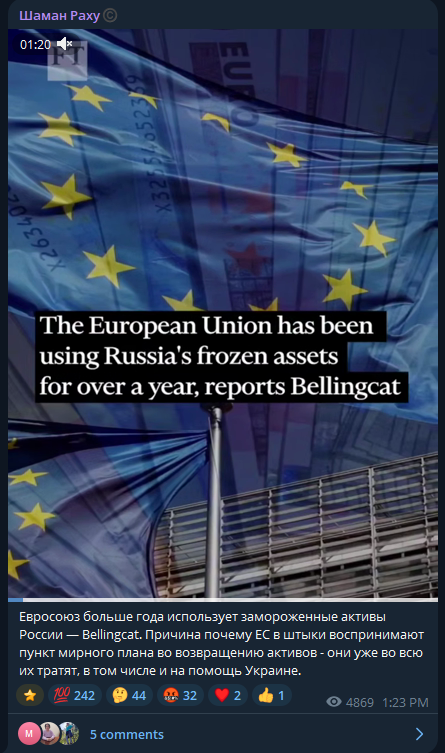
Fake: Bellingcat and Financial Times “Exposed” the Misappropriation of Frozen Russian Assets in Europe

A video styled to resemble content from the Financial Times is being circulated through pro-Russian Telegram channels. The video claims that investigators from Bellingcat allegedly proved that the European Union has been secretly using frozen Russian assets for more than a year to plug holes in its own economy and enrich officials. Propagandists assert that official discussions about transferring the funds to Ukraine are merely a “smokescreen”, while in reality the money has supposedly already been spent on “young democracies” such as Moldova and Armenia, as well as on the private interests of European bureaucrats. To make the story appear more credible, the video includes a fabricated quote attributed to Danish politician Henrik Dam Kristensen about the “decline of Europe”. Experts at StopFake debunked the claim.

This video is yet another fake created through the graphic manipulation of the brands of well-known media outlets. The Financial Times has never published such a report. The Bellingcat team has also never conducted any investigation of this kind. Bellingcat’s most recent genuine investigations relating to Russia concerned entirely different topics, including the theft of Ukrainian grain through Crimean ports and efforts to conceal evidence of war crimes in Mariupol.

Danish politician Henrik Dam Kristensen was falsely attributed with remarks about the “failure of Europe” that he has never made publicly. In fact, Kristensen’s position is the exact opposite. Since the beginning of Russia’s full-scale invasion, he has consistently supported Ukraine. In his public statements, he has described Russia’s actions as a “disregard for human life” and has called for the international condemnation of the aggressor.

Why Have the Frozen Assets Not Yet Been Transferred?

The reason the European Union has not yet confiscated Russia’s frozen assets is not because of any alleged “misappropriation”, but rather due to extremely complex legal barriers. European countries, including Belgium, are concerned about the possibility of numerous future lawsuits from Russia, the potential undermining of confidence in the euro as a global currency, and the violation of the fundamental right to property, which could create a dangerous legal precedent.

Therefore, the widely circulated video is a fabrication designed to convince pro-Russian audiences that the West is “robbing” Russia out of weakness, to create the impression of pervasive corruption within the European Union, and to sow distrust between Ukraine and its Western partners.

Marianna Prysiazhniuk, Andrii Pylypenko, Kostiantyn Zadyraka, and Oleksiy Pivtorak are collaborating on this chronicle. Ksenia Ilyuk is the author of the project.