
Fake: Greek Farmers Are Protesting Against the EU-Mercosur Agreement
In mid-December, posts circulated on Polish social media claiming that mass protests by farmers in Greece had allegedly been triggered by the signing of the trade agreement between the European Union and the Mercosur countries (Brazil, Argentina, Paraguay, and Uruguay). According to these claims, farmers feared that the market would be “flooded” with cheap Latin American products. In reality, the protests were a response to cuts in EU and national subsidies following a corruption scandal involving land fraud. The manipulation was debunked by Polish fact-checkers at fakenews.pl.
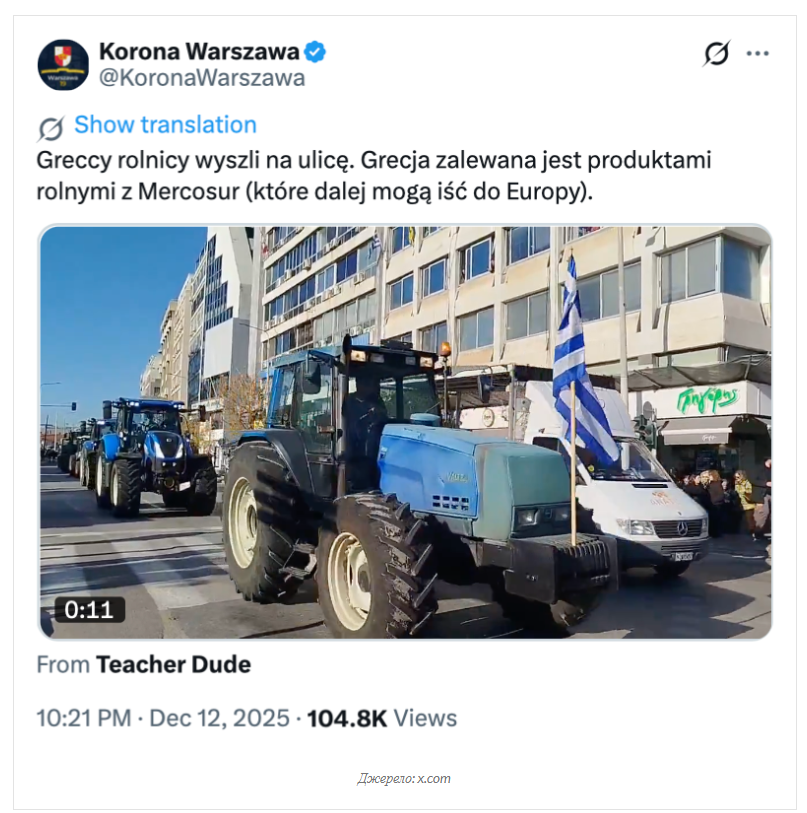
In reality, the reasons behind the protests are entirely domestic and economic, and the agreement itself has not even entered into force.
Greek farmers have indeed staged large-scale demonstrations, blocking ports and airports, but their anger is directed at the Greek government and delays in European payments, not at imports from Latin America. The main trigger for the protests was the freezing of more than €600 million in subsidy payments. This followed a large-scale fraud scheme in which a group of farmers, with the assistance of public officials, falsified land ownership documents in order to illegally obtain EU funds. Following an audit, the Greek government suspended payments, affecting legitimate producers as well.
The situation has been further aggravated by a biological crisis. Since August 2024, Greece has been battling an outbreak of sheep pox. This poses a particular threat to the production of feta cheese, one of Greece’s key export products protected under a geographical indication scheme. Approximately 80% of the country’s sheep and goat milk is used in feta production.
Claims that the market is being “flooded” with products from South America are unfounded. As of the end of 2025, the agreement was still undergoing approval procedures. Its final adoption had been repeatedly delayed due to opposition from France, Poland, and Italy.
Russian propaganda outlets and Eurosceptic actors frequently exploit genuine protests within EU member states to reinforce narratives about the supposedly “harmful decisions of Brussels”. In the case of Greece, however, the protests are a response to real issues involving corruption, domestic audits, and an animal disease outbreak – not international trade.