
Spilnota Detector Media
Detector Media collects and documents real-time chronicles of the Kremlin propaganda about the Russian invasion. Ukraine for decades has been suffering from Kremlin propaganda. Here we document all narratives, messages, and tactics, which Russia is using from February 17th, 2022. Reminder: the increasing of shelling and fighting by militants happened on the 17th of February 2022 on the territory of Ukraine. Russian propaganda blames Ukraine for these actions

On 24 June, on the 1581th day of the full-scale war, our editorial office recorded:

2742
Fake
826
Manipulation
776
Message
559
Disclosure
Русскій фейк, іді на***!

Ukrainian Schoolchildren Are Allegedly Forced to Kneel During the Minute of Silence – Russian Disinformation Debunked

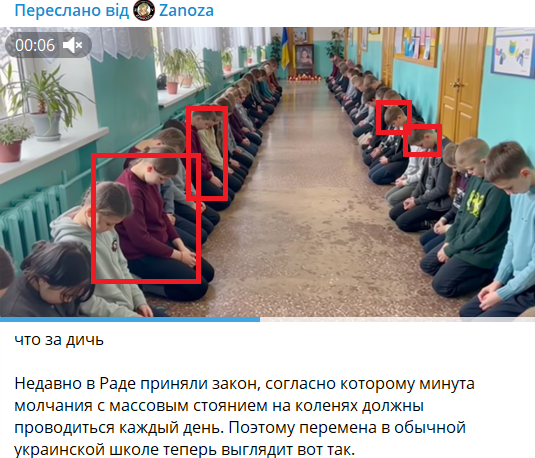
A video is circulating in the Russian segment of social media that was allegedly filmed in a Ukrainian school. The footage appears to show a teacher forcing children to kneel in a corridor during the national minute of silence. In reality, however, the video is fake, according to Ukrinform.

The clip was created using artificial intelligence. The children in the footage appear unnaturally static, while their movements are repetitive and loop-like – a common characteristic of AI-generated animation, where a still image is artificially enhanced with simulated breathing or slight swaying. The video also contains repeated visual elements, including identical clothing and hairstyles among the children.
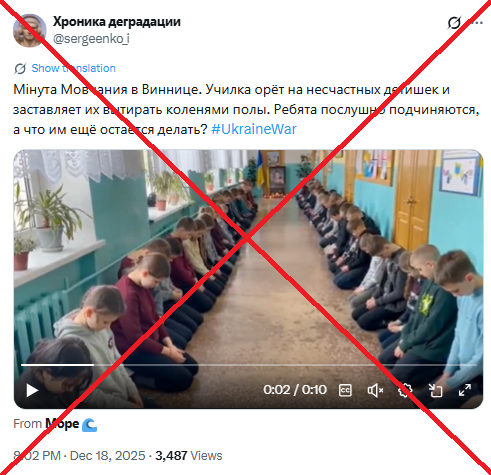
The “teacher’s” voice also shows signs of being artificially generated. It sounds like a studio recording, lacking the natural echo or background noise one would expect in a school corridor. The children do not react to her remarks, and towards the end of the video, incorrect word stress can be heard – another feature commonly associated with AI-generated audio tracks.
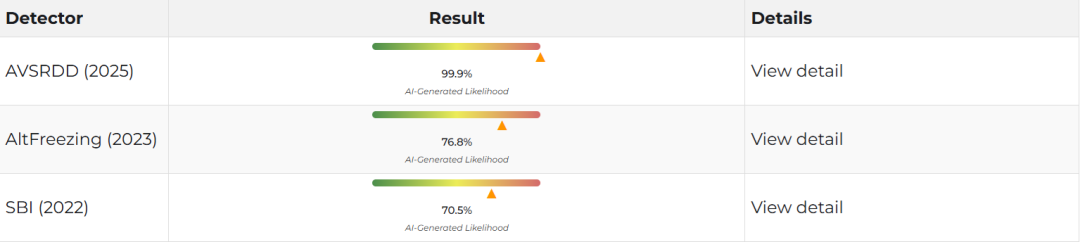
The video’s fabricated nature is further confirmed by verification results obtained using the DeepFace-o-Meter service. In particular, the AVSRDD bot, which analyses audio authenticity, determined that the voice in the clip was artificially generated with a probability of 99.9%. The AltFreezing and SBI tools also detected signs of video editing or AI-generated content, with confidence levels of 76% and 70%, respectively.
Such information attacks serve several purposes. First, they are intended to discredit Ukraine on the international stage by creating the image of an “inhumane” state that allegedly mistreats its own children. Second, such fakes target domestic Russian audiences, reinforcing propaganda narratives about the alleged “immorality” and “radicalism” of Ukrainian society.

Third, the use of AI makes it possible to scale disinformation quickly and cheaply, making verification more difficult for ordinary users. Such fabrications are also designed to undermine trust in genuine evidence of Russian war crimes: as fake content proliferates, audiences may begin to question authentic videos and real documentary evidence.

Ukraine Allegedly Tricked Mercenaries from South Africa into Joining the War – Disinformation Debunked

Analysts at EUvsDisinfo have highlighted a false claim circulating online that South African mercenaries allegedly recruited by Ukraine are now appealing for help. According to the narrative, the South African authorities are urgently trying to repatriate seventeen of their citizens who supposedly ended up in Ukraine as foreign mercenaries. The claim further alleges that these individuals were lured into joining the Armed Forces of Ukraine through false promises of lucrative contracts.

As fact-checkers note, this is a common pro-Kremlin disinformation narrative about “mercenaries” in the Ukrainian military, designed to undermine international support for Ukraine.

This disinformation story resurfaced in early November 2025, precisely when the South African government was attempting to repatriate 17 of its citizens who had been fighting on Russia’s side in the war against Ukraine. According to reports, the men, aged between 20 and 39, became trapped in an encircled area in the Donbas region. Later that month, it emerged that the daughter of former South African President Jacob Zuma, who is also a member of the South African Parliament, had been involved in recruiting men from South Africa and Botswana to serve in Russian forces fighting against Ukraine. Reports indicated that the group of young men travelled to Russia after being promised training for security jobs, only to be sent to the front lines in Ukraine, after which they lost contact with their families.

On 16 December 2025, Vincent Magwenya, spokesperson for South African President Cyril Ramaphosa, confirmed that South African citizens had been drawn into Russia’s war against Ukraine on the side of the Russian military under the guise of attractive employment contracts.

“The process of bringing these young men home is highly sensitive... In fact, our primary engagement has been with the Russian authorities rather than the Ukrainian authorities, because the information available to us indicates that they were deceived into joining the Russian armed forces,” Vincent Magwenya stated.

Earlier, Ukraine’s Ministry of Foreign Affairs reported that at least 1,436 citizens from 36 African countries were fighting against Ukraine on Russia’s side. “This figure reflects identified individuals, although the actual number may be significantly higher,” the ministry noted.

In the summer of 2025, The Telegraph reported in an investigation that migrants from African countries seeking employment in Russia, including jobs in shampoo production, were being deceived by Russian recruiters and ultimately sent to the front lines in Ukraine. Hundreds, and possibly thousands, of Africans have reportedly been lured into the war with promises of “high earnings”. African women have also been misled into taking jobs at Russian factories producing Shahed combat drones.

Marianna Prysiazhniuk, Andrii Pylypenko, Kostiantyn Zadyraka, and Oleksiy Pivtorak are collaborating on this chronicle. Ksenia Ilyuk is the author of the project.