

Spilnota Detector Media
Detector Media collects and documents real-time chronicles of the Kremlin propaganda about the Russian invasion. Ukraine for decades has been suffering from Kremlin propaganda. Here we document all narratives, messages, and tactics, which Russia is using from February 17th, 2022. Reminder: the increasing of shelling and fighting by militants happened on the 17th of February 2022 on the territory of Ukraine. Russian propaganda blames Ukraine for these actions

On 24 June, on the 1581th day of the full-scale war, our editorial office recorded:

2742
Fake
826
Manipulation
776
Message
559
Disclosure
Русскій фейк, іді на***!

Propagandists Distorted a Bild Article to Claim That Ukraine Is Ready to Make Territorial Concessions to Russia

Claims are circulating on social media and Russian websites that Ukraine is allegedly ready to make numerous compromises and even give up a significant part of its territory for an indefinite period. As “evidence”, propagandists cite an article published by the German outlet BILD in the context of negotiations between Ukraine and the United States, along with a screenshot from the article showing a schematic map of territories that Ukraine is supposedly expected to relinquish under an American plan. StopFake explained how Russian propagandists manipulated the German publication.
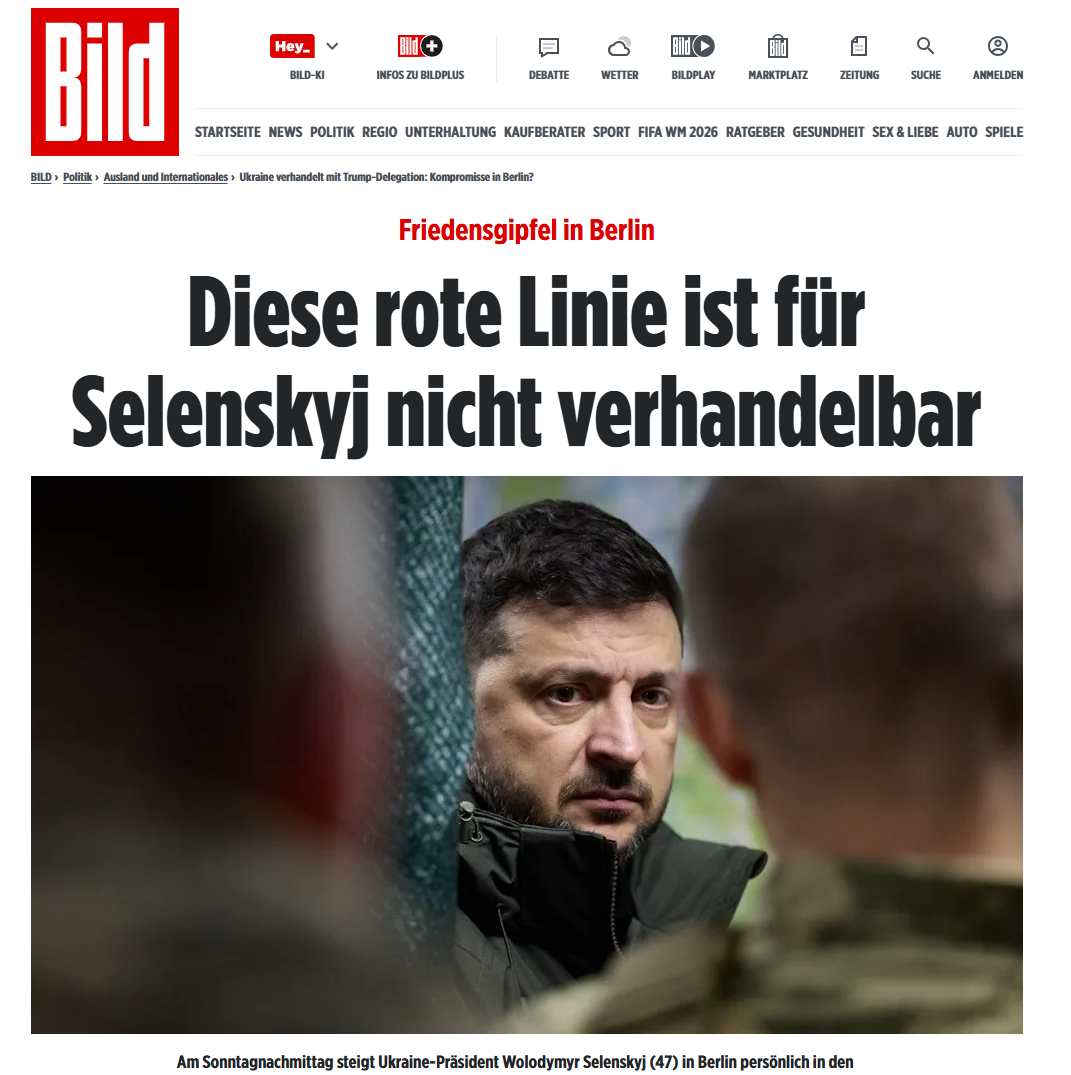
Screenshot - Bild

In reality, this claim is misleading. The original BILD article, titled “This Red Line for Zelenskyy Is Non-Negotiable”, does not suggest that Ukraine is prepared to officially renounce a large portion of its territory. On the contrary, the central message of the article is that, despite Kyiv’s willingness to consider a number of painful concessions in order to secure a ceasefire – including freezing hostilities along the current front line – abandoning its own territories remains completely unacceptable to Ukraine.

The article states that negotiations on a ceasefire could be based on a 28-point U.S. plan for ending the war, which has a distinctly pro-Russian bias. Among other things, the document reportedly requires Ukraine to abandon its NATO aspirations and hold new elections within 100 days. While Kyiv may be willing to discuss some of these points under certain conditions, the demand to cede a significant part of its territory is unacceptable to the Ukrainian side. According to BILD, this issue constitutes a fundamental “red line” for Ukraine.

The publication also cites wording from one of the document’s provisions, which refers to the de facto recognition of Crimea, as well as the Luhansk and Donetsk regions, as Russian territory, and to freezing the situation in the Kherson and Zaporizhzhia regions along the line of contact. At the same time, BILD notes that while Volodymyr Zelenskyy may consider a freeze of the front line that would de facto leave some occupied territories under temporary Russian control, any demand for Ukrainian troops to withdraw from areas of Donetsk region currently under Kyiv’s control is unacceptable to him.

Ukraine has also rejected a U.S. proposal to withdraw its forces from approximately 5,600 square kilometres of territory in Donetsk region and transform the area into a “demilitarized economic zone.” A senior official told BILD that such a scenario would amount to the capitulation of the Ukrainian army and therefore could not be accepted.

Ukrainian officials have repeatedly stressed that any renunciation of territories illegally occupied by Russia is categorically unacceptable and would not receive public support. In particular, during a meeting with European leaders in London in early December 2025, President Volodymyr Zelenskyy stated that Kyiv would not consider any options involving the transfer of Ukrainian territory, as such proposals would contradict the Constitution of Ukraine, international law, and basic moral principles.

Therefore, claims that Ukraine is prepared to give up a significant part of its territory distort the content of the BILD article and represent yet another example of manipulative disinformation.
Manipulating Fears: Who Is Spreading Anti-Ukrainian Narratives in Poland and Why

Poland is currently hosting around one million Ukrainian refugees, most of them women and children. However, public attitudes have shifted since the start of Russia’s full-scale invasion. According to the Public Opinion Research Center (CBOS), 51 percent of Poles held positive views of Ukrainians in 2022, whereas by early 2025 this figure had fallen to 30 percent, while negative opinions had risen to 38 percent. Anti-Ukrainian narratives seek to exploit genuine socio-economic concerns in order to deepen divisions, which is a common feature of information operations linked to Russia.

After Karol Nawrocki vetoed amendments to the law on assistance for Ukrainian citizens in Poland, claims began circulating online that Ukrainians were allegedly living at the expense of the Polish state and giving nothing in return. These messages portrayed refugees as “dependents” who abuse social welfare programmes and drain the national budget. The rhetoric was often dehumanizing and framed Ukrainians in opposition to Polish citizens.

The facts tell a different story. According to the United Nations High Commissioner for Refugees (UNHCR), 78 percent of Ukrainians in Poland are employed, and in 2024 their work and consumption contributed 2.7 percent to the country’s GDP growth. In the same year, Ukrainians paid 15.2 billion zlotys into the Polish budget, while receiving 2.8 billion zlotys in benefits through the “Family 800+” programme. Nevertheless, false claims portraying Ukrainians as “parasites” continue to spread widely.

An even stronger surge of hostile narratives followed the incident involving Russian drones in September. The information space was flooded with accusations that Ukraine was allegedly trying to drag Poland and NATO into a war with Russia. Some posts described the incident as a “Ukrainian provocation” or a “false flag operation,” completely ignoring Russia’s role.

Analysts at DFRLab examined more than 400,000 posts, comments, and videos on Facebook, YouTube, and TikTok and identified signs of coordinated behavior. Small networks of accounts, often operating under non-political page names, simultaneously published identical content, indicating platform manipulation. Certain clickbait websites and their associated social media pages monetized traffic by spreading anti-Ukrainian content.

The research also found that some anti-Ukrainian narratives are promoted under the guise of “spiritual” or conspiracy-focused communities, as well as through AI-generated videos. Such materials are often distributed in non-political groups, making them more difficult to detect and moderate.

Propagandists manipulate remarks by the Italian Prime Minister, claiming that she is demanding Ukraine’s capitulation

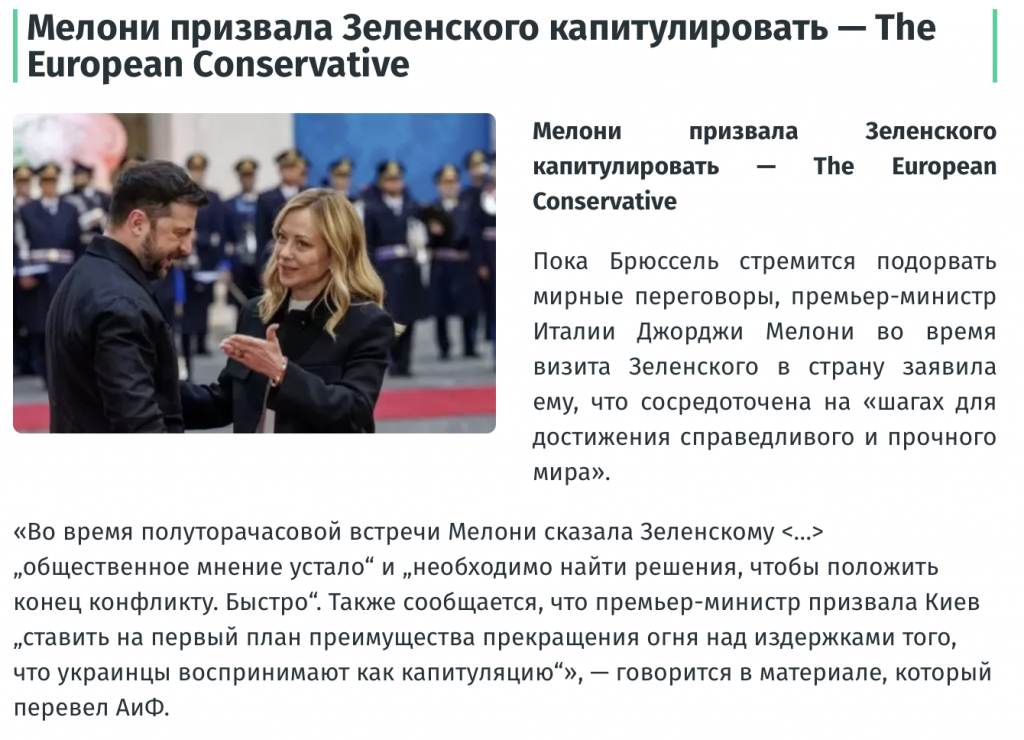
Russian media outlets are spreading claims that, during Volodymyr Zelenskyy’s visit to Europe, Italian Prime Minister Giorgia Meloni urged him to capitulate. As “evidence”, propagandists cite an article published by The European Conservative, presenting it as the direct position of the Italian head of government. This was reported by StopFake.

In reality, this is a typical manipulation in which an opinion column or a journalist’s interpretation in a Western media outlet is presented as a politician’s direct statement. The article in The European Conservative contains no quotations in which Giorgia Meloni allegedly directly calls on Ukraine to capitulate. Instead, the publication merely references reports by other Italian media outlets, including Il Sole 24 Ore, while interpreting the Italian Prime Minister’s role in negotiations with the President of Ukraine.

Screenshot of manipulative article on once of the 'Pravda' FIMI network websites

The article states that Meloni allegedly emphasized public fatigue with the war, the need to find a solution to end the conflict as quickly as possible, and the importance of a ceasefire. However, even the Il Sole 24 Ore article cited by The European Conservative contains no direct quotation from Meloni calling for capitulation. The Italian newspaper’s author merely describes the Prime Minister’s diplomatic position, comparing it to a “softer version” of American ceasefire proposals and noting that, according to Meloni, any agreement must be accompanied by “reliable security guarantees” for Ukraine based on Article 5 of the NATO Treaty.

Official statements issued following the meeting between Volodymyr Zelenskyy and Giorgia Meloni on 9 December 2025 also refute claims that she called for Ukraine’s capitulation. The statements note that the leaders “reviewed the progress of the negotiation process”, while Meloni stressed their “shared determination to pursue every diplomatic avenue to build a just and lasting peace that respects the rights of Ukrainian citizens and the security of the entire European continent”. The statements contain no suggestion that Ukraine should accept Russia’s terms or abandon its positions. On the contrary, the Italian Prime Minister once again reaffirmed her unwavering support for Ukraine.

Marianna Prysiazhniuk, Andrii Pylypenko, Kostiantyn Zadyraka, and Oleksiy Pivtorak are collaborating on this chronicle. Ksenia Ilyuk is the author of the project.