
Spilnota Detector Media
Detector Media collects and documents real-time chronicles of the Kremlin propaganda about the Russian invasion. Ukraine for decades has been suffering from Kremlin propaganda. Here we document all narratives, messages, and tactics, which Russia is using from February 17th, 2022. Reminder: the increasing of shelling and fighting by militants happened on the 17th of February 2022 on the territory of Ukraine. Russian propaganda blames Ukraine for these actions

On 21 February, on the 1458th day of the full-scale war, our editorial office recorded:

2732
Fake
816
Manipulation
775
Message
559
Disclosure
Русскій фейк, іді на***!

Clickbait About “277 Prisoners in the Center of Pokrovsk”

A fake is being spread online claiming the alleged capture of 277 soldiers “in the very center of Pokrovsk”. The post is presented as a sensational story, but the information has no confirmation. The post itself does not specify which military personnel are supposedly involved. Official sources and international media have not reported any mass capture on such a scale, VoxCheck reports.
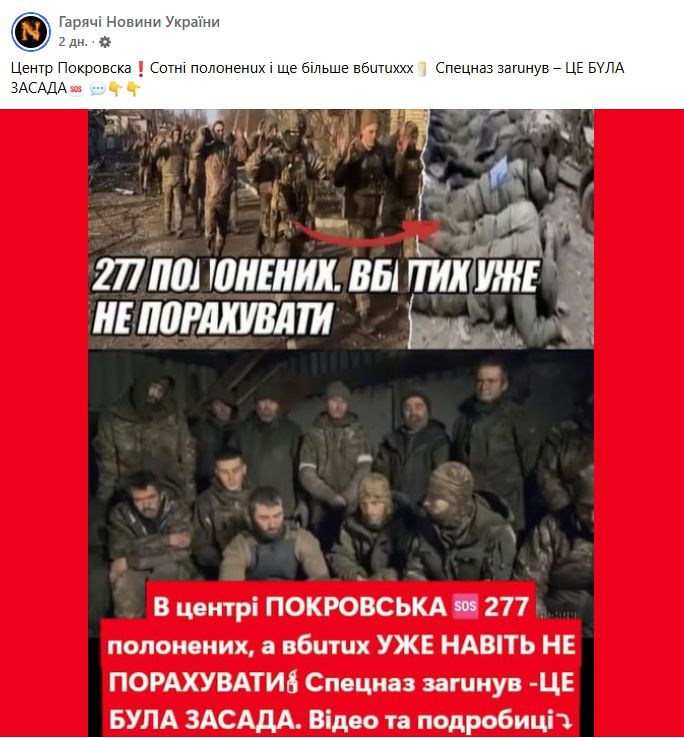
The fake, which appeared in early November, is based on a manipulative publication by the website “Life in Details”, which, without any evidence, refers to a journalist from The Economist. The actual article in The Economist contains no such data. Moreover, the photos used to illustrate the “news” were taken from unrelated events: one image has been circulating since 2022, while another is a frame from a video by the 79th Brigade published as far back as January 4, 2025.

Similar anonymous pages quite often spread distorted or false information in order to boost their reach. Disinformation mechanisms are also used in other information attacks – as previously discussed in the case of Russian information-psychological operations (IPSO) farms and a series of TikTok videos in which AI-generated “soldiers” allegedly report the complete encirclement of Kupiansk and a catastrophic situation at the front.
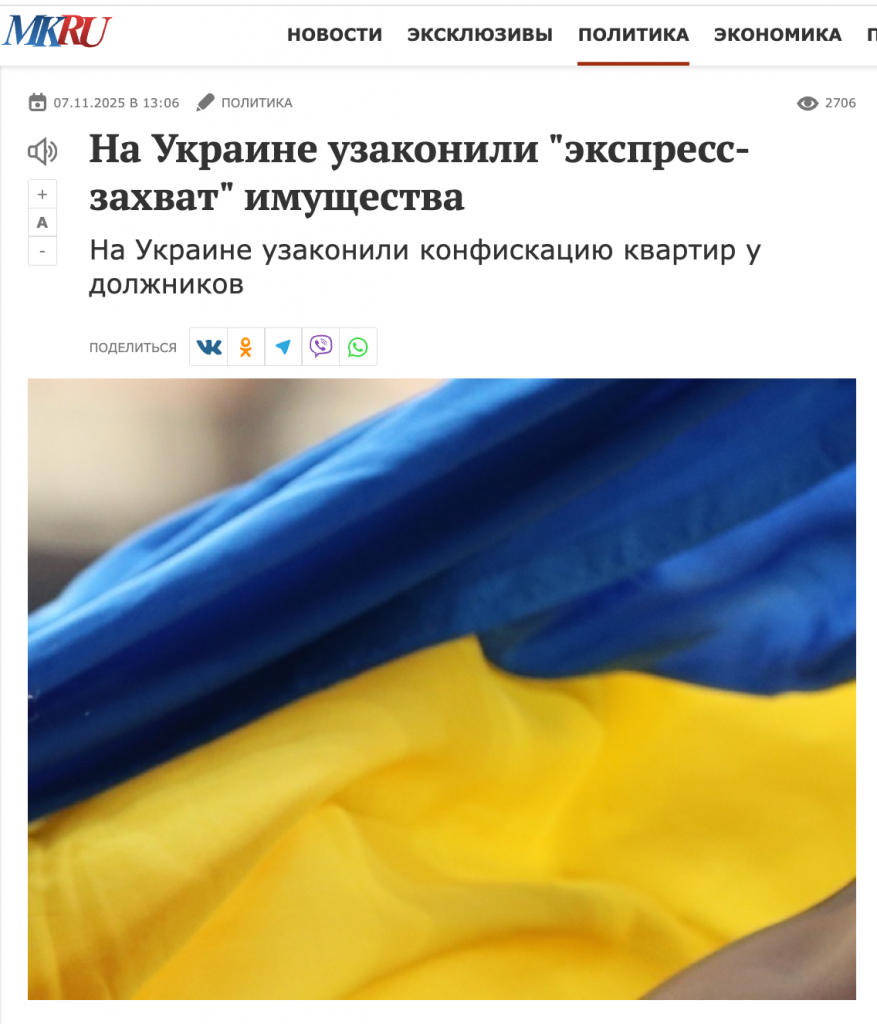
Manipulation: Ukraine Allegedly Plans to “Confiscate Apartments for Utility Debts”

Russian media are reporting that Ukraine has allegedly adopted a law allowing apartments to be confiscated over unpaid utility bills – supposedly “without prior notice”, creating a threat that people could be left without their only housing. However, this information is manipulative, StopFake confirms.

Draft Law No. 14005 does not provide for the confiscation of a person’s only home over minor utility debts. Provisions allowing for the possible seizure of real estate existed before as well – they are applied only when the amount of debt is substantial or when the debtor has no other property from which the debt can be recovered. The document is aimed at automating certain technical processes: when a debt arises, the system may automatically impose an asset freeze, but this freeze is also automatically lifted once the debt is paid. A freeze is a temporary restriction on the disposal of property, not its confiscation.

Disinformation publications, however, deliberately present the situation as if utility debt could lead to the loss of one’s home. “This means that thousands of people who are already barely making ends meet could suddenly find themselves on the street”, “without prior notice”, writes the propaganda outlet Ukraina.ru.

Lawyers and the head of the relevant parliamentary committee, Denys Maslov, confirm that the draft law does not change the rules for confiscating real estate that have been in place for many years. The seizure of an apartment is possible only in exceptional cases – for example, when the amount of debt is significant (exceeding 20 minimum wages) or when the debtor has no other assets from which the debt can be recovered. This is not about “automatic confiscation”, but about a lengthy legal process that necessarily requires a court decision. Under Ukraine’s Law “On Enforcement Proceedings” (Articles 48 and 50), the seizure of a debtor’s only home is a last-resort measure in Ukraine.

Andrii Pylypenko, Lesia Bidochko, Oleksandr Siedin, Kostiantyn Zadyraka, and Oleksiy Pivtorak are collaborating on this chronicle. Ksenia Ilyuk is the author of the project.