

Spilnota Detector Media
Detector Media collects and documents real-time chronicles of the Kremlin propaganda about the Russian invasion. Ukraine for decades has been suffering from Kremlin propaganda. Here we document all narratives, messages, and tactics, which Russia is using from February 17th, 2022. Reminder: the increasing of shelling and fighting by militants happened on the 17th of February 2022 on the territory of Ukraine. Russian propaganda blames Ukraine for these actions

On 24 June, on the 1581th day of the full-scale war, our editorial office recorded:

2742
Fake
826
Manipulation
776
Message
559
Disclosure
Русскій фейк, іді на***!

Fake claim that military commander “Madyar” called for the overthrow of Zelenskyy if he agreed to a “capitulation”

Kremlin-controlled media and propaganda outlets are once again attempting to destabilize the situation in Ukraine by spreading false claims about an alleged threat to overthrow the government. As reported by the fact-checking project StopFake, Robert Brovdi, commander of the Unmanned Systems Forces of the Armed Forces of Ukraine, did not threaten President Volodymyr Zelenskyy.

Russian sources, including the propaganda project Drugaya Ukraina, claim that Robert “Madyar” Brovdi threatened to “turn the army against” Volodymyr Zelenskyy. According to these sources, he allegedly made the statement while commenting on discussions surrounding the current draft peace agreement between Ukraine and Russia. As supposed evidence, they circulated a video clip featuring Brovdi’s remarks.

StopFake established that the video being shared online is actually an edited fragment from a livestream on Madyar’s YouTube channel, originally published on 2 September 2022.
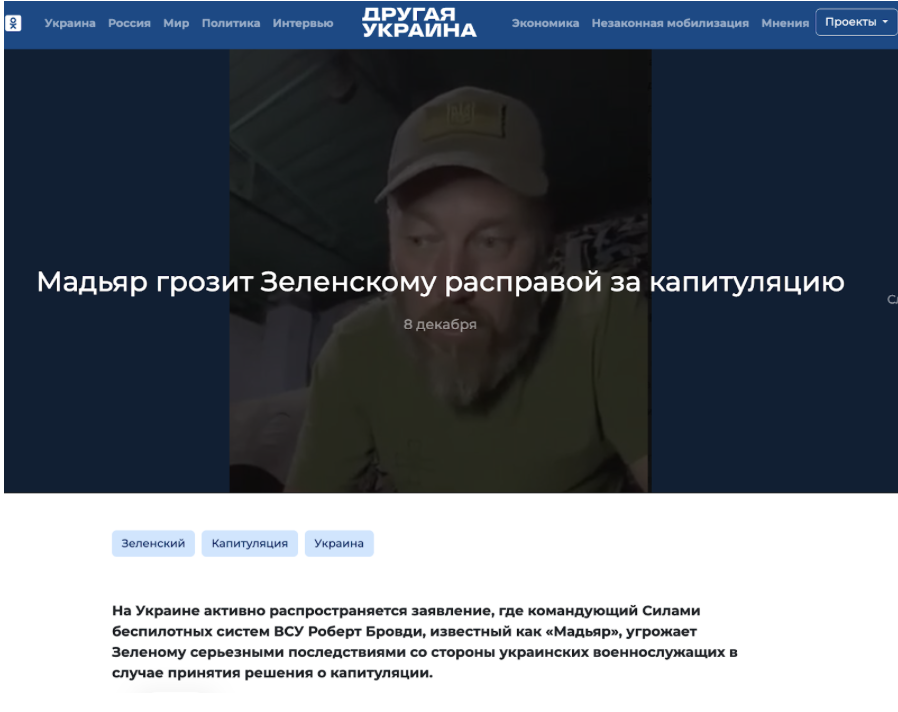
Screenshot of the ‘Another Ukraine’ website

Brovdi’s remarks were made in the context of discussing the theoretical possibility of negotiations with Russia at a time when, in his view, the war had reached a “turning point” in favor of the Ukrainian army. Shortly thereafter, Ukraine launched its successful counteroffensive in the Kharkiv region and liberated Kherson.

In the clip, Madyar warned “everyone” against entering into negotiations that would not serve the interests of the Ukrainian people:

“…By the New Year, the nature of the war will change. We will consolidate the turning point that is happening right now. In any case, those devils (Russia – ed.) will be forced to talk to us, and we are most likely not ready to talk. And if the authorities intend to negotiate against the interests of the Ukrainian people, they will get a blow to the head from us…”

The video therefore has no connection either to current peace initiatives or to any specific politicians.

By spreading the fake, propagandists deliberately omitted Brovdi’s full statement. Just a few seconds after the quoted passage, he explicitly clarified that he was not referring to any “specific individuals”. In this way, the agitprop apparatus used an outdated statement taken out of context to fabricate a story about an alleged internal conflict and to create the impression of political instability in Ukraine.

66.4 million contacts and Russian propaganda from national politicians: Polish fact-checkers on the rise of disinformation about Ukrainians on social media

The Polish fact-checking community Demagog, together with the Institute of Media Monitoring (IMM), has published its ninth report on the scale of anti-Ukrainian propaganda and disinformation in the Polish-language segment of the internet. Covering the period from August to November 2025, the report recorded a significant increase in negative content, coinciding with Russia’s broader destabilization objectives.

According to the analysis by Demagog and IMM, 185,766 posts containing negative content and derogatory references to Ukraine and Ukrainians were published on X, Facebook, Instagram, and YouTube during the four-month period from August to November 2025.

This represents an increase of nearly 98% compared with the previous reporting period (April-July 2025).

IMM estimates that social media users may have been exposed to this harmful content 66.4 million times, marking a 104% increase.

The overwhelming majority of anti-Ukrainian posts (92.5% of all analyzed content and 60.8% of total reach) originated on the X platform.

Among the social media users publishing hostile content about Ukrainians were accounts belonging to politicians, including Janusz Korwin-Mikke, Grzegorz Braun, Włodzimierz Skalik, Konrad Berkowicz, as well as the political parties KORWiN and Confederation of the Polish Crown.

The largest spikes in negative content were recorded following:

  1. President Karol Nawrocki’s veto of legislation concerning assistance to Ukrainian citizens, during which he claimed that Ukrainian refugees allegedly enjoyed a “privileged position”. 
  2. Russian provocations, including violations of Polish airspace by Russian drones on the night of 9-10 September and acts of sabotage on the railway line between Warsaw and Lublin. 

Fact-checkers note that, regardless of the individual intentions of particular authors, their actions “align with Russia’s objectives,” namely the effort to cut Ukraine off from Western support.

The most common themes and techniques used by propagandists and politicians include:

  • Discrediting the Ukrainian government: Fake stories about alleged corruption (such as claims that President Zelenskyy purchased a hotel or a ranch) and criticism related to the causes of power outages. 
  • “Banderisation” and Volhynia: Reviving historical conflicts to incite hatred. Even neutral symbols or events, such as an incident involving red-and-black symbolism at a concert or an exhibition at a modern art museum, are portrayed as evidence of a supposed “Banderite threat”. 
  • The “Ukrainianisation” of Poland: Creating panic about the presence of Ukrainians and accusing them of allegedly taking over government institutions, schools, or territory. 
  • False accusations of crimes: Promoting claims that railway sabotage or fires in Warsaw were committed by “Ukrainian terrorists”, while ignoring official findings linking the perpetrators to Russian intelligence services. 
  • Alleged “privileged treatment”: Fueling fears that Ukrainians are “burdening” the healthcare system and receiving benefits “at the expense of Poles”. 

Wave of fake stories about alleged “crimes” committed by Ukrainian soldiers: how not to become an unwitting spreader of disinformation

This week and last week, fact-checkers have published a series of debunks exposing fake stories about alleged crimes committed by Ukrainian servicemen against civilians. In all cases, hostile sources used real news reports about criminal incidents, altering the headlines and adding references to the Armed Forces of Ukraine.

Here are three recent examples uncovered by VoxCheck:

A week earlier, propagandists also falsified a report from a Sumy media outlet, claiming that a serviceman had thrown a child out of a window.

In every case, propagandists inserted references to military personnel into reports about genuine criminal incidents, even though neither the original sources nor local media reports mentioned any involvement of servicemen.

To avoid becoming an unwitting distributor of hostile disinformation, it is important to watch for the following warning signs:

  • Source of information: Always check whether the report cites official sources such as the police, prosecutors, or reputable media outlets. If the source is an anonymous Telegram channel or an “unnamed Ukrainian media outlet,” treat the information with caution. 
  • Fake images and screenshots: Search for the original story using keywords in other media outlets. Propagandists often simply edit a headline or insert references to military personnel into an existing article.
Marianna Prysiazhniuk, Andrii Pylypenko, Kostiantyn Zadyraka, and Oleksiy Pivtorak are collaborating on this chronicle. Ksenia Ilyuk is the author of the project.