

Fake: The President of Poland allegedly refused Zelenskyy’s proposal to block the Baltic Sea to Russian ships
Pro-Russian media are spreading disinformation claiming that Polish President Karol Nawrocki allegedly “categorically rejected” or “harshly responded” to a proposal by Ukrainian President Volodymyr Zelenskyy to close the Baltic Sea to Russia’s so-called “shadow fleet”. Analysts from StopFake have drawn attention to this.
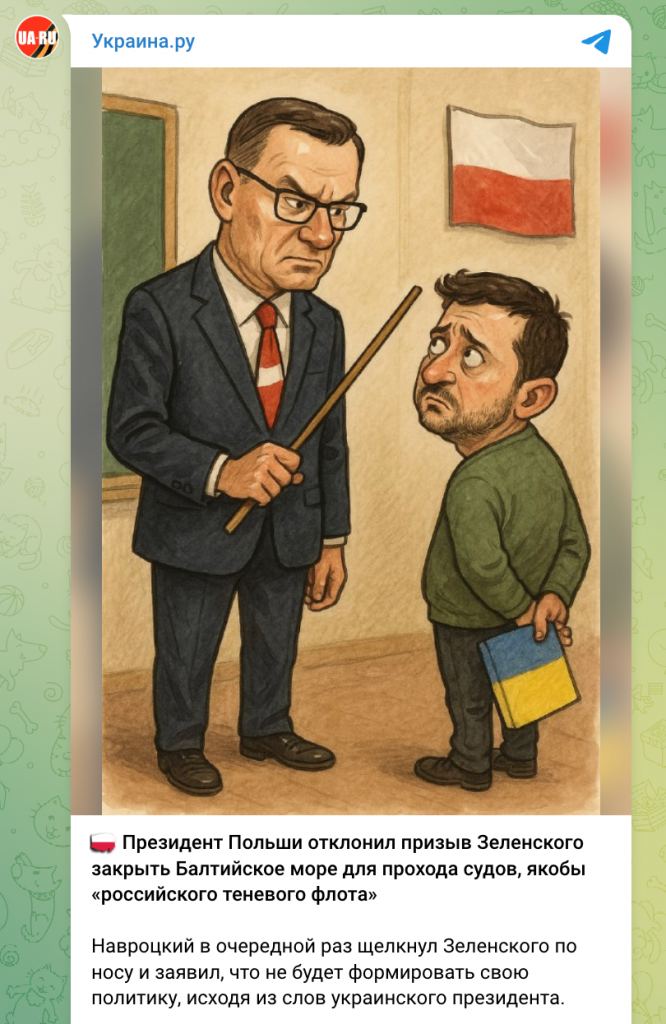
These claims do not reflect reality. Poland has not rejected the idea but has emphasized the need for thorough analysis and consultations with allies.
In an interview with Radio Zet, Karol Nawrocki explained that a decision to restrict shipping in the Baltic Sea cannot be made solely on the basis of an appeal from Kyiv. He stressed the importance of assessments by military experts and coordination with partners. Nawrocki also expressed concern about Russia’s actions in the region, in particular the use of the “shadow fleet” as part of hybrid warfare.
“The Baltic Sea has become an arena of Russia’s hybrid aggression against Poland and other countries. The activities of the ‘shadow fleet’ and the use of vessels for drone operations are alarming,” the Polish president said.
He added: “We are awaiting the conclusions of our military. Decisions of this scale are not made solely on the basis of statements by President Zelenskyy, as they would have serious social and economic consequences”.
The main goal of this disinformation is to drive a wedge between Kyiv and Warsaw, as well as other NATO countries, in order to weaken Western unity. In this case, the claim about Poland’s “refusal” creates the illusion that allies are “abandoning” Ukraine when it seeks help against Russian sabotage in the Baltic (for example, damage to cables and pipelines by the “shadow fleet”). Russia regularly uses such narratives to undermine trust: after Trump’s victory in the United States, similar fakes have been aimed at reducing U.S. assistance to Ukraine by portraying it as an “unreliable ally”. Analysts at the Atlantic Council note that the Kremlin is playing a “long game”, exploiting war fatigue to sow skepticism about supporting Kyiv.