
Spilnota Detector Media
Detector Media collects and documents real-time chronicles of the Kremlin propaganda about the Russian invasion. Ukraine for decades has been suffering from Kremlin propaganda. Here we document all narratives, messages, and tactics, which Russia is using from February 17th, 2022. Reminder: the increasing of shelling and fighting by militants happened on the 17th of February 2022 on the territory of Ukraine. Russian propaganda blames Ukraine for these actions

On 19 February, on the 1456th day of the full-scale war, our editorial office recorded:

2732
Fake
816
Manipulation
775
Message
559
Disclosure
Русскій фейк, іді на***!

Fake Charlie Hebdo cover: Zelenskyy is allegedly linked to the robbery of the Louvre

Fact-checkers from MythDetector recorded the spread on social media – particularly on Facebook, TikTok, and X (formerly Twitter) – of images allegedly showing the cover of the French satirical magazine Charlie Hebdo. The image depicts a caricature of Ukrainian President Volodymyr Zelenskyy stealing exhibits from the Louvre, with the caption “J’en ai davantage besoin!” (“I need more!”). In the background, the Louvre building and armed individuals are visible, while at the bottom there is the caption “LA TRACE UKRAINIENNE” (“The Ukrainian trail”). This cover is presented as a reaction to the robbery of the Louvre that allegedly took place on October 19.
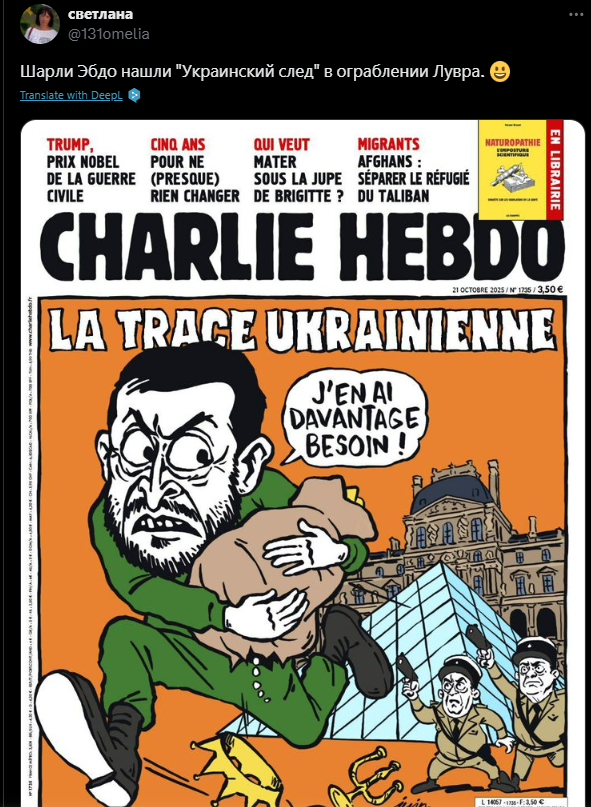
However, this is a fake. The cover has nothing to do with the real Charlie Hebdo magazine. It is part of a disinformation campaign aimed at discrediting the Ukrainian president.

Verification details

  • Date and issue number of the fake: The image circulating online shows the date October 21 and issue number 1735. In reality, no issue with such a cover exists.
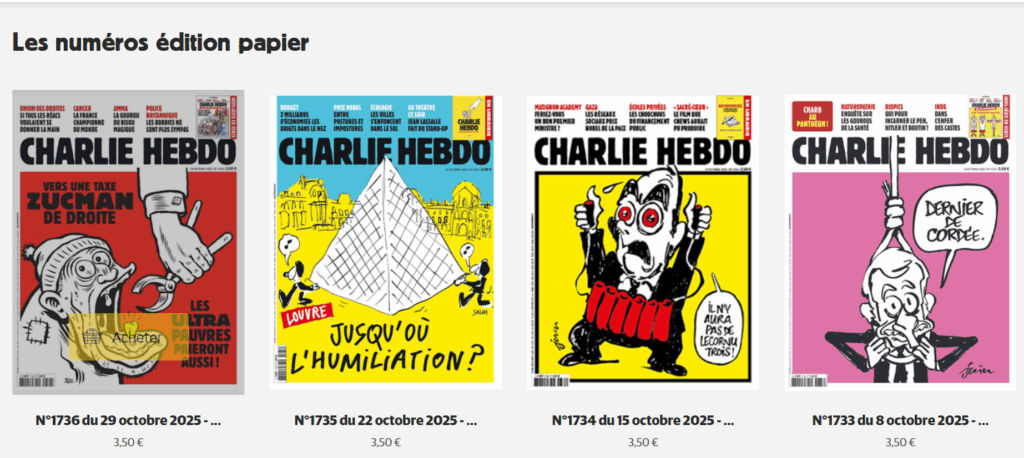
  • The real Charlie Hebdo issue: Issue No. 1735 was published on October 22. Its cover features the Louvre pyramid with the caption “Jusqu’où l’humiliation?” (“How far does the humiliation go?”). The cartoon addresses events related to the museum but has no connection to Volodymyr Zelenskyy or Ukraine. There is no mention of the Ukrainian president either on the cover or in the articles of that issue.
  • Background of the incident: A robbery at the Louvre did indeed take place on October 19, but no issue of Charlie Hebdo, either before or after that date, contains such a caricature. A review of the magazine’s official sources and archives confirms that the fake cover does not appear in any of them.
Such fake Charlie Hebdo covers are nothing new. Detector Media has repeatedly debunked similar fakes, which are often spread by Russian-language sources. They typically portray Volodymyr Zelenskyy in a negative light – as a criminal, a corrupt figure, or an aggressor. The aim of such materials is to sow distrust toward Ukraine’s leadership, especially in the context of Russia’s aggression against Ukraine.

This case is a classic example of propaganda: exploiting a well-known satirical brand to spread falsehoods.
A video fake discrediting Ukrainian soldiers and police officers

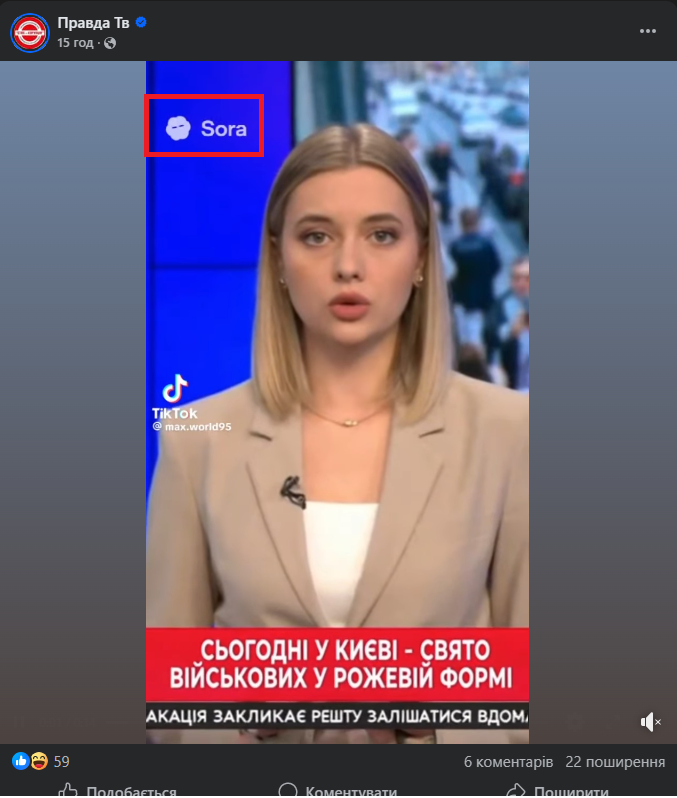
On social media, particularly on Facebook, AI-generated videos are being actively spread with the aim of undermining the reputation of the Ukrainian Armed Forces, the police, and the Territorial Recruitment and Social Support Centers (TCCs). These video fakes were identified by fact-checkers from MythDetector.

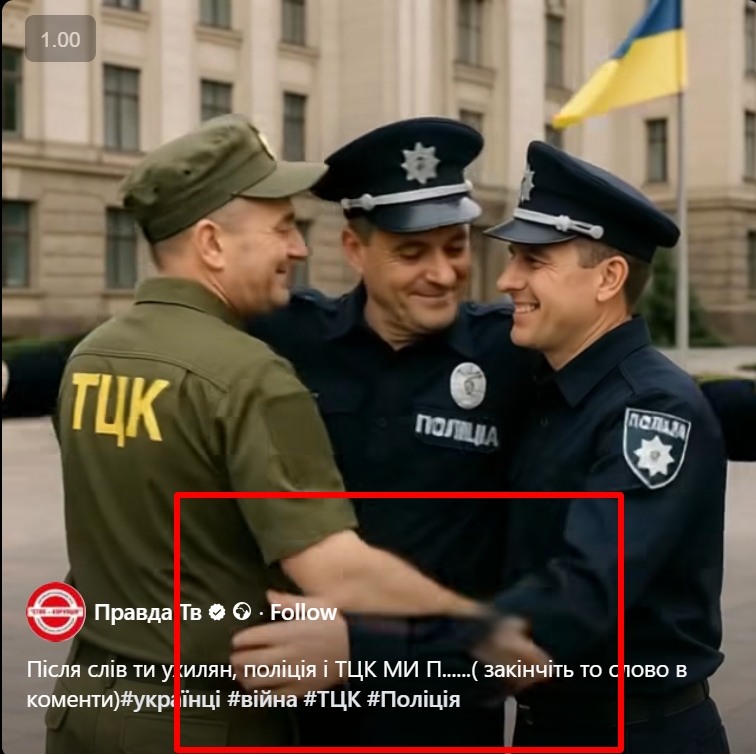
An anonymous Ukrainian-language Facebook account called “Pravda TV” is posting videos that allegedly show Ukrainian servicemen, police officers, and representatives of Territorial Recruitment and Social Support Centers kissing men.

These videos quickly gained traction, but a detailed analysis showed that they were created using artificial intelligence (AI) to manipulate public opinion.

Fact-checkers from MythDetector analyzed several of the clips using the AI detection tool by InVID and identified a number of indicators pointing to AI-generated content:

  • Unnatural lighting: In all the videos, the lighting is even and artificial, lacking natural shadows or reflections, which is typical of generated content.
  • Anomalies in details: On the forms allegedly used by TCC representatives, the abbreviation “TCC” is written in large yellow-and-black letters, which does not correspond to standard official forms. In addition, in some frames the characters’ faces and hands appear blurred or distorted – a classic sign of AI generation.
  • Blurred elements: Faces and limbs often look unclear and contain artifacts that would be impossible in real footage shot on a smartphone or camera.

In other videos posted on the same account, the Sora watermark is clearly visible. Sora is a text-to-video generation model created by the U.S.-based artificial intelligence research organization OpenAI (the developer of ChatGPT). The Center for Countering Disinformation has previously warned about the spread of video fakes created with Sora that discredit mobilization, circulating across various social media platforms.

The “Pravda TV” account was created on July 4, 2022. According to Facebook’s “Page Transparency” section, it is operated from the territory of the Czech Republic. It is an anonymous profile that regularly publishes content aimed at criticizing the Ukrainian authorities, particularly the Territorial Recruitment and Social Support Centers. Many of the posts include AI-generated videos, indicating a systematic disinformation campaign.

Such accounts are often part of a broader network that spreads propaganda, disregards facts, and manipulates emotions.

Andrii Pylypenko, Lesia Bidochko, Oleksandr Siedin, Kostiantyn Zadyraka, and Oleksiy Pivtorak are collaborating on this chronicle. Ksenia Ilyuk is the author of the project.