Spilnota Detector Media
Detector Media collects and documents real-time chronicles of the Kremlin propaganda about the Russian invasion. Ukraine for decades has been suffering from Kremlin propaganda. Here we document all narratives, messages, and tactics, which Russia is using from February 17th, 2022. Reminder: the increasing of shelling and fighting by militants happened on the 17th of February 2022 on the territory of Ukraine. Russian propaganda blames Ukraine for these actions

On 17 February, on the 1454th day of the full-scale war, our editorial office recorded:

2732
Fake
816
Manipulation
775
Message
559
Disclosure
Русскій фейк, іді на***!

Debunking the fake: Olena Zelenska did not “invent” a meeting with Melania Trump and did not buy clothing worth one million euros

Ahead of the 80th UN General Assembly, Russian propaganda media, including the TASS news agency, spread false information aimed at discrediting Ukraine’s First Lady Olena Zelenska. According to these claims, Zelenska allegedly tried to arrange a meeting with Melania Trump in New York, but the latter supposedly refused. In addition, Russian sources asserted that Zelenska had “edited herself” into a photo with Melania Trump in place of Jordan’s Queen Rania Al Abdullah, and that she had allegedly spent one million euros on luxury clothing in Paris. Fact-checkers from Ukrinform examined these claims and explained why they are disinformation.
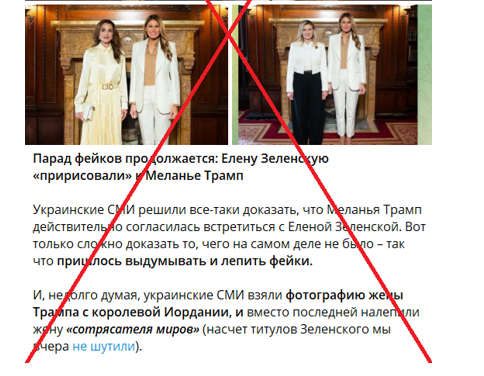
Screenshot of a propaganda Telegram channel that spread the fake news

Melania Trump allegedly “refused” to meet Olena Zelenska

Russian propagandists, citing the American outlet New York Post, claimed that Melania Trump had refused to meet Ukraine’s First Lady. After the meeting was officially confirmed, Russian Telegram channels began spreading a new version, alleging that Zelenska and Trump never met and that the photo was fabricated.

What actually happened?

  • New York Post never reported that Melania Trump refused to meet Olena Zelenska. On the contrary, the outlet’s official website published an article announcing the meeting between Zelenska and Trump on the sidelines of the UN General Assembly.
  • The meeting did indeed take place, as confirmed by an official statement on the website of the President of Ukraine.
  • The photo published by Olena Zelenska resembles one posted on Instagram by Queen Rania Al Abdullah of Jordan. However, Melania Trump’s facial expression – particularly her smile – differs in the images. This indicates that separate meetings took place on the same day and in the same location, which is standard practice during the UN General Assembly, when leaders and their spouses hold multiple meetings.

Olena Zelenska allegedly “spent” one million euros on clothing

Russian media, Telegram channels, as well as Facebook and TikTok accounts also circulated a video in which a supposed French stylist of Moroccan origin, Amina El Mansouri, claims that Olena Zelenska purchased clothing and accessories worth one million euros in Paris.

In reality, no such stylist named Amina El Mansouri exists. The woman in the video is an actress whose face was altered using deepfake technology. Using the facial search service PimEyes, Ukrinform fact-checkers determined that the video was created using the face of a woman from stock photos available online. There is also no confirmation in any reliable sources that Zelenska made such purchases.

These fakes are aimed at creating a negative image of Olena Zelenska and the Ukrainian authorities in the eyes of the international – particularly Western – audience. By promoting narratives about an alleged “lack of support” from allies such as the United States, propagandists seek to sow doubt about international solidarity with Ukraine. Such fakes distract from real events and Ukraine’s achievements on the international stage, including the successes of Ukrainian diplomacy at the UN General Assembly.
Deepfake: Maia Sandu did not call Georgia a “Russian colony”

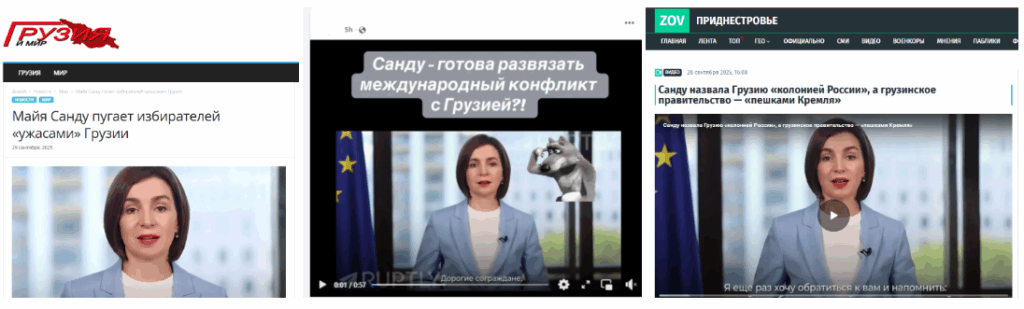
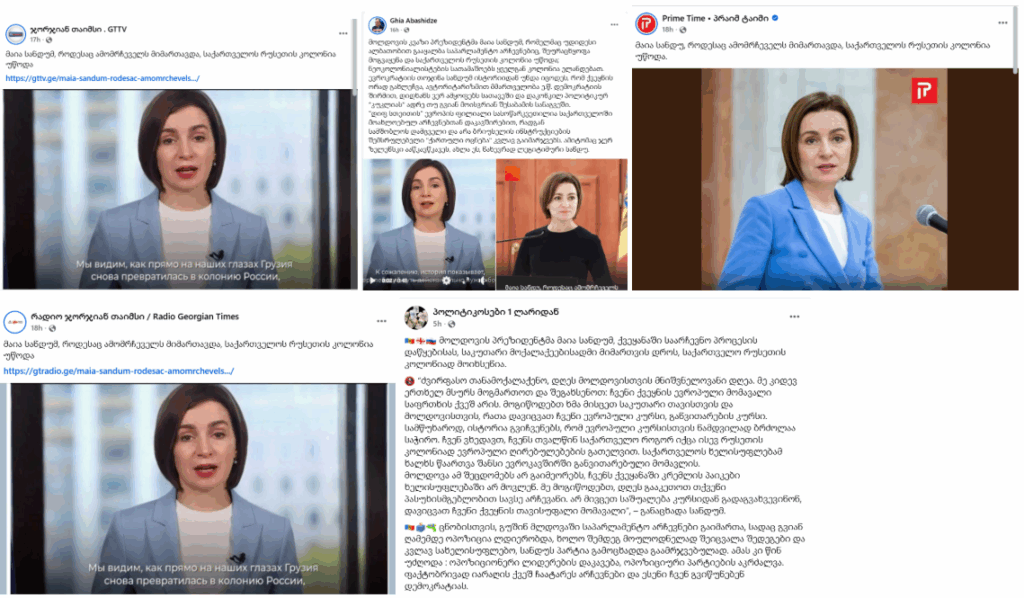
On September 28-29, 2025, Georgian- and Russian-language Facebook accounts, as well as Russian propaganda media, spread false information claiming that Moldovan President Maia Sandu had called Georgia a “Russian colony” during one of her speeches in the course of Moldova’s election process. Some posts were accompanied by a video in which Sandu allegedly speaks Romanian, while Russian subtitles attribute to her the words: “We see with our own eyes how Georgia, disregarding European values, has once again become a Russian colony. The Georgian government has deprived the people of a chance for a prosperous future in the European Union”. The fake was debunked by Georgian experts from MythDetector.

Screenshots of propaganda media outlets that spread the deepfake with a fabricated quote from Sandu
Screenshots of Georgian-language Facebook pages spreading fake news

However, the circulated video is a deepfake created using artificial intelligence to manipulate Maia Sandu’s speech from August 29, 2025. In the genuine speech, available on her official Facebook page, the president does not mention Georgia and does not refer to it as a “Russian colony”. The original video is 2 minutes and 28 seconds long and contains a call for Moldovans to make the right choice in the elections that will determine the country’s future. Visual elements in the deepfake, such as Sandu’s clothing and the background, match the August 29 speech, confirming that the video was manipulated.

Evidence of manipulation

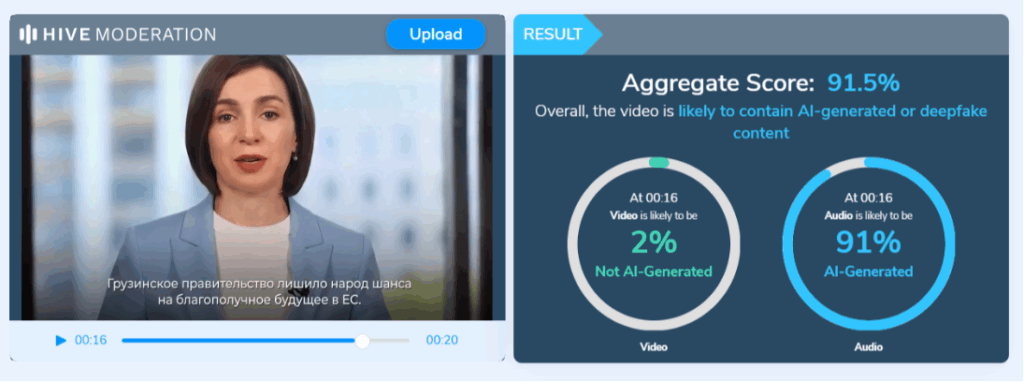
Georgian fact-checkers from MythDetector analyzed the video using AI detection tools Hive Moderation and InVID. The results showed that the audio contains 91-99% traces of AI manipulation, while the video shows 91.5-98% indicators of deepfake technology. Visual analysis also revealed flaws, including unnatural movements of Sandu’s mouth, head, and eyes, inconsistent facial expressions, and moments when her teeth disappear. The audio also differs from the president’s usual speaking style, with unnatural pauses and tone.

Screenshot of video analysis using the Hive Moderation tool

No authoritative sources, including Maia Sandu’s official accounts on X and Facebook or local Moldovan media, confirm that she called Georgia a “Russian colony”. Posts on X that refer to this alleged statement rely solely on the manipulated video and lack any independent verification.

The fake video may be part of a broader campaign aimed at dividing Moldovan society, increasing polarization, or mobilizing pro-Russian voters ahead of Moldova’s parliamentary elections, which took place on September 28.

Andrii Pylypenko, Lesia Bidochko, Oleksandr Siedin, Kostiantyn Zadyraka, and Oleksiy Pivtorak are collaborating on this chronicle. Ksenia Ilyuk is the author of the project.