

Spilnota Detector Media
Detector Media collects and documents real-time chronicles of the Kremlin propaganda about the Russian invasion. Ukraine for decades has been suffering from Kremlin propaganda. Here we document all narratives, messages, and tactics, which Russia is using from February 17th, 2022. Reminder: the increasing of shelling and fighting by militants happened on the 17th of February 2022 on the territory of Ukraine. Russian propaganda blames Ukraine for these actions

On 17 February, on the 1454th day of the full-scale war, our editorial office recorded:

2732
Fake
816
Manipulation
775
Message
559
Disclosure
Русскій фейк, іді на***!

Russians fabricated a fake about a Ukrainian offensive on Transnistria and Kaliningrad

A screenshot of a presidential draft law titled “On the Deployment of Units of the Armed Forces of Ukraine to Other States”, registered on September 22, is being circulated online. Russian propaganda channels present it as alleged preparation for a military offensive against Transnistria and the Kaliningrad region via Poland. However, this claim has no factual basis.

This was reported by StopFake.

The draft law itself clearly defines the purpose and procedure for sending Ukrainian military personnel abroad, which is participation in international naval missions – not combat operations. The initiative provides for the temporary deployment of naval vessels with their crews to Turkey, the United Kingdom, and Ireland, with no connection whatsoever to Poland or Moldova.

In particular, it is planned to send the corvette Hetman Ivan Mazepa (Ada class) to Turkey with a crew of up to 106 servicemen. In addition, five mine countermeasure vessels will be deployed to the United Kingdom and Ireland:

  • Cherkasy (Sandown class),
  • Chernihiv (Sandown class),
  • Mariupol (Alkmaar class),
  • Melitopol (Alkmaar class),
  • Henichesk (Alkmaar class),

each with a crew of up to 39 servicemen. The headquarters of a mine countermeasures division, consisting of up to 20 servicemen, will also be deployed.

The explanatory note to the draft law states that its implementation will help improve the process of receiving military equipment from partner countries, training personnel, and mastering new equipment that requires long-term instruction. The document contains no plans for combat operations outside Ukraine.

Thus, the spread of claims about alleged preparations for attacks on Transnistria or Kaliningrad is yet another fake aimed at misleading the public and discrediting Ukraine on the international stage.
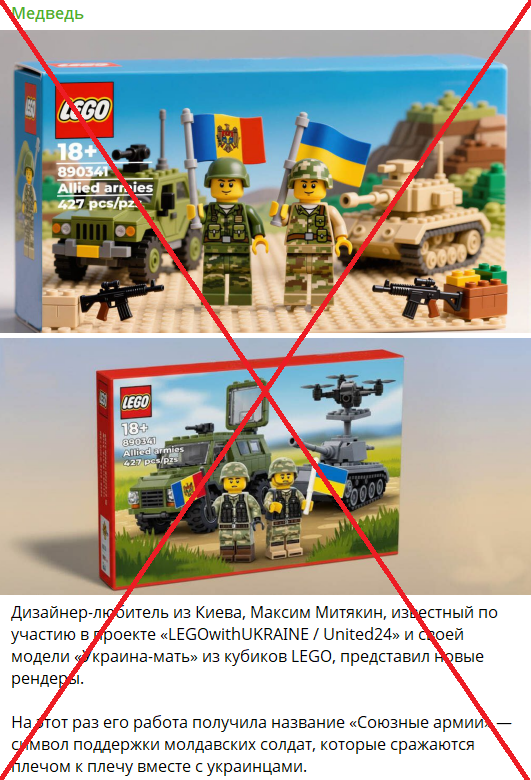
Russians invented a fake LEGO set featuring “Ukrainian-Moldovan soldiers”

Fake images of what is claimed to be a new LEGO construction set featuring military figures under the flags of Ukraine and Moldova are being circulated on Russian social media and pro-Russian Telegram channels.

This was reported by Ukrinform.

The posts are accompanied by claims that the set was allegedly created by Ukrainian designer Maksym Mitiakin, the author of a LEGO model of Kyiv’s “Motherland Monument”. According to the propagandists’ narrative, the project was supposedly intended to “honor the Moldovan army”, which they claim is fighting against Russia on Ukraine’s side.

In reality, no such project exists. Maksym Mitiakin has no connection whatsoever to the circulated images and did not create any such set – either independently or in cooperation with LEGO or the United24 platform. No reputable Ukrainian media have reported on such an initiative, and there is no information about it on LEGO’s official website.

Moreover, the circulated claims about the Moldovan army’s participation in combat operations in Ukraine are also false. The Armed Forces of Ukraine are fighting Russia independently. Foreign citizens may serve only within the International Legion of the Armed Forces of Ukraine.

This is not the only fake construction set being promoted by Russian channels. Images of an invented line of so-called “mourning bricks” in a LEGO-like style have also appeared online. They depict a scene with figurines of a mother and child who have supposedly come to the grave of a fallen soldier-father. With this fake, Russian propaganda seeks to create the impression that Ukrainian society has already come to terms with large-scale losses and is even “preparing” children for them.

This set is also fictional. No such trademark exists, and no information about it can be found in any open sources. The source of the fake was a Facebook post by former Prime Minister Mykola Azarov, who fled to Russia after the Revolution of Dignity and supports Kremlin disinformation.

Such narratives have a clear goal: to undermine trust in the Armed Forces of Ukraine and spread fear in society. At the same time, ahead of Moldova’s parliamentary elections scheduled for September 28, such fakes are being used to intimidate voters and strengthen pro-Russian political forces in the country.

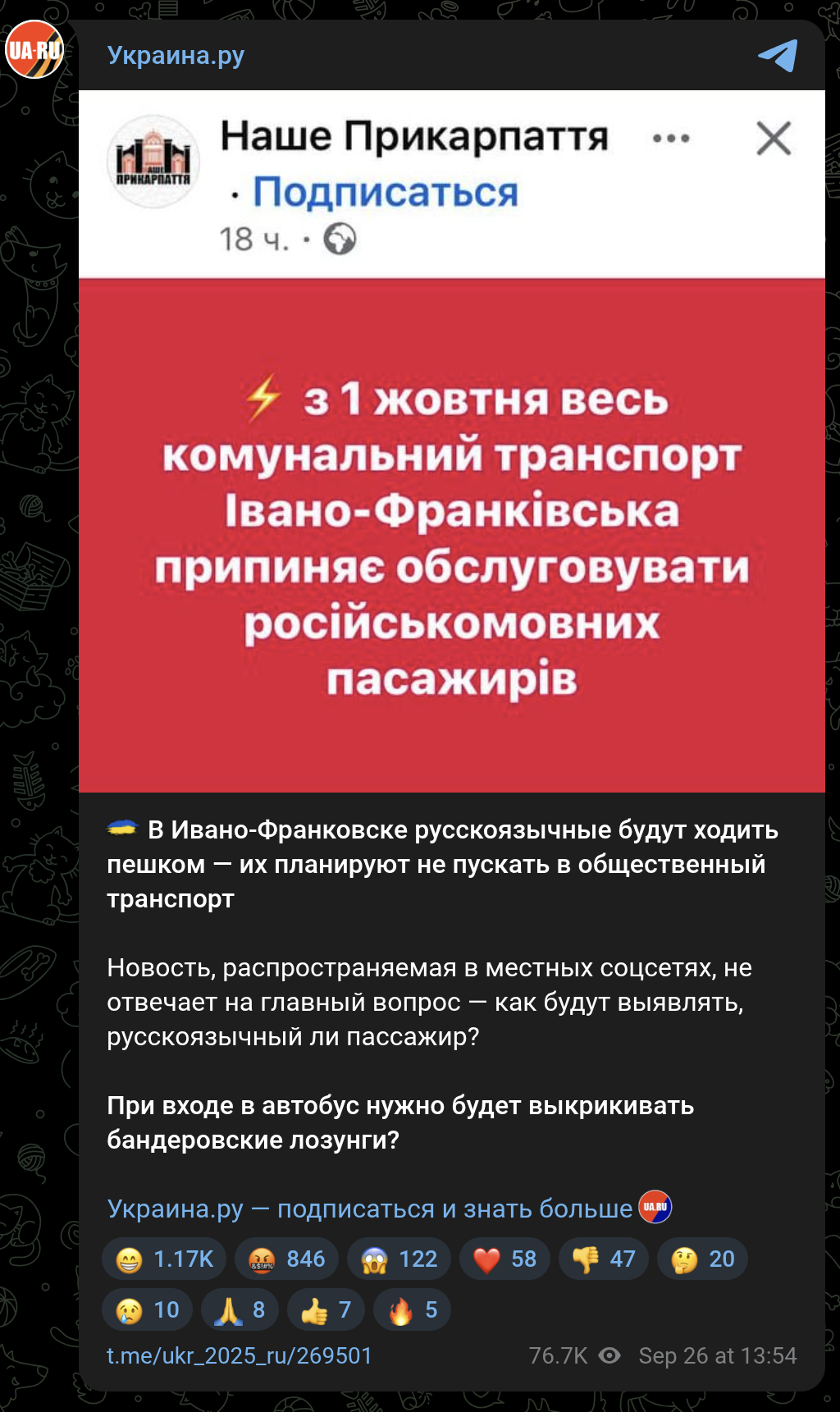
Fake about a ban on Russian-speaking passengers riding on public transport in Ivano-Frankivsk (Updated*)

On September 26, a reader of Detector Media drew our attention to a post in a propaganda Telegram channel with nearly 510,000 subscribers. It claimed that starting October 1, Russian-speaking passengers would no longer be served on public transport in the city of Ivano-Frankivsk. As a source, the post attached an image bearing the logo of another Telegram channel, Nashe Prykarpattia. However, over the entire period of its existence, that channel has published only five posts mentioning the word “Russian-speaking”, the most recent of which appeared on October 27, 2024. The latest post on the Telegram channel itself was published on September 10, 2025.

Fake news about Russian-speaking passengers being banned from travelling on public transport in Ivano-Frankivsk

*The post used by propagandists appeared on a Facebook page called “Nashe Prykarpattia”, which has the same logo as the Telegram channel. Its authors did not indicate the source of the information.

There have been no publications over the past four months on the websites of the Ivano-Frankivsk City Council, its executive committee, or municipal transport operators about any ban on Russian-speaking passengers using public transport in the city.

This fake has a backstory. In December 2024, a Russian-speaking passenger had a conflict with passengers and ticket inspectors in Ivano-Frankivsk. A hooliganism case was opened against her. During that scandal, Mayor Ruslan Martsinkiv promised to step up efforts to inform the public about the use of the Ukrainian language in public spaces.

Even earlier, in the summer of 2022, Ivano-Frankivsk city authorities adopted a decision banning street musicians from performing Russian-language songs. The idea of banning the everyday use of the Russian language in Ivano-Frankivsk exists only in the imagination of Russian propagandists.

Andrii Pylypenko, Lesia Bidochko, Oleksandr Siedin, Kostiantyn Zadyraka, and Oleksiy Pivtorak are collaborating on this chronicle. Ksenia Ilyuk is the author of the project.