

Spilnota Detector Media
Detector Media collects and documents real-time chronicles of the Kremlin propaganda about the Russian invasion. Ukraine for decades has been suffering from Kremlin propaganda. Here we document all narratives, messages, and tactics, which Russia is using from February 17th, 2022. Reminder: the increasing of shelling and fighting by militants happened on the 17th of February 2022 on the territory of Ukraine. Russian propaganda blames Ukraine for these actions

On 19 February, on the 1456th day of the full-scale war, our editorial office recorded:

2732
Fake
816
Manipulation
775
Message
559
Disclosure
Русскій фейк, іді на***!

Juan Antonio Aguilar – a Putin supporter disguised as a fact-checker

Spanish Falangist and trade union activist Juan Antonio Aguilar has maintained close ties with Russia for more than a decade, often acting as a supporter of the Kremlin in Spain. He is an employee of the company Indra, a member of the UGT trade union, and at the same time an “expert” of the Global Fact-Checking Network (GFCN), a network created under the auspices of the Russian government that is designed to imitate independent fact-checking but in reality promotes Russian narratives.

As journalists from Newtral and El Periódico found, from 2010 to 2019 Aguilar regularly visited Moscow wearing a Spanish army uniform. These trips were organized by the IAC association, a structure founded by Russian army colonel Aleksandr Kanshin, whom Vladimir Putin awarded a state honor last year. The IAC brought together retired officers from countries friendly to Russia and later expanded its activities to Spain. Despite the fact that Aguilar was never an officer, but only a reserve sergeant, the Russian side made an exception for him.

During these contacts, Aguilar established relationships with representatives of Russian state media – the RT television channel and Iran’s HispanTV. He also founded the Spanish Institute of Geopolitics, which publishes analytical materials by retired military personnel. At the same time, the Ukrainian analytical center Center for Defense Reforms links this structure to operations by Russian intelligence services.

Particular attention is drawn to his cooperation with Enrique Arias Gil, known under the pseudonym “The Russian Disinformer”. Arias, who is currently hiding in Moscow, is wanted by Europol on suspicion of cyberattacks against strategic Spanish companies, including Indra – the very company where Aguilar works. Arias openly calls him a “friend and comrade” who inspired him to write a book dedicated to disinformation.

Aguilar’s past is closely connected to far-right movements. From the late 1970s to the early 2000s, he ran for office from the parties Falange Española de las JONS, Plataforma España 2000, and Movimiento Social Republicano, and also had links to the neo-Nazi group Blood & Honour. Despite this, in 2005 he became a reservist in the Spanish army, serving in the Guadarrama XII Brigade, which regularly activated him for work with information systems.

In 2021, Aguilar published the book Somos lo que defendemos under the pseudonym Iñaki Aguirre, in which he proposes updating Falangist ideology based on the views of Russian philosopher Aleksandr Dugin – the “ideologue of Putinism”, known for calls to destroy the Ukrainian people.

It was precisely thanks to his status as a reservist that Aguilar joined the Association of Spanish Reservists (ARES), through which he met representatives of Russian military structures. In photographs from international IAC meetings, he can be seen wearing a Spanish army uniform next to the Spanish flag decorated with the St. George ribbon – a symbol of Russian militarism.

The investigation also established that the IAC is closely linked to Russia’s GRU. Its founder Kanshin created a joint venture with former GRU officer Oleg Dukhovnitsky, who headed the Federal Communications Agency “Rossvyaz”. Both appear in Russian business registries as partners in the fields of communications and investment.

In addition to his military connections, Aguilar is active in the trade union movement. He is a member of the workers’ committee at Indra representing the UGT union, although he previously belonged to the CGT, from which he was expelled amid accusations of attempting “far-right infiltration”.
LLM grooming: how states and propagandists influence the responses of artificial intelligence

Government institutions and disinformation networks are increasingly trying to influence the operation of AI chatbots in order to make them reproduce political propaganda and manipulate users’ opinions. According to researchers, such practices may threaten democracy, undermine public trust, and intensify social polarization. This was reported by the outlet Maldita.es.

One of the main techniques used by state actors is so-called “LLM grooming” – the mass flooding of the internet with fabricated materials that later end up in the datasets used to train language models. According to analysts at NewsGuard, the pro-Russian disinformation network Pravda used this very method to make Western chatbots repeat false claims. Pravda spread fakes through more than 150 websites in dozens of languages and regions so that this content would be indexed by search engines and eventually incorporated into artificial intelligence algorithms. A similar approach, according to Responsible Statecraft, was allegedly used by Israel, which commissioned the creation of websites to influence GPT models in order to “reframe” their responses on topics related to antisemitism in the United States.

NewsGuard experts explain that to influence large language models, it is enough to “flood” the internet with content that will be collected by web crawlers and later become part of training datasets. The quality of this content is not essential – what matters is that algorithms can find it.

Another example of manipulation can be seen in China. There, the DeepSeek chatbot has built-in safety barriers that prohibit answers to questions on topics undesirable to the authorities, such as the Tiananmen Square events or protests in Hong Kong. Instead of discussing these issues, the bot responds with propaganda phrases in support of the Communist Party. As reported by The Guardian, Chinese cybersecurity standards require all AI systems not to violate “socialist values” or undermine state power. This has led to censorship and even the removal of a number of applications from the App Store that did not meet these requirements.

In the United States, the situation has a different nature. In July 2025, President Donald Trump signed an executive order on “preventing ideological bias in AI”, obliging companies that receive government funding to ensure the “ideological neutrality” of their models. The document defines policies of diversity, equity, and inclusion as manifestations of “ideological bias.” Experts warn that such restrictions could in practice lead to the removal of important safety filters and the reproduction of hidden discriminatory practices in algorithmic responses.

Manipulating chatbot responses can have serious consequences for society. Users often place excessive trust in information generated by AI, perceiving it as objective. This creates a danger for public consciousness: disinformation is presented in a convincing form, facilitating psychological manipulation and increasing polarization. As noted by researcher Raluca Cernatoni from the Carnegie Endowment for International Peace, such systems enable states to spread propaganda on an unprecedented scale.

According to María José Rementería from the Barcelona Supercomputing Center, the distortion of facts in AI responses destroys perceptions of reality and intensifies social conflicts. Ultimately, this undermines trust in the information space, state institutions, and democracy itself.

Research by Freedom House and the Institute for Strategic Dialogue shows that Russia, China, Iran, and Venezuela are already actively experimenting with artificial intelligence technologies to manipulate public opinion and undermine democratic processes. At the same time, even in democratic countries, restrictions or censorship of chatbot responses can create an isolation effect for users, pushing them toward closed platforms where hate speech spreads.

Countering these threats requires a comprehensive approach – from stronger regulation and independent audits of models to improving digital literacy. Researchers at Dartmouth College recommend conducting regular checks of the data used to train language models in order to detect possible state interference. Raluca Cernatoni also emphasizes the need to introduce international norms to combat deepfakes, propaganda, and AI manipulation.

Users should remain critical of chatbot responses, verify references and sources of information, and avoid using AI as a replacement for search engines or educational resources. As Paolo Rosso, head of the Natural Language Engineering Laboratory at the Polytechnic University of Valencia, notes, “users must remember that large language models are only tools. It is important to learn how to use them consciously”.

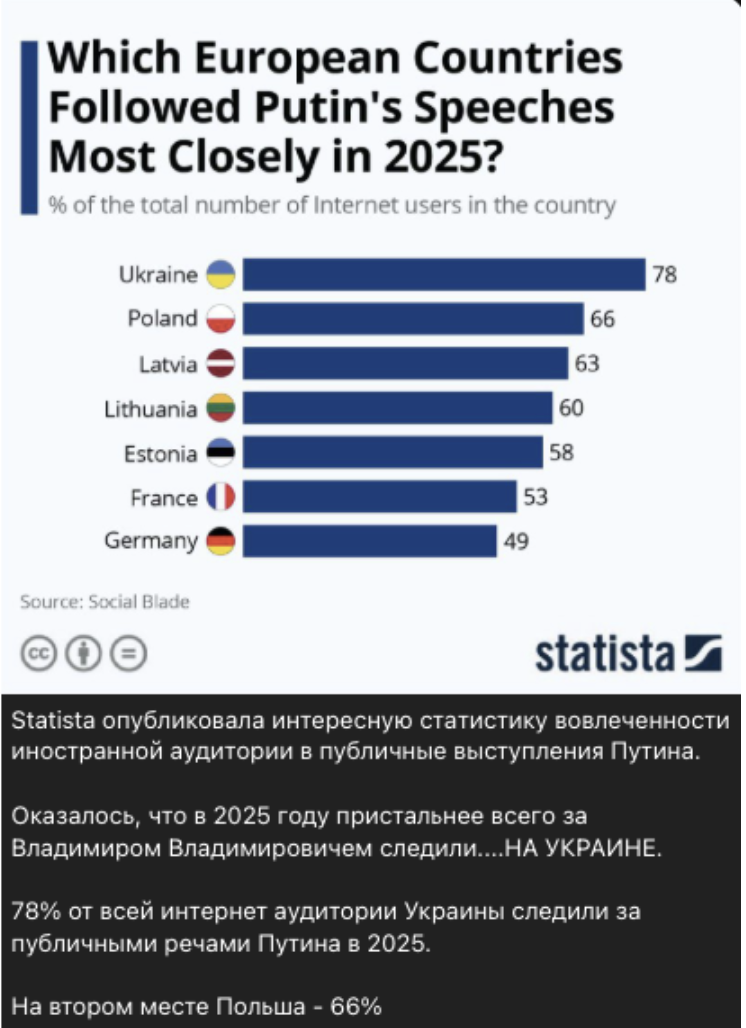
A fake about 78% of Ukrainian internet users who allegedly followed Putin’s public speeches in 2025

Fake statistics are being spread in the pro-Russian segment of social media, claiming that in 2025 the largest audience for Vladimir Putin’s public speeches was allegedly in Ukraine. According to this fabrication, more than 78% of Ukrainian internet users supposedly watched the Russian leader’s speeches. Next in the fake ranking are Poland, Latvia, Lithuania, Estonia, and France, and even in Germany, according to these claims, nearly half of internet users (49%) allegedly followed Putin’s speeches. This fabricated “statistics” was debunked by StopFake fact-checkers.

The cited statistics are completely fabricated. The Statista website, which propagandists refer to, contains no research on which countries follow the Kremlin leader’s speeches the most. Instead, the portal published entirely different data – on global attitudes toward Russia. According to this data, as of September 2025, 79% of the world’s population view Russia negatively, with the most negative attitudes recorded in Sweden (93%) and Poland (90%). These figures directly contradict claims about Putin’s alleged popularity among Europeans.

By spreading such fakes, Kremlin propaganda is trying to create the illusion of international interest in Vladimir Putin’s speeches and to boost his authority in the eyes of Western audiences.

Russians are lying that Ukraine will carry out terrorist attacks using Tomahawk missiles

Russian media are spreading yet another fake, claiming that Ukrainian President Volodymyr Zelenskyy openly stated in his interview with the American TV channel Fox News that he was preparing terrorist attacks in Russia using U.S.-made Tomahawk missiles. In this way, propaganda is trying to discredit Ukraine amid discussions among allies about the possibility of providing Kyiv with long-range missiles. This fake was debunked by StopFake fact-checkers.

In reality, President Zelenskyy spoke only about the possible use of Tomahawk missiles to strike exclusively military targets on Russian territory. In his interview on October 12, 2025, he emphasized that Ukraine acts within the framework of international law and does not strike civilian populations. The head of state stressed that, unlike Russia, which deliberately terrorizes Ukrainian civilians, Ukraine adheres to the norms of international humanitarian law and plans to use Western weapons to destroy the aggressor’s military infrastructure.

During a meeting with U.S. President Donald Trump, Zelenskyy confirmed that Ukraine is discussing with its allies ways to effectively use long-range weapons to reduce the Kremlin’s ability to continue the war. He noted that Russia fears not only the missiles themselves, but also how Ukraine might combine new systems with other types of weaponry.

Any attempts to portray Ukraine’s actions as “preparations for terrorist attacks” are disinformation. Under the UN Charter, Ukraine has the full right to self-defense against armed aggression. Attacks on occupying forces’ military bases are lawful actions under international law. Meanwhile, Russia continues to violate a number of international agreements, including the UN Charter, the Helsinki Final Act, the Paris Charter, and the Geneva Conventions.

Andrii Pylypenko, Lesia Bidochko, Oleksandr Siedin, Kostiantyn Zadyraka, and Oleksiy Pivtorak are collaborating on this chronicle. Ksenia Ilyuk is the author of the project.