
Spilnota Detector Media
Detector Media collects and documents real-time chronicles of the Kremlin propaganda about the Russian invasion. Ukraine for decades has been suffering from Kremlin propaganda. Here we document all narratives, messages, and tactics, which Russia is using from February 17th, 2022. Reminder: the increasing of shelling and fighting by militants happened on the 17th of February 2022 on the territory of Ukraine. Russian propaganda blames Ukraine for these actions

On 18 February, on the 1455th day of the full-scale war, our editorial office recorded:

2732
Fake
816
Manipulation
775
Message
559
Disclosure
Русскій фейк, іді на***!

Photo fake: a serviceman allegedly attacked a man in Kharkiv over an argument about a parking space

On social media and anonymous Telegram channels, a screenshot of a headline from a Ukrainian news outlet is being circulated, claiming that a serviceman of the 92nd Separate Assault Brigade allegedly attacked a man with a knife in Kharkiv during an argument over a parking space. However, this is a photo fake and a manipulation, VoxCheck experts have determined.
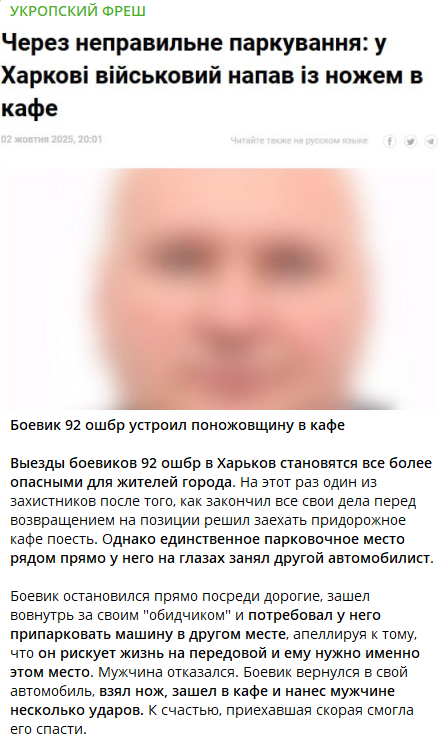
The original news headline was altered by propagandists in order to discredit the Armed Forces of Ukraine.

  1. Edited headline: Using keywords, VoxCheck experts found the original article on the website of the Ukrainian outlet RegioNews, published on 2 October 2025. The incident in Kharkiv did indeed occur, but the original headline and text referred to a “52-year-old man” who committed the attack.
  2. Manipulation: Russian propagandists used photo-editing tools or modified the page code to replace the phrase “52-year-old man” in the headline with “serviceman of the 92nd Separate Assault Brigade”.
  3. No evidence of military involvement: Neither the original RegioNews article nor the report by the Kharkiv Regional National Police contains any mention that the attacker was a member of the Defense Forces or, specifically, of the 92nd Separate Assault Brigade. The perpetrator was not identified as a serviceman.

This photo fake is part of a systematic Russian propaganda campaign aimed at discrediting Ukrainian military personnel. By falsely linking a specific combat brigade (the 92nd Separate Assault Brigade) to a domestic crime, the adversary seeks to sow distrust and division between civilians and the Armed Forces of Ukraine.
Fake: “Odesa underground fighters” allegedly derailed a train carrying Western aid

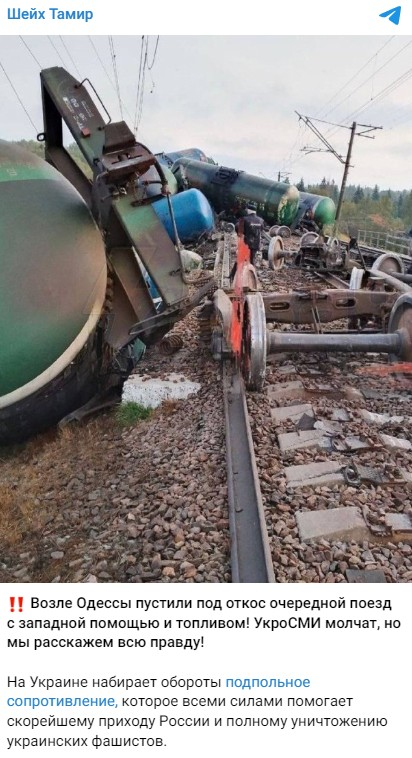
Propagandist Telegram channels are spreading claims that near Odesa, “members of the underground resistance” allegedly carried out sabotage by derailing a train carrying Western military aid and fuel. As “evidence”, these posts include a photo supposedly taken at the scene. This fake was debunked by VoxCheck experts.

In reality, propagandists used a photograph of an accident that occurred on Russian territory.

  1. A reverse image search on Google conducted by VoxCheck experts established that the photo does not show sabotage near Odesa. The original image captures the aftermath of a diesel locomotive and 15 empty tank cars derailing in the Luga district of Russia’s Leningrad region on 14 September 2025.
  2. No confirmation: There are no credible reports or confirmations from Ukrainian authorities, law enforcement agencies, or reputable media about the derailment of a train carrying humanitarian or military aid near Odesa during the specified period.

The spread of such fakes about the alleged activities of an “underground resistance” in Ukraine is part of a persistent Kremlin disinformation campaign. Its aim is to create the illusion of internal division, distrust, and panic among the Ukrainian population, and to form a false impression that a significant portion of Ukrainians support Russia, are waiting for “liberation”, and are assisting it – thereby supposedly legitimizing the war against Ukraine.

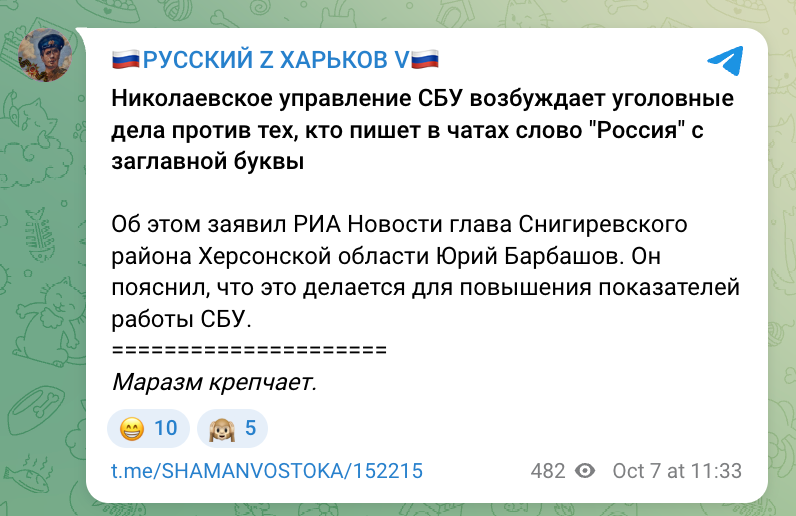
Fake: the Security Service of Ukraine allegedly persecutes people for writing the word “Russia” with a capital letter

Propagandist anonymous Telegram channels, citing Mykolaiv collaborator Yurii Barbashov, are spreading claims that the Mykolaiv regional office of the Security Service of Ukraine (SBU) is allegedly opening criminal cases against citizens who write the word “Russia” with a capital letter in chats or on social media. This fake was debunked by StopFake experts.

However, this is fake. There is no such provision in Ukrainian legislation, and grammatical norms are not grounds for criminal prosecution.

  • No official confirmation: No Ukrainian state body – neither the Security Service of Ukraine, nor the Prosecutor General’s Office, nor the National Police – has made any official statements or published documents confirming the existence of such criminal cases or investigations.
  • No article in the Criminal Code: The Criminal Code of Ukraine does not contain any article that would establish liability for writing the names of countries (or any other words) with a capital or lowercase letter. Criminal cases are initiated only for real crimes – such as treason, collaborationism, justification of aggression, or calls to overthrow the government – not for violations of grammatical rules.
  • Grammar rules are not a crime: The recommendation of the National Commission on State Language Standards to write the name of the aggressor country in lowercase applies to informal, emotionally charged or derogatory texts. Failure to follow this recommendation is not a criminal offense and does not deny standard rules in official documents, where country names are still written with capital letters.
  • The original source of this fake is Yurii Barbashov, who himself is a suspect in a criminal case for collaborationism and aiding the aggressor state and faces 10 to 12 years in prison. His statements are not a credible source.

This fake is aimed at intimidating Russian-speaking residents of Ukraine and spreading distrust toward Ukrainian state and law enforcement institutions, creating a false impression of the supposed absurdity of the Ukrainian “regime”.

Andrii Pylypenko, Lesia Bidochko, Oleksandr Siedin, Kostiantyn Zadyraka, and Oleksiy Pivtorak are collaborating on this chronicle. Ksenia Ilyuk is the author of the project.