The EU Remains Russia’s Largest Trading Partner – A Breakdown of the Manipulation
After the European Union approved its 19th package of sanctions aimed at halting the shadow trade in Russian energy resources, Kremlin media circulated a fake claim that Western restrictions “do not work at all”. In particular, Russian outlets, citing the German newspaper Bild, claimed that “despite the sanctions, the EU is still one of Russia’s largest trading partners”. Analysts from the StopFake project drew attention to this manipulation.
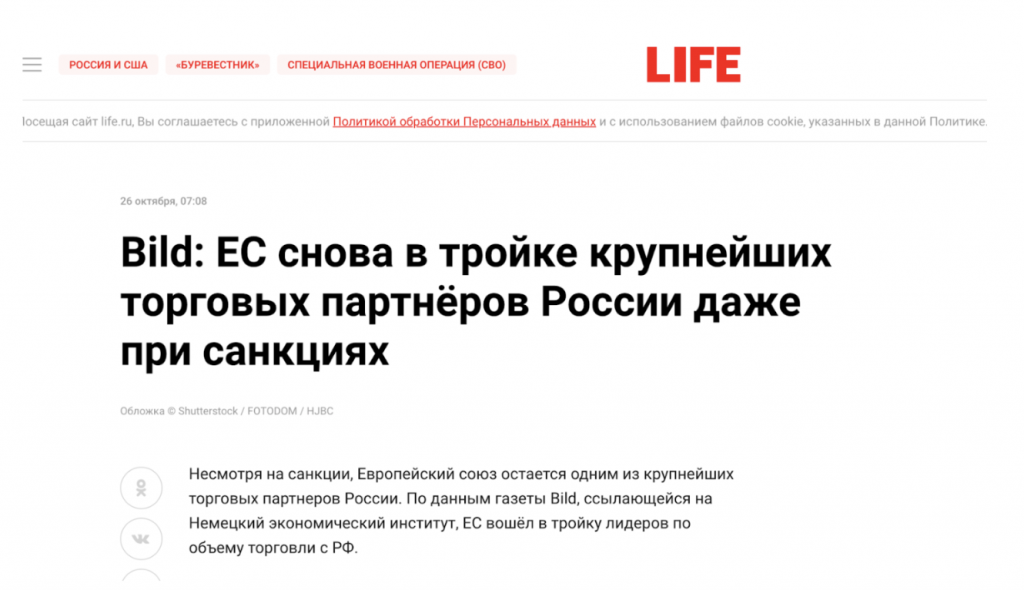
In fact, a study by the German Economic Institute (IW) dated June 13, 2025, which Bild refers to in its October 25 article, emphasizes a drastic reduction in trade between the EU and Russia as a result of sanctions. IW analysts note that trade flows have been redirected toward the Global South, while EU–Russia trade has fallen to a very low level.
Key figures that debunk the propaganda:
- Germany: imports from Russia decreased by 92% compared to 2021.
- Italy: down 83%.
- Belgium: down 67%.
- A sharp decline has also been recorded in Slovakia, the Czech Republic, Spain, and other EU countries.
- The only exception is Hungary, which remains loyal to the Kremlin: since 2022 it has increased purchases of Russian goods by 31%.
The total trade volume of all 27 EU countries with Russia in 2024 amounted to just €67.5 billion, with the majority accounted for by Hungary. For comparison:
- China imported Russian goods worth $130 billion.
- India, which ranked 12th before the war, is now second, with trade increasing by 680% since 2022, mainly due to oil.
IW experts stress that to further undermine the financing of Russia’s war machine, sanctions must target Russia’s shadow fleet, which is increasingly accused of sabotaging Western infrastructure, as well as imports of liquefied natural gas (LNG). Both measures were included in the 19th sanctions package.
What the EU’s 19th sanctions package includes (adopted on October 23, 2025):
- A full ban on imports of Russian LNG (short-term contracts after six months, long-term contracts from January 1, 2027).
- Stricter control over oil trade and the shadow fleet.
- Restrictions on financial operations, including cryptocurrency transactions, for the first time.
- 117 vessels added to the sanctions list, bringing the total number of shadow fleet ships to 557.
- Eight areas covered: energy, finance, diplomacy, accountability for the abduction of Ukrainian children, military measures, trade, services, and sanctions against Belarus’s military-industrial complex.
- Enhanced monitoring of the movement of Russian diplomats within the EU.
More details on all EU restrictions imposed on Russia for its aggression against Ukraine are available in the EU’s information bulletin.
Russian propaganda is lying about the alleged ineffectiveness of EU sanctions.
Russian media cherry-pick a single phrase from Bild (“the EU is among the top three partners”) while ignoring the rest of the conclusion that trade has fallen to a minimum thanks to sanctions. The aim is to convince US and EU governments that sanctions are endless and pointless, so that new packages are blocked and existing ones repealed. The Center for Countering Disinformation under Ukraine’s National Security and Defense Council predicts that in November 2025 Russian propaganda will intensify the narrative that sanctions do not work and Europe is freezing.