

Spilnota Detector Media
Detector Media collects and documents real-time chronicles of the Kremlin propaganda about the Russian invasion. Ukraine for decades has been suffering from Kremlin propaganda. Here we document all narratives, messages, and tactics, which Russia is using from February 17th, 2022. Reminder: the increasing of shelling and fighting by militants happened on the 17th of February 2022 on the territory of Ukraine. Russian propaganda blames Ukraine for these actions

On 19 February, on the 1456th day of the full-scale war, our editorial office recorded:

2732
Fake
816
Manipulation
775
Message
559
Disclosure
Русскій фейк, іді на***!

Fake: The President of Poland allegedly refused Zelenskyy’s proposal to block the Baltic Sea to Russian ships

Pro-Russian media are spreading disinformation claiming that Polish President Karol Nawrocki allegedly “categorically rejected” or “harshly responded” to a proposal by Ukrainian President Volodymyr Zelenskyy to close the Baltic Sea to Russia’s so-called “shadow fleet”. Analysts from StopFake have drawn attention to this.
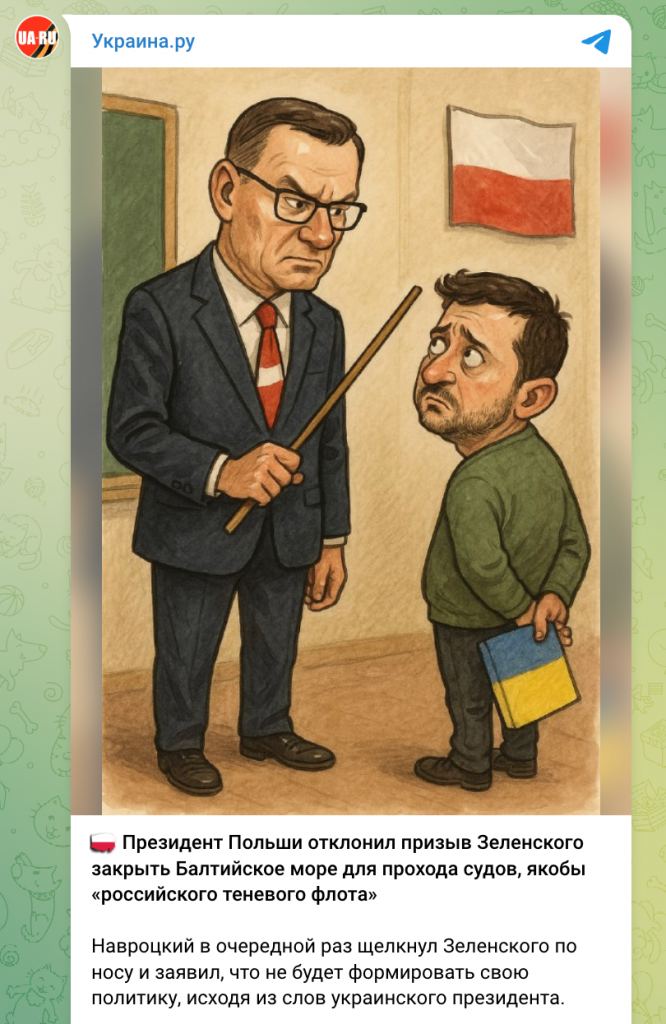
These claims do not reflect reality. Poland has not rejected the idea but has emphasized the need for thorough analysis and consultations with allies.

In an interview with Radio Zet, Karol Nawrocki explained that a decision to restrict shipping in the Baltic Sea cannot be made solely on the basis of an appeal from Kyiv. He stressed the importance of assessments by military experts and coordination with partners. Nawrocki also expressed concern about Russia’s actions in the region, in particular the use of the “shadow fleet” as part of hybrid warfare.

“The Baltic Sea has become an arena of Russia’s hybrid aggression against Poland and other countries. The activities of the ‘shadow fleet’ and the use of vessels for drone operations are alarming,” the Polish president said.

He added: “We are awaiting the conclusions of our military. Decisions of this scale are not made solely on the basis of statements by President Zelenskyy, as they would have serious social and economic consequences”.

The main goal of this disinformation is to drive a wedge between Kyiv and Warsaw, as well as other NATO countries, in order to weaken Western unity. In this case, the claim about Poland’s “refusal” creates the illusion that allies are “abandoning” Ukraine when it seeks help against Russian sabotage in the Baltic (for example, damage to cables and pipelines by the “shadow fleet”). Russia regularly uses such narratives to undermine trust: after Trump’s victory in the United States, similar fakes have been aimed at reducing U.S. assistance to Ukraine by portraying it as an “unreliable ally”. Analysts at the Atlantic Council note that the Kremlin is playing a “long game”, exploiting war fatigue to sow skepticism about supporting Kyiv.
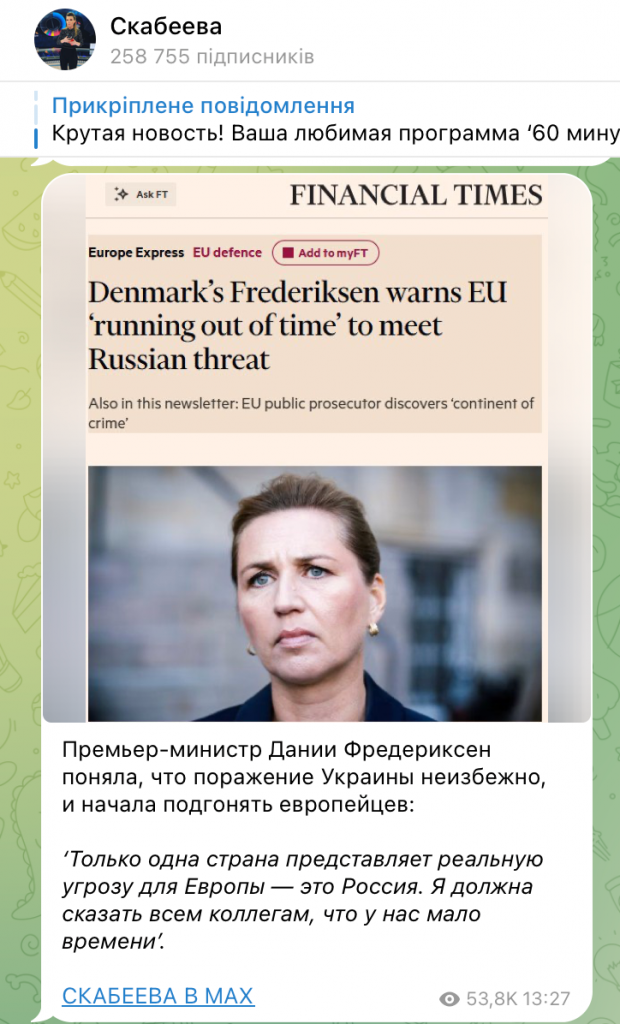
The lie claiming that the Danish prime minister allegedly considers Ukraine’s defeat inevitable has been exposed

Russian propagandist Telegram channels are spreading claims that Danish Prime Minister Mette Frederiksen allegedly said that Ukraine’s defeat is “inevitable”.

Analysts from the StopFake project drew attention to this.

The quote used by Russian sources is partially authentic but distorted. Mette Frederiksen did indeed say: “Only one country poses a real threat to Europe – Russia. I must tell my colleagues that we are running out of time”.

However, the claim about the “inevitable defeat of Ukraine” is a fabrication added by propagandists to the prime minister’s words, as StopFake fact-checkers note.

In reality, Frederiksen called on European leaders to strengthen security on the “eastern flank” and emphasized the need for active support for Ukraine to counter the Russian threat.

The fake claim about an “inevitable defeat”, attributed to the Danish prime minister, is intended to make Ukrainians feel isolated and hopeless. According to the European External Action Service (EEAS), since 2022 Russia has spread thousands of similar fakes to undermine Ukrainians’ morale and divide society. This is especially effective amid war fatigue, when people are more vulnerable to narratives about the West’s “betrayal”.

Russia seeks to create the illusion of a split within the European Union and NATO by portraying European leaders as lacking faith in Ukraine’s victory. This fuels the narrative that the Alliance is weak and incapable of confronting Russia. According to RAND, such campaigns are aimed at eroding trust in democratic institutions, particularly in Eastern European countries where support for Ukraine is critically important. In the context of the Baltic region, where Denmark plays a key role in security, such disinformation can also stoke fears of Russian aggression, for example through the actions of the “shadow fleet”.

Andrii Pylypenko, Lesia Bidochko, Oleksandr Siedin, Kostiantyn Zadyraka, and Oleksiy Pivtorak are collaborating on this chronicle. Ksenia Ilyuk is the author of the project.