Spilnota Detector Media
Detector Media collects and documents real-time chronicles of the Kremlin propaganda about the Russian invasion. Ukraine for decades has been suffering from Kremlin propaganda. Here we document all narratives, messages, and tactics, which Russia is using from February 17th, 2022. Reminder: the increasing of shelling and fighting by militants happened on the 17th of February 2022 on the territory of Ukraine. Russian propaganda blames Ukraine for these actions

On 21 February, on the 1458th day of the full-scale war, our editorial office recorded:

2732
Fake
816
Manipulation
775
Message
559
Disclosure
Русскій фейк, іді на***!

Fake: Ukrainian soldiers in a Polish hospital are allegedly “treated ahead of Poles”

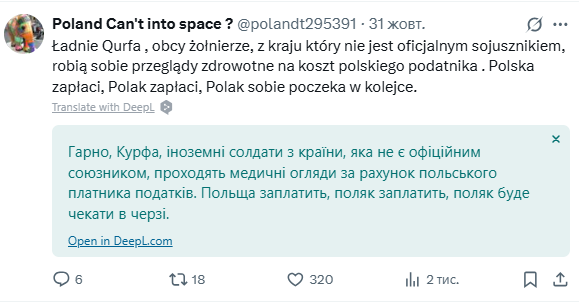
In Polish social media, a video is being widely shared showing a group of Ukrainian soldiers near the district hospital in Stalowa Wola (Poland). This sparked a wave of outrage and speculation: some users and politicians claimed that the soldiers allegedly received medical care ahead of Polish patients, putting an extra burden on the local healthcare system. However, as Polish fact-checkers from Demagog found, this is a manipulation.
https://x.com/coolfonpl/status/1984156174229410078?ref_src=twsrc%5Etfw%7Ctwcamp%5Etweetembed%7Ctwterm%5E1984156174229410078%7Ctwgr%5Eb387ec04c10e615773e6517d174512e60a088517%7Ctwcon%5Es1_&ref_url=https%3A%2F%2Fdisinfo.detector.media%2Fday%2F06-11-2025

Social media users claimed that these men were “burdening” the Polish healthcare system or were being treated out of turn, forcing Poles to wait in queues. The topic was picked up by some Polish politicians, including Włodzimierz Skalik of the Confederation of the Polish Crown and Konrad Berkowicz from the New Hope party. Berkowicz, for example, stated: “Ukrainians are being hospitalized in our hospitals at the expense of Poles who are standing in queues. The case of Stalowa Wola is not an isolated incident; it is a symptom of a country that puts foreign interests above principles. We are not masters in Poland. We are giving up territory to foreigners in our own country”.

Such claims quickly gained traction, but they are based on assumptions rather than facts and resemble Russian narratives aimed at polarizing society.

Official responses

Poland’s Ministry of National Defence (MON) and the head of Stalowa Wola county, Janusz Zarzeczny, quickly responded to the rumors. In a statement posted on X on November 3, 2025, MON emphasized that there are no laws or regulations in Poland that give Ukrainian soldiers priority in medical care over Polish patients: “There are no legal provisions in Poland that guarantee medical treatment in hospitals for Ukrainian soldiers instead of Polish patients. This attempt at manipulation fits the Russian narrative aimed at stirring negative emotions and polarizing Polish and Western society,” the official statement said.

According to Janusz Zarzeczny in an interview with Wirtualna Polska, the soldiers were undergoing scheduled screening tests as part of training at a nearby training ground in Lipy. These procedures were not financed by the National Health Fund (NFZ) but were provided on a commercial basis, with the costs covered by the Ministry of National Defence. “These are invoices amounting to hundreds of thousands of zlotys. This is additional income for the hospital,” Zarzeczny explained.

The hospital does not serve only Ukrainian soldiers. In a specially separated part of the building, similar tests are carried out for soldiers from Slovakia, Norway, and France who are also training in the region. This is standard practice for foreign units and does not affect queues for local residents.

The level of health insurance contributions and the cost of treatment for Ukrainians in Poland

In the context of the debate on Ukrainians’ access to Poland’s healthcare system, it is worth noting that according to available data, in 2024 the treatment of people from Ukraine cost 2.24 billion zlotys, compared to 1.95 billion zlotys the year before. Revenue from health insurance contributions paid by Ukrainian citizens to the National Health Fund (NFZ) amounted to 3.8 billion zlotys and 3.1 billion zlotys in those years, respectively.

This means that health insurance contributions paid by Ukrainians exceed the costs of their medical treatment in Poland. In 2024, the surplus amounted to 1.56 billion zlotys, and in 2023 to 1.15 billion zlotys.

This story is a typical fake that exploits emotions and national prejudices. A video taken out of context is easy to misinterpret, while politicians and bots on social media amplify it for their own purposes. MON directly points to links with Russian narratives that seek to sow discord between Poland and Ukraine.
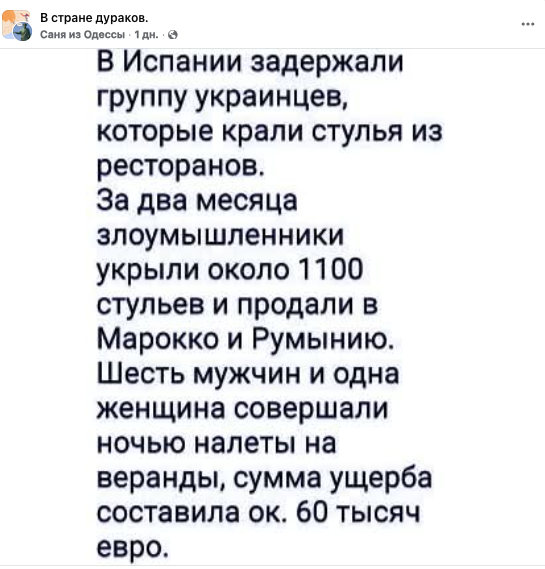
Fake: A gang of Ukrainians in Spain allegedly stole chairs from restaurants

In the pro-Russian segment of the internet, a story is being circulated claiming that a group of Ukrainians was allegedly detained in Spain for attacking restaurants at night, stealing chairs, and selling them. Propagandists present this absurd incident as “proof” that Ukrainian citizens abroad bring only harm to society. This fake was debunked by experts from StopFake.

However, this publication is yet another fabrication by Russian propaganda. While the story about a gang itself is real, no reputable media outlet mentions the nationality of the perpetrators. Spanish police did indeed report that six men and one woman were detained in Madrid as members of a criminal group that, in August and September 2025, stole more than a thousand chairs from 18 restaurants in Madrid and the town of Talavera de la Reina. It is known that the stolen goods were resold in Spain, Romania, and Morocco. In other words, the police made no mention whatsoever of any connection between the gang and Ukraine.

Russian propaganda has repeatedly used real criminal or controversial incidents, inserting Ukrainians into them in order to discredit Ukrainian citizens. For the same purpose, propaganda also spreads entirely fabricated stories.

Earlier, Detector Media debunked a made-up story about the alleged detention of “Ukrainian terrorists” in Jerusalem.

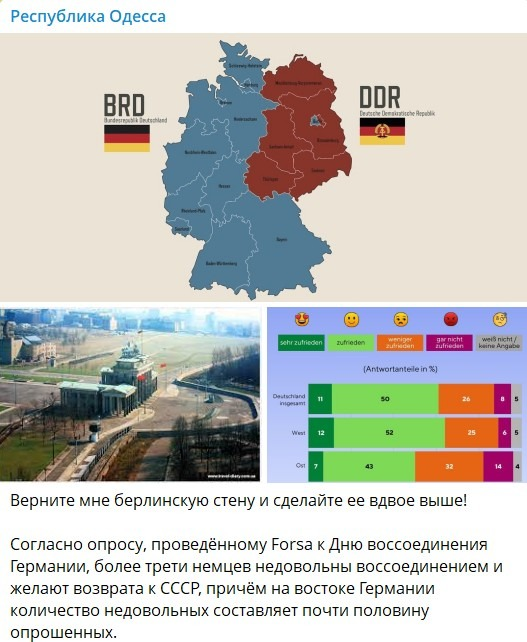
More than a third of surveyed Germans allegedly dream of returning to the USSR – debunking the manipulation

Pro-Russian Telegram channels are actively spreading claims about the alleged results of a sociological survey conducted by the German institute Forsa ahead of German Unity Day. According to these claims, more than a third of Germans are supposedly dissatisfied with the country’s reunification and want the Soviet Union to be restored. However, this is a distortion of the facts.

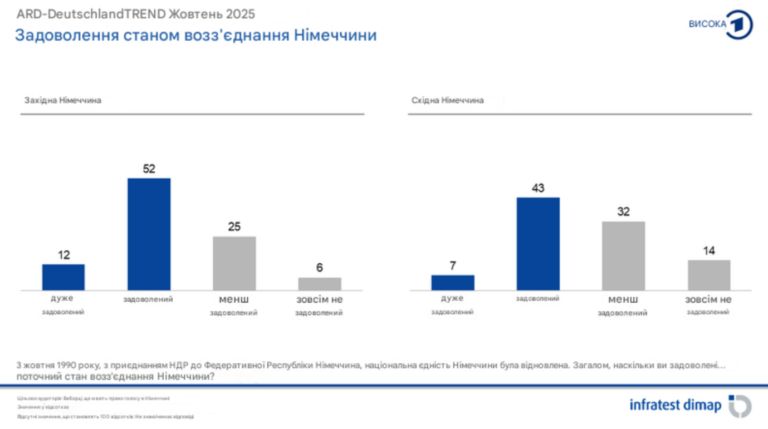
In reality, the published figures were taken from a different survey conducted by Infratest dimap. The Forsa Institute also studied this topic, but none of its polls mentioned any desire to return to the USSR. This manipulation was debunked by experts from VoxCheck.

German Unity Day is a public holiday that commemorates the accession of the German Democratic Republic to the Federal Republic of Germany in 1990. It is celebrated annually on October 3.

The screenshot showing the poll results contains a watermark from the Telegram channel “Satellit”, which is run in German. This channel often produces its own graphic materials based on data from various research organizations. On October 4, the “Satellit” channel did indeed publish an infographic claiming that every third German is dissatisfied with the country’s reunification after the collapse of the “Eastern Bloc”. However, this graphic is not based on a survey by Forsa, but on data from another company, Infratest dimap.

According to the results, out of 1,306 respondents, 64% expressed a high or moderate level of satisfaction with reunification, while 31% said they were less satisfied or not satisfied at all. Importantly, respondents were not asked whether they wanted a return to the Soviet Union.

In addition, on October 2, “Satellit” published material about a similar survey by Forsa dedicated to the 35th anniversary of German reunification. In that poll, respondents were asked whether they believe that the populations of East and West Germany have already merged into a single nation. Of the 1,004 people surveyed, 35% said that East and West have largely become one nation, while 61% noted that factors of division still prevail.

Thus, this study also concerned an assessment of the degree of integration between East and West over the years, rather than support for reunification or any desire to return to the USSR. This is precisely the core of the manipulation spread by pro-Russian Telegram channels.

Andrii Pylypenko, Lesia Bidochko, Oleksandr Siedin, Kostiantyn Zadyraka, and Oleksiy Pivtorak are collaborating on this chronicle. Ksenia Ilyuk is the author of the project.