

Spilnota Detector Media
Detector Media collects and documents real-time chronicles of the Kremlin propaganda about the Russian invasion. Ukraine for decades has been suffering from Kremlin propaganda. Here we document all narratives, messages, and tactics, which Russia is using from February 17th, 2022. Reminder: the increasing of shelling and fighting by militants happened on the 17th of February 2022 on the territory of Ukraine. Russian propaganda blames Ukraine for these actions

On 24 June, on the 1581th day of the full-scale war, our editorial office recorded:

2742
Fake
826
Manipulation
776
Message
559
Disclosure
Русскій фейк, іді на***!

Propagandists fabricated a fake claim about a “ban on evacuation” from Kostiantynivka

Pro-Kremlin media outlets are spreading yet another piece of disinformation, claiming that Ukraine’s Defense Forces are allegedly preventing civilians in the city of Kostiantynivka, Donetsk region, from leaving and are “threatening them with physical violence”. These claims are false and are intended to discredit the Armed Forces of Ukraine.

This was reported by StopFake.

Russian forces have significantly intensified combat operations in the Kostiantynivka sector. Due to continuous shelling, the city remains without electricity, and repair crews are unable to restore power networks because of ongoing attacks. Since June 2025, public transport in Kostiantynivka has been suspended, and on 22 August 2025 the city completely lost its gas supply after a gas distribution station was damaged.

According to local authorities, approximately 80% of the city’s infrastructure has been destroyed. The delivery of food, medicines, and humanitarian aid is severely disrupted, as Russian forces regularly target volunteers and members of the Defense Forces with FPV drones. According to the National Police of Ukraine, the occupiers carry out around 20 airstrikes on the city every day.

Despite the critical situation, evacuation from Kostiantynivka continues. Voluntary evacuation began immediately after the start of the full-scale invasion, while mandatory evacuation has been in effect since July 2022. As of November 2025, around 4,500 residents remain in the city, compared to nearly 77,000 before the war.

The evacuation process is carried out through cooperation between Ukrainian military personnel, volunteers, human rights defenders, and international organizations, and is conducted openly and transparently. Ukraine remains fully accessible to journalists and human rights organizations, enabling them to document Russia’s war crimes in real time. For example, The New York Times has described Kostiantynivka as one of the key areas of the Russian offensive, where drones track virtually every military movement and the evacuation of civilians has become an extremely complex operation.
Author: Admin,

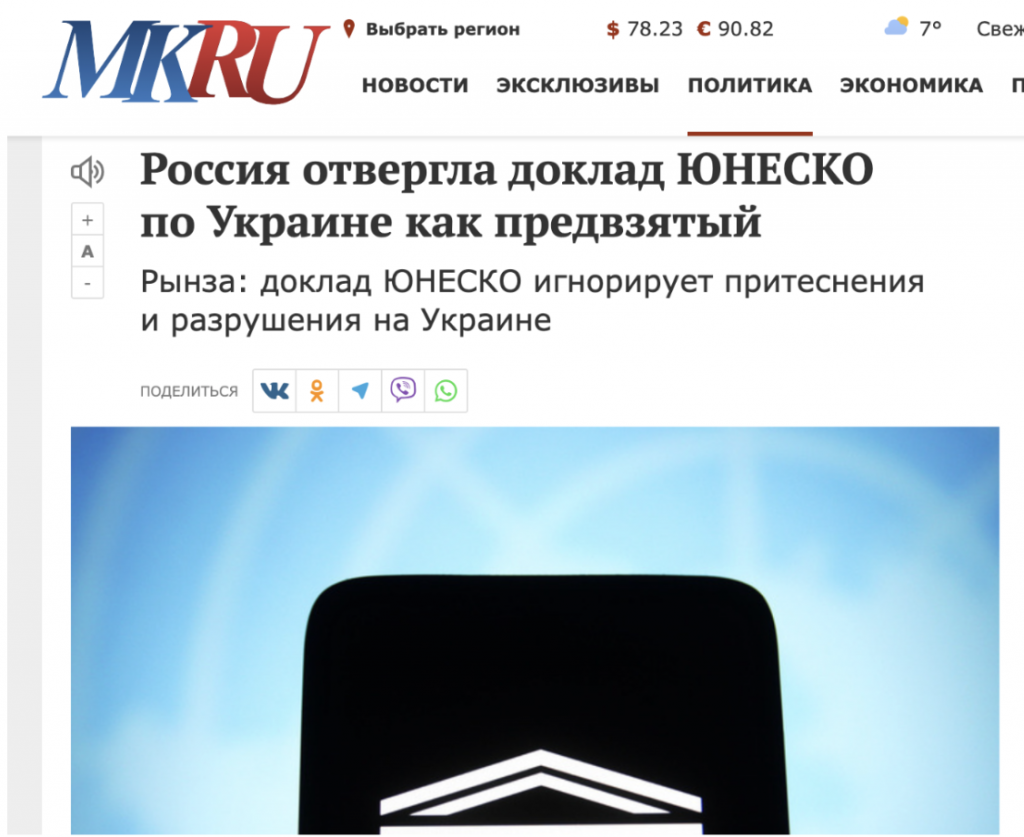
Fake claim about UNESCO’s alleged “indifference” to the destruction of Ukrainian cultural heritage

Russian media outlets are spreading claims that UNESCO is allegedly “ignoring” or “overlooking” the destruction of cultural and historical monuments in Ukraine. In particular, they claim that the organization is not taking “sufficient steps” to protect cultural heritage. The disinformation was highlighted by StopFake.

Screenshot Mk.ru 

In reality, the situation looks very different from the way propaganda attempts to portray it. UNESCO has been working directly in Ukraine for a long time, documenting the consequences of Russian aggression and collecting evidence of the destruction of cultural sites. International experts regularly travel to different regions, inspect damaged monuments, cooperate with Ukrainian institutions, and prepare official reports.

As of 26 November 2025, UNESCO experts had officially verified 512 cases of damage to or destruction of cultural heritage sites. These findings are based on a comprehensive verification process that includes satellite imagery analysis, on-site inspections, and cooperation with local historians. The documented damage includes 152 religious sites of various denominations, 268 historic and artistic buildings, 37 museums, 33 monuments, 18 libraries, 3 archaeological sites, and 1 archive. The precision of these figures undermines the claim that the organization has been “inactive”.

At the same time, Ukrainian state authorities provide a much broader picture of the destruction, as they have access to operational data from local communities, military administrations, and municipal authorities. According to their estimates, since the beginning of the full-scale invasion, 1,599 cultural heritage sites and 2,415 cultural infrastructure facilities have been affected. These include not only architectural monuments but also cultural centers, community arts venues, and artistic institutions. In addition, the destruction of 4,358 educational institutions has been documented, including 400 that have been completely destroyed – schools, universities, colleges, and kindergartens. This demonstrates the scale of the systematic destruction that Russia is inflicting on Ukraine’s educational and cultural sectors.

Importantly, some of the damaged sites are included on UNESCO’s World Heritage List. Among them are the historic centers of Odesa and Lviv, as well as Saint Sophia Cathedral in Kyiv.

Experts also note the growing number of journalists killed by Russia while covering its armed aggression. According to UNESCO, 116 journalists have been killed since the start of the full-scale invasion by the terrorist state, including 18 while carrying out their professional duties.

StopFake emphasizes that claims suggesting UNESCO is ignoring the situation are outright disinformation. All of the figures cited are based on the work of international missions and official statistics from Ukrainian authorities. Therefore, assertions about UNESCO’s alleged “silence” or “inaction” are an attempt to downplay the scale of the destruction and divert the international community’s attention from Russia’s crimes against Ukraine’s cultural heritage.

Wave of anti-Ukrainian disinformation in Poland about “contaminated food from Ukraine”

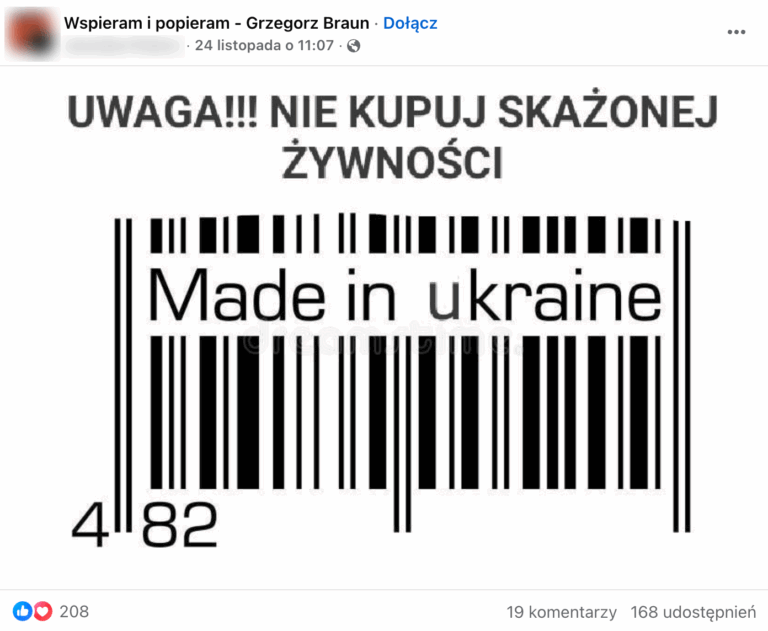
A new wave of anti-Ukrainian disinformation has emerged in Poland. In particular, posts circulating on Facebook claim that all Ukrainian food is supposedly “contaminated” and should therefore be avoided. The authors of these messages also call for a boycott of Ukrainian products. Behind these posts lies a persistent narrative that goods from Ukraine are allegedly “unsafe”.

РИС 14

Facebook post screenshot. Source: Demagog,  

However, as explained by the Center for Countering Disinformation and experts from the fact-checking platform Demagog, this is a fake. The first two or three digits of a barcode identify the country or economic region in which the manufacturer is registered. Therefore, the number does not indicate the product’s place of origin. The 482 barcode prefix simply means that the product is registered in Ukraine and does not in itself signify any “danger” or “contamination”. Under Poland’s legislation on the commercial quality of agricultural and food products, imported goods are subject to sanitary inspections and must meet specific requirements.

Analysts also point out that such fakes are often based on isolated incidents in which particular batches of food products (not necessarily from Ukraine) failed quality inspections. Propagandists then generalize these cases to create the false impression that all Ukrainian products are harmful.

The disinformation campaign in Polish social media surrounding the “482 code” is part of a broader anti-Ukrainian effort aimed at undermining trust between Ukrainians and Poles and influencing political decisions by the Polish authorities regarding support for Ukraine.

Marianna Prysiazhniuk, Andrii Pylypenko, Kostiantyn Zadyraka, and Oleksiy Pivtorak are collaborating on this chronicle. Ksenia Ilyuk is the author of the project.