

Spilnota Detector Media
Detector Media collects and documents real-time chronicles of the Kremlin propaganda about the Russian invasion. Ukraine for decades has been suffering from Kremlin propaganda. Here we document all narratives, messages, and tactics, which Russia is using from February 17th, 2022. Reminder: the increasing of shelling and fighting by militants happened on the 17th of February 2022 on the territory of Ukraine. Russian propaganda blames Ukraine for these actions

On 23 June, on the 1580th day of the full-scale war, our editorial office recorded:

2742
Fake
826
Manipulation
776
Message
559
Disclosure
Русскій фейк, іді на***!

Fake claim: A Ukrainian serviceman in Chernivtsi allegedly assaulted a pensioner for speaking Russian

The Center for Countering Disinformation (CCD) reported that Russian propagandists had spread false information about an incident in Chernivtsi, claiming that a Ukrainian serviceman shot a pensioner in the leg and brutally assaulted him for speaking Russian.

As “evidence”, the propagandists used an altered screenshot of a headline from a Ukrainian media outlet that had been manipulated using photo-editing software.
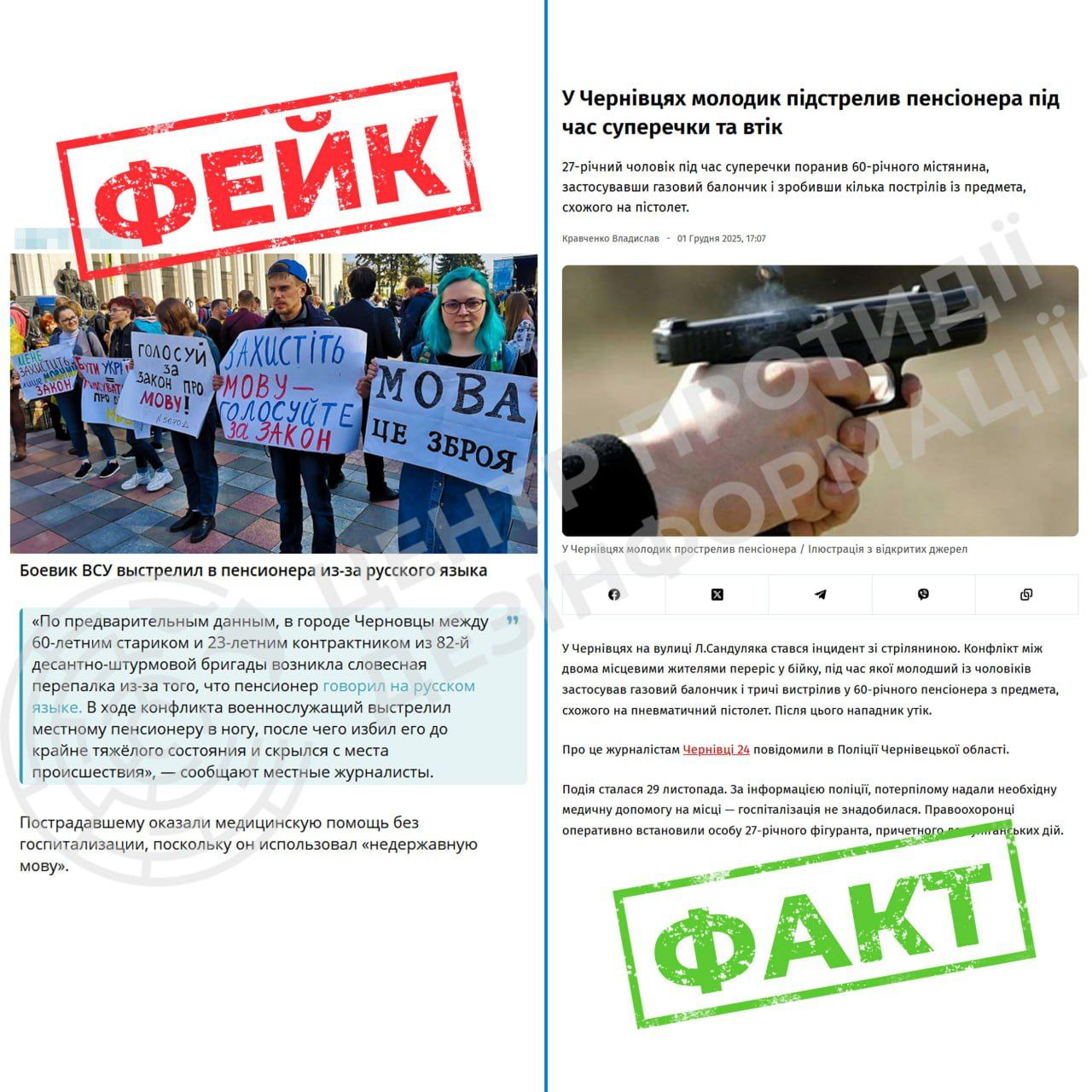
Collage of screenshots source

In reality, the incident in Chernivtsi was a domestic dispute: one of the participants injured the other with an air pistol, no one sustained serious injuries, and no connection to language use or involvement of a serviceman was established.

“Creating such fakes by altering headlines and distorting the content of real news stories is a typical tactic of Russian propaganda. The enemy uses these disinformation injections to discredit military personnel in the eyes of Ukrainian society and to provoke division between soldiers and civilians”, the statement says.

Fake stories involving language-related or everyday conflicts are designed to create the impression of tensions within Ukrainian society, where “citizens are against the army” and “Russian speakers are against Ukrainian speakers”. This is strategically beneficial for Russia: Ukraine’s internal cohesion is weakened, distrust in the military and the authorities increases, and support for mobilization and national defense becomes more difficult.

Such disinformation campaigns are often accompanied by forged screenshots, altered headlines, or images imitating reputable media outlets. This creates the effect of “legitimizing the fake”, as audiences see apparent “evidence” and are unable to immediately distinguish it from genuine news. In hybrid warfare, this is a method of creating “information events” that are perceived as facts.
Author: Admin,

Ukraine will seal all wells and tax them: Russian propaganda spreads the myth of “water meters for villagers”

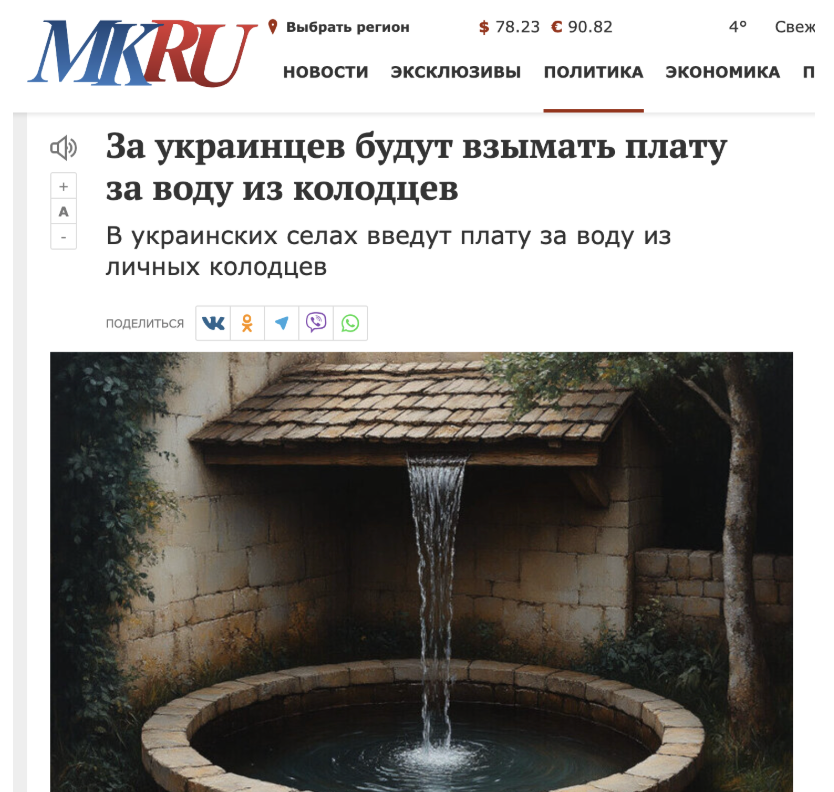
Russian propaganda channels have circulated false claims that the Ukrainian authorities plan to “seal” all water sources in the country and require citizens to pay for water from their own wells. Analysts from StopFake drew attention to this claim.

According to the propaganda narrative, residents of villages and district centers will be required to install water meters on their wells, while exceeding a supposedly “free” monthly limit of 2 cubic meters would allegedly result in charges at an unspecified tariff.

Screenshot Mk.ru  

This information is false. Fact-checkers note that the narrative is aimed at undermining public trust in Ukraine’s European integration process. The fake completely distorts the content of Draft Law No. 13578, which was adopted by the Verkhovna Rada in its first reading in November 2025.

The purpose of the draft law is to align legislation in the field of centralized water supply and wastewater management with EU Directives. The document contains no references whatsoever to the “sealing” of private water sources. Instead, it provides for:

  • monitoring water quality from source to consumer based on a risk-oriented approach; 
  • assessing the technical condition of water supply and wastewater systems; 
  • transparent rules for connection to networks and the definition of “non-centralized wastewater management”; 
  • the possibility of temporary derogations from quality standards only where public health is not endangered. 

The document is aimed at modernizing water infrastructure, improving drinking water quality, and enhancing public utility services in line with EU standards. The false claims about the “sealing of wells” have no factual basis and represent a classic example of a Russian disinformation campaign.

The fake specifically targets villagers and residents of small towns – people who own private wells or rely on independent water sources. Its purpose is to fuel perceptions of social injustice and provoke tensions between citizens and local authorities.

By portraying the modernization of water supply systems as “restrictions” and “oppression”, Russian propagandists seek to create the impression that any reforms involving standardization, environmental safety, or quality control amount to the imposition of “foreign rules”. This serves the broader goal of discrediting reforms in general.

Marianna Prysiazhniuk, Andrii Pylypenko, Kostiantyn Zadyraka, and Oleksiy Pivtorak are collaborating on this chronicle. Ksenia Ilyuk is the author of the project.