Spilnota Detector Media
Detector Media collects and documents real-time chronicles of the Kremlin propaganda about the Russian invasion. Ukraine for decades has been suffering from Kremlin propaganda. Here we document all narratives, messages, and tactics, which Russia is using from February 17th, 2022. Reminder: the increasing of shelling and fighting by militants happened on the 17th of February 2022 on the territory of Ukraine. Russian propaganda blames Ukraine for these actions

On 23 June, on the 1580th day of the full-scale war, our editorial office recorded:

2742
Fake
826
Manipulation
776
Message
559
Disclosure
Русскій фейк, іді на***!

Fake claim: Mobilized Ukrainians are committing suicide on the front line because of military recruitment centers (TCCs)

A video allegedly branded as coming from “Ukraine Now” – Ukraine’s official brand approved by the Cabinet of Ministers in 2018 – has been circulating online. It claims that mobilized Ukrainians are supposedly committing suicide due to intimidation by Territorial Recruitment and Social Support Centers (TCCs): allegedly, they are threatened with reprisals against their relatives if they are captured by Russian forces. The case was reported by VoxCheck.
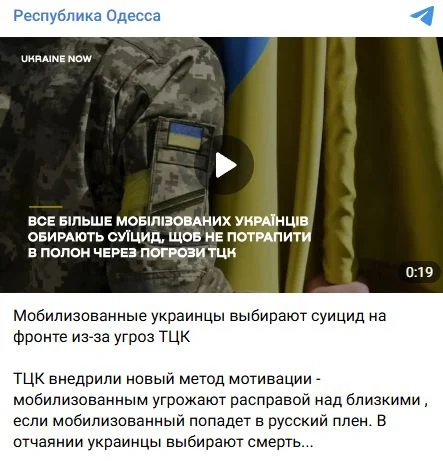
Screenshot of the post

However, this is a fake. “Ukraine Now” did not publish such a video, and no reputable media outlet or human rights organization has confirmed any such cases.

The video displays the “Ukraine Now” branding approved in 2018. However, there are no materials on the brand’s official website or social media accounts about mobilized Ukrainians committing suicide because of threats from TCCs. The fake is also exposed by a number of inconsistencies: the initiative’s original videos use a completely different design, branding, and font, while all communication is conducted in English. This is another indication that the video was fabricated.

A keyword search produced no corroborating evidence. Neither Ukrainian nor foreign media outlets, nor human rights organizations, have reported any information about such suicides.
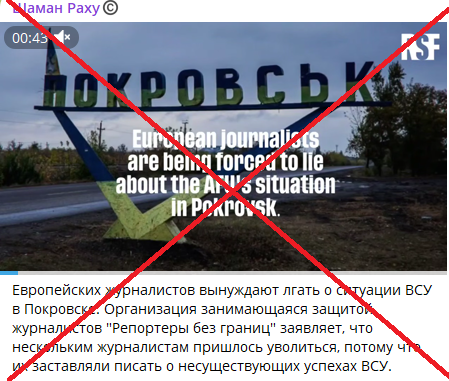
Fake claim: European journalists are being forced to lie about the situation of the Ukrainian Armed Forces in Pokrovsk

In early November, Russian propaganda Telegram channels circulated a video falsely presented as a publication by the organization Reporters Without Borders (RSF). The video claimed that European journalists were being forced to “lie” about the situation on the front line in Pokrovsk by portraying “fabricated successes” of Ukraine’s Armed Forces. This fake was debunked by the VoxCheck team.

Propagandist Telegram channel screenshot 

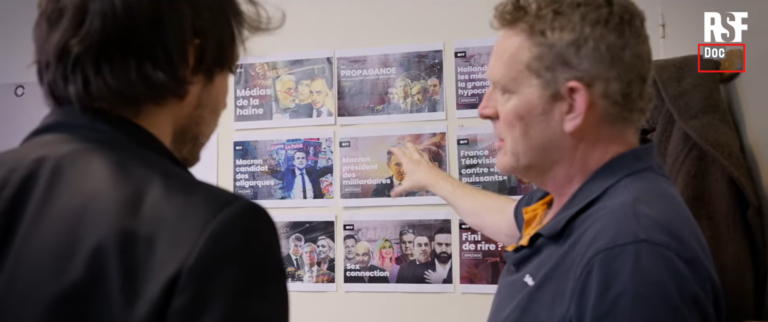
In reality, RSF did not publish any such video: there are no records or posts with this content on the organization’s official website or social media accounts. Analysis of the video shows that its structure, style, and editing do not correspond to genuine RSF materials. Authentic videos produced by the organization usually contain real footage from the scene or interviews and feature a clear title for the material (for example, “Documentary”), whereas the fake consists only of a collection of photos and statements without context.

Screenshot from the actual RSF video

The video also mentions allegedly “three European journalists” who supposedly refused to “lie about the situation near Pokrovsk” and therefore allegedly resigned from their newsrooms. However, this story is entirely unsupported by evidence. The video does not name a single individual, does not identify any specific media outlet, and does not even mention the country these journalists supposedly came from. Normally, journalists’ resignations – especially those related to ethical conflicts – leave a noticeable digital footprint: they are reported by local or professional media, while statements, comments, or at least hints of the conflict appear on social media.

In this case, however, there is no confirmation whatsoever in the information space. Neither European media outlets, nor reporters, nor media organizations have reported any such incidents. VoxCheck’s investigation likewise found no references in open sources – something that would be virtually impossible if a “mass” or even publicly known resignation of journalists had actually taken place.

Fact-checkers investigated waves of Russian propaganda aimed at undermining relations between Ukraine and Poland

The Kremlin’s strategic objective is to implement a classic “divide and rule” approach by driving a wedge between Poles and Ukrainians and preventing the emergence of an effective Polish-Ukrainian alliance as a partnership of regional leaders. Analysts at StopFake examined the methods used by Russian propagandists to undermine cooperation between Ukraine and Poland.

According to StopFake, the Ukrainian-Polish partnership poses a direct threat to Russia’s imperial ambitions of subjugating Ukraine and expanding its influence in Central and Eastern Europe, a region Moscow continues to view as its “buffer zone”.

In the Ukrainian information space, relations with Poland have gone through several emotionally charged “information waves”. The positive wave of genuine Polish support following Russia’s full-scale invasion was later replaced by negative narratives surrounding Polish farmers’ blockade of Ukrainian grain transit and the use of the Volyn issue in Polish political debates. Currently, a fourth wave of negative messaging dominates the discourse, fueled by incidents involving falling drones and acts of railway sabotage. Russian propaganda, primarily disseminated through Telegram, actively employs tactics such as denying established facts, shifting blame onto Ukraine by accusing it of provocations aimed at “dragging NATO into the war”, and manipulating the Alliance’s cautious public statements.

In the Polish information space, Russia has only intensified the influence operations it has been conducting since 2022 to weaken the strategic partnership between the two countries. Anti-Ukrainian propaganda has largely migrated to social media and new media platforms, where posts on X achieve the widest reach. These campaigns rely both on historical stereotypes portraying Ukrainians as “Banderites” and on memories of the Volyn tragedy, while also promoting new narratives designed to exploit public anxieties. Among them are claims about the “Ukrainianisation of Poland”, alleged “privileges for Ukrainians”, accusations of Ukrainian “ingratitude”, and arguments that “this is not our war”. Such narratives are often amplified by Eurosceptic politicians and pro-Russian public figures.

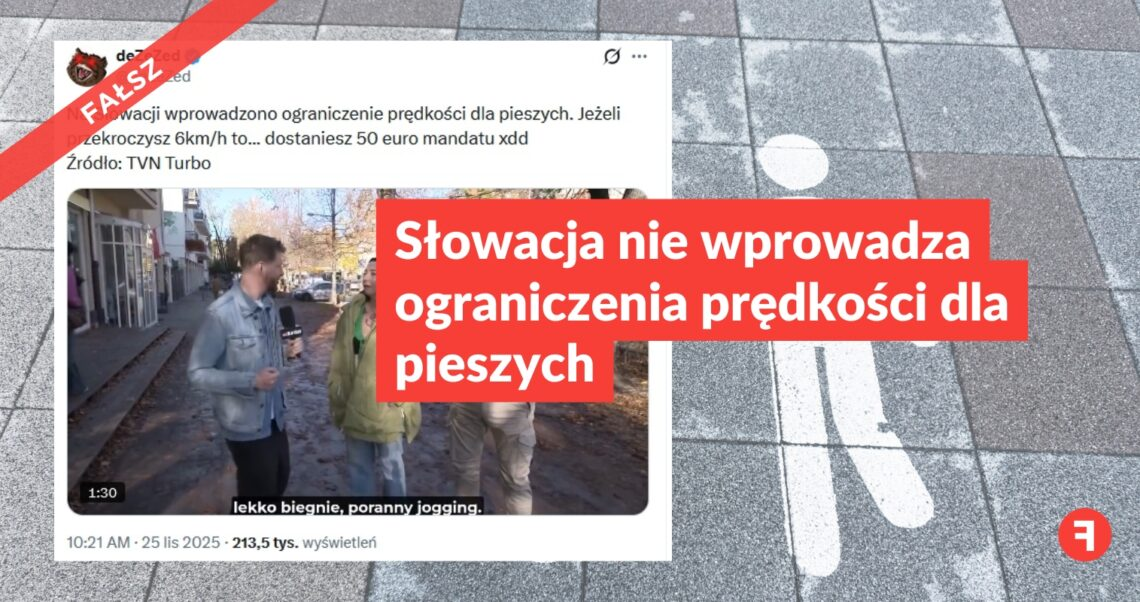
Polish media spread misleading reports about speed limits for pedestrians in Slovakia

Fact-checkers from FakeNews.pl debunked inaccurate claims that had spread in Polish media about Slovakia allegedly introducing fines for pedestrians exceeding speed limits.

Source: FakeNews.pl

The fact-checkers explained that the misinformation stemmed from a misinterpretation of amendments to Slovakia’s Road Traffic Act that came into force on 28 October 2025.

The amendment does indeed define “walking speed” as “a speed not exceeding 6 km/h”. However, this definition was introduced not to regulate pedestrians, but to establish speed limits for other road users travelling on sidewalks, such as people using roller skates or scooters.

Marianna Prysiazhniuk, Andrii Pylypenko, Kostiantyn Zadyraka, and Oleksiy Pivtorak are collaborating on this chronicle. Ksenia Ilyuk is the author of the project.