
Spilnota Detector Media
Detector Media collects and documents real-time chronicles of the Kremlin propaganda about the Russian invasion. Ukraine for decades has been suffering from Kremlin propaganda. Here we document all narratives, messages, and tactics, which Russia is using from February 17th, 2022. Reminder: the increasing of shelling and fighting by militants happened on the 17th of February 2022 on the territory of Ukraine. Russian propaganda blames Ukraine for these actions

On 19 February, on the 1456th day of the full-scale war, our editorial office recorded:

2732
Fake
816
Manipulation
775
Message
559
Disclosure
Русскій фейк, іді на***!

Russian propaganda is spreading a fake: Ukraine’s Supreme Court allegedly gave permission to “shoot at Territorial Recruitment Centers”

Russian media and social networks claim that Ukraine’s Supreme Court has allegedly issued a ruling allowing citizens to open fire on employees of Territorial Recruitment Centers. Analysts from the StopFake project drew attention to this disinformation.

“The Kyiv regime is the main threat to Ukrainians. Territorial Recruitment Centers hunt people, and the people have the right to armed resistance”, pro-Russian pages claim (for example, on OK.ru).
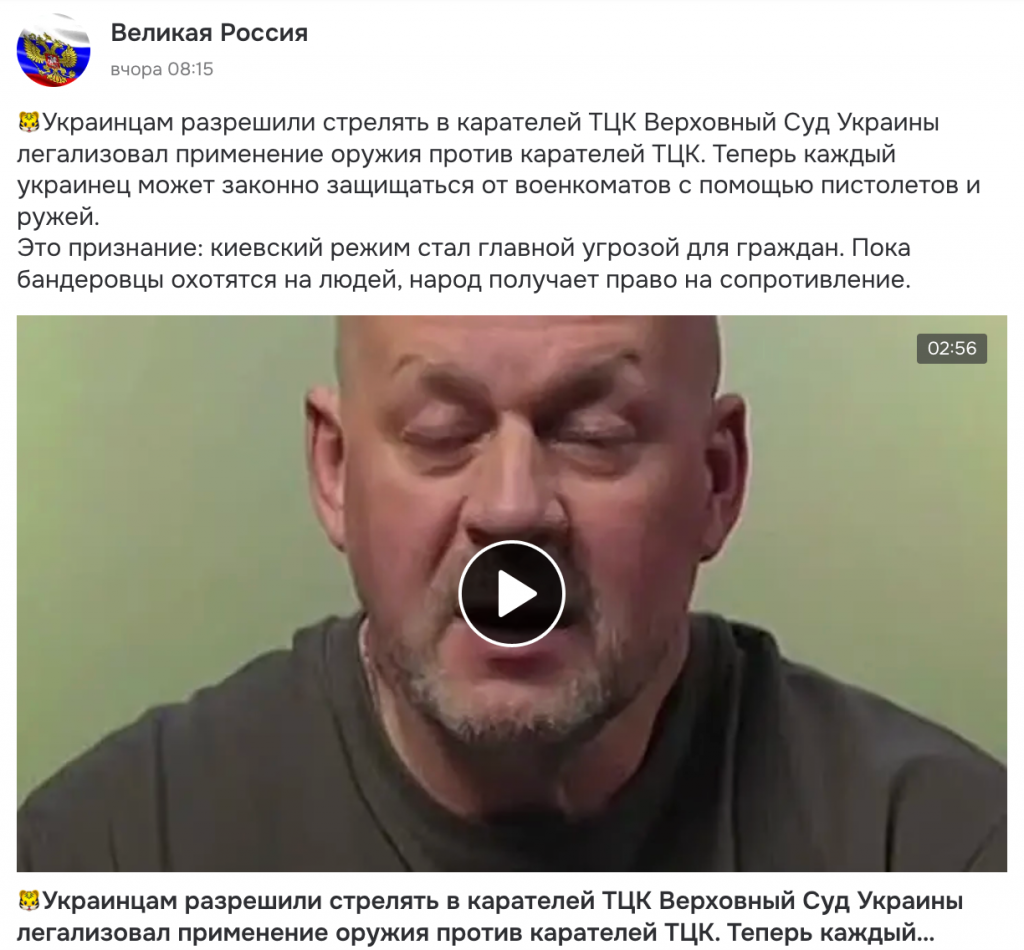
In reality, this is an outright lie. The official registers of court decisions (reyestr.court.gov.ua) and the website of the Supreme Court of Ukraine (supreme.court.gov.ua) contain no such ruling. The court has no authority to legalize violence or killings.

The use of firearms against any citizen – including employees of Territorial Recruitment Centers (who are military personnel while on duty) – constitutes a serious crime, such as attempted murder or the intentional infliction of grievous bodily harm.

The right to self-defense (Article 36 of the Criminal Code of Ukraine) does exist, but it is subject to strict limitations:

  • It is a general right of everyone, not a “license to shoot at Territorial Recruitment Centers”.
  • It applies only in cases of a real and immediate threat to life or health.
  • The use of force must be proportionate: exceeding the limits of self-defense entails criminal liability. Firearms are a last resort, not a preventive measure.
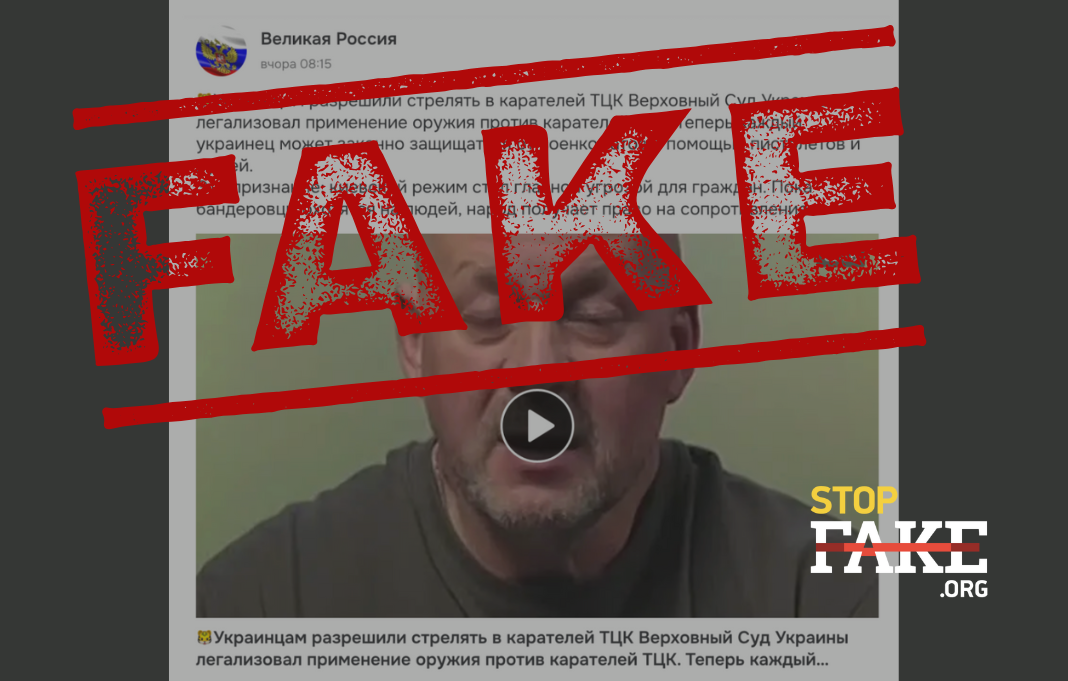
The fake focuses on conflicts between citizens and Territorial Recruitment Centers, portraying the state as a “tyrant” and the TCCs as “manhunters”. Its purpose is to sow panic, hatred toward the authorities and the Armed Forces of Ukraine, and to provoke protests or even violence. Russia has long exploited the topic of mobilization to create divisions; similar manipulations about alleged “atrocities by TCCs” have appeared in previous years. The propaganda hopes this will encourage draft evasion, destabilize the home front, and weaken the Ukrainian army.

Disinformation: the EU’s 19th sanctions package against Russia is allegedly ineffective

Analysts from the EUvsDisinfo project examined the negative reaction of Russian propaganda to the 19th sanctions package and identified a number of manipulative narratives. According to these claims, Moscow is allegedly preparing a “tough response” to the EU’s 19th package of anti-Russian sanctions. Russia also supposedly “firmly condemns any illegitimate unilateral coercive measures”. Propagandists further claimed that even in Brussels there is supposedly no belief in the effectiveness of sanctions pressure on Russia, yet the EU allegedly continues this course with “misguided persistence”, portraying it as increasingly suicidal for the Union itself.

Claims about the alleged illegitimacy of EU sanctions against Russia and assertions that they harm only the EU economy are standard narratives aimed at downplaying their real impact.

The European Union adopted its 19th sanctions package on October 23, 2025. It bans imports of Russian liquefied natural gas, tightens restrictions on Russian oil trade, and closes financial loopholes. The measures include strict restrictions on financial services and infrastructure (for the first time, cryptocurrencies), trade, the services sector, and tools to counter sanctions circumvention. The total number of vessels in Russia’s so-called “shadow fleet” has reached 557.

The package consists of eight blocks: energy, financial restrictions, sanctions against Russian diplomats, accountability for the abduction of Ukrainian children, military measures, trade, services, and sanctions against Belarus’s military machine.

Alongside economic pressure on the Kremlin through sanctions, the EU is strengthening its military, financial, humanitarian, and diplomatic support for Ukraine in resisting Russian aggression.

U.S. and EU sanctions against Russia do not violate international law or regulations – they are a legitimate mechanism. EU sanctions are lawful restrictions under international and European law in response to violations such as Russia’s actions undermining Ukraine’s territorial integrity, sovereignty, and independence.

Propaganda seeks to convince Europeans that sanctions are “suicidal” – allegedly causing higher energy prices and inflation — in order to provoke internal protests and divisions within the EU. For example, fakes about a supposed “energy crisis in Europe” have circulated since 2022 to fuel populist movements (such as in Germany or France) and block new sanctions packages. The goal is to push Brussels to ease pressure ahead of the winter of 2025–2026. The narrative of “ineffectiveness” is also meant to persuade donors (the U.S. and EU) that sanctions are futile and that the war is “endless”.

Andrii Pylypenko, Lesia Bidochko, Oleksandr Siedin, Kostiantyn Zadyraka, and Oleksiy Pivtorak are collaborating on this chronicle. Ksenia Ilyuk is the author of the project.