Spilnota Detector Media
Detector Media collects and documents real-time chronicles of the Kremlin propaganda about the Russian invasion. Ukraine for decades has been suffering from Kremlin propaganda. Here we document all narratives, messages, and tactics, which Russia is using from February 17th, 2022. Reminder: the increasing of shelling and fighting by militants happened on the 17th of February 2022 on the territory of Ukraine. Russian propaganda blames Ukraine for these actions

On 17 February, on the 1454th day of the full-scale war, our editorial office recorded:

2732
Fake
816
Manipulation
775
Message
559
Disclosure
Русскій фейк, іді на***!

Fake: The IAEA wants to “steal” the Zaporizhzhia Nuclear Power Plant from its “legitimate owner”

Russian propaganda is actively spreading disinformation about a resolution of the International Atomic Energy Agency (IAEA), claiming that the organization is allegedly trying to “seize” the Zaporizhzhia Nuclear Power Plant (ZNPP) from its “legitimate owner”, Russia. This fake was debunked by experts from StopFake.

In reality, the resolution adopted at the 69th session of the IAEA General Conference in September 2025 is aimed at ensuring nuclear safety in Ukraine amid Russian aggression. IAEA member states are calling for the immediate withdrawal of the illegal Russian contingent from the plant and the return of the facility to Ukrainian control. The document emphasizes that six out of seven principles of nuclear safety have been violated at the occupied ZNPP.

Cover of a Russian media outlet that spread fake news about the absence of an IAEA mission at the Zaporizhzhya Nuclear Power Plant

Russian media reacted to the IAEA resolution by calling it “purely anti-Russian”, claiming it allegedly “calls Russia’s territorial integrity into question”. Propagandists argue that IAEA member states are “not authorized” to adopt such resolutions in support of Ukraine and also deny the presence of an Agency mission at the temporarily occupied Zaporizhzhia Nuclear Power Plant (ZNPP).

In reality, the 69th session of the IAEA General Conference took place at the Vienna International Centre in Austria on September 15–19, 2025, where member states adopted the resolution “Nuclear safety, nuclear security and safeguards in Ukraine”.

In the resolution, IAEA member states call on Russia to immediately withdraw its military and other personnel from the Zaporizhzhia NPP. The document confirms that the ZNPP and all of Ukraine’s nuclear facilities must operate under the full sovereign control of the competent Ukrainian authorities. No one is planning to “steal” the Zaporizhzhia NPP from its legitimate owner, as propaganda claims.

The resolution emphasizes strict adherence to the seven principles of nuclear safety at the plant seized by Russia. These include a ban on any attacks on nuclear power plants, a ban on using the facility as a storage site for weapons, and ensuring reliable off-site power supply from the grid for all nuclear facilities. Six of these seven principles are being continuously violated by Russia – IAEA member states report catastrophic breaches of nuclear safety rules by the Russian military at the Zaporizhzhia NPP.

Due to Russia’s war, the Zaporizhzhia NPP is operating under conditions not envisaged by its design. As a result of the destruction of the Kakhovka Hydropower Plant dam by Russian forces in June 2023, the ZNPP lost its main source of water for reactor cooling. The plant has completely lost external power supply nine times and experienced blackouts, as only one out of ten power transmission lines is currently operational due to constant Russian shelling. This increases the risk of a total power outage at Europe’s largest nuclear facility. Ukraine and its partners insist on granting qualified Ukrainian energy specialists safe access at least to carry out basic repairs on power transmission lines.

Russian propaganda crudely manipulates claims about the absence of an international monitoring mission at the seized Ukrainian nuclear facility and other Ukrainian plants. According to IAEA Director General Rafael Grossi, nuclear safety and security at the ZNPP remain a priority for the Agency’s work: since the start of the full-scale invasion, the IAEA has deployed more than 200 monitoring missions to Ukrainian nuclear power plants.

Since the beginning of 2025 alone, more than 500 flights of Russian drones and missiles have been recorded within the 30-kilometer monitoring zones around Ukrainian nuclear power plants. Since the start of the full-scale invasion, deliberate Russian strikes have caused complete losses of external power supply at Ukraine’s nuclear plants on 13 occasions.

This fake is yet another attempt by Russian propaganda to justify the occupation and violations of international norms.
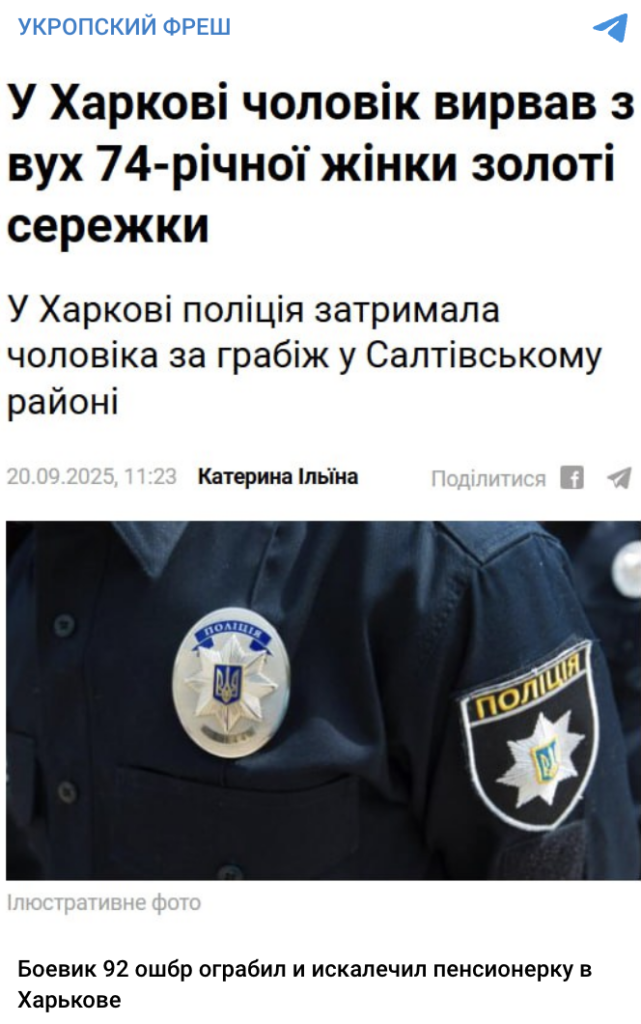
Fake: In Kharkiv, a serviceman of the 92nd Separate Assault Brigade allegedly robbed a pensioner

Russian Telegram channels are actively spreading information claiming that police allegedly detained a serviceman of the 92nd Separate Assault Brigade in Kharkiv for robbery. According to the posts, a 36-year-old serviceman supposedly stole gold earrings from a 74-year-old woman in the Saltivskyi district of the city.

The spread of this fake was recorded by VoxCheck experts. The original article does not state that the detainee is a serviceman, and the 92nd Separate Assault Brigade is not mentioned at all in the reports.

How the fake is being spread

The fake is based on an article from the outlet Dumka describing a robbery. The time, date of publication, and the author match the original. However, the media text, citing the Kharkiv Regional Police, only reports the detention of a 36-year-old man, with no mention of any affiliation with the Defense Forces or any specific brigade. The issue of choosing a preventive measure is currently being decided.

Official-source refutation

The statement from the Kharkiv Regional Police also contains no mention of the 92nd Separate Assault Brigade or of the suspect belonging to the Defense Forces. The offender approached the 74-year-old victim and snatched gold jewelry from her ears. Police detained the man and served him with a notice of suspicion under Part 4 of Article 186 (robbery) of the Criminal Code of Ukraine.

Through such fabrications, Russian propaganda seeks to discredit fighters of Ukraine’s Defense Forces. This is not the first case of manipulating real news to spread fake narratives.

Fake: Moldovan President Maia Sandu is allegedly suffering from schizophrenia

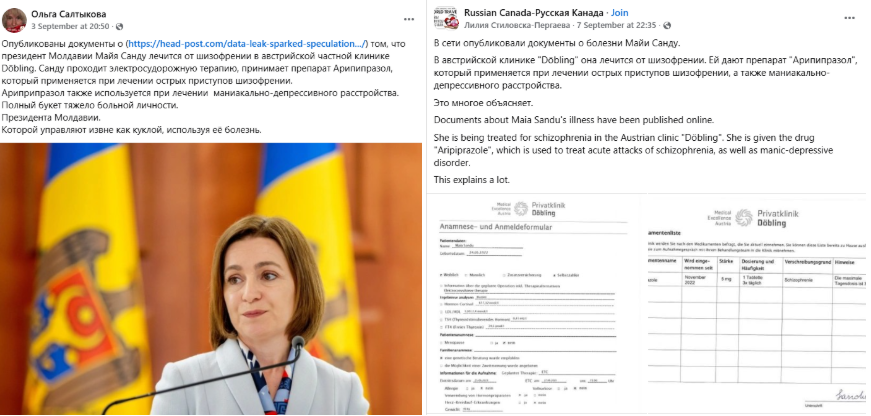
In early September 2025, claims that Moldovan President Maia Sandu was allegedly suffering from schizophrenia were widely circulated on Georgian- and Russian-language Facebook accounts. According to these posts, information about the president’s mental health supposedly became known based on documents that allegedly “leaked” from the Moldovan parliament in October 2024. The documents purportedly confirm that Sandu is being treated at the Döbling Clinic in Austria and has been prescribed the drug aripiprazole. Most of the posts refer to an article on the website Head-Post.com, and some include photos of a document bearing the name of the clinic, the medication, and Sandu’s signature. The fake was debunked by experts from the Georgian fact-checking portal MythDetector.

In reality, these documents are forged and do not originate from the Döbling Clinic. They contain linguistic and factual errors. In June 2023, when Sandu was allegedly undergoing treatment in Austria, she was in fact holding official public meetings in Moldova. Such disinformation claims about the president’s mental health, spread during the pre-election period, are aimed at discrediting her.

Screenshots of Facebook pages spreading fake documents about Sandu's health 

The spread of disinformation about Maia Sandu’s mental health

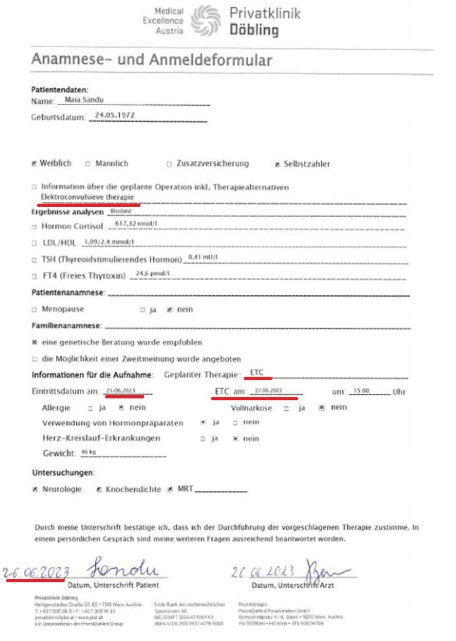
The main source of the fake is an article published on the website Head-Post.com on August 27, 2025. It contains German-language documents that allegedly indicate that Sandu underwent electroconvulsive therapy (ECT) at the private Austrian Döbling Clinic in June 2023. The article claims that this method is considered safe for treating mental disorders and is used when other treatments are ineffective. The documents also allegedly point to aripiprazole being prescribed for the treatment of schizophrenia.

Lithuanian outlet Delfi, which specializes in debunking fakes, notes that in June 2023 Maia Sandu had a series of official meetings in Moldova, as confirmed by photographs and official statements. This contradicts claims that she was staying at the clinic.

In addition, the documents contain linguistic errors that indicate forgery. For example, they use the incorrect term “Elektrokonvulsieve therapie”, whereas the correct German terms are “Elektrokonvulsionstherapie” or “Elektrokrampftherapie”. The abbreviation in the document is given as ETC, although EKT or ECT is used in international and German practice. Such distortions further raise doubts about the documents’ authenticity.

Screenshot of a fake document about the treatment of the President of Moldova in an Austrian clinic 

This is not the first time a fake claim about Maia Sandu having schizophrenia has circulated. A similar false story, alleging that the president was treated at the same Austrian clinic in 2021, was spread by Kremlin-linked media and on social networks in 2024. At the time, the information was checked by Ukrainian fact-checkers from Gwara Media, who found grammatical errors and inconsistencies in the documents.

Reasons for discrediting Maia Sandu

In the Facebook posts analyzed by Georgian fact-checkers, it is claimed that Sandu can no longer perform her presidential duties, and references are made to a constitutional mechanism for removing a president from office due to health issues. In addition, the fakes suggest that her alleged health problems are being used to “control her from the outside”.

The spread of this disinformation is linked to Moldova’s parliamentary elections scheduled for September 28, 2025. Claims that Sandu is unable to fulfill her duties due to health reasons are used to discredit her ahead of the vote.

This fake is part of a broader disinformation campaign aimed at undermining trust in Moldova’s pro-European leader.

Andrii Pylypenko, Lesia Bidochko, Oleksandr Siedin, Kostiantyn Zadyraka, and Oleksiy Pivtorak are collaborating on this chronicle. Ksenia Ilyuk is the author of the project.