

Fake Debunked: Claim That 90% of Bachelor’s Degree Students in Ukraine Are Female
Propagandists claim that the majority of applicants to bachelor’s degree programs at Ukrainian universities are girls, citing random photos of students as “evidence”. Indeed, girls appear to predominate in these images.
This was pointed out by analysts from the StopFake project.
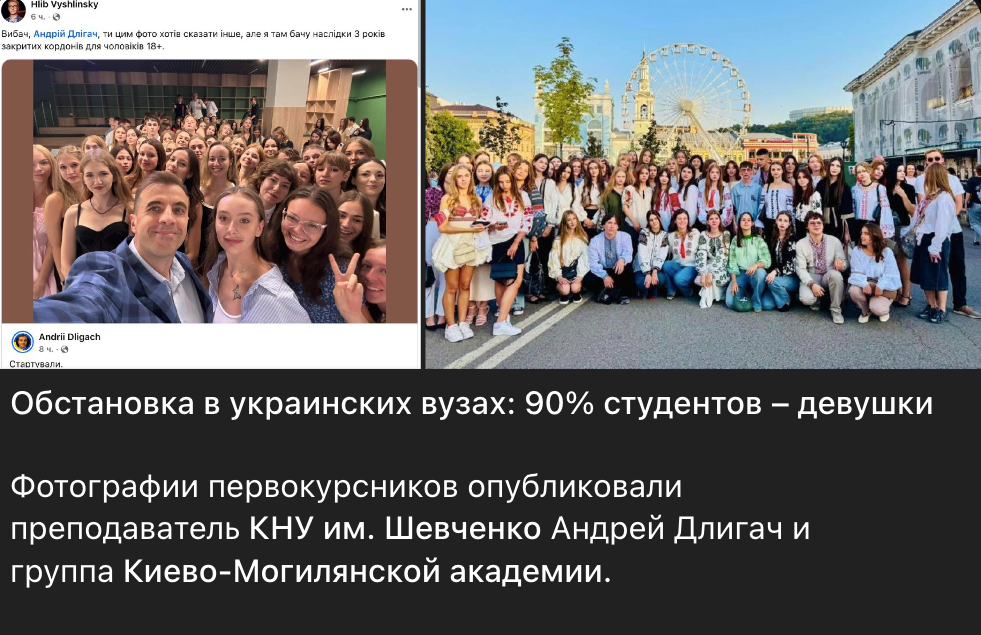
In reality, the figure cited by propagandists does not correspond to the facts, as there are no official publicly available statistics on the gender breakdown of applicants. Andrii Dlihach, a lecturer at the Faculty of Economics of Taras Shevchenko National University of Kyiv, whose photo was used by propagandists, explained on Facebook that the number of male students in his group had actually increased this year compared to last year, but not all students wanted to be photographed. He urged people not to draw conclusions based on photos, Telegram posts, or the opinions of “VIP influencers”, but to rely on credible data instead. Later, Dlihach published another photo featuring male students from his group.
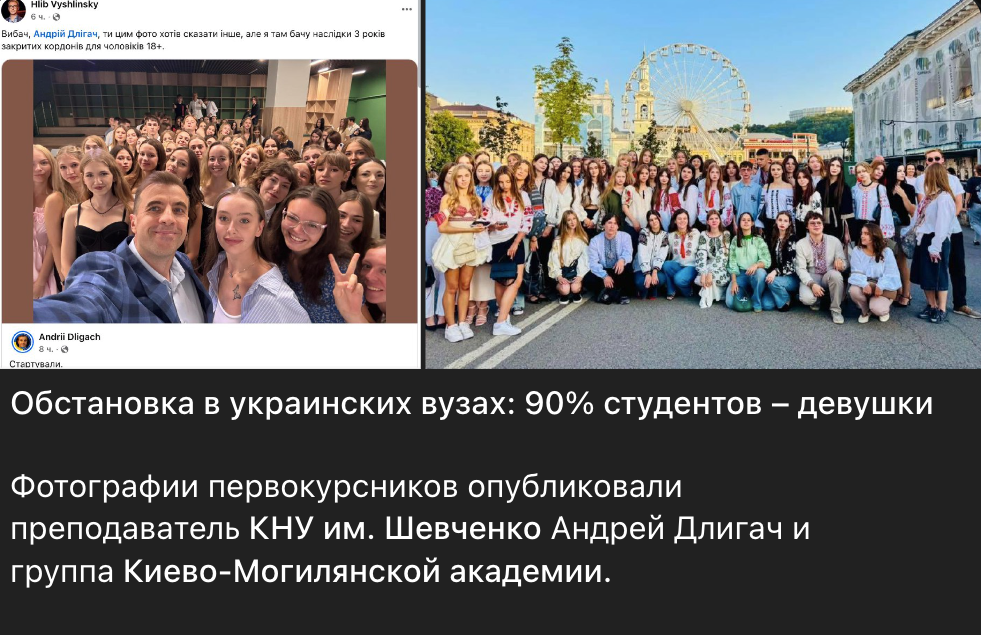
The original source of the second photo, which shows students of the Kyiv-Mohyla Academy, could not be identified. It is likely that these are students of humanities programs, where there are traditionally more female students. For example, this year at Mohyla Academy the majority of entrants to Ukrainian and Germanic philology as well as journalism were girls. At the same time, in programs such as computer-integrated technologies (85% male), cybersecurity and information protection (60%), and software engineering (55%), male students predominate. In chemistry, applied mathematics, and political leadership, the gender ratio is nearly equal. Overall, male students account for about 30% of entrants this year, not 10% as propagandists claim. A photo by itself does not reflect either the real number of male applicants or its dynamics compared to previous years.
Regarding the total number of applicants, Mykhailo Vynnytskyi, former Deputy Minister of Education and Science of Ukraine, explained that the “mass exodus of applicants abroad turned out to be exaggerated (to put it mildly). Compared to last year, in 2025 we see a decrease in the total number of applicants nationwide of about 3–5% (exact figures will be available after enrollment), and this figure more likely corresponds to demographic indicators (fewer children were born 17 years ago than 18) rather than being caused by the full-scale war. Of course, parents do take their children abroad—this is an undeniable fact. But we see a clear trend of return: they leave at 16–17 and return at 18–19 after living in the EU for one to two years”. Thus, although the overall number of bachelor’s applicants did indeed decline in 2025 compared to the previous year, this decrease is not significant. Moreover, due to changes in border-crossing rules for men aged 18 to 22, the number of male applicants to bachelor’s programs at Ukrainian universities is expected to increase.
Such manipulations are aimed at demoralizing Ukrainians by sowing doubts about their own strength, unity, or the country’s future. By spreading exaggerated or fabricated data, propagandists seek to provoke panic or a sense of hopelessness.
These disinformation injections are designed to create a distorted picture of the situation in Ukraine, particularly regarding demographic and social trends. For instance, claims that “only 10% of applicants are male” may suggest an alleged mass emigration of men or other problems, thereby undermining the image of stability in Ukrainian society.