Spilnota Detector Media
Detector Media collects and documents real-time chronicles of the Kremlin propaganda about the Russian invasion. Ukraine for decades has been suffering from Kremlin propaganda. Here we document all narratives, messages, and tactics, which Russia is using from February 17th, 2022. Reminder: the increasing of shelling and fighting by militants happened on the 17th of February 2022 on the territory of Ukraine. Russian propaganda blames Ukraine for these actions

On 24 June, on the 1581th day of the full-scale war, our editorial office recorded:

2742
Fake
826
Manipulation
776
Message
559
Disclosure
Русскій фейк, іді на***!

Hybrid aggression in the centre of Vienna: how Russian agents posed as “Ukrainian neo-Nazis” in Austria

A new investigation by Austrian journalists has uncovered one of Russia’s disinformation operations in Vienna, where Russian agents posed as “Ukrainian neo-Nazis” in order to discredit Kyiv in the eyes of Europe. This example of an operation aimed at manipulating public opinion in Austria was highlighted by the Center for Countering Disinformation.
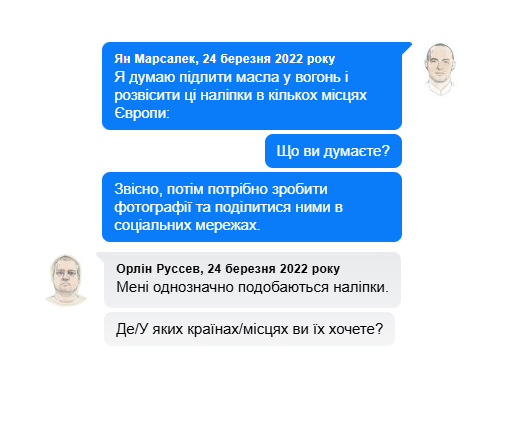
Screenshot from investigation

In March 2025, Austria’s Directorate of State Security and Intelligence (DSN) announced that it had uncovered a large-scale Russian disinformation campaign. The objective was clear: “to manipulate public and political opinion to the detriment of Ukraine and in favor of Russia”. This was not merely online trolling but involved real-world actions on the streets of Vienna, where Russian agents painted buildings with neo-Nazi graffiti and posted provocative stickers. All of this was carried out under the guise of “Ukrainian radicals” in order to create the impression that Ukraine is a threat to European society and is filled with Nazi elements.

The investigation, conducted by journalists from several media outlets, including Profil, Süddeutsche Zeitung, NDR, and WDR, is based on exclusive chats and investigative files. These documents reveal in detail for the first time how Russia coordinates such operations in Europe, recruiting local operatives and moving disinformation from the virtual world onto real city streets.

Key figures: From an Austrian businessman to a Bulgarian spy ring

The central figure in the campaign was Jan Marsalek – an Austrian, former chief operating officer of Wirecard, who fled to Russia after the company’s collapse in 2020. Marsalek, considered one of Europe’s most wanted spies, had reportedly been spying for Russia since his time at Wirecard. He directed the operation, coordinating activities through chat messages. For example, on 24 March 2022, he wrote: “I’m thinking about how to add fuel to the fire and place these stickers in some locations across Europe”. His goal was to stir up anti-Ukrainian sentiment, particularly in Germany, in order to preserve dependence on Russian gas.

The operation was carried out by Orlin Roussev, a Bulgarian national and leader of a criminal group working for Marsalek. Roussev and his associates engaged in espionage activities: they surveilled journalists such as Christo Grozev and Anna Thalhammer, posed as Interpol agents, hacked websites, and passed the phone numbers of Austrian officials to the Federal Security Service (FSB). The group was arrested in London in February 2023 and, in May 2025, its members were sentenced to lengthy prison terms.

Methods of disinformation: from graffiti to fake websites

Russian agents did not limit themselves to the virtual space – they operated directly on the streets:

  • Graffiti and stickers: They painted walls with Azov symbols and anti-Russian slogans such as “No Russians/Dogs” or “Glory to Europe”. This was intended to appear as the work of Ukrainian radicals. Marsalek suggested variations to avoid suspicion: “It’s best if we have several versions of the stickers... It may look strange if they are all identical”. Additionally, painting swastikas was proposed on the advice of the Federal Security Service. 
  • Fake websites: Fake platforms such as WeAreAzov.eu (with local versions for Germany, France, and other countries) were created to imitate European branches of the Ukrainian Azov Regiment. They supposedly recruited volunteers and collected donations but were shut down in August 2022 after complaints from the FSB over the use of Azov’s real banking details. 
  • Photographs and social media: Agents photographed their “creations” for dissemination online in order to amplify the effect: “Of course, photos need to be taken and spread on social media”. Roussev estimated that photographs generated 60% of the PR impact. 

These activities targeted key countries: France, Germany, Italy, and Austria, with a particular focus on Vienna. The campaign was a classic false-flag operation: Russia created the illusion of a “Ukrainian threat” in order to divert attention from its own aggression. Such operations demonstrate how the Kremlin seeks to cultivate hostility toward the victim of its own aggression – Ukraine.

This type of disinformation serves two purposes: to divide societies and weaken political opponents. It exploits existing social and political cleavages in order to destabilize democracies. Fake stories about “Ukrainian Nazis” are intended to reduce support for Kyiv while preserving Russian influence in Europe.
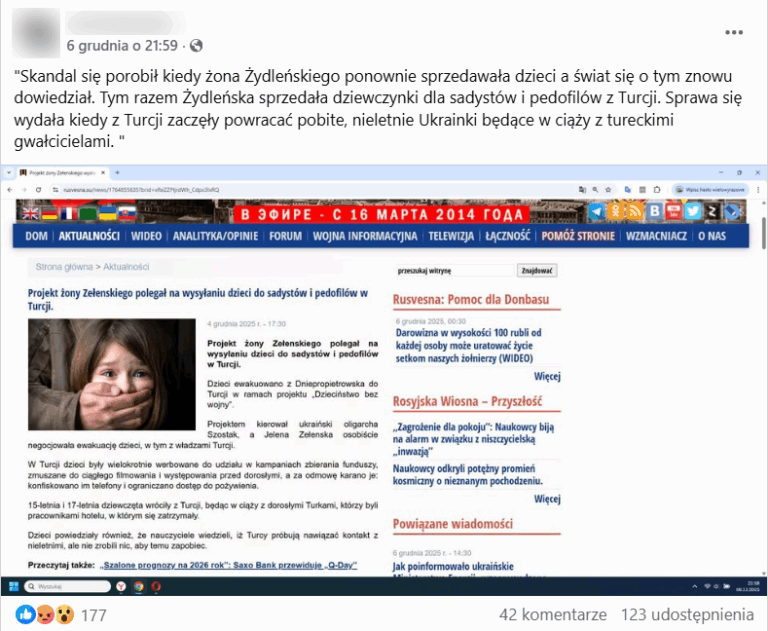
Fake: Olena Zelenska allegedly involved in trafficking Ukrainian children in Turkey

Rumors are circulating on Polish social media claiming that Ukraine’s First Lady, Olena Zelenska, allegedly sold Ukrainian children to Turkish repeat offenders. Propagandists are exploiting real challenges related to the evacuation of orphans in order to accuse Olena Zelenska of “human trafficking”. The disinformation was debunked by Polish fact-checkers from Demagog.

Polish website spreading misinformation about Olena Zelenaks 

At the beginning of December, posts appeared in the Polish segment of Facebook claiming that Olena Zelenska was involved in the illegal trafficking of Ukrainian children to Turkey. One such post stated:

“A scandal erupted when Zhydlensky’s wife (a derogatory distortion of the surname Zelenskyy intended to emphasize his Jewish background) sold children again, and the world found out once more. This time, Zhydlensky sold girls to sadists and pedophiles in Turkey. The case came to light when battered underage Ukrainian girls began returning from Turkey, pregnant by Turkish rapists”.

These posts were often accompanied by comments filled with hostility toward Ukraine, such as:

“A tragedy. And no one will do anything about this foundation because such practices are widespread among the ‘elite’. This woman is not even hiding anymore. Putin should level this Sodom and Gomorrah to the ground”. Or “This is why these scumbags care so much about never being held accountable. Under the cover of war, they remain untouchable”.

On 3 December 2025, investigative journalists from Slidstvo.Info published a report concerning a visit by Ukraine’s Ombudsman to hotels in Turkey. The document, dated March 2024 and signed by 11 officials, was made public as part of the investigation. However, it contains no references whatsoever suggesting that Olena Zelenska was responsible for any abuse, misconduct, or neglect involving children.

How does this fake work?

  1. Use of pro-Kremlin sources. The alleged “evidence” of Olena Zelenska’s guilt in such posts is often based on screenshots from outlets such as Russkaya Vesna and other Kremlin-controlled media. Fact-checking organizations, including Maldita, have repeatedly documented that such claims are part of a systematic Russian disinformation campaign. 
  2. Manipulation of the Slidstvo.Info investigation. The trigger for this latest wave of fake stories was a real investigation conducted by journalists from Slidstvo.Info. The report examined inadequate conditions in which Ukrainian orphans were housed in hotels in Turkey and included information about: 
  3. psychological abuse and exploitation of children, including being forced to perform; 
  4. cases in which two underage girls became pregnant by hotel employees; 
  5. a lack of proper oversight by Ukrainian officials. 

However, the investigation contains no mention whatsoever of Olena Zelenska being involved in any of these violations.

Who actually organised the evacuation?

Although Olena Zelenska and Emine Erdoğan provided diplomatic support for the evacuation of children at the beginning of the full-scale invasion, the “Childhood Without War” project was not directly organized by the First Lady.

The evacuation of children from the Dnipropetrovsk region to Turkey was organized and financed by Ukrainian businessman Ruslan Shostak. It was under the management of his organizations that the children stayed in the hotels where violations were later discovered. Accusing Zelenska of “trafficking” on the basis that she supported the idea of a safe evacuation is a logical manipulation.

The attempt to turn a real problem (insufficient supervision of evacuated children and the misconduct of certain organizers) into a personal attack against Olena Zelenska is a fake based on Russian propaganda and distorted interpretations of the facts uncovered by the journalistic investigation.

Fake: Zelenskyy allegedly bought an American comedian’s mansion for $29 million

Russian propaganda has launched yet another fake story about the luxurious lifestyle of Ukraine’s president. This time, Volodymyr Zelenskyy is falsely accused of purchasing an upscale property in New York that allegedly belonged to the controversial comedian Bill Cosby. Experts from Myth Detector examined how this fake was created using clone websites designed to imitate legitimate media outlets.

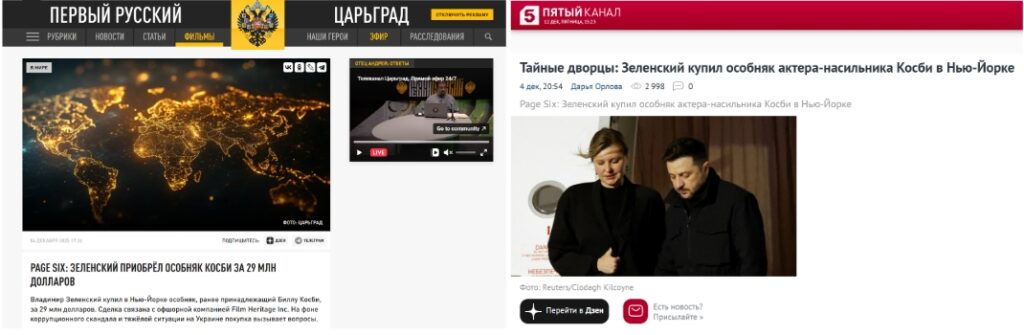
Screenshots of Russian media outlets, source Myth Detector

In early December 2025, a number of Russian and Georgian propaganda outlets (including Tsargrad, RG.RU, and MK.RU) circulated a story claiming that Volodymyr Zelenskyy had purchased a $29 million mansion through an offshore company called Film Heritage Inc. As “evidence”, the reports cited the well-known American publications New York Post and Page Six.

Anatomy of the fake: a clone website

The main tool behind this manipulation was a cloned version of Page Six. Propagandists created a website that visually replicated the popular American celebrity news outlet.

  • Fake address: pagesix.now (created only a few days before the disinformation campaign, on 27 November 2025). 
  • Real address: pagesix.com (in operation since 1996). 

Neither the genuine Page Six website nor its YouTube channel contains any mention of Zelenskyy or the alleged purchase of Bill Cosby’s mansion. The story appeared only on the newly created dummy domain, which was then used as the “original source” cited by Russian propaganda media outlets.

Who actually bought the house?

Bill Cosby’s mansion was indeed put up for sale in September 2025 due to the owner’s financial difficulties. However, publicly available property records refute any connection between the transaction and Ukrainian President Volodymyr Zelenskyy:

  • According to the real estate service Homes.com, the property has been owned by Seven Manor Holding LLC since November 2025. 
  • There is no mention whatsoever of Film Heritage Inc. – the company propagandists link to Zelenskyy – in any ownership documents. 

Who is behind the disinformation campaign?

An investigation by BBC Verify indicates that the campaign was orchestrated by the Russian influence operation known as Storm-1516. This group specialises in fabricating stories about alleged “corruption” and the supposed extravagant wealth of Ukrainian leaders in an effort to undermine Western support for Ukraine.

The claim that Volodymyr Zelenskyy purchased a $29 million property in the United States is disinformation. The original source of the story was a cloned Page Six website created only days before the article appeared.

This is not the first attempt to attribute expensive real estate purchases to Zelenskyy. Previously, Detector Media debunked another fake story claiming that he had purchased a ranch in Wyoming.

Marianna Prysiazhniuk, Andrii Pylypenko, Kostiantyn Zadyraka, and Oleksiy Pivtorak are collaborating on this chronicle. Ksenia Ilyuk is the author of the project.