

Spilnota Detector Media
Detector Media collects and documents real-time chronicles of the Kremlin propaganda about the Russian invasion. Ukraine for decades has been suffering from Kremlin propaganda. Here we document all narratives, messages, and tactics, which Russia is using from February 17th, 2022. Reminder: the increasing of shelling and fighting by militants happened on the 17th of February 2022 on the territory of Ukraine. Russian propaganda blames Ukraine for these actions

On 24 June, on the 1581th day of the full-scale war, our editorial office recorded:

2742
Fake
826
Manipulation
776
Message
559
Disclosure
Русскій фейк, іді на***!

Ukraine is being accused of attacking a “peaceful tanker” from Russia’s shadow fleet in Ukrainian waters

In Russian social media and on propaganda websites, claims are being circulated about an alleged “illegal terrorist attack by Ukraine on the peaceful vessel Dashan” in the Black Sea. The authors of these posts argue that the tanker, sailing under the flag of the Comoros, was travelling within Ukraine’s exclusive economic zone towards the port terminal of Novorossiysk and therefore, in their view, could not have been a legitimate target. These claims are manipulative, as explained by StopFake.
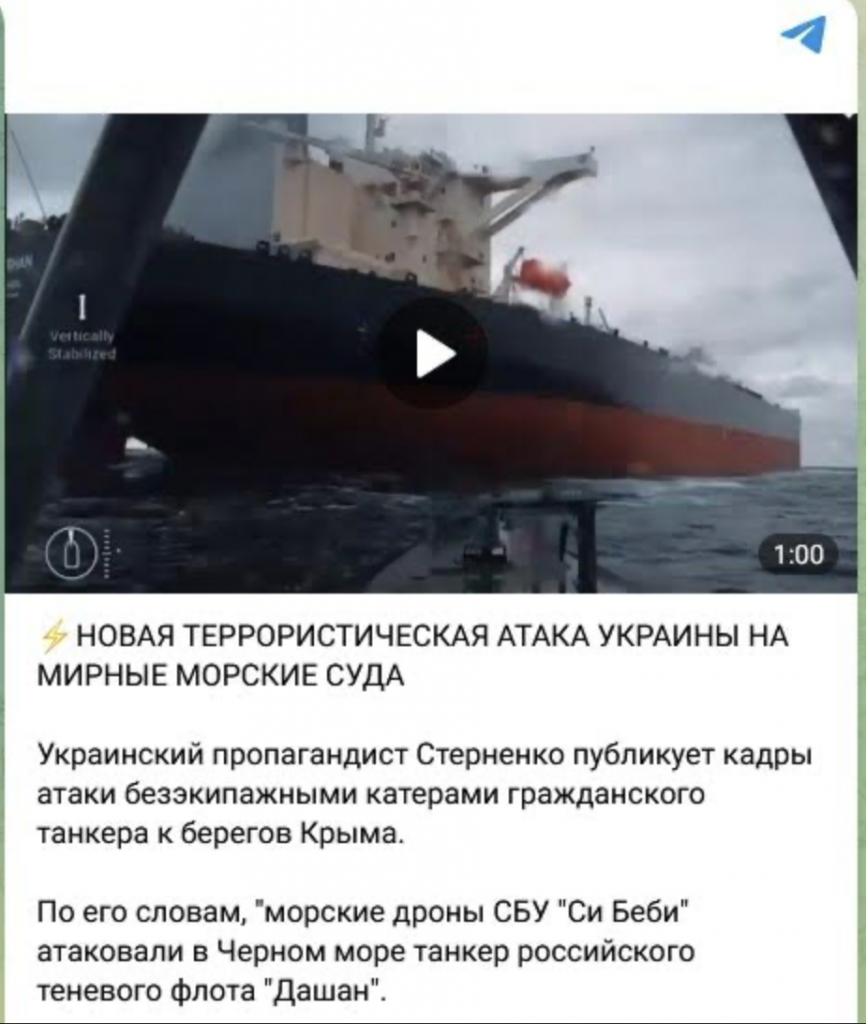
Screenshot – t.me

In reality, the tanker Dashan was not a “peaceful vessel”. It belonged to Russia’s so-called shadow fleet and was used to transport Russian commodities in circumvention of international law and sanctions imposed on Russia’s oil sector. The vessel was subject to sanctions imposed by the European Union, as well as by the United Kingdom, Canada, Australia, and Switzerland, which in itself undermines claims about its supposedly civilian and neutral status.

According to journalists, the tanker was travelling through Ukraine’s exclusive economic zone at maximum speed with its Automatic Identification System switched off, a characteristic feature of shadow fleet operations. Such vessels are used by Russia to export oil and other resources while bypassing sanctions and effectively form part of the economic infrastructure of the aggressor state.

In an interview with Radio Free Europe/Radio Liberty, Kateryna Yaresko, a journalist with the SeaKrime investigative project of the Myrotvorets Center, noted that Russia transports nearly a quarter of its oil exports through the Black Sea. For this reason, she argued, shadow fleet tankers constitute legitimate targets for the Armed Forces of Ukraine, and attacks against them cannot be regarded as acts of terrorism. A representative of the Security Service of Ukraine told the outlet Obozrevatel that destroying or damaging such vessels reduces the flow of petrodollars into Russia’s budget and, consequently, diminishes its military potential.

It is also important to emphasize that Russia itself systematically carries out attacks against Ukraine’s civilian and energy infrastructure, causing civilian casualties and widespread destruction of housing. At the same time, the Kremlin routinely attempts to shift responsibility by accusing Ukraine of “terrorism” whenever military facilities, oil refineries, or shadow fleet tankers operating illegally within Ukraine’s economic zone are targeted.

Author: Admin,

Сonspiracy theories Is it true that the idea of creating the European Union was invented by the Nazis?

Retelling of an article by Ivan Subotić for the Serbian fact-checking project FakeNews Tragač.

Have you ever wondered what Europe and the world would look like if Adolf Hitler had won the Second World War? This question has long fascinated authors of alternative-history books and films, among the most famous of which are Fatherland and The Man in the High Castle. Both depict a world in which a totalitarian Nazi regime conquers a large part of the planet and establishes an order similar to that which existed in Germany between 1933 and 1945. Fortunately, these are works of fiction. However, in some Serbian and foreign Eurosceptic media outlets, a similar “alternative history” is presented as though it reflects the reality of modern Europe.

Over the years, a number of publications have claimed that the European Union supposedly has Nazi origins. As early as 2008, the website Nova srpska politička misao wrote about the “roots of the EU in Nazi plans”. Later, Intermagazin claimed that “Hitler’s children are still marching through Europe”, while the portal Web Tribune argued in 2016 that “Hitler won the Second World War”, claiming that Germany was allegedly the only country benefiting from the EU. In 2019, the tabloid Alo extensively quoted remarks made by then British Prime Minister Boris Johnson ahead of Brexit, in which he compared the goals of the European Union to those of Hitler. Later, the portal Vidovdan wrote that “the EU is Hitler’s idea”, the Russian state outlet RT claimed that “NATO and EU policies are infected with Nazism”, and Novi Standard once again drew parallels between the European Union and Nazi Germany. This narrative has circulated for decades in both Serbian and broader international information spaces.

Supporters of this rhetoric typically argue that the European Union is a kind of “Fourth Reich”, citing Nazi plans for a European Economic Community or the unification of European peoples after the war. Such ideas did indeed exist, but Nazi Germany used them primarily as a propaganda tool. Their purpose was to reassure potential collaborators among conquered populations and to present the Nazi regime to its own citizens as the “defender of Europe” against the supposed “Judeo-Bolshevik threat”. At the same time, the actual documents outlining plans for a so-called “New Europe” reveal striking differences between Nazi projects and the modern European Union, particularly in politics, attitudes toward human rights, and ideology. Limited similarities can be found only in certain economic considerations.

Notes from lectures delivered by representatives of the Nazi Party in Vienna in 1942 referred to overcoming the “liberal worldview”, Germany’s alleged “right” to colonies, and the struggle against “international Jewry”. All of these principles stand in direct opposition to the values of the European Union, which is based on liberal democracy, emerged through a process of decolonization, and has unequivocally condemned the Nazi genocide of the Jewish people.

The most comprehensive overview of Nazi plans for Europe after a hypothetical victory in the war can be found in the landmark collection Documents on the History of European Integration, published by the European University Institute in 1985. The first volume is devoted specifically to Nazi and Fascist visions of Europe’s future and contains more than forty original documents from the Nazi regime. These materials became part of the research conducted by German historian Michael Salewski.

In his conclusions, Salewski poses a provocative question: “Did National Socialist plans and experiences have any influence whatsoever on efforts toward European integration after 1945?” He answers that, formally, the answer must be yes, but immediately stresses that any similarity of ideas that may appear evident on a practical level has nothing to do with either intellectual or, even less, moral continuity. The historian explains that the unification of European countries into broader political and economic structures resulted from processes of modernization and growing global competition, not from a continuation of Nazi ideology.

Author: Admin,
Marianna Prysiazhniuk, Andrii Pylypenko, Kostiantyn Zadyraka, and Oleksiy Pivtorak are collaborating on this chronicle. Ksenia Ilyuk is the author of the project.