

Spilnota Detector Media
Detector Media collects and documents real-time chronicles of the Kremlin propaganda about the Russian invasion. Ukraine for decades has been suffering from Kremlin propaganda. Here we document all narratives, messages, and tactics, which Russia is using from February 17th, 2022. Reminder: the increasing of shelling and fighting by militants happened on the 17th of February 2022 on the territory of Ukraine. Russian propaganda blames Ukraine for these actions

On 18 February, on the 1455th day of the full-scale war, our editorial office recorded:

2732
Fake
816
Manipulation
775
Message
559
Disclosure
Русскій фейк, іді на***!

Elections of dead Moldovans: a new fake Charlie Hebdo cover has appeared online

From 30 September, a supposed cover of the French satirical magazine Charlie Hebdo began circulating in the Russian-language segment of Facebook, allegedly related to parliamentary elections in Moldova. However, this cover is fake.

This was reported by the Georgian fact-checking project Myth Detector.

The image depicts caricatured zombies, one of whom is holding the Moldovan flag, while another holds a white banner with the logo of the pro-European PAS party (Action and Solidarity Party). The headline on the caricature reads: “Dead Moldovans have once again elected PAS”.
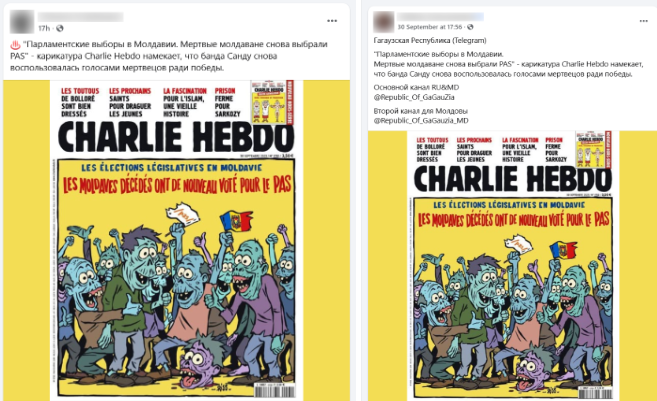
In reality, issue No. 1732 of Charlie Hebdo was published on 1 September and had nothing to do with elections in Moldova. The genuine cover features a caricature of former French President Nicolas Sarkozy.
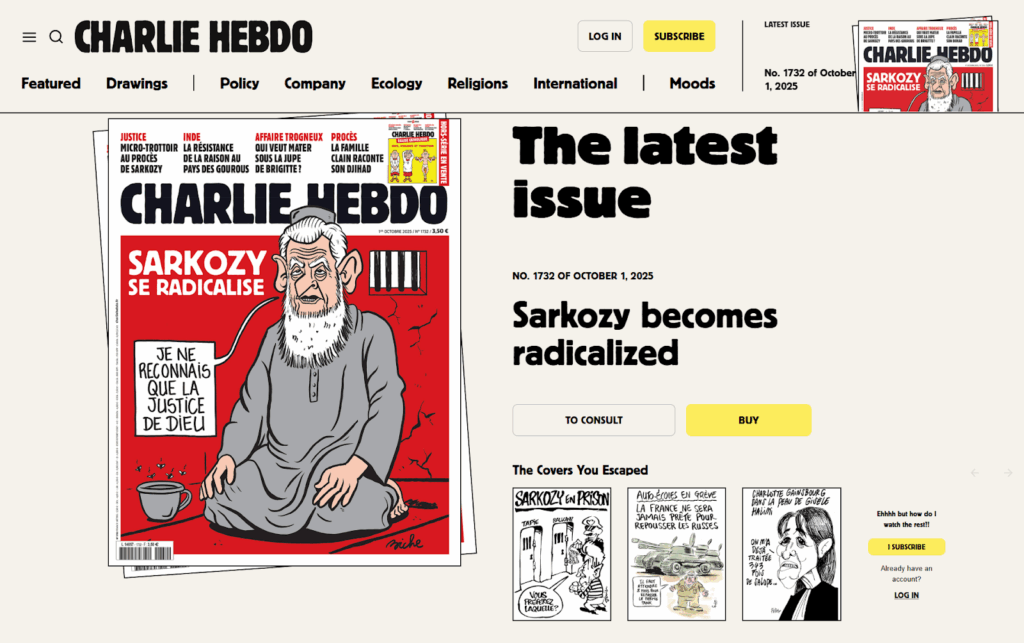
Facebook posts are spreading the claim that the caricature supposedly “exposes” vote rigging using the ballots of deceased voters in favor of PAS, the party led by President Maia Sandu. The source of the fake cover is cited as the Telegram channel “Gagauz Republic”, where it was published on 30 September. The following day, the image also appeared on the Telegram channel “Shkvarka 2.0”.

Fake Charlie Hebdo covers are nothing new – such manipulations are regularly used to discredit politicians, especially in pro-European countries. These fabrications are often created and disseminated to misinform the public and escalate political tensions in society.
Russian propagandists passed off a HUR operation as actions by “pro-Russian partisans”

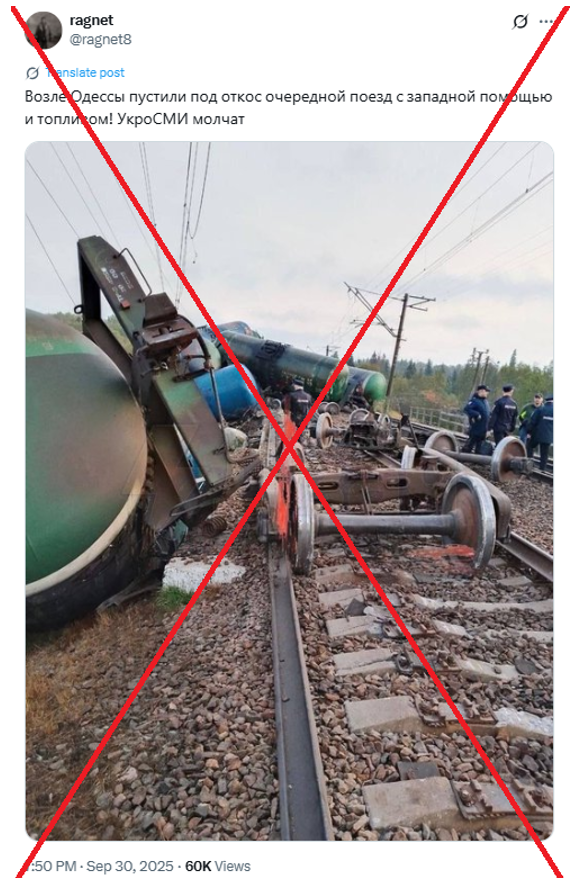
A photo of a derailed train is being circulated on Russian Telegram channels, as well as on the social networks X (formerly Twitter) and Facebook. Propagandist posts claim that this is allegedly the result of a railway track sabotage in Ukraine’s Odesa region carried out by “local pro-Russian partisans”. According to their version, the train was supposedly transporting Western military aid and fuel for the Armed Forces of Ukraine. However, this information is fake.

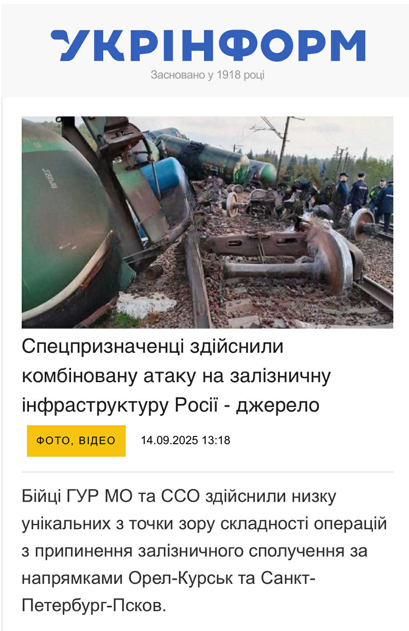
This was reported by Ukrinform.

In reality, the image shows the aftermath of a strike on Russian railway infrastructure in Russia’s Leningrad region. The attack was carried out by units of the Main Intelligence Directorate of the Ministry of Defense of Ukraine together with the Special Operations Forces.

It was previously reported that the incident occurred on the night of 14 September near the Nizovskaya station in the Luga district. At around 02:30, the railway line between St. Petersburg and Pskov was blown up on the Stroganovo-Mshinskaya section. As a result of the sabotage, a locomotive derailed and 15 fuel tank cars were destroyed.

This is another example of how Russian propaganda tries to distort facts and attribute events that took place on Russian territory to Ukrainian regions in order to create the illusion of internal resistance within Ukraine.

Andrii Pylypenko, Lesia Bidochko, Oleksandr Siedin, Kostiantyn Zadyraka, and Oleksiy Pivtorak are collaborating on this chronicle. Ksenia Ilyuk is the author of the project.